
Sandisk stock has become one of the most watched names in the memory-chip trade, but its recent drop shows how quickly momentum can reverse when expectations get too hot. After a powerful rally tied to AI data-center demand, NAND pricing strength, and long-term memory contracts, SNDK faced heavy selling as traders moved out of crowded hardware names.
The pullback was not isolated to Sandisk. Broader memory and hardware stocks also weakened, with names such as Micron, Western Digital, Seagate, SK Hynix, Dell, and other semiconductor-linked companies under pressure. Market coverage from MarketWatch and Investor’s Business Daily has pointed to sector rotation, stretched valuations, and concerns that AI hardware growth may already be heavily priced in.
For traders following stock-linked crypto markets, Tapbit’s SNDKUSDT perpetual contract provides a way to track Sandisk-related price action and short-term volatility.
Sandisk Stock Price Today: What the Tapbit Chart Shows
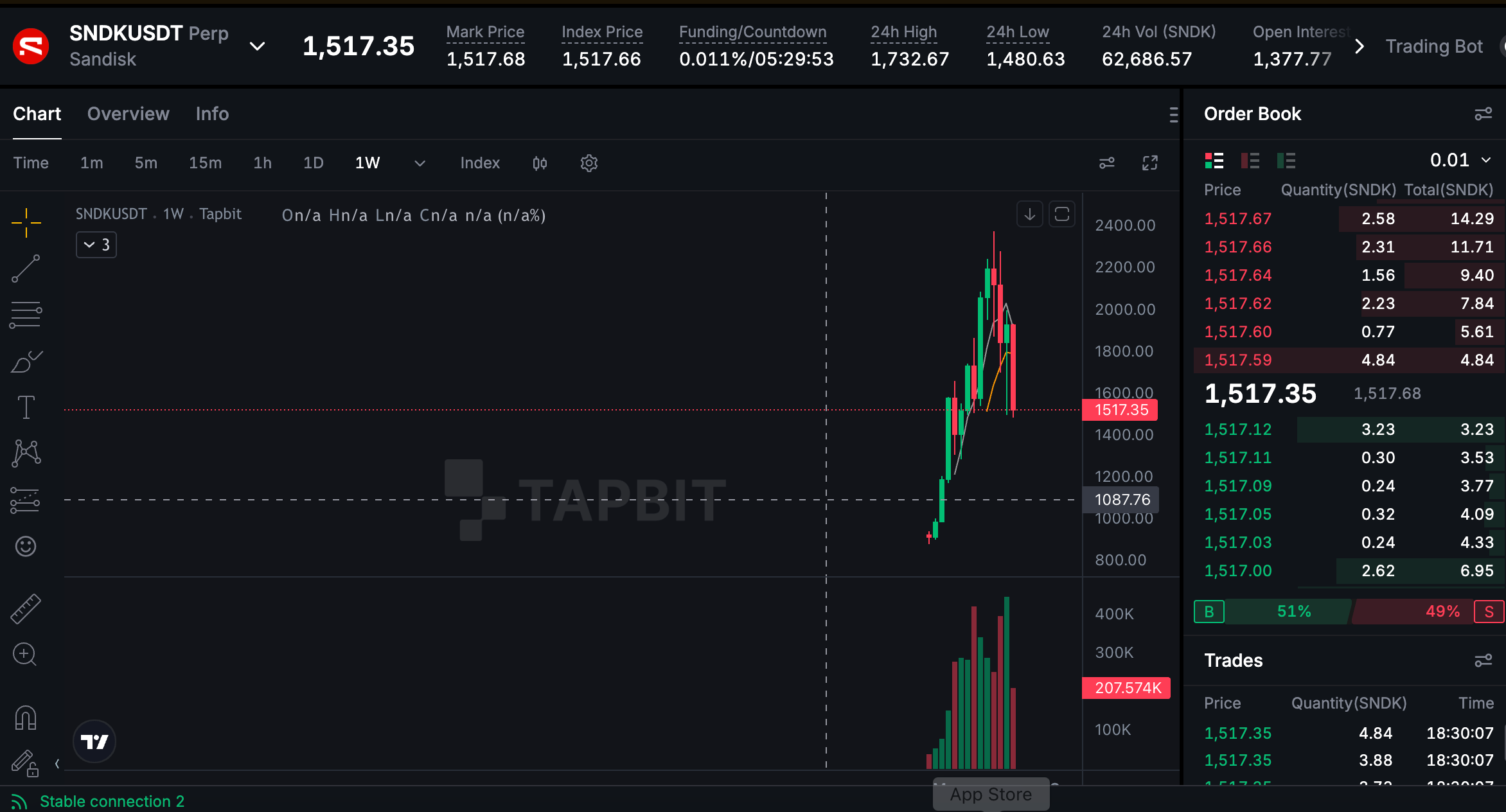
The provided Tapbit chart shows SNDKUSDT trading around 1,517.35, with a 24-hour high near 1,732.67 and a 24-hour low around 1,480.63. That wide range shows how unstable Sandisk-linked price action has become after a steep rally.
The one-week chart also shows a sharp climb followed by a fast reversal. In simple terms, Sandisk did not merely drift lower. It ran hard, attracted momentum buying, then sold off quickly once the memory-stock trade started cooling.
Why Did Sandisk Stock Crash?
The main reason Sandisk stock crashed is that investors began taking profits from one of the hottest memory-chip trades of 2026. When a stock has already priced in rapid earnings growth, AI demand, and stronger pricing, even a small shift in sentiment can trigger a large move.
Sandisk’s decline looks more like a sector-wide reset than a single company-specific collapse. Semiconductor and storage names had been supported by the AI infrastructure story, but that same theme became crowded. Once sellers appeared, the weakness spread across memory stocks quickly.
Sector Rotation Hit Memory and AI Hardware Stocks
One major pressure point was sector rotation. Investors moved away from memory and AI hardware names and toward other large-cap technology stocks. In a market where megacap software and consumer-tech names were still attracting flows, hardware stocks became easier targets for profit-taking.
This rotation is especially important for Sandisk because the stock had already moved sharply higher. A strong business can still see its stock fall if the market believes too much future growth has already been priced into the share price.
AI Hardware Expectations Became Too Hot
Sandisk benefited from the AI infrastructure boom because data centers need storage, NAND flash, and memory-related hardware. But the question for investors is no longer whether AI demand exists. The harder question is whether current valuations already assume too much demand too quickly.
Recent commentary around the sector has focused on whether some demand may have been pulled forward. If enterprise customers accelerated orders earlier in the year, the second half of 2026 could be more uneven than the market expected. That concern can pressure even fundamentally strong stocks.
SK Hynix and Global Memory Volatility
Another reason Sandisk fell is volatility across global memory stocks. Weakness in SK Hynix and other Asian semiconductor names spilled into U.S. memory stocks, including Micron, Western Digital, and Sandisk.
Memory stocks often trade as part of a global cycle. Investors compare pricing power, capacity expansion, supply discipline, customer contracts, and AI-related demand across companies. When sentiment turns against one major memory name, the whole group can move together.
Is Sandisk’s Business Still Strong?
The sell-off does not necessarily mean Sandisk’s business has collapsed. Analysts have continued to highlight NAND demand, AI storage growth, supply constraints, and long-term customer agreements as possible supports for the company.
The bullish argument is that AI data centers need more storage, memory supply is not easy to expand quickly, and long-term contracts may improve revenue visibility. The bearish argument is that the stock had already moved so far that even good news might not be enough to support the price.

SNDK Price Outlook: Levels Traders Are Watching
After a sharp decline, traders usually watch whether the stock can stabilize near recent lows. Based on the provided chart, the 1,480 area is an important short-term reference point because SNDKUSDT recently traded near that level.
If buyers defend that zone, Sandisk could attempt a rebound toward 1,600 and then 1,700. If the level fails, traders may look for a deeper reset, especially if memory-sector ETFs and peers such as Micron, Western Digital, and SK Hynix remain weak.
Is Sandisk Stock a Buy After the Crash?
Sandisk may still appeal to investors who believe AI storage demand and NAND pricing power remain strong. But after such a large rally, the stock is not low-risk. The issue is not simply whether the company is good. The issue is whether the current price leaves enough room for uncertainty.
For long-term investors, the key questions are earnings durability, NAND supply discipline, long-term contract quality, and whether AI infrastructure spending continues expanding. For short-term traders, the focus is different: support levels, volume, sector sentiment, and whether selling pressure is slowing.
Main Risks for Sandisk Stock
The biggest risk is that the memory cycle turns faster than expected. If supply expands, pricing weakens, or AI customers slow purchases, Sandisk’s earnings outlook could be revised lower.
Another risk is valuation. A stock that rises several hundred percent can still be fundamentally strong and technically vulnerable at the same time. Sandisk may also continue to move with the broader memory-stock basket, even when company-specific news is limited.
Conclusion
Sandisk stock crashed because the memory-chip trade became overheated, investors rotated out of AI hardware names, and global memory-sector volatility hit sentiment. The provided Tapbit chart shows SNDKUSDT pulling back sharply from recent highs, with price action still unstable.
The long-term Sandisk story may still be supported by AI storage demand and NAND supply constraints. But after a massive rally, the stock needs to prove that earnings growth and investor expectations can stay aligned.
FAQ
Why did Sandisk stock crash?
Sandisk fell because of profit-taking, sector rotation, weakness in memory stocks, and concerns that AI hardware expectations had become too aggressive.
Is Sandisk stock still strong fundamentally?
The business may still benefit from AI storage demand and NAND pricing power, but the stock’s valuation and momentum created downside risk.
What price level matters for SNDK now?
Based on the provided chart, traders may watch the 1,480 area as a near-term support zone.
Can Sandisk stock recover?
It can recover if memory-sector sentiment improves, AI demand remains strong, and buyers return near support. But volatility remains high.
Where can traders follow SNDKUSDT?
Traders can track the SNDKUSDT perpetual contract on Tapbit through the Sandisk futures market page.


