
As blockchain technology continues evolving beyond traditional Proof-of-Work systems, projects focused on scalability, decentralization, and quantum resistance are attracting renewed attention across the crypto market. One of the more unique infrastructure projects in this sector is Nexus (NXS), a blockchain network known for its experimental 3D blockchain architecture and satellite-powered decentralized internet vision.
Unlike many cryptocurrencies that simply focus on payments or smart contracts, Nexus aims to redesign the underlying structure of blockchain networking itself. The project combines decentralized consensus mechanisms, quantum-resistant cryptography, and distributed communications infrastructure to create a next-generation blockchain ecosystem.
For traders exploring emerging infrastructure-focused cryptocurrencies, NXS remains one of the more technically ambitious long-term blockchain projects in the market.
What Is Nexus (NXS)?
Nexus is an open-source blockchain network and cryptocurrency project designed to improve scalability, security, and decentralization through advanced peer-to-peer technologies.
The native cryptocurrency of the network is NXS, which powers staking, consensus participation, and network activity.
Originally launched in 2014 by Colin Cantrell, the project was initially known as CoinShield before later rebranding to Nexus.
The platform’s primary goal is to build what it describes as a “truly distributed internet,” combining blockchain technology with satellite communications and mesh networking infrastructure.
How Nexus Blockchain Works
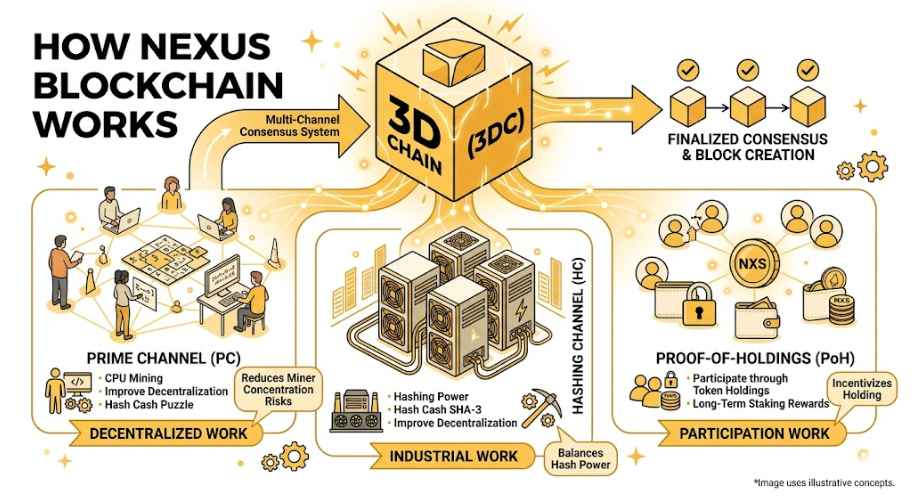
The Nexus blockchain operates differently from most traditional blockchain networks because it uses a multi-channel consensus system known as the 3D Chain (3DC).
Instead of relying on a single mining or staking mechanism, Nexus combines three separate consensus channels:
- Prime Channel
- Hashing Channel
- Proof-of-Holdings Channel
This structure is designed to improve decentralization while reducing miner concentration risks.
Nexus 3D Blockchain Technology Explained
One of the most important innovations behind Nexus is its 3D blockchain architecture.
Traditional blockchains typically use one consensus mechanism, but Nexus distributes network security across multiple channels simultaneously.
Prime Mining Channel
The Prime Channel searches for special prime number clusters to validate blocks.
This system is designed to resist ASIC mining dominance and improve decentralization by allowing CPU miners to participate more effectively.
Hashing Channel
The Hashing Channel operates similarly to traditional Proof-of-Work mining.
It uses SHA-3 hashing algorithms and typically relies on GPU-based mining operations.
Proof-of-Holdings Channel
The Proof-of-Holdings system allows users to earn rewards simply by holding and staking NXS coins.
This mechanism is somewhat similar to staking systems used by projects like Ethereum and NEO.
Several factors influence staking rewards, including:
- Interest rate
- Trust weight
- Stake weight
- Block weight
The combination of these three consensus channels forms Nexus’s unique “three-dimensional blockchain” structure.
Why Nexus Focuses on Quantum Resistance
One of the biggest long-term concerns in blockchain security involves the future threat of quantum computing.
Nexus has positioned itself as a blockchain project focused heavily on quantum-resistant cryptography.
The platform integrates:
- 571-bit private keys
- Skein hashing algorithms
- Keccak hashing algorithms
- Signature chains (SigChains)
These technologies are designed to strengthen network security against future computational threats.
Quantum resistance has become an increasingly important topic as blockchain developers explore how future computing advances may affect wallet security and encryption systems.
Nexus Satellite Network Vision
One of the most ambitious parts of the Nexus ecosystem is its decentralized communications infrastructure.
The project aims to create a distributed internet system powered by:
- Mesh networks
- Cube satellites
- Ground stations
This approach attempts to reduce dependence on centralized internet infrastructure providers.
Mesh Networks
Mesh networking allows nodes to communicate directly with one another instead of relying on centralized routing systems.
This improves redundancy and decentralization.
Cube Satellites
Nexus has discussed plans involving low-orbit satellites designed to host parts of the blockchain network globally.
The goal is to create blockchain accessibility even in regions with limited internet infrastructure.
Ground Stations
Ground stations would connect terrestrial users with the orbital satellite network.
Together, these technologies aim to build a fully decentralized communications ecosystem connected directly to blockchain infrastructure.
Nexus Lower Level Library (LLL)
Another major part of the Nexus ecosystem is the Lower Level Library framework.
The system includes several infrastructure layers:
Lower Level Cryptography (LLC)
Provides encryption and hashing systems.
Lower Level Protocol (LLP)
Allows developers to build networking protocols more efficiently.
Lower Level Database (LLD)
Designed to support scalable database systems for large applications and websites.
This framework reflects Nexus’s broader goal of becoming a foundational internet and blockchain infrastructure platform rather than simply another cryptocurrency.
NXS Coin Utility and Tokenomics
The native asset of the network is the NXS coin.
NXS is used for:
- Staking rewards
- Network participation
- Transaction validation
- Consensus security
- Value transfer
According to historical tokenomics models, Nexus planned an initial 10-year distribution schedule before transitioning to long-term inflation mechanisms.
After the original distribution phase, the network supply growth was designed to expand gradually through:
- Prime mining rewards
- Hashing rewards
- Proof-of-Holdings rewards
The blockchain also targets relatively fast transaction confirmation speeds compared to many older networks.
Nexus (NXS) Price and Market Overview
Historically, NXS has traded as a small-cap infrastructure-focused cryptocurrency.
At one stage, the project recorded:
| Metric | Value |
|---|---|
| NXS Price | $0.332 |
| Circulating Supply | 59.9M NXS |
| Market Cap | $19.8M |
Like most smaller blockchain infrastructure projects, NXS experiences significant market volatility depending on broader crypto market sentiment.
What Makes Nexus Different From Other Cryptocurrencies?
Several characteristics differentiate Nexus from traditional blockchain projects:
Multi-Channel Consensus
Most blockchains rely on either Proof-of-Work or Proof-of-Stake. Nexus combines multiple systems simultaneously.
Quantum-Resistant Security
Nexus focuses heavily on future-proof cryptographic security.
Satellite Integration
Very few blockchain projects attempt to integrate orbital communications infrastructure directly into the blockchain ecosystem.
Decentralized Internet Vision
The project extends beyond finance into internet infrastructure and communications.
Signature Chains (SigChains)
SigChains provide identity verification and proof-of-ownership systems within the network.
Potential Advantages of Nexus Blockchain
The Nexus team aims to solve several common blockchain problems:
- Scalability limitations
- Miner centralization
- Slow block times
- Network accessibility
- Quantum vulnerabilities
- Difficulty adjustment inefficiencies
If successful, these improvements could help position Nexus as a specialized infrastructure-focused blockchain ecosystem.
Risks and Challenges Facing Nexus
Despite its ambitious technology, Nexus also faces substantial risks.
High Technical Complexity
The project’s advanced architecture may slow mainstream adoption.
Competition
Nexus competes against major infrastructure ecosystems including:
- Ethereum
- Solana
- Polkadot
- Cosmos
Satellite Deployment Costs
Building decentralized orbital infrastructure requires significant funding and engineering resources.
Limited Mainstream Adoption
Compared with larger Layer-1 ecosystems, Nexus currently maintains a relatively small developer and user base.
The Future of Nexus Blockchain
Nexus remains one of the more experimental blockchain infrastructure projects in the market.
Its long-term vision combines:
- Decentralized internet infrastructure
- Quantum-resistant security
- Multi-layer blockchain consensus
- Satellite-powered communications
As blockchain technology evolves toward more scalable and decentralized infrastructure systems, projects like Nexus may attract renewed attention from investors interested in next-generation blockchain architecture.
However, the success of the project will largely depend on real-world adoption, continued development progress, and the team’s ability to execute its highly ambitious technical roadmap.
Final Thoughts on Nexus (NXS)
Nexus is not simply another cryptocurrency focused on payments or speculative trading.
Instead, it represents an ambitious attempt to rethink blockchain networking, internet infrastructure, and decentralized communications from the ground up.
Its 3D blockchain model, satellite integration plans, and quantum-resistant security mechanisms make it one of the more technically unique blockchain ecosystems in the crypto market.
While the project remains relatively niche compared to larger Layer-1 networks, Nexus continues to stand out for its long-term vision of creating a fully decentralized global infrastructure system.
FAQ About Nexus (NXS)
What is Nexus (NXS)?
Nexus is an open-source blockchain network and cryptocurrency project focused on decentralized infrastructure, quantum resistance, and 3D blockchain technology.
What is the Nexus 3D blockchain?
The Nexus 3D blockchain uses three separate consensus channels: Prime Mining, Hashing, and Proof-of-Holdings.
What is NXS coin used for?
NXS is used for staking, transaction validation, consensus participation, and network security.
Is Nexus quantum resistant?
Nexus incorporates advanced cryptographic systems designed to improve resistance against future quantum computing threats.
What makes Nexus different from Bitcoin?
Unlike Bitcoin, Nexus combines multiple consensus systems, satellite networking plans, and quantum-resistant cryptography.
Is Nexus a good investment?
Nexus is considered a high-risk infrastructure-focused cryptocurrency project. Investors should evaluate market conditions, development activity, adoption progress, and risk tolerance before investing.


