
If you searched "trading pool" and ended up confused, you're not alone — and it's not your fault. The term means something completely different depending on who's using it. A DeFi trader, a Forex investor, and a financial regulator could all say "trading pool" and be talking about entirely different things.
This guide starts by mapping out all four meanings so you can find what you're actually looking for. Then it focuses on the one most relevant to crypto: the DeFi liquidity pool — what it is, how it works, and what risks to understand before you use one.
"Trading Pool" — Four Meanings, One Term
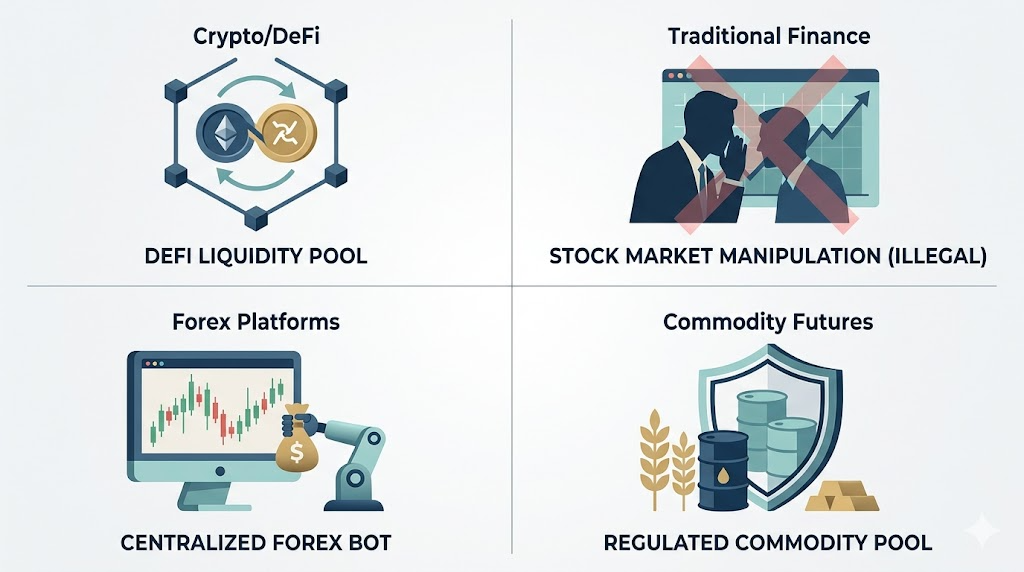
Before diving deeper, here's a quick breakdown of what "trading pool" actually means across different contexts — so you can find exactly what you're looking for.
Crypto / DeFi In this space, a "trading pool" refers to tokens locked inside a smart contract that anyone can swap against, with prices determined automatically by algorithmic formulas. Well-known examples include Uniswap and PancakeSwap.
Traditional Finance In conventional financial markets, the term historically describes a scheme where two or more investors coordinate to manipulate a stock's price — which is illegal in most jurisdictions. You'll typically encounter it in regulatory filings and legal documents rather than in everyday practice.
Forex Platforms Some Forex platforms market their automated bot services under the "trading pool" label. However, these operations are entirely centralized and run on conventional infrastructure, with no blockchain involvement whatsoever.
Commodity Futures In the futures world, a "trading pool" refers to a pooled investment fund where multiple participants contribute capital, which is then managed by a licensed operator to trade futures contracts — commonly known as a commodity pool regulated by the CFTC.
If you came across a platform offering automated Forex trading under the "trading pool" name, that is a centralized product using traditional trading software — not a DeFi mechanism. It has no connection to blockchain or crypto liquidity pools. Before using any such platform, always verify their regulatory license number and the name of their supervising authority. A claim of being "fully compliant" without a verifiable license number is a warning sign worth taking seriously.
Everything from this point on covers the crypto meaning: DeFi liquidity pools.
What Is a Trading Pool in Crypto?
In the crypto world, a trading pool — more commonly called a liquidity pool — is a collection of tokens locked inside a smart contract. Instead of matching a buyer with a seller the way a traditional exchange does, anyone can trade directly against the tokens already sitting in the pool.
Think of it like a vending machine. A traditional exchange is like a market stall where you need a seller to be present to buy something. A liquidity pool is the vending machine — the inventory is always there, the price adjusts automatically, and you can transact at any time without waiting for another person.
Three groups of people interact with a trading pool:
-
Traders swap one token for another and pay a small fee (typically 0.1%–0.3%) to the pool
-
Liquidity providers (LPs) deposit pairs of tokens into the pool and earn a share of every fee generated by trades
-
The smart contract runs the pricing formula automatically — no human market maker needed
This structure powers the major decentralized exchanges (DEXs) you may have heard of: Uniswap on Ethereum, PancakeSwap on BNB Chain, and Curve for stablecoin swaps. You can check live token prices before deciding which assets to interact with on-chain.
How a Crypto Trading Pool Actually Works
The pricing formula
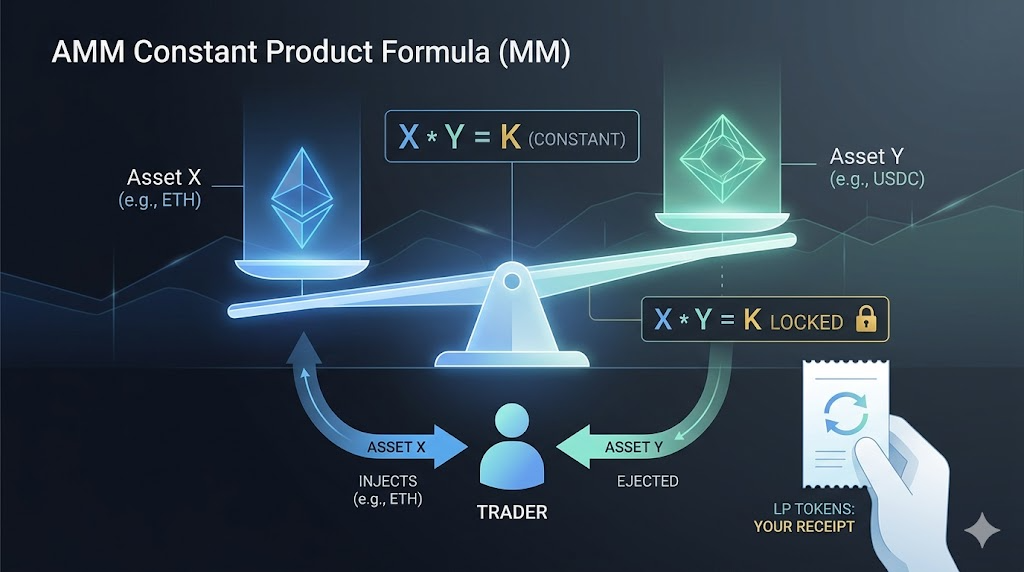
Most trading pools use a formula called the constant product formula: x × y = k. Here's what that means in plain language:
Imagine a pool holds 100 ETH and 200,000 USDC. Multiply those together and you get k = 20,000,000 — a number that must always stay constant. If a trader buys 10 ETH from the pool, the ETH balance drops to 90. To keep k the same, the USDC balance must rise — meaning the trader has to pay more USDC than the simple spot price would suggest. The bigger the trade relative to the pool size, the more the price moves. This price movement is called slippage, and it's why large trades in small pools can be costly.
LP tokens: your receipt for providing liquidity
When you deposit tokens into a trading pool, the smart contract mints LP tokens and sends them to your wallet. These represent your share of the pool — like a receipt that proves how much you put in. LP tokens serve three purposes:
-
Claim your share back: return your LP tokens when you want to exit, and receive your portion of the pool's current balance plus accumulated fees
-
Earn passive fee income: as long as you hold LP tokens, you earn a proportional cut of every trade that passes through the pool
-
Stack rewards elsewhere: many DeFi protocols let you stake LP tokens to earn additional reward tokens — a strategy commonly called yield farming
The Risks Every Beginner Needs to Know
Trading pools are not passive income with no strings attached. Three risks matter most before you commit any funds:
Impermanent loss — the risk unique to liquidity providers
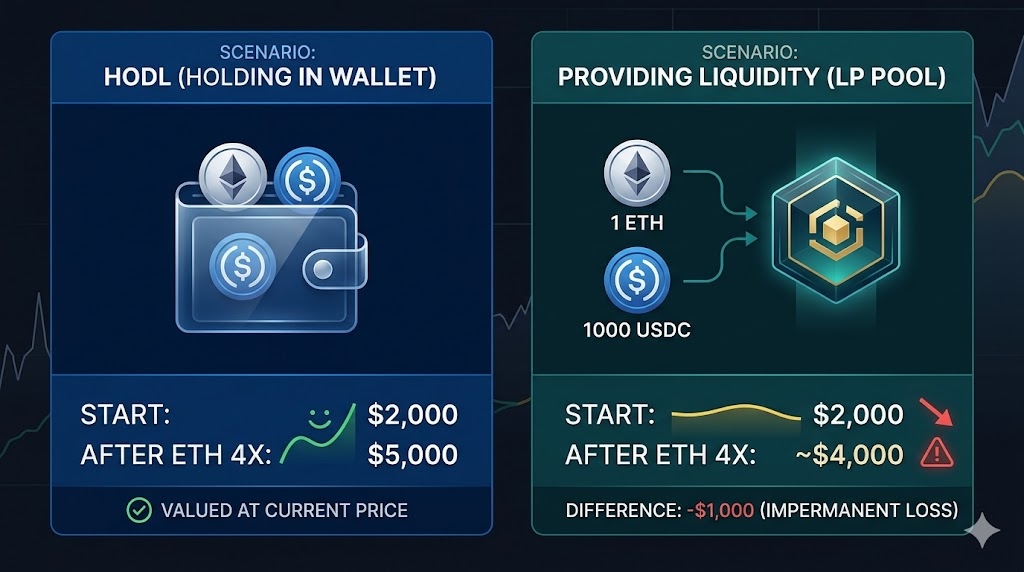
When the price ratio of the two tokens in your pool changes significantly, your LP position ends up worth less than if you had simply held the tokens in your wallet. Here's a concrete example with real numbers:
|
Scenario |
Method |
Starting Value |
Value After ETH Rises from $1,000 to $4,000 |
|
A |
Hold 1 ETH + 1,000 USDC in wallet |
$2,000 |
$5,000 |
|
B |
Deposit same assets into ETH/USDC pool |
$2,000 |
~$4,000 |
|
Difference |
~−$1,000 |
The loss is called "impermanent" because if ETH's price returns to $1,000, the gap disappears. But if you withdraw while prices are still far apart, the loss becomes permanent. Trading fees can offset impermanent loss — but there is no guarantee they will, especially during sharp or sustained price moves.
Smart contract risk
The pool's code governs your funds. If there is a bug in that code, an attacker can exploit it and drain the pool. This has occurred across multiple well-known DeFi protocols. Choosing pools on protocols that have completed multiple independent security audits significantly reduces — but does not eliminate — this risk.
Rug pull risk
Anyone can create a liquidity pool for any token. Fraudulent projects sometimes set up pools, attract liquidity from other users, and then withdraw everything — leaving other LPs with worthless tokens. Before providing liquidity to any lesser-known token, check whether the LP tokens are locked in a verifiable time-lock contract using a blockchain explorer like BscScan.
DeFi Trading Pools vs. Other "Trading Pool" Products
Since the same term appears across completely different industries, here is a direct side-by-side comparison:
|
Dimension |
DeFi Liquidity Pool |
Forex "Trading Pool" Platform |
Centralized Crypto Exchange |
|
Underlying technology |
Blockchain smart contract (AMM) |
Traditional trading software (e.g., MT5) |
Internal matching engine |
|
What you're trading |
Crypto tokens (BEP-20, ERC-20, etc.) |
Forex currency pairs (EUR/USD, etc.) |
Crypto spot and derivatives |
|
Asset custody |
Your own wallet — you control the keys |
Platform holds your funds |
Platform holds your funds |
|
Transparency |
All activity on-chain, publicly verifiable |
No on-chain record |
Proof of reserves where offered |
|
Regulatory framework |
No unified regulator; protocol-governed |
Should hold a verifiable financial license |
Regulated by local jurisdiction |
|
Main risk |
Impermanent loss + smart contract bugs |
Platform credit risk + strategy failure |
Platform credit risk |
The practical takeaway: DeFi liquidity pools and Forex "trading pool" platforms share a name and nothing else. If you are evaluating any centralized platform, reviewing its trading fees and confirming its regulatory license with the named authority are the minimum steps before depositing funds.
How to Get Started — 4 Steps
If you want to interact with a DeFi trading pool, the general workflow is the same across most protocols:
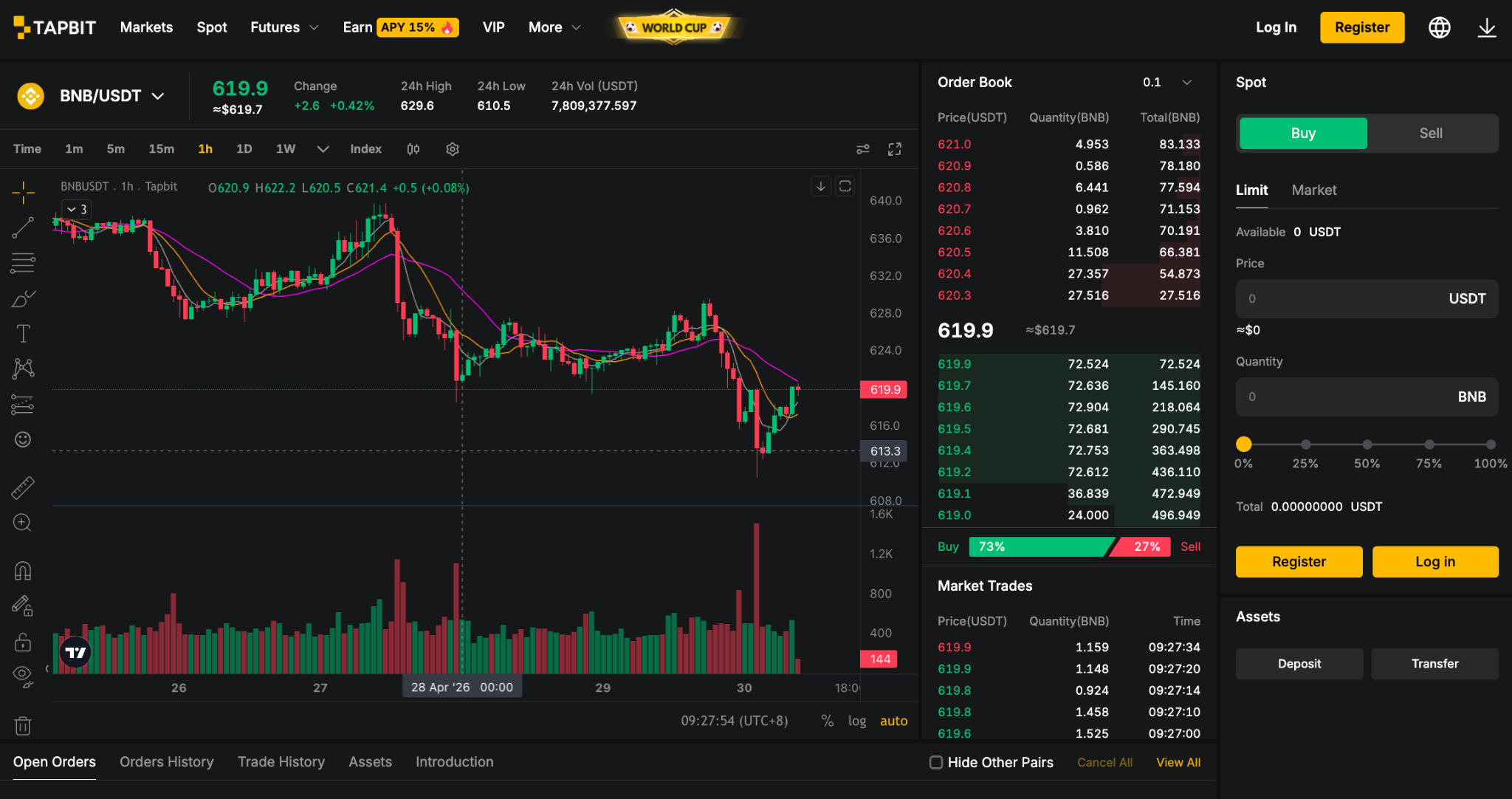
Step 1 — Acquire and transfer your assets Buy the tokens you need on a centralized exchange, then withdraw them to a self-custody wallet. MetaMask is the most common choice for EVM-compatible chains. Keep a small amount of the network's native token — BNB for BNB Chain, ETH for Ethereum — to cover gas fees. You can buy BNB on Tapbit and withdraw directly to your wallet once your account is set up.
Step 2 — Connect your wallet to a DEX Visit the DEX that hosts the pool you want — PancakeSwap is a good starting point for BNB Chain. Click "Connect Wallet," approve the connection in your wallet app, and confirm you are on the correct network. Connecting your wallet does not transfer any funds; it only allows the interface to read your address and balances.
Step 3 — Execute a swap or provide liquidity For a simple swap: select your token pair, enter the amount, and set a slippage tolerance of 0.5%–1% for most liquid pairs. For liquidity provision: go to the "Liquidity" or "Pool" section, select your token pair, deposit equal values of both tokens, and receive LP tokens in return.
Step 4 — Monitor your position After your transaction confirms on-chain, track your LP token balance and accumulated fee income over time. Periodically compare your pool position's value against simply holding the same tokens — this tells you whether fees are outpacing impermanent loss. Start with a small amount until you are comfortable with how positions behave. For any questions about the Tapbit side of the process, our support team is available around the clock.
If you prefer to keep your exposure to crypto without managing wallets or on-chain risk, Tapbit's earn products offer structured yield options that don't require interacting with DeFi protocols directly.
Note on legal access: DeFi protocols do not require identity verification to access, but whether participation is legally permitted in your country varies by jurisdiction. Some regions have issued specific guidance on DeFi; others have not. Always verify the rules that apply in your location before interacting with any DeFi product.
FAQ
What does trading pool mean, and how does it differ from a liquidity pool?
In crypto, the two terms are used interchangeably in most contexts. "Liquidity pool" is the more precise technical term for the underlying smart contract that holds funds. "Trading pool" is a broader label that sometimes also refers to the routing layer — software that finds the best path across multiple liquidity pools for a given trade. For everyday purposes, treat them as synonyms unless the surrounding context suggests otherwise.
Do I need to provide liquidity to use a trading pool?
No. You can swap tokens through a trading pool as a trader without ever becoming a liquidity provider. Providing liquidity is an optional activity for users who want to earn fee income in exchange for accepting risks like impermanent loss. Most beginners start by making simple swaps before exploring liquidity provision once they understand the mechanics.
Are trading pools on BNB Chain different from those on Ethereum?
The core AMM mechanics are identical across both chains. The practical differences are cost and speed: BNB Chain gas fees typically run under $0.01 per transaction, while Ethereum fees can be substantially higher during periods of network congestion. The protocols also differ — PancakeSwap leads on BNB Chain, while Uniswap and Curve dominate on Ethereum. The risk profile — impermanent loss and smart contract exposure — is the same on both.
What happens to my funds if a trading pool I'm in gets hacked?
If the pool's smart contract is exploited, funds in that pool may be partially or fully lost. There is generally no deposit insurance or recovery mechanism for DeFi hacks. This is why experienced DeFi users spread positions across multiple protocols and prioritize pools with long, audit-verified track records over newer alternatives offering higher yields.
Can I earn passive income from a trading pool without actively trading?
Yes — this is the primary reason liquidity providers participate. Once you deposit tokens and receive LP tokens, you passively earn a share of every swap fee generated by the pool, proportional to your share of total liquidity. Some protocols distribute additional reward tokens on top of base fees. However, impermanent loss can offset or exceed fee income during volatile periods, so returns are not guaranteed.
Is a DeFi trading pool legal to use?
DeFi protocols do not require identity verification, but legal access depends on your jurisdiction. Some countries have explicitly restricted or banned participation in DeFi; others have issued no specific guidance. This is a question of local law, not blockchain technology, and the answer varies significantly by country. Verify what applies to you before participating.
References
-
Uniswap v3 Core Documentation — AMM mechanics and constant product formula
-
PancakeSwap Documentation — BNB Chain liquidity pool implementation
-
CFTC: Seeing Commodity Pools More Clearly — traditional commodity pool regulatory definition
-
CoinGecko: What Are Liquidity Pools and How Do They Work in DeFi? — updated May 2026
-
DefiLlama: Total Value Locked Dashboard — DeFi TVL data, May 2026


