

While retail traders are distracted by meme coin volatility, Solana is quietly executing the most aggressive consensus overhaul in the history of Layer-1s. The Alpenglow upgrade, currently live on the community testnet, is a structural "Alpenswitch" that fundamentally resets how the network achieves finality.
This isn't just an optimization—it’s the death of Solana’s original "cryptographic clock," Proof of History (PoH), in favor of a direct-voting engine designed for institutional-grade high-frequency trading.
The End of the "Buffer Cycle"
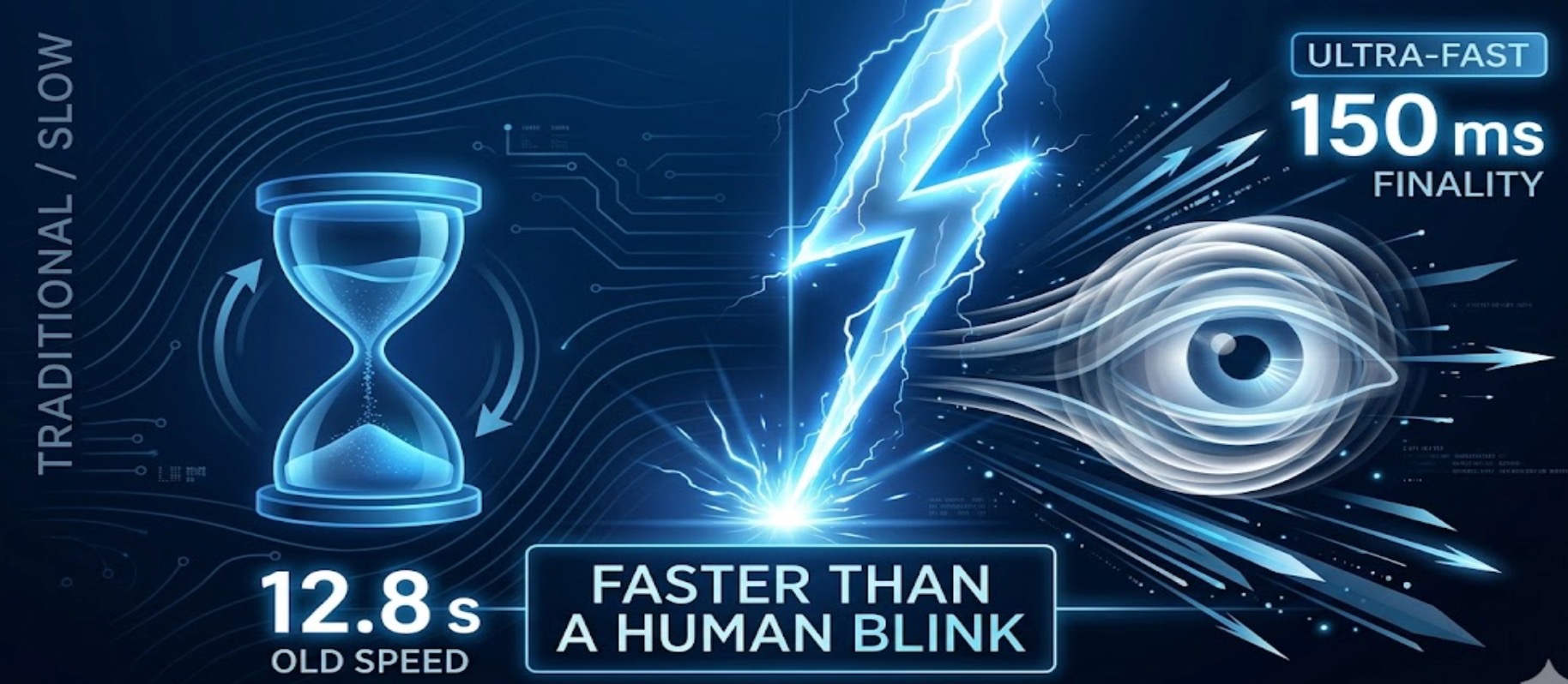
For years, Solana relied on PoH and Tower BFT to order transactions without needing real-time communication between nodes. It worked, but it created a structural delay. Alpenglow retires this old framework for a high-speed parallel voting system:
-
The Votor Engine: A new direct-voting system that hits "fast confirmation" the moment it receives over 80% support from staked weight.
-
The Rotor Network: A revamped data propagation system that utilizes staked relay nodes to slash bandwidth overhead and latency.
-
The 150ms Threshold: Finality time is dropping from roughly 12.8 seconds to a sub-perception range of 100–150 milliseconds.
At 150ms, Solana’s finality is now faster than a human blink or a standard web search, effectively matching the speed requirements of traditional financial matching engines.
Lowering the Barrier for Nodes
One of the quietest but most impactful parts of Alpenglow is the reform of validator economics. By moving voting mechanisms off-chain via the Votor engine, the network is drastically lowering the cost to participate:
-
Validator Admission Tickets (VAT): Instead of variable on-chain voting fees, validators now pay a fixed ticket cost of approximately 1.6 SOL per epoch.
-
The Burn Rate: This VAT mechanism is expected to burn roughly 296,000 SOL annually, adding a stable contraction force to the SOL supply.
-
Small-Scale Inclusion: The staking breakeven point for a node is projected to drop from roughly 4,850 SOL to just 450 SOL, opening the door for a much more decentralized network.
Institutional Infrastructure: Firedancer & RWA
Solana’s TVL hit $8.7 billion in mid-May 2026, a 47% surge driven by more than just retail FOMO. The institutional "pipes" are finally being connected:
-
Firedancer 1.0: Jump Crypto’s independent validator client began its mainnet rollout on May 5, 2026, providing the multi-client redundancy that financial institutions require.
-
Real-World Assets (RWA): On-chain RWA value on Solana has cleared the $2.5 billion mark.
-
B2C2 Settlement: Leading institutional crypto firm B2C2 has officially designated Solana as its primary settlement network for institutional stablecoins.
The Desk Verdict
The Alpenglow mainnet launch is targeted for Q3/Q4 2026. By removing the 12-second confirmation lag and releasing up to 13% of block space previously used for voting transactions, Solana is positioning itself as the only Layer-1 capable of handling "infinite scalability" at the speed of traditional finance.
As the network transitions to a more deflationary model and lowers the barrier for validators, the focus shifts from "can it stay online?" to "how much institutional flow can it capture?".
Ready to execute with institutional speed?
-
High-Liquidity Pairs: Trade SOL/USDT with professional execution and zero-hallucination data on Tapbit.
-
New to the Platform? Register on Tapbit today to secure your welcome rewards and access our 2026 institutional-grade charting suite.
Frequently Asked Questions (FAQ)
What exactly is the "Alpenglow" upgrade?
Alpenglow is a massive consensus overhaul, often called the "Alpenswitch," that replaces Solana’s original Proof of History (PoH) mechanism. Instead of relying on a cryptographic clock, the network is moving to a direct-voting engine (the Votor Engine) designed to achieve nearly instantaneous transaction finality.
How much faster will the network actually be?
The upgrade aims to reduce finality time—the moment a transaction becomes irreversible—from approximately 12.8 seconds down to a range of 100–150 milliseconds. This performance leap makes Solana’s finality faster than a standard web search, meeting the strict requirements of traditional financial matching engines.
Does this help decentralize the network?
Yes. By moving voting mechanisms off-chain and standardizing costs, the barrier to entry for smaller nodes is dropping significantly. The staking breakeven point for a validator is expected to fall from roughly 4,850 SOL to just 450 SOL, allowing more participants to secure the network.


