
What Is BlackRock XRP ETF?
What is a BlackRock XRP ETF? It sounds straightforward, but the answer is more complicated than most headlines suggest.
BlackRock is the world's largest asset manager, overseeing more than $10 trillion in assets. It launched the iShares Bitcoin Trust (IBIT) in January 2024 — which became the fastest-growing ETF in Wall Street history. It followed that with an Ethereum ETF. Naturally, the crypto market started asking: is an XRP ETF next?
The short answer: as of current available information, BlackRock has not officially filed a spot XRP ETF with the SEC or any U.S. exchange. No S-1 registration. No 19b-4 exchange filing. No official announcement.
What you have seen circulating online is a mix of speculation, analyst predictions, and — most notably — a fraudulent 2023 filing that caused real market damage. We'll cover that in detail below.
Understanding what is BlackRock XRP ETF starts with separating two things: what BlackRock has actually done, and what people wish or assumed it had done.
What Exactly Is an XRP ETF?
Before asking whether BlackRock will launch one, it helps to understand what an XRP ETF actually is.
An ETF (Exchange-Traded Fund) is a regulated fund that trades on a stock exchange — like the NYSE or Cboe. You buy shares through a brokerage account, the same way you'd buy Apple stock. You don't need a crypto wallet. You don't manage private keys.
An XRP ETF is simply an ETF that tracks the price of XRP — either by holding real XRP (spot ETF) or by using derivatives contracts (futures ETF).
Here's the key thing: owning an XRP ETF share is not the same as owning XRP.
| Feature | XRP ETF | Holding XRP Directly |
|---|---|---|
| Access | Brokerage account | Crypto exchange / wallet |
| Custody | Fund custodian | User or exchange |
| Trading hours | Stock market hours | 24/7 |
| Fees | ETF expense ratio + spread | Exchange trading fees |
| Ownership | ETF shares | Actual XRP tokens |
| On-chain use | ❌ Not possible | ✅ Transfer, stake, transact |
| Regulatory wrapper | SEC-regulated | Varies by platform/country |
ETFs make XRP accessible to investors who don't want to manage crypto infrastructure. But they add a layer between you and the asset.
Spot XRP ETF vs Futures or Derivative XRP ETF
Not all XRP ETFs work the same way. The difference matters.
① Spot XRP ETF The fund holds real XRP in custody. Its price tracks XRP closely. Approved spot XRP ETFs — from issuers like Bitwise (ticker: XRP), Canary Capital (XRPC), 21Shares (TOXR), and Franklin Templeton (XRPZ) — launched in late 2025. These are physically backed.
② Futures / Derivative XRP ETF The fund uses futures contracts instead of holding real XRP. Products like ProShares Ultra XRP ETF (UXRP) fall into this category. These can carry additional costs from rolling contracts and may not track XRP's spot price precisely.
③ Leveraged / Inverse XRP ETF Products designed to deliver 2x or -1x daily returns. High risk. Designed for short-term traders, not long-term holders.
⚠️ Important: Trading XRP ETFs on a brokerage platform is a completely different activity from trading XRP directly on a crypto exchange. ETF exposure does not equal direct ownership.
How to Buy XRP Spot on Tapbit
Tapbit offers XRP spot trading — direct XRP/USDT trading, not ETF trading.
① Go to Tapbit's XRP/USDT spot page
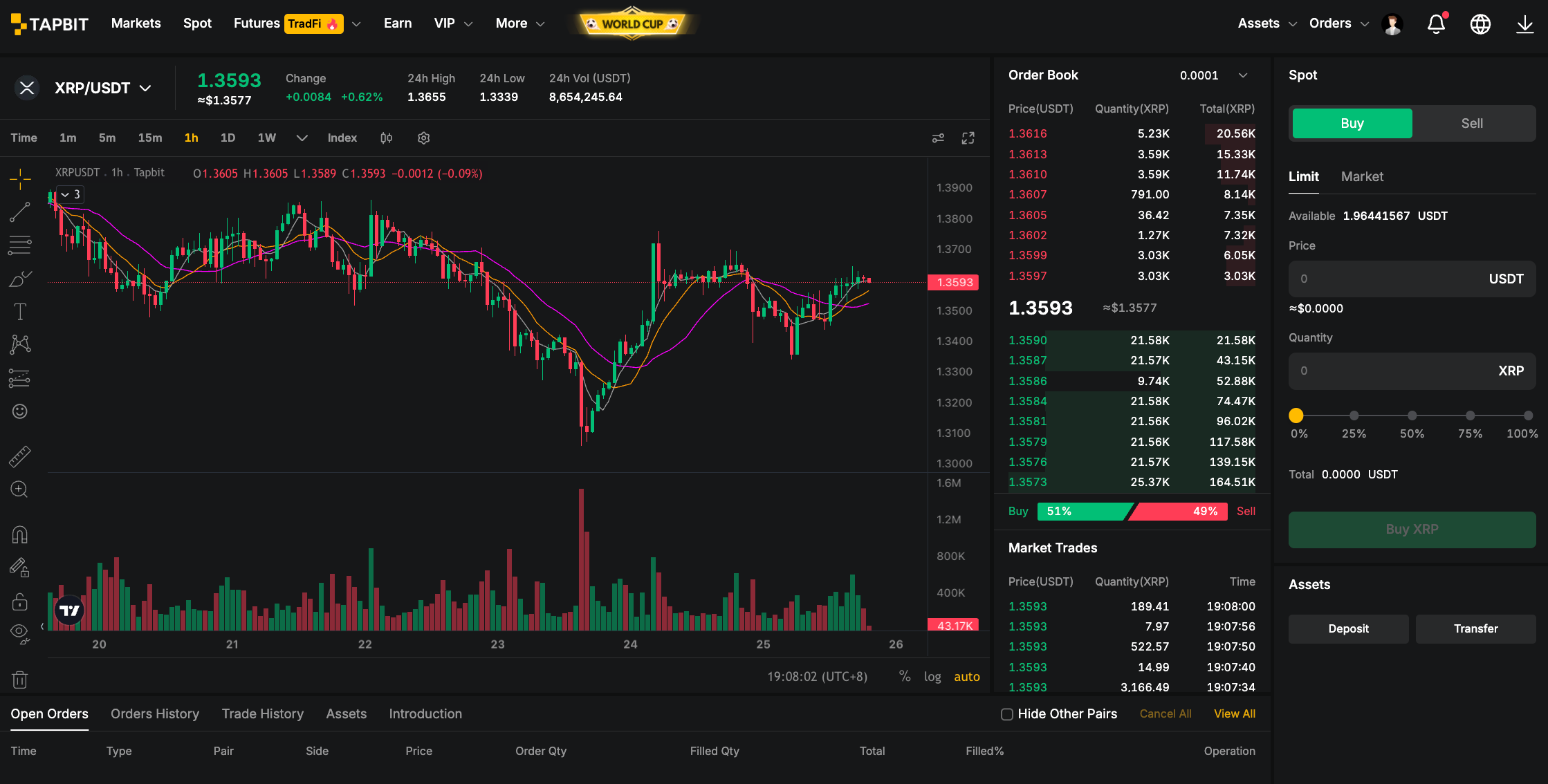
② Check the live price, order book, and market depth
③ Choose a market order or limit order
④ Confirm order details and submit
How to Trade XRP Futures on Tapbit
Tapbit also offers XRP futures trading for traders who want leveraged exposure.
① Go to Tapbit's XRP/USDT futures page
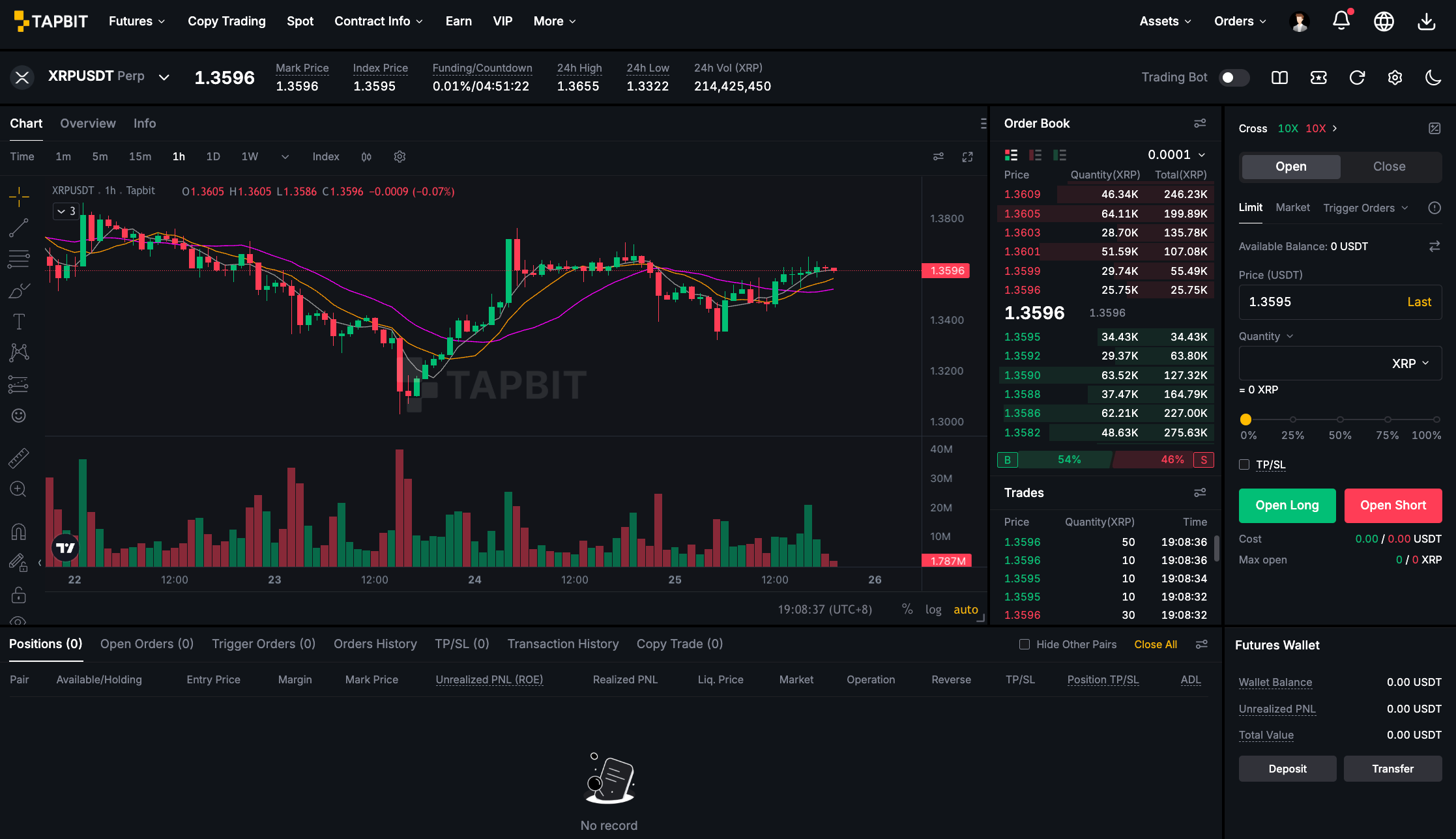
② Review contract details, leverage options, funding rate, and risk controls
③ Choose long or short based on your market view
④ Set your margin, take-profit/stop-loss, and confirm carefully
✅ Tapbit offers XRP spot and futures trading — not BlackRock XRP ETF trading or any ETF product. Tapbit is a crypto exchange, not a securities platform.
What Does BlackRock Have to Do With XRP?
BlackRock's name became linked to XRP for two reasons: its crypto ETF track record, and a fraudulent 2023 filing.
BlackRock's ETF reputation When BlackRock filed for a Bitcoin ETF in June 2023, the market reacted immediately — Bitcoin's price spiked. That's because BlackRock has submitted over 600 ETF applications and received only one rejection in its history. Its SEC approval rate is exceptional. When BlackRock moves on a product, it tends to win.
That same logic made the crypto community eager to see a BlackRock XRP ETF. If BlackRock filed, approval seemed nearly guaranteed.
The 2023 Fake Filing — What Actually Happened
In November 2023, an entity named "iShares XRP Trust" appeared on Delaware's Division of Corporations website. The filing used the name and address of a real BlackRock managing director. It looked almost identical to BlackRock's legitimate iShares Ethereum Trust filing from the prior week.
XRP's price jumped 12% in under 30 minutes.
Then Bloomberg ETF analyst Eric Balchunas confirmed with BlackRock: the filing was fake. Someone had impersonated a BlackRock executive to file it.
Within an hour, XRP gave back all its gains.
The Delaware Office of the Secretary of State referred the matter to the state Department of Justice for investigation.
→ Key lesson: Delaware's corporate registry is open to public filings. Anyone can submit a name registration. A Delaware filing alone is not evidence of a real ETF. It is not part of the SEC approval process.
How to Verify Whether an XRP ETF Filing Is Real
Before reacting to ETF news — especially news that moves markets — take 5 minutes to verify.
✅ Step 1 — Search SEC EDGAR Go to sec.gov/cgi-bin/browse-edgar and search for the issuer name. Look for an S-1 or S-1/A registration statement, or a 19b-4 filing from an exchange.
✅ Step 2 — Check the issuer's official website For a BlackRock XRP ETF claim, go directly to blackrock.com or ishares.com. If it's not listed there, it's not official.
✅ Step 3 — Find the exchange's 19b-4 filing Real ETFs require the listing exchange (NYSE Arca, Cboe BZX, Nasdaq) to file a rule change with the SEC. This filing is publicly searchable on EDGAR.
✅ Step 4 — Look for a fund prospectus and ticker Approved ETFs have a published prospectus and an assigned ticker symbol. No ticker, no product.
❌ Step 5 — Do not rely on social media screenshots Screenshots of Delaware registrations, screenshots of tweets, and screenshots of "BREAKING" posts have all been used to manipulate crypto prices. Verify primary sources first.
You can also check crypto prices and market data on Tapbit to monitor XRP's real-time price action around major news events.
Is a BlackRock XRP ETF Good or Risky for Investors?
This question gets ahead of itself — since BlackRock has not filed a spot XRP ETF as of this writing. But it's worth understanding what the implications would be, and what risks already apply to XRP and the ETF products that do exist.
If BlackRock did file, the likely impact: A BlackRock XRP ETF filing would be a major signal of institutional legitimacy. BlackRock's distribution network — reaching pensions, endowments, and sovereign wealth funds — would bring a new class of capital into XRP. The market would almost certainly react sharply upward on news of a filing alone.
Risks to understand right now:
⚠️ Price volatility. XRP dropped roughly 30% in a single month in early 2026, despite a favorable regulatory backdrop. ETF packaging doesn't insulate you from the underlying asset's moves.
⚠️ Fake news risk. The 2023 fake filing showed that a single fraudulent document can move XRP's price 12% in minutes — and collapse just as fast. Retail investors acting on unverified news often absorb the losses.
⚠️ ETF-specific fees. Spot XRP ETFs charge an annual expense ratio. Bitwise's XRP ETF, for example, carries a 0.34% management fee. Over time, this compounds against your returns compared to holding XRP directly.
⚠️ No on-chain utility. ETF shares are securities. You cannot use them to transact on the XRP Ledger, participate in DeFi protocols, or transfer XRP to another wallet. For users who want to use XRP — not just hold exposure — direct ownership may still make more sense.
Regulatory clarity has improved. The Ripple vs. SEC lawsuit resolved in August 2025, confirming XRP's non-security status in secondary market trading. This reduced one of the major risk factors that had blocked earlier XRP ETF applications.
The Bottom Line: What Is BlackRock XRP ETF, Really?
Right now, the BlackRock XRP ETF is still a market expectation — not a product.
What is BlackRock XRP ETF in plain terms: it would be an iShares-branded exchange-traded fund tracking XRP's price, issued by the world's largest asset manager. That product does not currently exist.
What does exist: spot XRP ETFs from Bitwise, Canary Capital, Franklin Templeton, 21Shares, Grayscale, and others — all approved in late 2025. These are legitimate products, but they are not BlackRock products.
If you want to track XRP market data, trade XRP directly, or build positions in XRP while watching ETF news develop, view live XRP data and trade on Tapbit. You can also review Tapbit's fee structure and proof of reserves before getting started.
Always verify claims. Always check primary sources. And remember: a Delaware filing is not a BlackRock ETF.
FAQ
Q1: Did BlackRock file an ETF for XRP?
No. As of current available information, BlackRock has not officially filed a spot XRP ETF with the SEC. No S-1 or 19b-4 filing exists from BlackRock for an XRP product. Analysts speculate a filing could come in late 2026, but speculation is not a filing.
Q2: What was the fake BlackRock XRP Trust filing in 2023?
In November 2023, someone submitted a fraudulent corporate name registration on Delaware's Division of Corporations website, naming it "iShares XRP Trust" and using a real BlackRock executive's information. BlackRock confirmed it was fake. XRP's price spiked 12% and crashed within an hour. Delaware authorities referred the matter to the state's Department of Justice.
Q3: Can a fake ETF filing affect XRP's price?
Yes — significantly and quickly. The 2023 fraudulent filing caused a 12% price spike in under 30 minutes before the truth emerged. This is why verifying claims through SEC EDGAR and official sources before acting on ETF news is essential.
Q4: Which companies have actually launched spot XRP ETFs?
As of late 2025, approved and trading spot XRP ETFs include products from Bitwise (XRP), Canary Capital (XRPC), Franklin Templeton (XRPZ), 21Shares (TOXR), Grayscale (GXRP), REX-Osprey, and Amplify. None of these are BlackRock products.
Q5: Does owning an XRP ETF mean I own real XRP?
For spot XRP ETFs, the fund holds real XRP — but you hold ETF shares, not XRP itself. You cannot transfer that XRP to a wallet, use it on-chain, or access it outside the ETF structure. For futures-based ETFs, the fund doesn't hold XRP at all — only derivatives contracts.
Q6: Can I trade a BlackRock XRP ETF on Tapbit?
No. Tapbit is a crypto exchange offering XRP spot and futures trading — not ETF products. No BlackRock XRP ETF currently exists, and even if it did, ETFs are traded on regulated securities exchanges through brokerage accounts, not on crypto exchanges. On Tapbit, you can trade XRP directly or trade XRP futures.


