

What Is Market Structure in Crypto?
What is crypto market structure bill? It is a proposed legal framework for how crypto markets should operate. In traditional finance, market structure refers to the rules that define who can issue assets, where assets can trade, how brokers and exchanges must behave, and which regulator supervises which activity.
Crypto has long lacked a single clear U.S. framework. Some digital assets may look like securities. Some may behave more like commodities. Some protocols are decentralized. Some platforms hold customer assets, match trades, provide custody, or offer brokerage-like services. A crypto market structure bill tries to organize that landscape into clearer categories.
The most discussed U.S. proposal is the Digital Asset Market Clarity Act, commonly shortened to the CLARITY Act. The bill is designed to clarify how digital assets fit into U.S. law, especially the roles of the Securities and Exchange Commission (SEC) and the Commodity Futures Trading Commission (CFTC).
For users, the bill matters because unclear rules can affect which tokens are listed, which platforms can serve U.S. customers, what disclosures users receive, and how quickly legitimate crypto businesses can build products.
What Will the Cryptocurrency Bill Do?
A crypto market structure bill does not make every token safe, legal, or valuable. Its purpose is more specific: to define regulatory responsibilities and market rules.
In plain English, the bill could:
- Clarify when a digital asset is treated under securities rules.
- Define when a digital commodity may fall under CFTC oversight.
- Set standards for trading platforms, intermediaries, and disclosures.
- Create a path for some crypto businesses to register and operate under clearer rules.
- Give regulators a more consistent framework for enforcement and supervision.
That last point is important. Without clear market structure, regulators may rely heavily on enforcement after the fact. With clearer rules, companies can better understand what they must do before launching products or serving users.
This does not remove crypto risk. It may reduce legal uncertainty, but users still face volatility, smart contract risk, liquidity risk, and project risk. Tapbit users can review proof of reserves, check market data, and create an account to explore available tools.
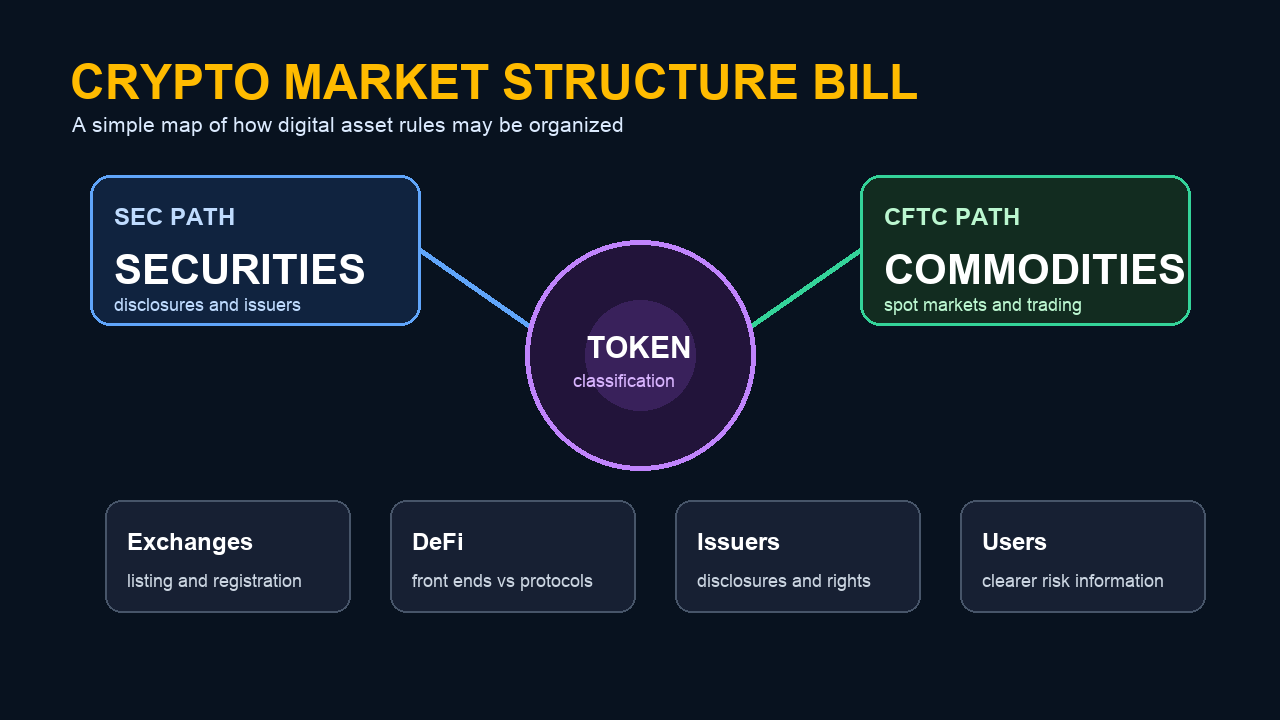
SEC vs CFTC: Why the Bill Matters for Token Classification
The SEC and CFTC have different roles. The SEC generally supervises securities markets, while the CFTC supervises commodity derivatives markets and certain commodity-related activity. In crypto, the hard question is where a token belongs.
If a token is treated like a security, issuers and platforms may face securities-law registration, disclosure, and conduct obligations. If a token is treated as a digital commodity, the regulatory path could look different, especially for secondary-market trading.
| Question | Why It Matters |
|---|---|
| Is the asset a security or commodity? | Determines the main regulatory framework |
| Is the network decentralized? | May affect how the asset is classified |
| Who runs the trading platform? | Determines exchange, broker, or intermediary obligations |
| What disclosures are required? | Affects what users can evaluate before trading |
This is why the bill is watched closely by exchanges, token issuers, market makers, venture investors, DeFi builders, and crypto users. Classification can shape the entire path from token launch to exchange listing.
Has Trump Signed the Crypto Bill?
As of this article's current research window, the main market-structure proposals were still part of the U.S. legislative process. A bill is not law simply because it is introduced, debated, or passed by one chamber. It generally needs to pass both the House and Senate and be signed by the president.
Readers should be careful with headlines that imply a bill has already changed the law. A proposal can influence market expectations before it becomes law, but legal obligations usually depend on the final enacted text and regulatory implementation.
The practical way to follow progress is to watch:
- Whether the House advances the bill.
- Whether the Senate introduces or modifies a companion version.
- Whether the SEC, CFTC, Treasury, or banking regulators comment on implementation.
- Whether industry groups support or challenge specific language.
What Are the Three Major Crypto Bills?
In 2026, U.S. crypto policy discussion often centers on several types of legislation rather than one single bill.
First, there are market structure bills such as the CLARITY Act. These focus on token classification, trading venues, regulator roles, and digital asset market rules.
Second, there are stablecoin bills, including the GENIUS Act discussion. These focus on reserve backing, issuer obligations, redemption, payment stablecoins, and supervision. Tapbit Learn's GENIUS Act stablecoin guide gives related background.
Third, there may be bills or policy proposals touching taxes, anti-money-laundering rules, custody, banking access, or decentralized finance. These do not always move at the same speed.
The reason users hear about multiple bills is simple: crypto touches many financial functions at once. It can be a payment rail, an investment asset, a trading market, a custody product, and a software protocol. A single law rarely covers every detail cleanly.
How the Bill Could Affect Exchanges, DeFi and Token Issuers
For exchanges, clearer market structure could create more predictable listing and registration paths. That could reduce uncertainty for compliant platforms, but it could also increase costs for platforms that need licensing, reporting, surveillance, or customer-protection systems.
For DeFi, the impact depends on definitions. A truly decentralized protocol may be treated differently from a front-end, operator, broker, or platform that actively facilitates trading. The details matter because DeFi is not one business model. It includes protocols, interfaces, liquidity pools, governance structures, and service providers.
For token issuers, the bill could affect how assets are launched, disclosed, and traded. Projects may need to think more carefully about decentralization, governance, insider allocations, investor communications, and ongoing reporting.
For users, the main benefit would be more clarity. A clearer rulebook can make it easier to understand what a platform is, what a token claims to be, and what protections may or may not apply.
What Crypto Users Should Watch Next
The most important thing to watch is not just whether a bill passes. Users should watch the final language. Small wording differences can change how tokens, platforms, and decentralized systems are treated.
Users should also separate legal clarity from investment quality. A clearer framework does not mean every crypto asset is a good project. It only means the rules around issuance, trading, and supervision may become easier to understand.
The answer to what is crypto market structure bill is therefore broader than one piece of legislation. It is a debate over how digital asset markets should be organized, who should supervise them, and how users can get clearer information before interacting with crypto products.
FAQ
What is the crypto market structure bill?
It is a proposed framework for how digital asset markets, tokens, trading platforms, and intermediaries should be regulated.
Is the CLARITY Act the same bill?
The CLARITY Act is one of the main U.S. crypto market structure proposals.
Does the bill make crypto legal?
It does not automatically make every crypto asset legal or safe. It aims to clarify rules and regulatory roles.
What does it mean if a token is a commodity?
It may fall more under CFTC-related oversight for certain market activities, though the final treatment depends on the law and facts.
How could this affect crypto exchanges?
It could shape registration, listing, disclosure, custody, and trading requirements for platforms.


