
MU stock closed near $900.20 on July 27, 2026, down about 2.3% for the session. The daily percentage looks modest beside the larger losses in other memory names, but the context is more important: Micron had already fallen almost 7% in the previous session, leaving the stock roughly 9% below its July 23 close near $990.
The immediate catalyst was a broad reassessment of the memory trade after the powerful market debut of China’s ChangXin Memory Technologies. Investors are now asking whether stronger Chinese capacity could pressure DRAM pricing just as valuations for AI-linked memory companies have become demanding. That concern sits beside a very different fundamental picture: Micron’s latest quarter showed record revenue, strong data-center profitability and high-volume HBM4 shipments.
MU Stock Price Today: What the $900 Level Means
Micron traded between roughly $854.79 and $935 on July 27 before closing near $900.20. That wide range shows that the market is struggling to decide whether the current move is a healthy reset or the beginning of a deeper memory-sector repricing.
The $900 area is psychologically important, but the intraday structure matters more. Buyers appeared below $875, while sellers remained active above $930. A stable base would require MU to hold the $855–$875 region and then reclaim the upper end of the latest range. A quick bounce that fails below $935 would not be enough to confirm that the correction is finished.
The weekly picture is less dramatic than the two-session fall suggests. MU remained modestly above its July 20 close, which is a reminder that short-term percentages depend heavily on the chosen starting point. The stock is volatile because expectations for memory earnings have risen extraordinarily fast.
Why Is Micron Stock Under Pressure?
The main issue is not current demand alone. It is the market’s estimate of how long exceptional pricing and margins can last. Memory stocks often peak before reported earnings weaken because investors anticipate future supply responses.
CXMT and China Competition
CXMT focuses on DRAM, which places it closer to Micron and SK Hynix than to pure storage companies. Its market debut highlighted the amount of capital China may be able to direct toward domestic memory expansion. Even if Chinese suppliers remain behind at the leading edge, additional conventional DRAM capacity could change the industry’s supply balance over time.
That does not mean CXMT can immediately replace Micron’s HBM4 products. Advanced HBM depends on design, stacking, packaging, thermal performance and qualification with large AI customers. The near-term stock risk is therefore expectation compression: investors may apply a lower valuation multiple before a direct earnings impact appears.
AI Expectations May Already Be Reflected in Valuation
Micron’s fiscal third-quarter 2026 results were exceptionally strong. The company reported $41.46 billion in revenue, record profitability and a fourth-quarter revenue outlook of about $50 billion. It also said HBM4 was in high-volume shipments for a lead customer and that HBM4E development was progressing toward 2027 production.
Those numbers support the business case, but they also explain the stock’s sensitivity. When a company is expected to deliver very high growth and margins, merely good news may not be enough. The market starts asking whether the next quarter can beat an already extraordinary baseline.
Memory Pricing Still Controls the Cycle
HBM is the premium product, but Micron also sells DRAM, NAND, server memory, mobile memory and storage products. The earnings outlook depends on the mix of high-value AI products and the pricing environment across the wider portfolio. If supply expands faster than demand in conventional memory, pressure can spread to sentiment even while HBM remains strong.
Is MU a Good Stock to Buy Now?
The most useful answer is conditional. MU may be attractive for investors who believe the AI memory cycle remains structurally tight, but a falling price is not enough by itself to create a favorable entry.
The Bull Case for Micron
The bull case rests on three points. First, AI systems require more memory bandwidth and capacity per accelerator generation. Second, Micron is shipping HBM4 and developing HBM4E, which keeps it involved in the highest-value part of the market. Third, the latest results show that data-center and cloud demand are translating into revenue, margins and cash flow rather than remaining only a narrative.
This case becomes stronger if the stock holds above the July low near $855 and recovers above $935. A move back through approximately $990 would show that the market has absorbed the China-related shock and is again prioritizing earnings momentum.
The Bear Case for Micron
The bear case is that record profitability encourages too much industry investment. Memory producers have historically expanded capacity during strong periods, creating later oversupply. China adds another source of capital and policy support, while AI customers may become more cost-sensitive if infrastructure returns disappoint.
Under this scenario, the market could continue reducing Micron’s valuation even before revenue contracts. A sustained break below $855 would weaken the immediate stabilization case and make the lower part of the prior trading range more relevant.
What Is the MU 12-Month Forecast?
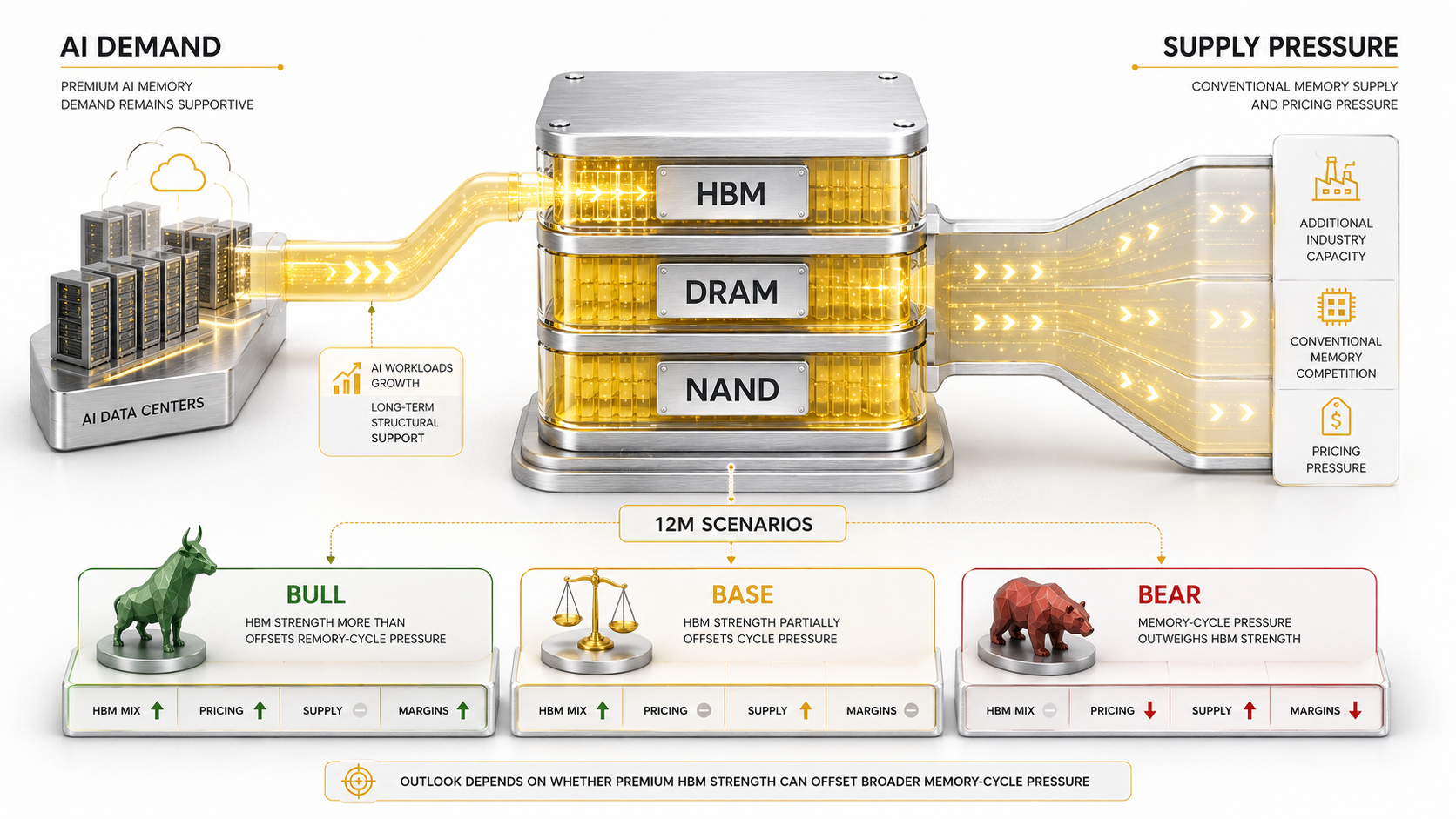
A 12-month outlook should be built from operating assumptions, not a single analyst target. Micron’s future price will depend on HBM shipment growth, DRAM and NAND pricing, gross margin, capital expenditure and evidence that AI customers can keep funding large infrastructure programs.
| Scenario | Operating Assumption | Market Signal |
|---|---|---|
| Bull | HBM4 shipments expand, HBM4E qualification advances and memory pricing remains disciplined. | MU reclaims $935, then moves back above roughly $990 with improving sector breadth. |
| Base | AI demand stays strong, but valuation compresses as investors price more future supply. | The stock forms a broad range between approximately $855 and $990. |
| Bear | Conventional DRAM pricing weakens, China capacity concerns rise or AI spending slows. | A sustained break below $855 invalidates the near-term base-building thesis. |
The strongest confirmation would not be price alone. Investors should also watch the next earnings guidance, HBM customer commentary and whether capital spending remains aligned with contracted demand. A rising stock without improving evidence can be a short-covering rally; improving evidence without price confirmation can still take time to matter.
What Do Analysts and Market Commentators Need to Address?
Market commentary on Micron often focuses on whether the stock is a buy after a drop. A better discussion separates four questions: Is HBM demand still expanding? Are conventional memory prices stable? Is capacity growth disciplined? Does the current valuation already assume an unusually long period of peak margins?
Celebrity opinions or television commentary should only be used when the original statement and date can be verified. For a durable article, company guidance and industry data are more useful than a decontextualized quote.
Tapbit Learn’s previous analysis of Micron near $904 covered the earlier pullback. This update differs by focusing on the CXMT shock, the July 27 close near $900 and the new question of whether China-related capacity can change the 12-month memory outlook. Readers can also review the broader semiconductor stock outlook.
How to Trade MU-USDT on Tapbit
Tapbit offers MU-USDT stock-linked futures. The product tracks Micron-related price movement through a derivative contract. It is not a direct Micron share and does not provide shareholder ownership, voting rights or dividends.
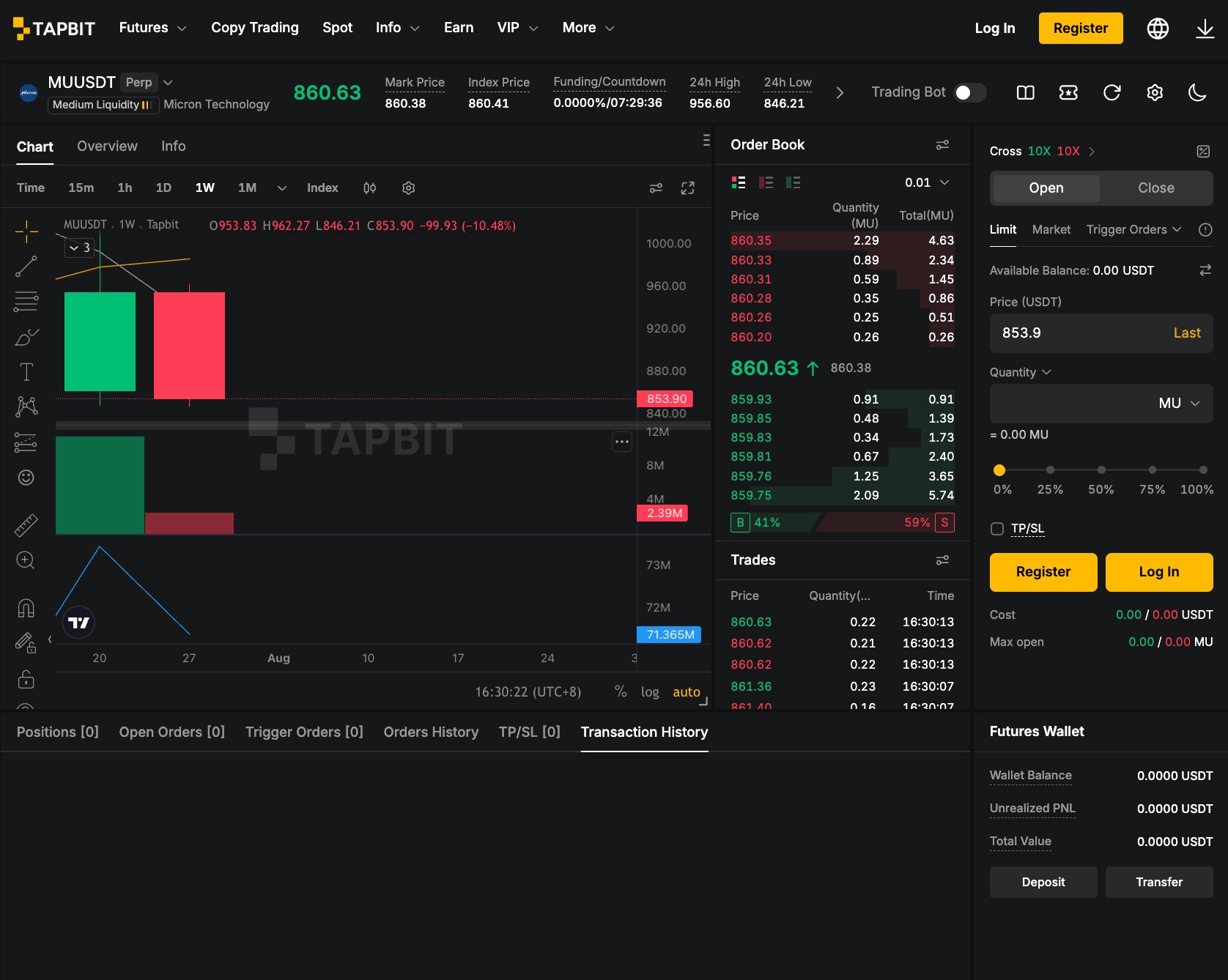
- Step 1: create an account and transfer collateral to the futures account.
- Step 2: Open MU-USDT and review the live contract price, funding, margin mode, liquidity and available leverage.
- Step 3: Choose the order type, direction and position size only after defining the maximum acceptable loss.
- Step 4: Set stop-loss and take-profit levels, and monitor U.S. equity-market hours because new Micron or semiconductor news can rapidly change volatility.
Micron’s business data still supports the AI memory thesis, but the stock’s fall toward $900 shows that the market is beginning to price competition and future supply more aggressively. The next decisive signal is whether MU can defend the $855–$875 area and reclaim $935. Until then, the 12-month opportunity remains real, but the entry timing requires confirmation.


