
CME Group’s launch of single stock futures marks another step in the convergence between traditional markets and derivatives-driven trading. For years, stock traders mostly used shares, options and ETFs to express views on individual companies. Crypto traders, meanwhile, became deeply familiar with perpetual futures, margin, funding, liquidations and fast-moving market access.
Now CME is bringing futures-style exposure to single U.S. stocks at a larger scale. The launch matters because it makes single-name equity exposure look more like commodities, index futures and crypto contracts: standardized, margin-based and designed for directional trading or hedging.
For users comparing stock futures, crypto futures and broader derivatives markets, Tapbit’s registration page offers a starting point to explore crypto market tools, trading features and futures-related access. Traders who want the official exchange context can also review CME Group for product information and market notices.
What Did CME Launch?
CME launched single stock futures on July 27, 2026, giving traders a way to trade futures contracts tied to individual U.S. stocks. The offering includes both standard-sized contracts and micro-sized contracts. Larger contracts are designed for active or institutional-style traders, while micro contracts can make notional exposure easier to manage for smaller accounts.
The key point is simple: instead of trading only broad market index futures such as the S&P 500 or Nasdaq 100, traders can now trade futures linked to individual companies. That turns major stocks into futures products with standardized contract terms, margin requirements and cash-settlement mechanics.
What Are Single Stock Futures?
Single stock futures are futures contracts based on the price of one company’s stock. For example, instead of buying Nvidia shares or trading Nvidia options, a trader may use a futures contract linked to Nvidia’s stock price. The contract allows the trader to take a bullish or bearish view on that specific stock through a futures structure.
This matters because futures contracts are generally more linear than options. Options require traders to think about strike price, expiration, implied volatility and time decay. Futures are more direct: if the underlying stock rises, the long futures position generally benefits; if it falls, the long position loses value.
How Do Single Stock Futures Work?
A single stock future tracks the price movement of an individual stock through a standardized futures contract. Traders do not need to pay the full value of the underlying shares upfront. Instead, they post margin. That makes the product capital-efficient, but it also introduces leverage risk because a smaller amount of capital can control a larger notional position.
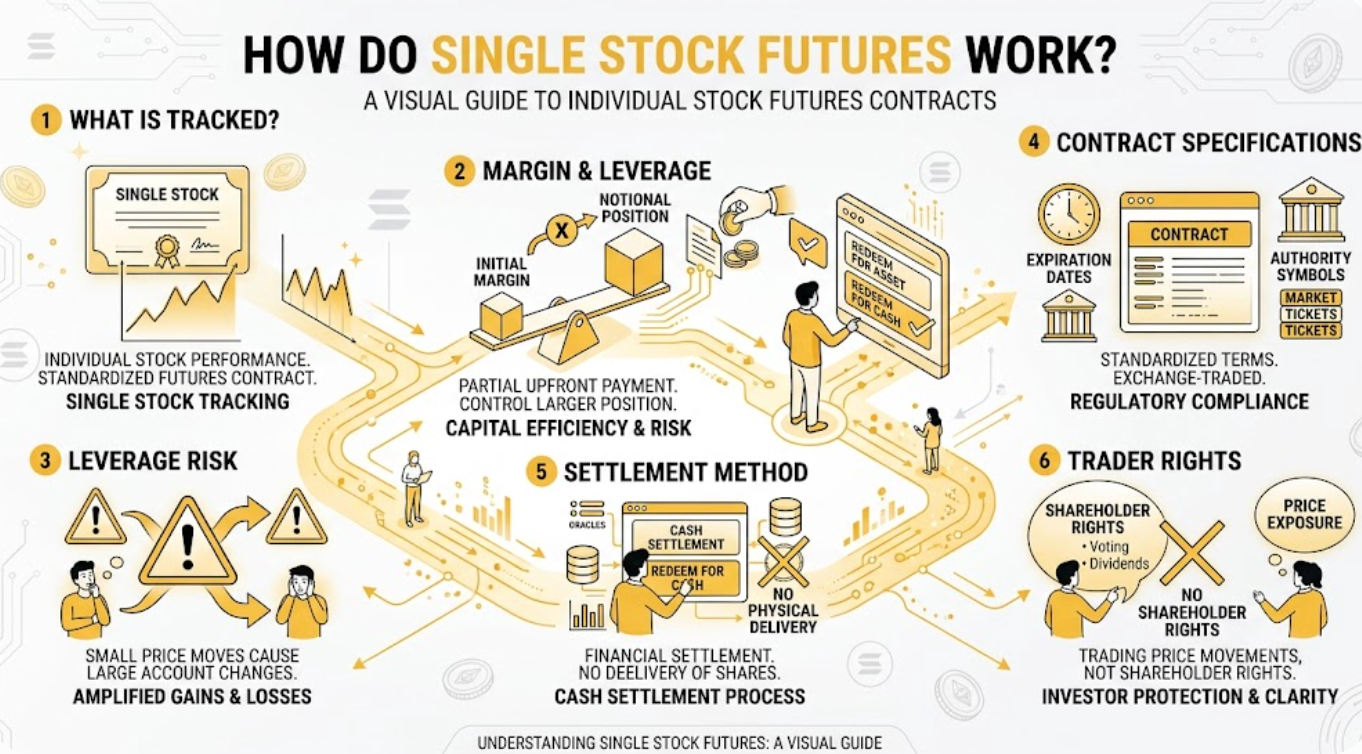
The contracts are typically financially settled, meaning traders settle in cash rather than taking delivery of shares. This is an important distinction. A futures trader is trading price exposure, not shareholder rights. A long position may benefit from a rising price, but it does not usually provide voting rights, dividends or direct ownership of the company.
Why Are Stock Futures Becoming More Like Commodities?
Commodities such as oil, gold, natural gas and agricultural products have long traded through futures markets. Traders use them for speculation, hedging and risk management. Single stock futures apply a similar idea to individual equities. A stock like Nvidia or Tesla becomes tradable through a futures framework, just as crude oil or gold can be traded through standardized contracts.
This reflects a broader market trend: more assets are being turned into standardized, margin-based instruments. Stocks, crypto assets, ETFs, commodities and tokenized assets are increasingly traded through products that emphasize speed, access and capital efficiency.
Single Stock Futures vs Stock Options
Single stock futures and stock options both allow traders to express a view on an individual company, but they behave differently. Options can be powerful, but they are not always intuitive. A trader can be right on direction and still lose money if timing or volatility moves against them. Futures are usually easier to understand because price exposure is more direct.
| Feature | Single Stock Futures | Stock Options |
|---|---|---|
| Price exposure | Direct futures-style exposure | Depends on strike, expiry and volatility |
| Time decay | No traditional options theta decay | Time decay can be significant |
| Complexity | Usually simpler | More complex |
| Leverage | Margin-based | Premium-based or margin-based |
| Shareholder rights | No | No, unless exercised into shares |
Single Stock Futures vs Crypto Futures
The comparison with crypto futures is especially important. Crypto traders are used to trading BTC, ETH and altcoin futures without owning the underlying asset directly. They understand margin, liquidations, long and short positioning, and the idea that derivatives can move quickly during volatile markets.
Single stock futures bring a similar mindset to equities. Instead of trading BTCUSDT or ETHUSDT futures, a trader may follow Nvidia, Tesla or Apple futures. The underlying assets are different, but the risk structure feels familiar: margin, volatility, leverage and fast repricing.
The biggest difference is market structure. Crypto markets often operate around the clock, while U.S. equity-linked products still connect to stock-market hours, settlement rules, company events and regulatory frameworks.
Why Traders Care About Nvidia, Tesla, Apple and Other Stock Futures
The first wave of attention is likely to focus on high-volume, high-volatility technology stocks. Nvidia matters because of AI chip demand. Tesla matters because of electric vehicles, robotics and Elon Musk-related sentiment. Apple matters because it remains one of the world’s most widely held stocks. Meta, Alphabet and Amazon matter because they sit at the center of advertising, cloud, AI and consumer technology.
Single stock futures give traders another way to express views on these companies. Instead of buying shares or using options, they can use futures to trade direction, hedge exposure or react to earnings expectations. That does not make the product automatically safer. It simply gives traders another tool.
Key Risks: Leverage, Liquidity, Gap Moves, and Margin
The biggest risk is leverage. Margin makes futures efficient, but it also means losses can grow quickly if the position is too large. A trader who treats stock futures like spot shares may underestimate how fast account equity can change.
Liquidity is another concern. A new futures product may take time to develop deep order books. If liquidity is thin, spreads may widen and exits may become more expensive. Gap moves also matter. Individual stocks can move sharply after earnings, guidance changes, analyst downgrades, product news or regulatory headlines.
Margin calls are the final risk many beginners underestimate. If the position moves against the trader, additional margin may be required. If the trader cannot meet that requirement, the position may be closed.
What This Means for Stock Derivatives Trading in 2026
CME’s single stock futures launch shows that derivatives trading is moving toward more flexible, single-asset exposure. For traditional stock traders, it creates another alternative to options and leveraged ETFs. For crypto traders, it makes equity markets feel more familiar because the product structure resembles futures-based crypto trading.
The larger implication is that the line between TradFi and crypto trading continues to blur. Traders increasingly expect flexible position sizing, long and short exposure, margin-based products and fast access across multiple asset classes.
Conclusion
CME’s launch of single stock futures is a meaningful development for both stock and crypto derivatives traders. The product gives traders futures-style exposure to individual stocks such as Nvidia, Tesla, Apple and other major U.S. names. It may offer simpler directional exposure than options and more targeted exposure than index futures.
However, single stock futures are not the same as owning shares. They are leveraged derivatives, and they carry risks around margin, liquidity, volatility and stock-specific events. Traders should understand the product structure before using it.
FAQ
What are CME single stock futures?
CME single stock futures are futures contracts linked to the price movement of individual U.S. stocks.
When did CME launch single stock futures?
CME launched single stock futures on July 27, 2026.
Are single stock futures the same as owning shares?
No. They provide price exposure through a futures contract, but they do not give shareholder rights such as voting or dividend ownership.
Are single stock futures like crypto futures?
They are similar in that both are margin-based derivatives, but they are linked to stocks rather than crypto assets.
What stocks are traders watching?
Traders are likely to focus on major names such as Nvidia, Tesla, Apple, Meta, Alphabet and Amazon.
What is the biggest risk?
The biggest risk is leverage. Price moves can create large gains or losses relative to the margin posted.


