

Micron stock today has moved from momentum favorite to market stress test in one sharp session. MU recently traded around $904.28 after falling nearly 8% in a single day, with an intraday low near $874.35. That kind of move gets attention fast, especially in South Korea and the broader global semiconductor market, because Micron is not just another chip stock. It sits at the center of the memory cycle, the HBM story, and the wider debate over whether AI-linked hardware names have run too far too fast.
The important point is that this drop should not be framed as one simple headline move. A decline like this usually reflects a mix of valuation reset, positioning unwind, sector-wide pressure, and changing expectations around future earnings power. When investors sell high-performing semiconductor names, the question is not only why the stock fell, but what the drop changes about the risk-reward profile from here.
Micron Stock Price Today: What the 8% Drop Changed
The drop to roughly $904 changes the short-term trading setup much more than the long-term business narrative. Before the selloff, Micron had been treated as one of the cleanest ways to gain exposure to the AI memory theme. HBM demand, stronger pricing for high-value memory products, and optimism around Nvidia-related supply chains all helped support that view. After the selloff, investors are becoming more selective. They still recognize the long-term opportunity, but they are asking whether the market had priced in too much good news too quickly.
That distinction matters. A stock can remain fundamentally strong while still becoming vulnerable to a correction. In Micron's case, the selloff suggests that the market is rechecking three assumptions at the same time: first, whether HBM demand will stay tight enough to protect margins; second, whether memory pricing can continue improving; and third, whether investors should keep assigning premium valuation multiples to semiconductor winners after such a strong run. In other words, the market is not necessarily saying Micron is broken. It may simply be saying the stock needs fresh proof.
For traders and investors, that means the $874 to $900 area becomes more important than the headline drop itself. If buyers can defend that zone, the selloff may look more like a reset within a larger uptrend. If the stock cannot stabilize there, then the market may start treating the move as a deeper repricing instead of a routine pullback.
Buy, Wait or Avoid MU?
The practical decision is not whether Micron is a good company. The more useful question is whether the current setup supports buying now, waiting for confirmation, or stepping aside. Those three approaches can all be reasonable depending on risk tolerance and market discipline.

Buy Case
The buy case works only for investors who can tolerate volatility and who still believe the HBM and AI-memory thesis remains intact. That case becomes stronger if MU stabilizes around the $874 to $900 region and if broader semiconductor sentiment stops deteriorating. A disciplined buyer would not purchase the stock just because it is down sharply. The better argument is that the market may be shaking out weak hands while the longer-term earnings opportunity remains valid.
In this scenario, investors would be betting that high-value memory demand is still strong, that Micron's product mix continues improving, and that any short-term valuation reset creates a better entry point rather than a structural breakdown. Readers who want more context on memory demand can also review Tapbit Learn content on HBM memory and high bandwidth memory, both of which help explain why AI infrastructure has been such a powerful driver for the sector.
Wait Case
The wait case is probably the most balanced stance for many readers. Instead of guessing the bottom, investors can wait for the stock to reclaim roughly $950 and then watch whether earnings estimates or management commentary begin improving again. Waiting sacrifices some upside if the rebound comes quickly, but it reduces the risk of buying during a still-unfinished correction.
This approach is especially useful when a stock has already had a huge prior run. After strong momentum names fall, they often need time to rebuild confidence. A clean recovery back above the mid-$900s would suggest buyers are regaining control. From there, attention can turn back to whether MU can challenge the area near $993, which is a more meaningful strength confirmation zone.
Avoid Case
The avoid case is not bearish for drama's sake. It is a risk-management case. If Micron breaks below $874 and industry concerns around future supply expansion continue getting worse, then the market may be telling investors not to rush into a falling stock. A large decline on its own is not a buy signal. Sometimes it is only the first step in a broader repricing process.
Investors should be especially careful if memory pricing expectations weaken, if HBM shipment enthusiasm cools, or if rising supply from China changes the medium-term margin outlook. In that setup, trying to buy only because the stock looks cheaper can become a trap.
What Could Reprice Micron Higher?
If the stock is going to recover in a durable way, the market will need fresh evidence. The first re-rating driver is HBM shipment guidance. Investors want proof that AI-related demand is still strong enough to support both revenue quality and margin expansion. The second is memory contract pricing. If pricing remains firm, it supports the argument that the earnings power story has not cracked.
The third driver is gross margin. Micron is not being valued only on sales growth; it is being judged on how much of that demand can turn into profitable growth. Strong margin performance would help restore confidence after the selloff. The fourth is Nvidia-driven demand and broader AI server investment. As long as AI infrastructure spending stays healthy, the memory names remain tied to a larger strategic trend.
The final driver is China supply developments, including CXMT-related expectations. Investors do not just care about current demand. They care about future balance. If the market believes supply expansion will eventually pressure margins, the stock can stay under pressure even when near-term demand looks solid. This is why Micron should be analyzed not only as a momentum stock, but as part of a broader memory-cycle equation.
How to Trade MU-Linked Futures on Tapbit
For readers who want market exposure through derivatives instead of direct stock ownership, Tapbit offers MU-USDT stock-linked futures. This product is linked to Micron's market performance, but it is not direct ownership of Micron stock and does not provide shareholder rights, voting power, or dividends.
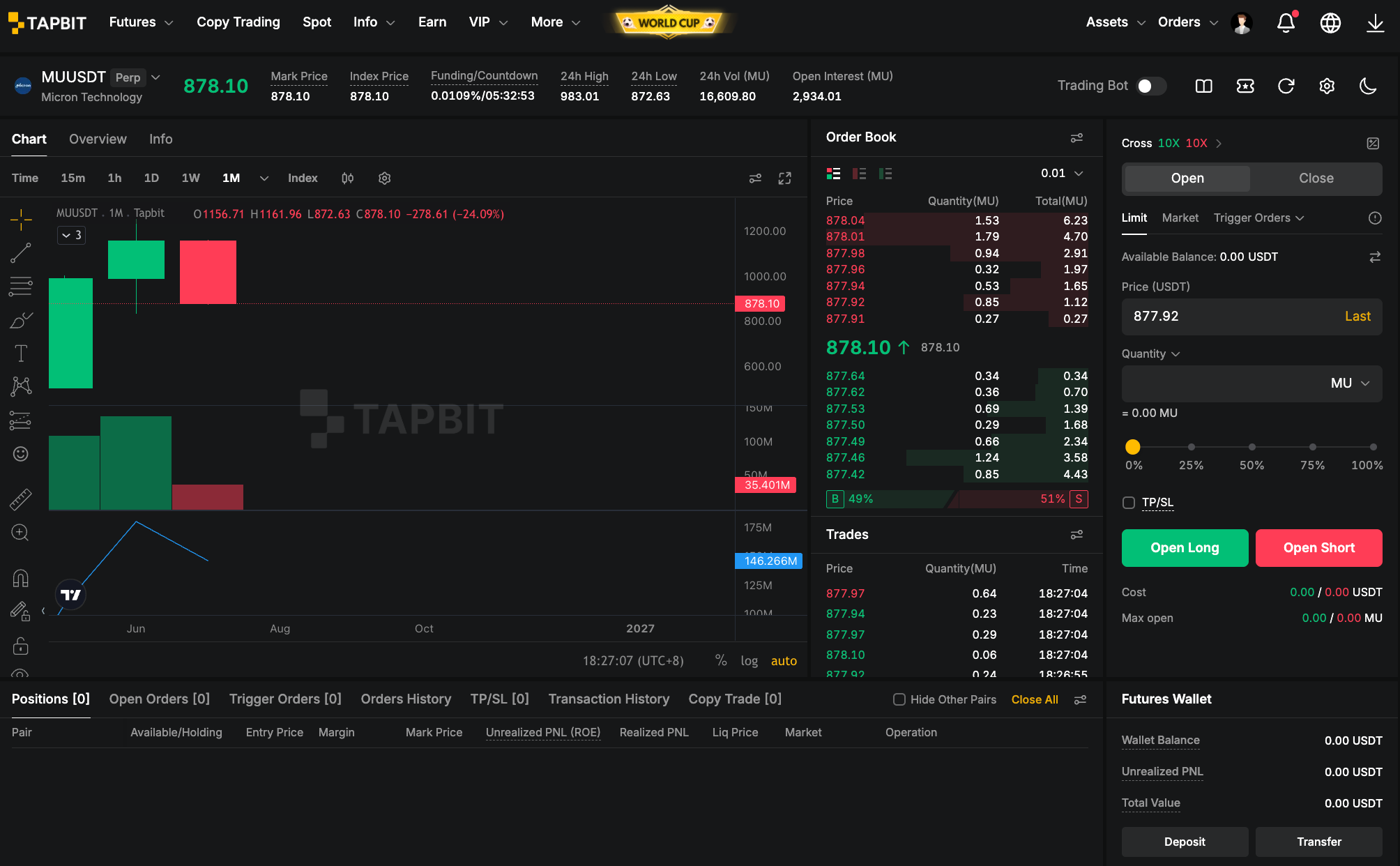
- Create an account and open the MU-USDT market.
- Review the contract specification, funding, liquidity, and available leverage before placing a trade.
- Select the order type, position size, and risk level that fit your trading plan.
- Confirm the trade and manage the position with a predefined exit, including both stop-loss and take-profit logic.
This section matters because many traders want exposure to semiconductor and AI themes without using a traditional stock brokerage account. However, using a derivative product requires more discipline than simply buying a stock. Position sizing and risk management are essential.
MU Bull, Base and Bear Scenarios
| Scenario | What It Looks Like | Confirmation Zone | Invalidation / Risk Zone |
|---|---|---|---|
| Bull | MU stabilizes in the $874-$900 zone, HBM demand remains strong, and the stock reclaims $950 before pushing back toward $993. | Recovery above ~$950, then stronger follow-through toward ~$993. | Failure to hold support and renewed weakness in memory sentiment. |
| Base | The stock spends time consolidating after the selloff while the market waits for clearer earnings and pricing evidence. | Sideways stabilization above the recent low and better sector sentiment. | Repeated rejection on rebounds and weakening estimates. |
| Bear | Support breaks, supply fears rise, and the market keeps cutting the premium it was willing to pay for MU. | Break below ~$874 with worsening industry expectations. | A sharp recovery above resistance would weaken the bear case. |
The scenario framework is useful because it keeps the discussion practical. Investors do not need to predict the future with certainty. They only need to identify which setup is becoming more likely and respond accordingly. That is usually more effective than trying to call the exact bottom after a large one-day decline.
Final Thoughts
Micron stock today is a test of discipline more than a test of narrative. The stock has dropped sharply, but the core HBM and AI-memory thesis has not automatically disappeared just because one session turned ugly. That said, investors should not treat a big decline as a shortcut to a good entry. The better approach is to watch support, follow earnings and pricing signals, and build a clear buy, wait, or avoid framework before taking action.
For traders who want to stay close to the semiconductor opportunity set, Micron remains an important name to monitor alongside other semiconductor stocks. And for users who want to explore market-linked opportunities directly, Tapbit makes it possible to access supported products after confirming contract details and risk conditions.
Frequently Asked Questions
Why is Micron stock down today?
Micron stock is under pressure because the market is reassessing valuation, positioning, and future memory earnings power rather than reacting to only one simple headline. A big decline often reflects a sector reset as much as a company-specific issue.
Is MU a buy after the drop?
It can be a buy only if an investor accepts high volatility and sees stabilization in the $874 to $900 area along with continued strength in the HBM demand story. Otherwise, waiting for stronger confirmation may be a more disciplined choice.
What level should investors watch next?
The first support zone is roughly $874 to $900. On the upside, a reclaim of around $950 would improve the setup, while the zone near $993 is more important for confirming renewed strength.
What are the biggest risks for Micron from here?
The main risks are valuation compression, weaker memory pricing, slower AI-related demand, and future supply expansion concerns, including China-related developments.


