

The retail market frequently misprices regulatory milestones. A prevailing narrative in the digital asset space suggests that the conclusion of the 2025 SEC v. Ripple case and the recent joint SEC/CFTC commodity classification are sufficient to trigger scaled institutional adoption for XRP.
From an institutional compliance perspective, this is a dangerous miscalculation. Knowing that an asset is legally classified as a non-security commodity dictates what it is, but it completely fails to provide compliance officers with explicit federal guidance on how they can deploy it in standard clearing and settlement operations. Institutions do not allocate billions of dollars based on administrative memos that a future SEC administration can reverse. They require the concrete foundation of a federal statute.
Here is the raw math and legislative reality behind why the CLARITY Act is the definitive bridge between retail trading and institutional utility.
The Regulatory Illusion: Why Existing Clarity Isn't Enough

Professional institutions operate under strict federal guardrails. While Judge Torres’s ruling was a landmark defense for Ripple, a court ruling is not the same as a comprehensive market framework. Risk officers require explicit legislative rulebooks before onboarding an asset for high-volume corporate treasury or cross-border payment operations.
As crypto researcher SMQKE accurately highlighted, the lack of a formalized federal framework is exactly why enterprise usage has not yet scaled. The cost of this regulatory uncertainty is measurable: 88% of centralized exchange volume currently executes offshore, and the U.S. share of Web3 developers has plummeted by 51% over the last decade. The CLARITY Act is engineered specifically to reverse this capital flight.
Section 105: The CLARITY Act’s Regulatory Moat
The May 14, 2026, Senate Banking Committee vote, which advanced the CLARITY Act with a bipartisan 15-9 margin, represents a structural shift in market dynamics.
Within the 309-page draft legislation, the most critical mechanism for XRP is Section 105. This specific clause dictates that if a U.S. court has already ruled a transaction is not a security prior to the bill’s enactment, that asset cannot be retroactively reclassified by regulators later.
For XRP, Section 105 acts as a bespoke regulatory moat. It effectively locks the prior court victories into federal law, completely stripping future regulatory bodies of the administrative power to challenge its status. This is the exact legal certainty institutional capital requires before entry.
Price Action and Infrastructure Readiness: The Raw Math
Smart money is already beginning to price in this legislative de-risking. Immediately following the committee's 15-9 vote, XRP registered a sharp 5% increase, temporarily breaking the $1.50 resistance level. During that trading window, the asset's weekly momentum outpaced both Bitcoin and Ethereum, signaling early capital positioning ahead of a potential full Senate floor vote.
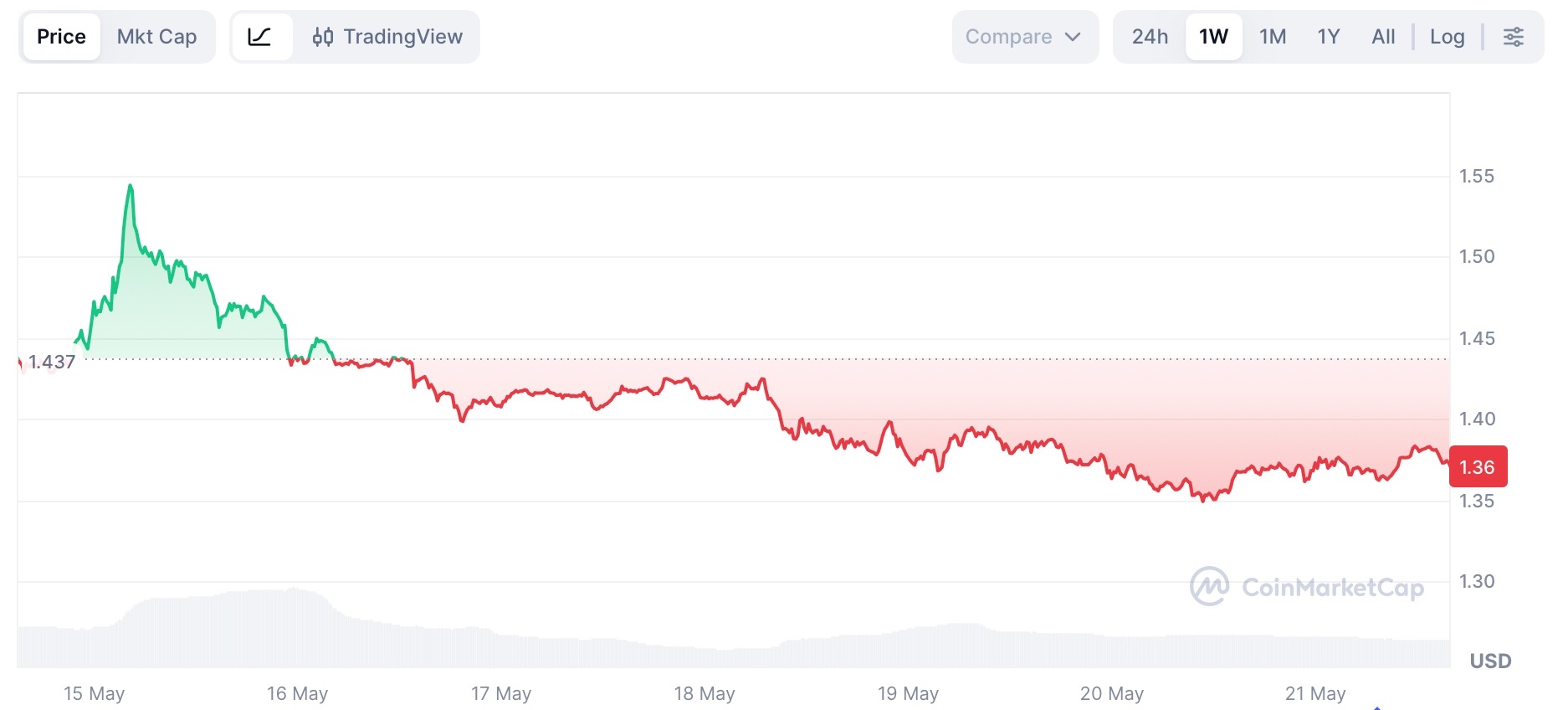
However, a regulatory moat is useless without the underlying infrastructure to support Traditional Finance (TradFi) demands. XRP’s technical fundamentals are currently aligned with the legislative progress:
-
RWA Scale: The XRP Ledger (XRPL) has officially surpassed the $3 billion threshold in tokenized Real-World Assets, solidifying its position as a dominant non-EVM infrastructure for institutional deployment.
-
Latency Testing: In mid-May, a real-world pilot program involving Ripple, JPMorgan, Mastercard, and Ondo Finance successfully executed the redemption of tokenized U.S. Treasuries in under 5 seconds. This sub-5-second metric directly proves that the network satisfies the ultra-low latency requirements necessary for traditional interbank clearing.
The Bottom Line
The market is moving past the era of relying on temporary court wins or administrative memos. For anyone managing institutional risk, a courtroom victory is just a defensive shield, but a federal statute like the CLARITY Act is an offensive blueprint. By anchoring assets like XRP firmly within a statutory commodity framework under the CFTC, Washington is finally building a predictable legal on-ramp for corporate treasury and cross-border settlement.
Position your portfolio for the upcoming institutional shift:
-
Trade the Trend: Log in to Tapbit to execute trades across spot markets and professional futures pairs with institutional depth.
-
Secure Your Setup: Register on Tapbit today to claim your verified welcome rewards package and access advanced charting tools.
-
Track the Capital: Monitor live order book liquidity and macro volume changes directly on the Tapbit Homepage.
Frequently Asked Questions (FAQ)
Why doesn't the SEC v. Ripple ruling automatically trigger institutional adoption?
The court ruling established that XRP is not a security, but it did not provide a regulatory framework for how banks and institutions can legally use it for commercial operations. Institutional compliance teams require explicit federal laws—not just the absence of a security classification—to manage risk effectively.
What makes the CLARITY Act different from previous regulatory guidelines?
Previous guidelines, like the SEC/CFTC joint explanatory statement, are administrative actions that future government administrations can revoke. The CLARITY Act, specifically through clauses like Section 105, codifies these protections into federal statute, making them permanent unless altered by Congress.
Is the XRP Ledger capable of handling traditional bank settlement speeds?
Yes. Recent pilot tests involving major institutions like JPMorgan and Mastercard demonstrated that the XRPL can settle tokenized U.S. Treasuries in less than 5 seconds. This processing speed meets the stringent latency demands required for enterprise-grade, cross-border financial settlements.


