
SNDK stock traded near $1,259 on July 27, 2026, after falling roughly 12% in one session. The decline pushed SanDisk more than 45% below its June record high near $2,354 and extended a violent reset across memory and semiconductor stocks.
The drop did not arrive because storage demand suddenly disappeared. SanDisk’s latest reported quarter showed rapid data-center growth, strong pricing and a major shift toward higher-value customers. The problem is that the stock had already priced in an extraordinary expansion. When investors saw the market debut of China’s CXMT and renewed signs of domestic Chinese chip-equipment progress, they reassessed how long memory scarcity and premium margins could last.
SNDK Stock Price Today: Current Performance and Market Position
At roughly $1,259, SNDK is far below its recent peak but still dramatically above the levels where it began its 2026 rally. That combination creates a difficult setup. The stock looks cheaper relative to the June high, yet it remains expensive relative to its historical base and exposed to sharp momentum reversals.
The July 27 sell-off also broke an important technical reference: market coverage noted that the stock fell below its 100-day moving average for the first time since August 2025. A moving-average break is not a fundamental verdict, but it can change the behavior of systematic traders and momentum funds.
The first question is whether buyers can stabilize the stock around $1,200–$1,260. A rebound toward $1,400 would improve the short-term structure, while a recovery above $1,500 would provide stronger evidence that the market has absorbed the latest sector shock.
Why Is SanDisk Stock Crashing or Pulling Back?
The sell-off reflects several overlapping forces rather than one company-specific failure.
NAND Pricing and Memory-Cycle Volatility
SanDisk is primarily exposed to NAND flash and storage, not HBM. NAND demand benefits from data growth, enterprise SSD adoption and AI infrastructure, but the market remains cyclical. When prices rise and margins expand, suppliers have an incentive to increase output. Investors then begin discounting the possibility that future capacity will reduce scarcity.
China’s memory strategy matters even though CXMT is more directly associated with DRAM. The IPO demonstrated the amount of capital available for domestic semiconductor expansion, while the expected development of other Chinese memory companies keeps supply risk in focus across the whole sector.
Profit-Taking After an Extreme Rally
SNDK had gained several hundred percent before the correction. A move of that scale attracts momentum capital, but it also creates a large pool of investors with substantial unrealized gains. Once the trend weakens, profit-taking can accelerate because each lower price encourages another group to protect returns.
This is why a fundamentally strong company can fall 10% or more without a new earnings warning. Price can move much faster than the underlying business when positioning becomes crowded.
AI Storage Expectations vs Actual Earnings Growth
The long-term AI storage argument is credible. Training, inference and enterprise deployment produce large amounts of data, and data centers need high-capacity, efficient storage. SanDisk’s fiscal third-quarter 2026 results showed data-center revenue of $1.47 billion, up 233% sequentially, while total revenue reached $5.95 billion.
However, investors are no longer asking whether AI storage demand exists. They are asking whether growth can remain fast enough to justify the valuation after the rally. The next earnings report on August 5 is therefore a major confirmation event.
Does SanDisk Have a Future in the AI Storage Market?
SanDisk has a clear role in the AI infrastructure stack, but it is different from the role played by Micron or SK Hynix.
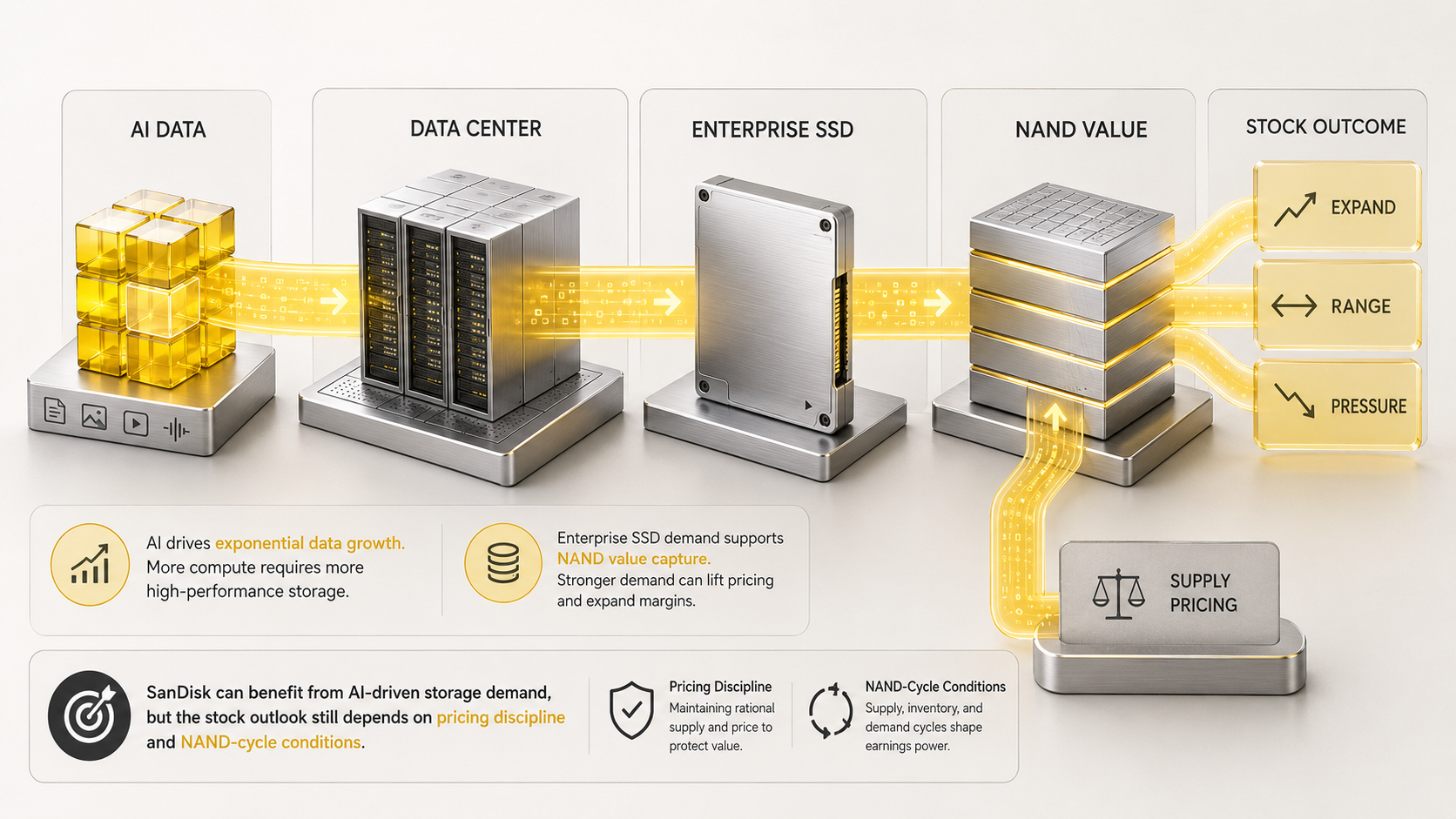
How AI Data Growth Supports Storage Demand
AI systems need storage for training data, model checkpoints, retrieval databases, logs and enterprise information. As companies move from experiments to production, storage requirements can expand across data centers and edge environments. High-capacity enterprise SSDs are particularly relevant where speed, power efficiency and density matter.
SanDisk has also been sampling BiCS10 1Tb TLC 3D NAND, which is designed to improve density, interface speed and power efficiency for data-intensive workloads. Product progress like this matters because storage demand alone does not guarantee market share; performance and manufacturing economics determine which supplier captures the opportunity.
Why NAND Is Different From HBM and DRAM
HBM sits close to AI processors and provides very high bandwidth. DRAM serves working memory across servers, PCs and devices. NAND provides non-volatile storage. These markets can move together during a broad semiconductor cycle, but their supply structures, customers and pricing patterns are not identical.
That distinction is important when comparing SNDK with Micron and SK Hynix. SanDisk offers more direct exposure to NAND and enterprise storage. Micron has DRAM, HBM and NAND. SK Hynix combines HBM leadership with a wider memory portfolio. A headline about “memory stocks” can therefore hide very different operating risks.
What Is the Future of SNDK Stock?
The future depends less on whether data keeps growing and more on whether SanDisk can translate that growth into durable margins while the industry manages supply.
| Scenario | Business Driver | Price Confirmation |
|---|---|---|
| Bull | Fiscal Q4 results beat guidance, data-center demand remains strong and NAND supply stays disciplined. | SNDK reclaims roughly $1,400 and then moves above $1,500. |
| Base | Revenue continues growing, but the market applies a lower valuation after the extreme rally. | The stock builds a wide range around $1,200–$1,500. |
| Bear | NAND pricing weakens, China capacity fears intensify or the August outlook disappoints. | A sustained break below roughly $1,200 would invalidate the immediate stabilization case. |
These levels are scenario markers rather than guaranteed targets. The decisive inputs will be revenue guidance, data-center mix, gross margin, customer agreements and evidence that new supply is being absorbed.
Is SanDisk Still a Buy After the Pullback?
A 45% decline from the peak makes SNDK less expensive than it was in June, but it does not automatically make the stock low risk. Investors considering the pullback should separate the business case from the entry case.
The business case is supported by rapid data-center revenue growth, higher-value customer mix and next-generation NAND development. The entry case requires price stabilization and a credible earnings confirmation. Buying only because a stock is far below its record high can be dangerous when the previous high reflected unusually optimistic assumptions.
A patient approach would watch whether SNDK holds above $1,200, whether volume becomes less one-sided and whether the August 5 results support the company’s prior revenue and margin outlook. A stronger trend signal would appear if the stock can reclaim $1,400 and then $1,500.
Tapbit Learn previously explained the earlier SNDK sell-off. This update focuses on the new July 27 drop, the price near $1,259, the break below the 100-day average and the role of CXMT-related competition fears. The broader AI memory stock comparison adds context on how SanDisk differs from Micron.
How to Trade SNDK-USDT on Tapbit
Tapbit offers SNDK-USDT stock-linked futures. The contract provides derivative exposure to SanDisk-related price movement. It is not direct ownership of SanDisk stock and does not provide voting rights, dividends or other shareholder benefits.
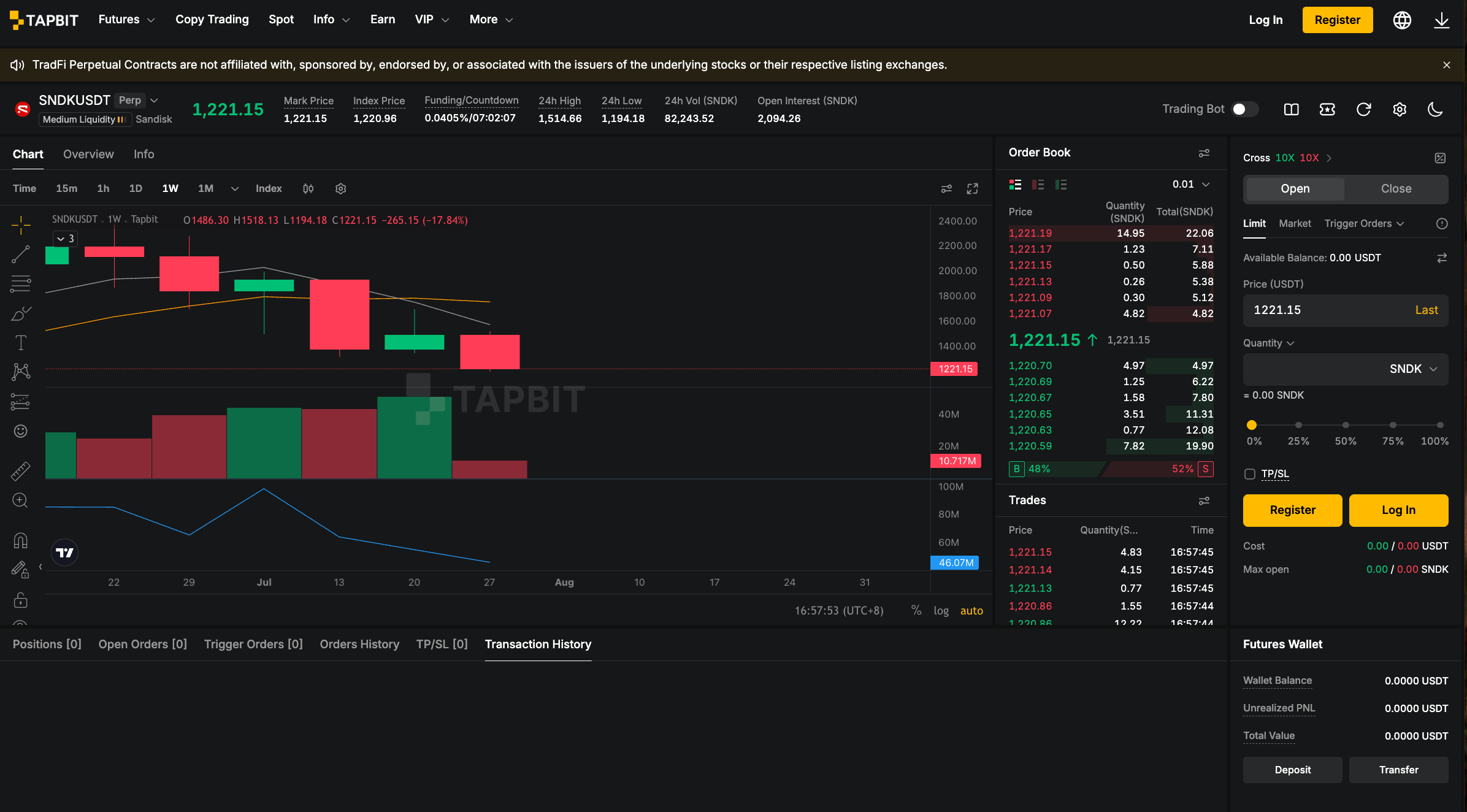
- Step 1: create an account and add collateral to the futures account.
- Step 2: Open SNDK-USDT and check the live contract price, reference source, liquidity, funding and available leverage.
- Step 3: Select the position direction, order type and size only after defining a maximum loss and an invalidation level.
- Step 4: Set risk controls and monitor U.S. market hours, the August 5 earnings event and any memory-sector news that could increase volatility.
SanDisk still has a credible future in AI storage, but the market is no longer rewarding the story without demanding proof. The stock’s position near $1,259 reflects both real operating growth and a severe valuation reset. The next stage depends on whether earnings confirm the data-center thesis and whether the shares can rebuild above $1,400.


