
SK Hynix stock closed near ₩1.55 million on July 28, 2026, after falling roughly 14% in one session. The move came during a much wider Korean chip sell-off: the KOSPI lost more than 10%, Samsung Electronics also dropped sharply, and investors reacted to a combination of AI financing concerns, China competition and stretched semiconductor valuations.
The size of the decline makes the immediate question obvious: has the HBM growth story broken, or has the market simply repriced a crowded AI trade? The answer is not binary. SK Hynix still has a strategically important position in high-bandwidth memory, and its latest HBM4E progress shows that the technology roadmap is moving forward. At the same time, the stock now needs fresh evidence that AI infrastructure spending, pricing power and next-generation product demand can justify the valuation investors assigned during the rally.
SK Hynix Stock Price Today: Why Shares Fell About 14%
The July 28 decline was not driven by one company announcement. It was a sector shock. Korean chip stocks were hit as investors questioned whether the AI infrastructure boom had become too dependent on aggressive financing, continued hyperscaler spending and permanently tight supply. Concerns intensified after China’s ChangXin Memory Technologies completed a powerful market debut and reports suggested progress in domestic lithography equipment.
Those headlines affected SK Hynix in two ways. First, the company is one of the clearest public-market proxies for HBM demand, so any reduction in confidence about AI data-center spending can produce an outsized move. Second, stronger Chinese memory capacity could eventually pressure conventional DRAM pricing, even when the technology gap in advanced HBM remains meaningful.
The stock finished near the session low, around ₩1.55 million, after trading as high as roughly ₩1.67 million. That leaves a clear short-term message: buyers did not regain control during the session. The first stabilization test is whether the shares can hold the ₩1.55 million area rather than extending the decline immediately.
Is the SK Hynix HBM Growth Story Still Intact?
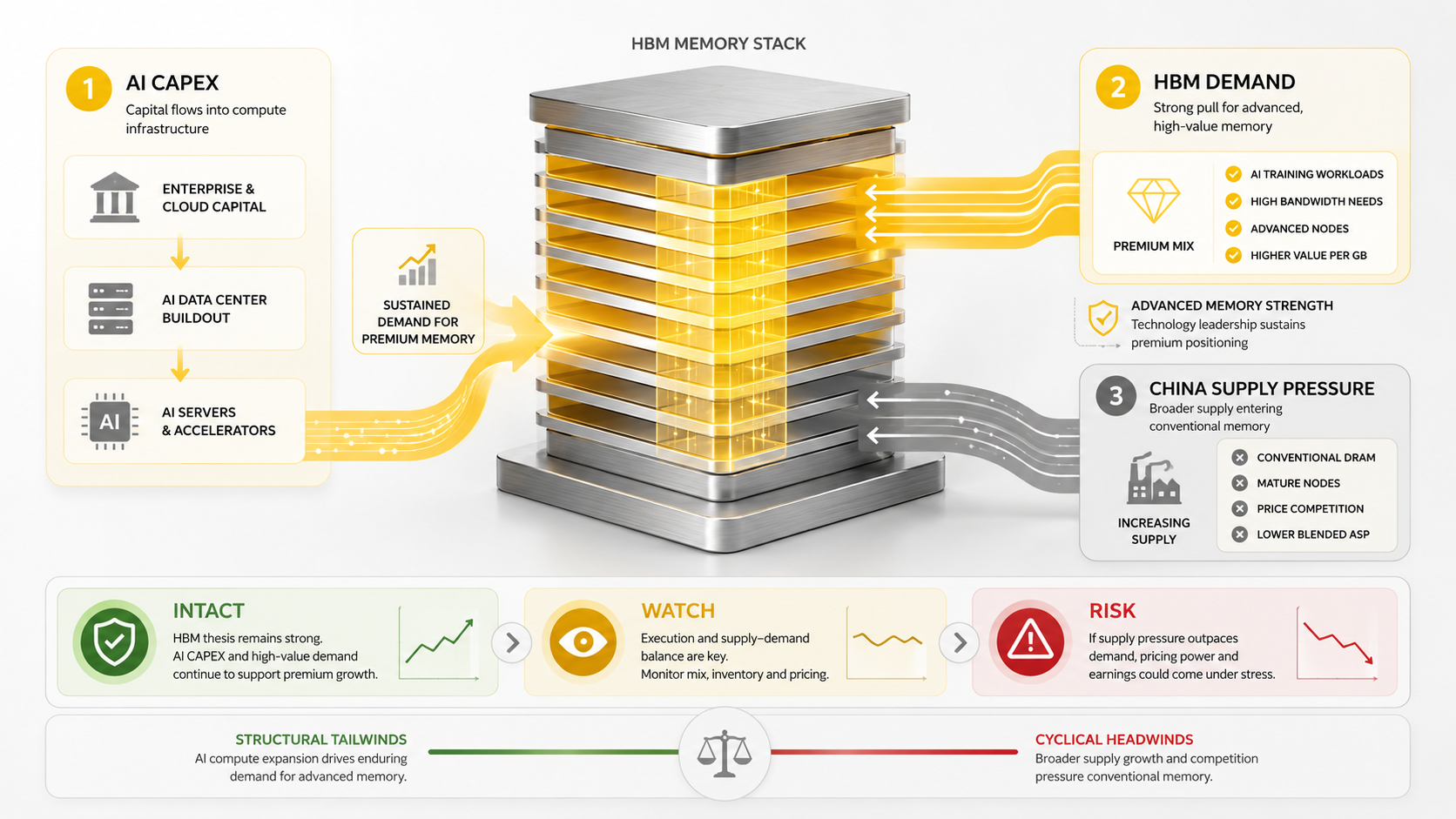
HBM remains central to the bull case. AI accelerators need extremely high memory bandwidth, and that requirement has made advanced stacked memory one of the most valuable parts of the AI hardware chain. SK Hynix has spent years building process expertise, packaging capability and customer relationships that cannot be replicated simply by adding ordinary DRAM capacity.
Could AI Infrastructure Spending Slow HBM Demand?
The most important risk is not that AI disappears. It is that the pace and financing structure of AI investment becomes less aggressive. If cloud providers, model developers or data-center operators delay projects, demand expectations can be revised even before physical HBM orders fall. The stock market prices the next several quarters, not only current shipments.
That is why reports about unusually large financing commitments matter. They raise questions about whether chip demand is being supported by self-reinforcing capital arrangements rather than end-user cash flow alone. A slowdown would not eliminate HBM demand, but it could reduce the premium investors are willing to pay for future growth.
How Much Pressure Could Chinese Memory Companies Create?
China’s memory expansion is a more complicated risk. CXMT is a direct competitor in DRAM, but leadership in advanced HBM requires more than wafer capacity. It also depends on yields, stacking, thermal management, packaging and qualification with major AI customers. SK Hynix’s June shipment of 12-layer HBM4E samples shows that the company is still pushing the high end of the roadmap.
The near-term threat is therefore more likely to appear through conventional memory pricing and investor expectations than through an immediate loss of HBM leadership. If Chinese suppliers expand lower-cost capacity, the broader memory cycle could become less profitable. That would matter because SK Hynix is not an HBM-only company.
Is SK Hynix Listed in the United States?
SK Hynix is primarily listed in South Korea under ticker 000660. The company also has U.S.-listed exposure under SKHY. These instruments should not be confused with each other or with a stock-linked futures contract.
SK Hynix Korea Shares vs SKHY U.S. Shares
The Korean ordinary shares trade in won during Korean exchange hours. The U.S.-listed SKHY instrument trades in dollars during U.S. market hours. Currency, local liquidity and trading-session differences can cause the two prices to move differently in the short term even when they reference the same company.
Readers researching whether they can buy SK Hynix in the United States should therefore verify the exact instrument, exchange, custody structure and fees offered by their broker. A ticker match alone is not enough.
SKHYNIX-USDT Is a Derivative, Not a Direct Share
Tapbit’s SKHYNIX-USDT stock-linked futures provide derivative exposure to SK Hynix-related price movement. The contract is not a Korean ordinary share or a U.S.-listed share. It does not provide company ownership, voting rights, dividends or other shareholder benefits.
Stock-linked futures may also use leverage and can trade beyond the underlying stock exchange’s normal hours. That can create differences between the contract price and the latest available cash-market reference, particularly during fast news events.
SK Hynix Stock Forecast: Recovery Levels and Downside Risk
A useful forecast should be conditional rather than built around one target. After a 14% decline, the market needs to prove that selling pressure is slowing before a durable recovery can be assumed.
| Scenario | What Would Support It | Confirmation or Invalidation |
|---|---|---|
| Bull | HBM demand remains firm, customer qualification continues and the broader chip sell-off stabilizes. | A reclaim of roughly ₩1.67M would be the first signal; a move back through the ₩1.80M–₩1.82M area would be stronger confirmation. |
| Base | The HBM roadmap remains intact, but valuation and China-related concerns keep volatility elevated. | The shares hold near ₩1.55M and build a range before the next earnings or customer update. |
| Bear | AI spending expectations weaken, conventional memory pricing rolls over or China capacity fears intensify. | A sustained break below the ₩1.55M area would invalidate the immediate stabilization case. |
The distinction between confirmation and hope matters. A rebound inside the prior day’s range may only be short covering. A stronger recovery would require the stock to regain important reference areas while sector breadth improves and new HBM evidence supports the fundamental thesis.
What Investors Should Watch Next
The first checkpoint is management commentary on HBM4, HBM4E, production capacity and customer commitments. The second is memory pricing outside HBM. Strong high-end demand can coexist with pressure in conventional DRAM or NAND, and the combined mix determines earnings quality.
The third checkpoint is the wider AI capital-expenditure cycle. Nvidia, cloud providers and data-center developers now influence the memory trade almost as much as traditional PC or smartphone demand. The fourth is China. Investors should separate headlines about new capacity from verified progress in yields, advanced packaging and customer qualification.
For broader context, Tapbit Learn’s guides to the 2026 HBM market outlook and AI chip stocks explain why memory has become one of the main bottlenecks in AI infrastructure.
How to Trade SKHYNIX-USDT on Tapbit
Traders who want derivative exposure can use the following process. Because leverage can magnify both gains and losses, the contract specification and liquidation level should be reviewed before entering a position.
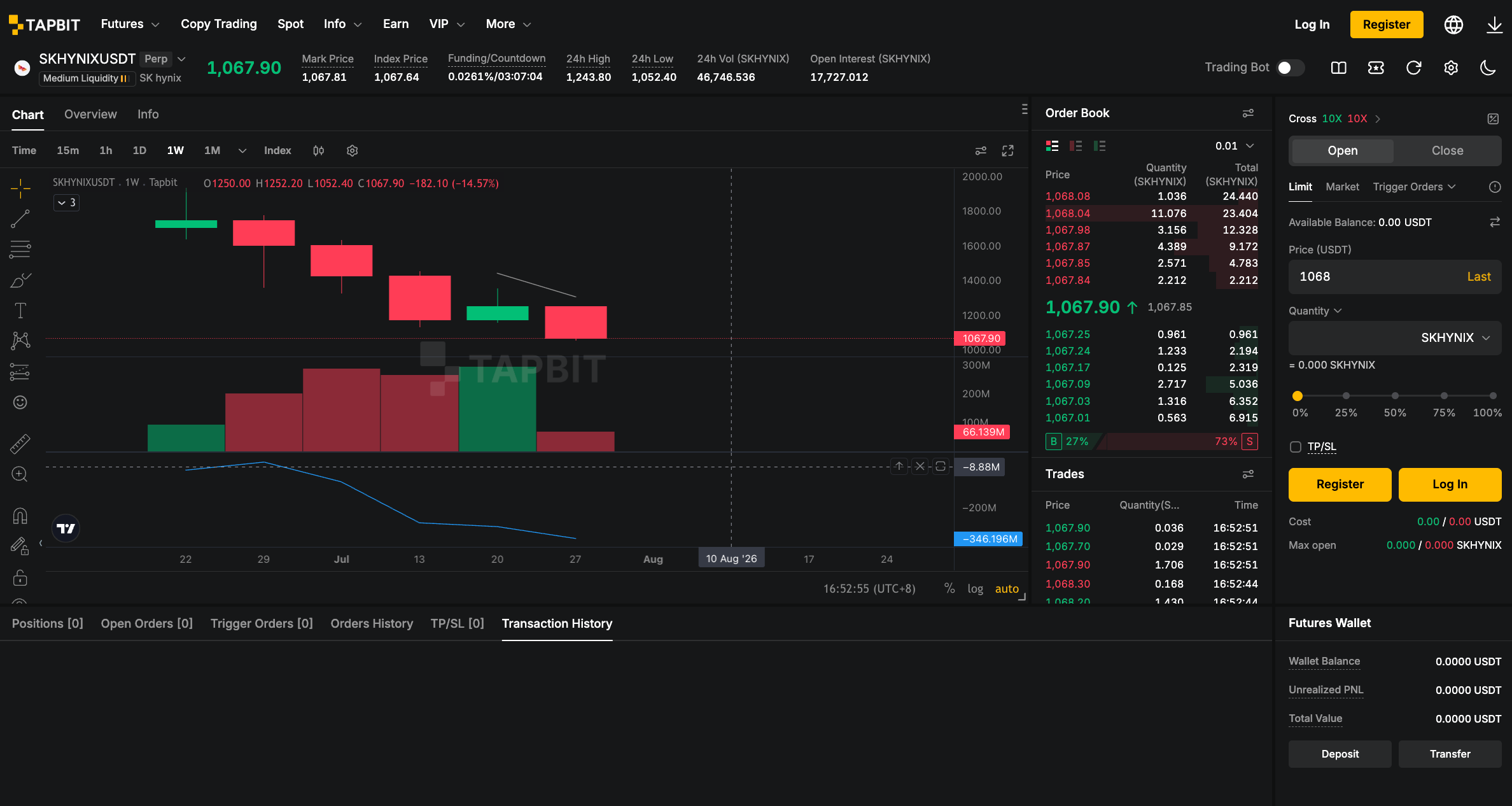
- Step 1: create an account and fund the futures account.
- Step 2: Open SKHYNIX-USDT and check the current reference price, funding information, order book and available leverage.
- Step 3: Choose the position direction, order type and size based on a predefined risk limit rather than the headline alone.
- Step 4: Set an invalidation level, monitor the Korean and U.S. trading sessions, and manage liquidation risk as volatility changes.
The sharp fall does not prove that SK Hynix has lost its HBM advantage. It does prove that the market is no longer willing to accept the AI memory story without questioning financing, competition and valuation. The next move will depend on whether the stock can hold near ₩1.55 million and whether fresh operating evidence supports the long-term thesis.


