
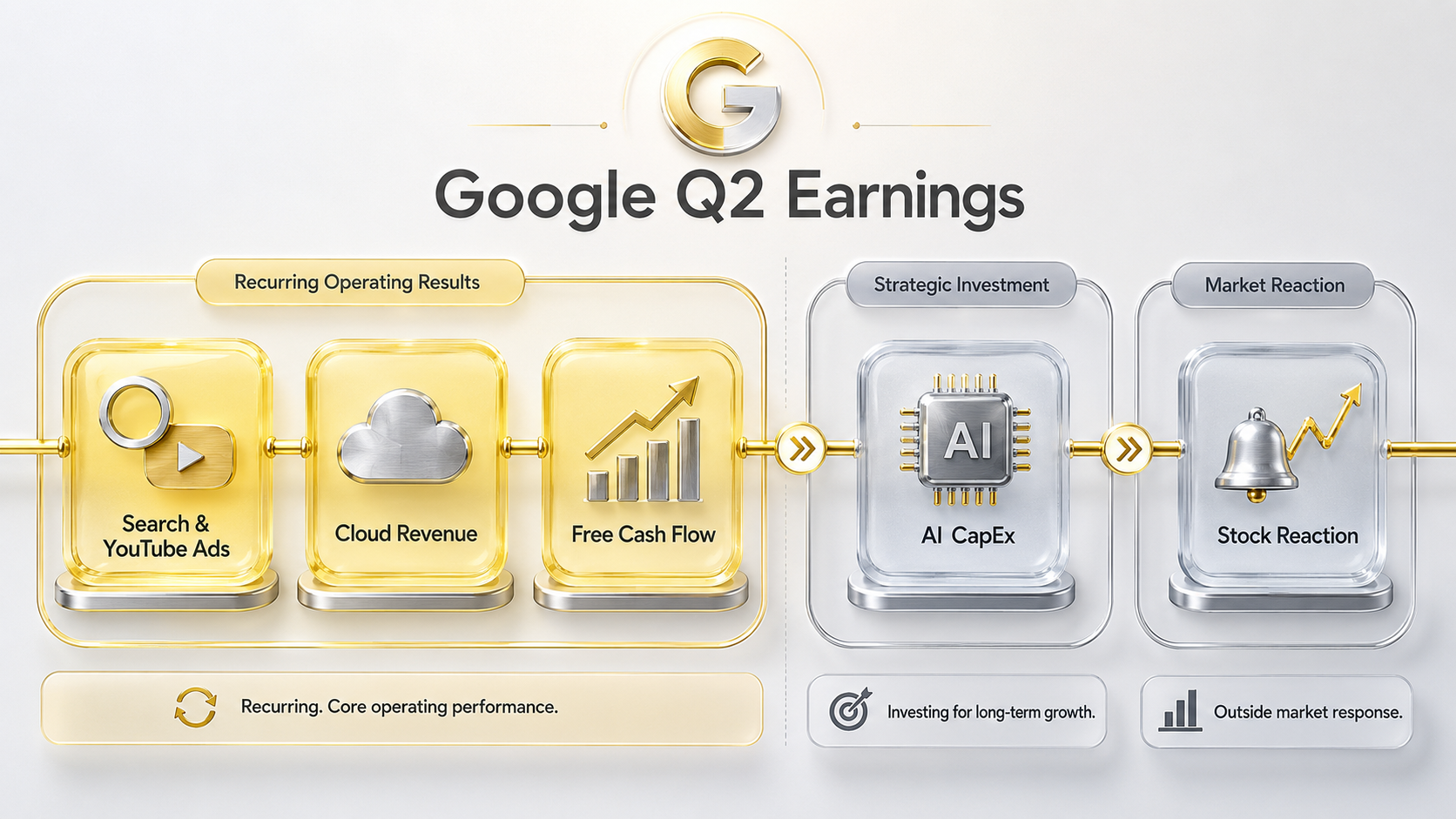
Google Q2 earnings delivered strong revenue growth, exceptional Cloud performance and a much larger AI investment plan. Alphabet reported quarterly revenue of about $119.8 billion, while Google Cloud revenue rose 82% to roughly $24.8 billion.
The market reaction was mixed because investors looked beyond the revenue beat. Alphabet raised 2026 capital-expenditure guidance to $195–$205 billion and reported negative quarterly free cash flow. The quarter therefore strengthened the AI growth story while increasing questions about the cost of winning it.
Google Q2 Earnings: The Main Numbers
| Metric | Q2 Result | Market Meaning |
|---|---|---|
| Revenue | About $119.8B | Strong year-over-year growth |
| Google Cloud | About $24.8B | 82% growth and major upside signal |
| Advertising | About $81.6B | Core business remained resilient |
| 2026 CapEx guidance | $195B–$205B | Higher AI investment burden |
| Quarterly free cash flow | Negative | Spending and timing concern |
The figures show why the report cannot be judged as a simple beat or miss. Operating growth was strong, but the amount of capital required to support it has become central to the valuation.
Google Search and Advertising Remain Resilient
Advertising revenue reached about $81.6 billion, supported by Search and YouTube. This matters because Search remains Alphabet’s largest profit engine and provides cash that funds Cloud, AI models and data-center expansion.
AI Overviews and AI Mode are changing how users interact with search results. The opportunity is to create more useful answers and new commercial formats. The risk is that direct answers reduce clicks to publishers or change the economics of traditional search advertising.
Google must therefore prove that AI improves engagement and monetization without weakening the advertising model that finances the investment cycle.
Google Cloud Becomes the Key Growth Engine
82% Revenue Growth
Google Cloud revenue increased to roughly $24.8 billion, far outpacing the rest of the company. The result suggests strong enterprise demand for computing, data services, AI models and infrastructure.
Cloud Backlog
A large backlog supports future revenue visibility, but investors should examine the timing and profitability of those contracts. Long-term commitments can be valuable while still requiring significant upfront infrastructure.
AI Infrastructure Demand
Google is monetizing both internal and external AI demand. Its custom TPU chips, data centers, security products and models create a vertically integrated platform. This can become a competitive advantage if utilization and pricing support attractive returns.
YouTube and Other Businesses
YouTube advertising continued to grow, supported by video demand, subscriptions and major events. The platform also gives Alphabet another channel for AI-assisted recommendations, creator tools and commerce.
Other Bets remain smaller and less predictable. Their value should be separated from the recurring economics of Search, YouTube and Cloud rather than used to justify the entire valuation.
Why AI CapEx Became the Main Concern
Alphabet increased its capital-spending plan to $195–$205 billion for 2026. The money supports data centers, chips, networking and energy infrastructure. These assets may generate revenue for years, but they require large cash outlays before the return is visible.
The spending creates three risks. First, depreciation can pressure future operating margins. Second, demand may not grow fast enough to use all new capacity. Third, investors may require a lower valuation multiple while free cash flow remains weak.
The counterargument is that underinvesting could be more dangerous. If Google loses AI model quality, developer adoption or enterprise workloads, protecting short-term cash flow would damage the long-term franchise.
Why Reported Profit Needs Careful Interpretation
Alphabet reported an unusually large non-operating investment gain. That increased reported net income but does not represent recurring revenue from Search, YouTube or Cloud.
Investors should separate operating profit from investment gains and focus on normalized earnings. Free cash flow, depreciation, Cloud margins and recurring advertising growth provide a cleaner view of the business.
Why Google Stock Fell After the Report
The stock reaction reflected expectations rather than weak absolute results. Google Cloud beat expectations, but investors were already pricing in strong AI demand. The higher spending plan raised the threshold for future performance.
Delays or competitive pressure in AI models also matter. If Google spends more while competitors maintain product leadership, the market may question the return on capital. If Gemini, Cloud and Search monetization improve, the same spending can support a stronger long-term thesis.
What Investors Should Watch Next
- Google Cloud growth and backlog conversion
- Free-cash-flow recovery
- Capital-expenditure guidance
- Gemini adoption and monetization
- Search engagement and advertising pricing
- Cloud and company-wide margin trends
Tapbit Learn’s technology investment-cycle guide explains how high growth and high capital intensity can coexist. The market-confirmation framework can help readers separate a short-term reaction from a durable trend.
How to Follow the Market Reaction on Tapbit
GOOGL-USDT is a confirmed stock-linked futures contract on Tapbit. It can be used to follow or trade Google-linked price movements, but it is not a Google share.
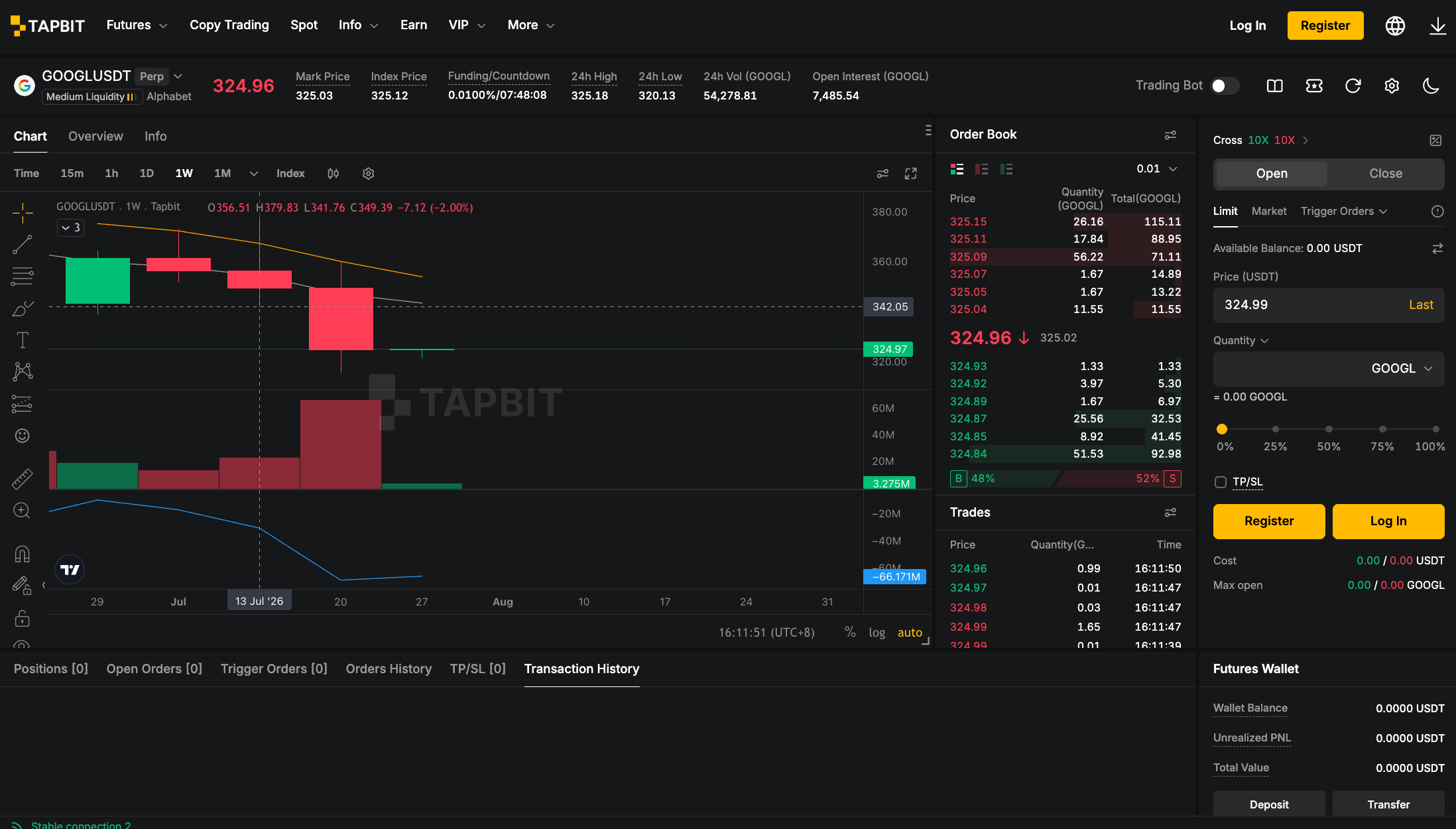
The contract does not provide ownership, voting rights or dividends. It may also use leverage, which can amplify post-earnings gaps and create liquidation risk. Traders should review margin, funding and the live contract specification before opening a position.
A practical workflow is to monitor the underlying GOOGL market, compare it with the contract price, identify the post-earnings support and resistance zones, and define an invalidation level. Trading-hour differences can create temporary price gaps between the underlying stock and the derivative.
After understanding those mechanics, users can create an account and review the live contract. The product should be used only when it matches the user’s risk tolerance and market view.
Final Assessment
Google’s Q2 report showed a company with accelerating Cloud growth and rising AI costs. The operating story remains strong, but the investment burden is now too large to ignore. Future stock performance will depend on whether AI spending produces durable revenue, margins and free cash flow.
Frequently Asked Questions
Did Google beat Q2 expectations?
Revenue and Cloud growth were strong, but adjusted profit and cash-flow concerns complicated the result.
How fast did Google Cloud grow?
Google Cloud revenue rose about 82% to roughly $24.8 billion.
Why did Google stock react cautiously?
Investors focused on higher capital spending, negative free cash flow and the return on AI investment.
Is GOOGL-USDT the same as a Google share?
No. It is a stock-linked futures contract and does not provide ownership, voting rights or dividends.


