
SK Hynix stock returned to the center of the AI trade after an unusually sharp two-market reversal. The Korean-listed shares traded near ₩1.729 million on July 14, 2026, down about 12.66% over 24 hours. In the United States, the newly listed SKHY American Depositary Receipts fell about 7.9% to roughly $154.70 in early trading on July 13 after closing their first Nasdaq session at $168.
The speed of the move matters. SK Hynix priced the ADR offering at $149, opened near $170 and finished its debut session above the offer price. That strong first-day reaction showed how much demand U.S. investors had for a direct AI-memory name. The following decline showed the other side of the setup: when a new listing begins with high expectations, profit-taking can arrive before the underlying business story changes.
This article explains what happened, why Korean shares and the SKHY ADR can move differently, how HBM affects the outlook and what price signals traders should watch next. Prices are reference points from July 13–14, 2026 and should be refreshed before publication or trading.
SK Hynix Stock Price Today
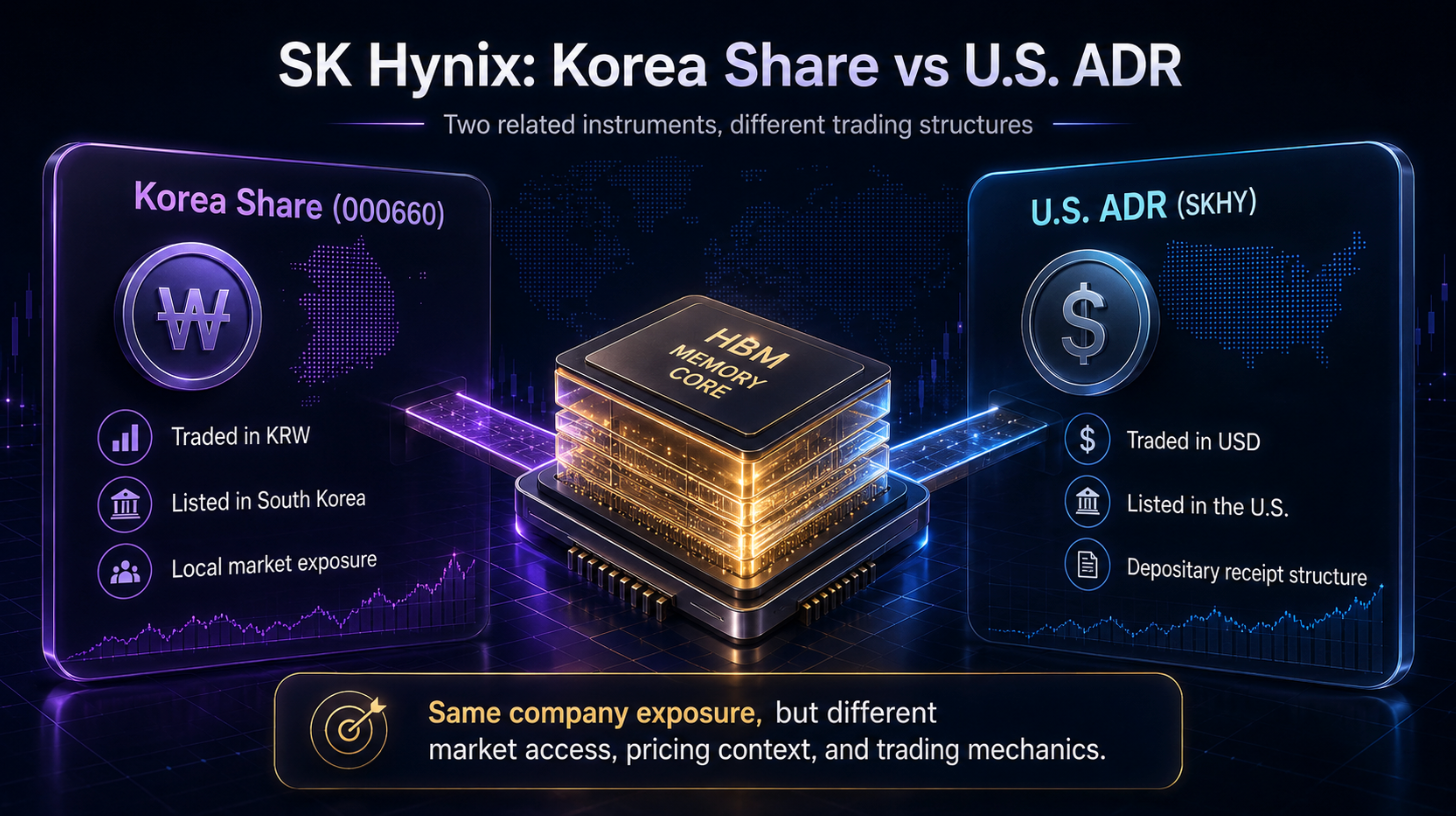
The most useful starting point is to separate the two quoted markets. SK Hynix trades in South Korea under ticker 000660, while SKHY is the U.S.-listed ADR. Both reflect exposure to the same company, but they trade in different currencies, time zones and liquidity pools.
| Market | Reference Price | Recent Move | What It Represents |
|---|---|---|---|
| KRX 000660 | About ₩1.729M | Down about 12.66% | Korean-listed ordinary share |
| Nasdaq SKHY | About $154.70 in early trade | Down about 7.9% | American Depositary Receipt |
| ADR offer price | $149 | Initial reference | Price used for the U.S. offering |
| First U.S. close | $168 | More than 12% above offer | First-session closing price |
The figures show why “SK Hynix stock price” can produce different answers. A reader in Seoul may mean the 000660 price in Korean won. A U.S. investor may mean SKHY in dollars. A crypto-market user may instead be viewing a stock-linked contract. These prices can be related without matching exactly at every moment.
Why Is SK Hynix Stock Falling?
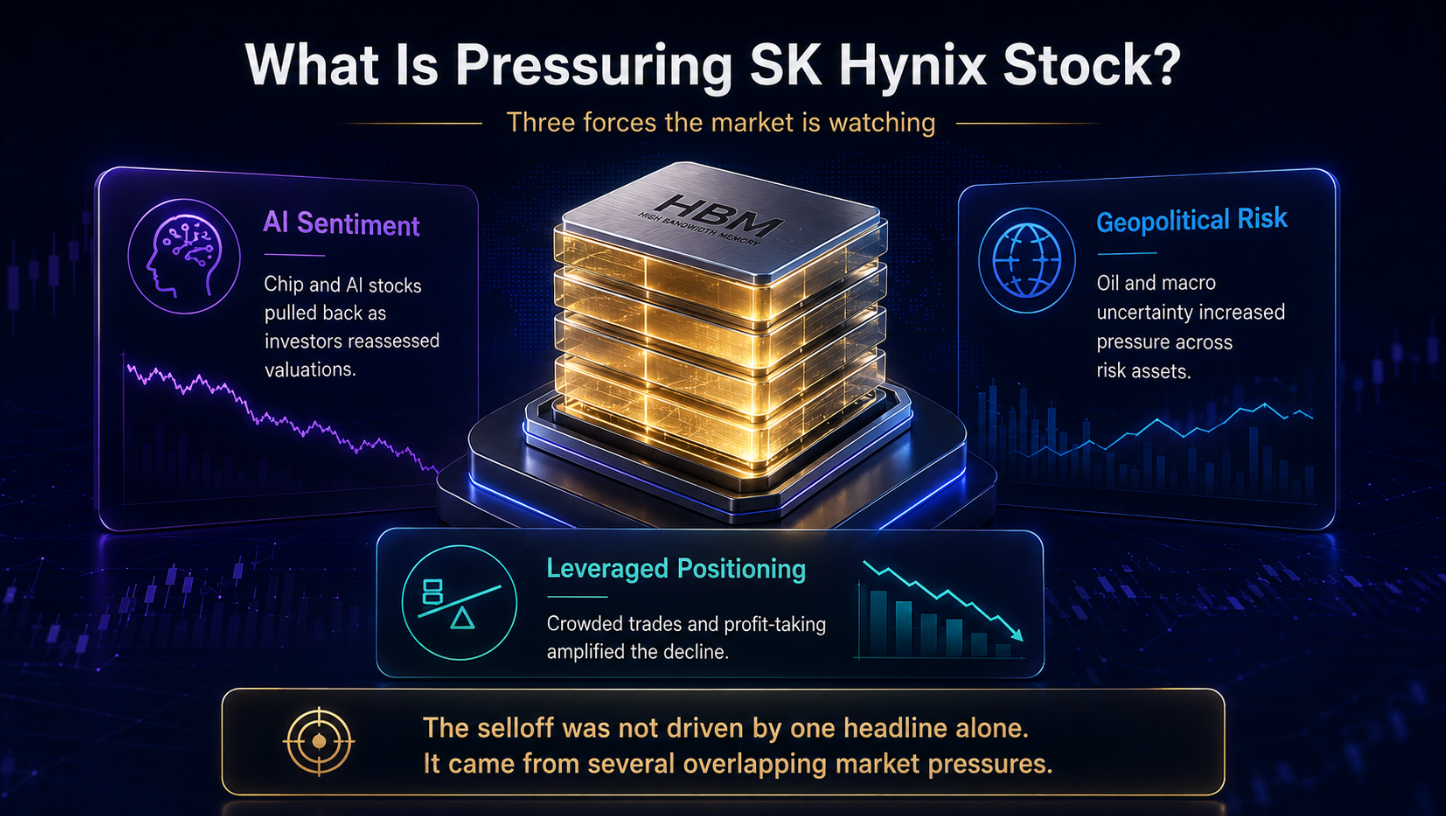
The selloff was not caused by one isolated problem. Several forces arrived at the same time, and the combination made the move much larger than an ordinary post-listing pullback.
Profit-Taking After a Strong ADR Debut
The first driver was straightforward. Investors who bought around the $149 offer price saw the ADR open at $170 and close at $168. That created a rapid paper gain. When SKHY could not extend the first-session move, some holders locked in profits. New listings often experience this type of price discovery because the market is still learning how much liquidity exists and what premium investors will pay.
Profit-taking does not prove that the HBM thesis is broken. It does show that a good company story and a good entry price are not the same thing. A stock can have strong demand, leading technology and positive revenue expectations while still falling when too much optimism is already reflected in the quote.
Pressure Across AI and Semiconductor Stocks
SK Hynix also fell with a broader group of AI-related companies. Nvidia, Micron and other chip names moved lower as investors reassessed the durability of the AI rally. The Nasdaq declined, oil prices jumped and Treasury yields became more uncomfortable for high-valuation growth assets.
This sector effect matters because SK Hynix does not trade in isolation. Investors often buy or sell the whole AI hardware theme at once. For a broader view of memory suppliers, GPU designers and equipment companies, Tapbit Learn’s guide to semiconductor stocks explains why these names can move together even when their business models are different.
Geopolitical Risk and Leveraged Korean Positioning
Renewed tension around the Strait of Hormuz pushed oil sharply higher and increased inflation concerns. That hurt global risk appetite. In South Korea, the decline was amplified by heavy speculative and leveraged exposure after SK Hynix had risen several times over the previous year.
Leverage changes market behavior. A normal decline can trigger forced selling, margin calls or the closing of leveraged ETF positions. That can push a stock below the level justified by the first headline. It also explains why the Korean share drop was more severe than the initial ADR decline.
The wider Korean market is important here. The KOSPI index provides context for foreign flows, domestic risk appetite and the performance of large Korean exporters. If the KOSPI stabilizes while SK Hynix continues falling, the weakness may be more company-specific. If both remain under pressure, macro and positioning risk may still dominate.
SK Hynix Korea Shares vs SKHY ADR
An ADR is a U.S.-traded receipt connected to shares held through a depositary structure. It gives investors dollar-based access during U.S. market hours, but it is not identical to buying the Korean ordinary share directly.
| Feature | KRX 000660 Share | Nasdaq SKHY ADR |
|---|---|---|
| Trading currency | KRW | USD |
| Main session | South Korea | United States |
| Instrument | Ordinary share | Depositary receipt |
| Price influences | Korean market, KRW, local flows | U.S. liquidity, ADR demand, USD, AI sentiment |
| Possible gap | May trade at local discount or premium | May trade at ADR premium or discount |
Some market data services list an ADR ratio of 0.1 local share per SKHY receipt. Even with a stated ratio, the market relationship can be affected by exchange rates, custody costs, settlement rules and whether investors can freely convert between the instruments. Reported post-listing conditions showed a meaningful price gap, so traders should not assume that an apparent difference can be captured without friction.
The practical lesson is simple: compare the correct instrument with the correct reference. Do not use the Korean price as if it were a dollar quote, and do not assume the ADR must instantly converge with the local share.
Does the HBM Growth Story Still Support SK Hynix?
High-bandwidth memory, or HBM, remains the strongest part of the long-term case. AI accelerators need very fast access to large amounts of data. A powerful processor can sit idle if memory cannot deliver data quickly enough. SK Hynix has built a leading position in this part of the system and has continued to move from HBM3E toward HBM4 and HBM4E.
In June 2026, the company said it had shipped samples of 12-layer HBM4E to major customers. That is strategically important because the market is no longer valuing memory companies only on traditional DRAM and NAND cycles. Investors are also pricing their ability to supply customized, high-margin memory for next-generation AI systems.
However, strong demand does not remove valuation risk. The stock had already risen dramatically before the latest decline. The market now needs evidence that HBM shipments, pricing and margins can keep beating increasingly aggressive expectations. If earnings merely meet forecasts, the share price may remain volatile even while revenue grows.
SK Hynix Stock Outlook After the Selloff
The next move is likely to depend on whether the decline becomes an orderly reset or develops into a larger unwinding of leveraged AI positions. A scenario framework is more useful than pretending there is one guaranteed target.
| Scenario | Possible Price Behavior | Main Conditions |
|---|---|---|
| Bull case | KRX shares recover toward ₩1.95M–₩2.20M; SKHY regains the upper-$160s | Chip sector stabilizes, HBM guidance stays strong, volume confirms the rebound |
| Base case | Shares consolidate around ₩1.60M–₩1.95M with wide daily moves | Fundamentals remain intact but investors wait for earnings and pricing data |
| Bear case | KRX shares fall toward ₩1.45M or lower; ADR loses the offer-price area | AI sentiment weakens, leverage unwinds and earnings expectations are cut |
These are working market zones, not analyst consensus targets. The bull case requires more than one rebound session. The stock would need to hold above the latest panic low, recover lost levels and show that buyers are willing to support the price after the first bounce.
What Would Confirm a Recovery?
- The Korean share price stabilizes above roughly ₩1.60M–₩1.70M.
- SKHY reclaims the $168 first-close area with stronger volume.
- Nvidia, Micron and the broader semiconductor group stop making lower lows.
- SK Hynix maintains strong HBM shipment and margin guidance.
- The KOSPI and Korean won stabilize instead of extending the risk-off move.
What Would Invalidate the Bull Case?
A decisive break below the latest local-share low, followed by weak rebounds, would suggest that the market is still reducing exposure. A sustained SKHY move below the $149 offer price would also weaken the post-listing narrative. The most serious fundamental invalidation would be evidence of slower HBM demand, weaker memory pricing or customer delays.
How Can U.S. Investors Buy SK Hynix Stock?
U.S. investors now have a clearer route through the SKHY ADR. A broker that supports Nasdaq-listed securities may allow eligible users to buy or sell SKHY during U.S. market hours. Investors should still review the depositary terms, fees, liquidity and how the ADR relates to the Korean ordinary shares.
Directly buying 000660 in South Korea is different. It generally requires a broker with access to the Korea Exchange, foreign-market onboarding and currency conversion into Korean won. Taxes, fees and regional eligibility can also differ.
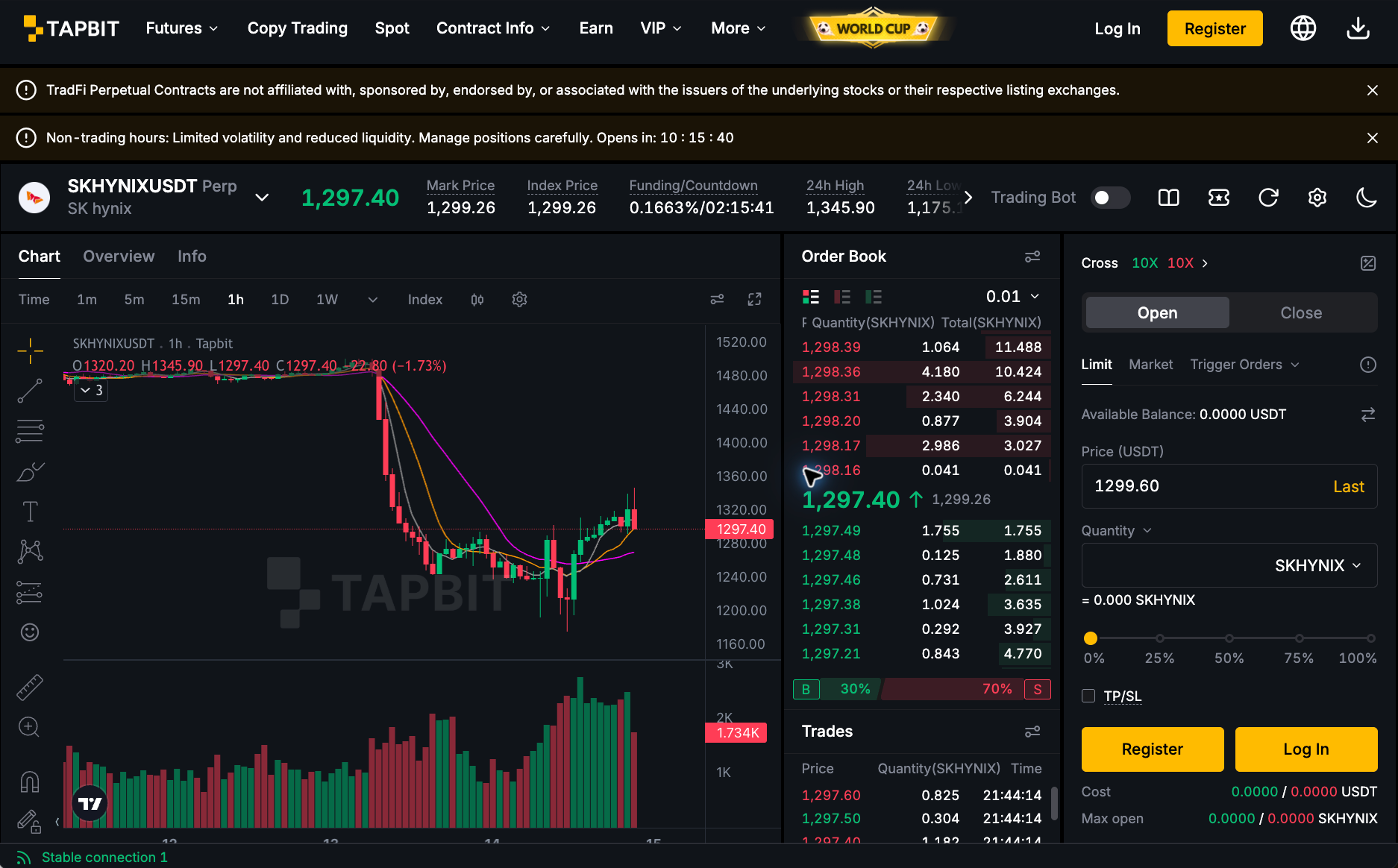
Tapbit users looking for price exposure can review the SKHYNIX-USDT stock-linked futures market after they create an account. This contract is a derivative. It is not direct ownership of SK Hynix shares, does not provide shareholder voting rights and does not grant stock dividends. Leverage can magnify both gains and losses.
Readers comparing these structures can also review Tapbit Learn’s explanation of tokenized stocks. An ADR, a tokenized share product and a perpetual futures contract may all track a company-related price, but their legal rights, settlement and risk are not interchangeable.
What Should Traders Watch Next?
The next major checkpoint is the company’s earnings update, currently expected on July 22, 2026. Investors will focus on HBM shipments, HBM4 and HBM4E customer progress, DRAM pricing, gross margin and capital expenditure. Management commentary will matter more than a single backward-looking revenue number.
Outside the company, watch Nvidia’s data-center demand, Micron’s HBM commentary, the KOSPI, the Korean won and global oil prices. A calmer macro environment could allow the market to refocus on earnings. Continued geopolitical escalation could keep technical and positioning risk in control.
Final SK Hynix Stock Outlook
SK Hynix stock near ₩1.73 million and SKHY near $155 represent a sharp reset from the excitement of the Nasdaq debut. The fall does not automatically end the HBM growth story, but it proves that the stock is sensitive to valuation, leverage and global risk sentiment.
The base case is a volatile consolidation while investors wait for earnings and clearer evidence on HBM pricing. A recovery becomes more credible if the local shares hold the ₩1.60M–₩1.70M area and SKHY later regains the high-$160s with volume. The outlook weakens if the ADR falls sustainably below its $149 offer price or if company guidance shows that AI-memory expectations are cooling.
FAQ
What is the SK Hynix stock price today?
SK Hynix traded near ₩1.729 million in South Korea on July 14, 2026. The SKHY ADR fell toward $154.70 in early U.S. trading on July 13. Refresh both quotes before relying on them.
Why is SK Hynix stock falling?
The decline reflects profit-taking after the ADR debut, a wider semiconductor selloff, geopolitical risk, rising oil prices and heavily leveraged positioning in Korean shares.
How can I buy SK Hynix stock in the United States?
Eligible investors may access the Nasdaq-listed SKHY ADR through a supporting securities broker. This is different from buying the 000660 ordinary share in South Korea.
Is SKHY the same as SK Hynix stock?
SKHY is an American Depositary Receipt linked to SK Hynix shares. It provides company exposure but trades as a separate U.S.-listed instrument with its own market price.
Are Tapbit stock-linked futures direct shares?
No. Stock-linked futures are derivatives. They do not represent direct share ownership and do not provide voting rights or dividends.
Disclaimer
Cryptocurrency, futures and stock-linked derivative trading involve significant risk of loss. Prices can change rapidly, and leverage can magnify losses. This article is for informational purposes only and does not constitute investment, legal or tax advice. Always conduct your own research and never trade more than you can afford to lose.


