Why did Bitcoin’s latest rally stop near $84,000?
 Tapbit Wire
Bitcoin price has rebounded toward $84,000 on October 13 despite a steep selloff in South Korean equities, but weak ETF demand and heavy selling orders near resistance have prevented buyers from pushing higher.
Summary
Bitcoin recovered toward $84,000 despite heavy losses in South Korean technology stocks, with the KOSPI falling approximately 7.4% over the past week.
US spot Bitcoin ETFs recorded roughly $451 million in net outflows during October, including $69 million on Monday, as institutional demand remained weak.
CoinGlass data showed a concentration of sell orders near $84,000, where Bitcoin has repeatedly struggled to sustain gains.
Bitcoin’s four hour RSI stood at 51.81, indicating a modest recovery in buying momentum, while $82,000 remained the nearest support level.
According to TradingView data, Bitcoin (BTC) was trading near $83,395 at the time of writing, after recovering from a decline toward $81,000 earlier in the session.
The cryptocurrency briefly approached $84,000 before giving back some gains, leaving it within its recent trading range of approximately $80,000 to $87,000.
The recovery came as South Korea’s stock market suffered another difficult session, led by heavy losses in semiconductor companies. Bitcoin managed to regain ground even as the selloff raised concerns about investor appetite for risk assets.
However, declining demand for US spot Bitcoin exchange traded funds and a concentration of sell orders near $84,000 have continued to limit the recovery.
Bitcoin price holds up as South Korean stocks tumble
South Korea’s KOSPI Composite Index has lost approximately 7.4% over the past week as selling pressure continued across technology and semiconductor stocks.
The index fell below its 200 day moving average for the first time since late July, a technical level commonly used to assess longer term market trends.
SK Hynix was among the worst performers, with its shares closing more than 10% lower on Tuesday. Samsung Electronics faced further pressure after reporting weaker than expected third quarter earnings last week.
Foreign investors have reportedly sold approximately 173 trillion won, or $129 billion, worth of Samsung and SK Hynix shares since the beginning of 2026. The two companies accounted for most of the foreign selling recorded across the KOSPI during that period.
Bitcoin initially faced selling pressure as Asian equity markets weakened but subsequently recovered toward $84,000.
Its performance contrasted with the August market selloff, when weakness in technology stocks was accompanied by substantial losses across cryptocurrencies.
You might also like: Strive buys 3,311 Bitcoin as BTC holdings reach 32,773
Some market analysts have attributed Bitcoin’s latest resilience to expectations that central banks could ease monetary policy if economic conditions deteriorate.
However, the Federal Reserve’s next interest rate decision remains a source of uncertainty.
US consumer inflation figures are due on October 14, ahead of the central bank’s October 28 policy announcement. Investors are currently expecting the Fed to leave borrowing costs unchanged.
The upcoming inflation report could influence those expectations, particularly if price pressures remain elevated.
Bitcoin ETF withdrawals continue to weigh on demand
Institutional demand has weakened since late September, when US spot Bitcoin ETFs attracted approximately $2.39 billion in net inflows during a single week.
The funds subsequently experienced a substantial slowdown in buying activity, followed by several sessions of withdrawals in October.
As crypto.news previously reported, US spot Bitcoin ETFs recorded $678.9 million in net outflows during the week ending October 9.
The withdrawals formed part of approximately $1.29 billion in combined outflows across tracked US crypto investment products during the same period.
More recent figures cited in Tuesday’s market coverage placed Bitcoin ETF withdrawals at approximately $451 million for October so far, including another $69 million on Monday.
The latest withdrawals indicate that institutional investors have yet to return to the sustained buying seen during September’s recovery.
Bitcoin had already struggled to maintain gains above $87,000 earlier this month, when ETF buying slowed near investors’ average entry prices.
In its October 5 assessment, Bitfinex noted that investors in US spot Bitcoin ETFs had recently recovered their estimated average purchase price after spending 233 consecutive days below that level.
The firm identified insufficient spot demand as an obstacle to a sustained recovery, particularly as Bitcoin approached levels where existing investors could sell without realizing substantial losses.
Institutional withdrawals subsequently accelerated during the second week of October.
On October 7, Bitcoin ETFs recorded $484.9 million in net redemptions, their largest daily withdrawal since June.
BlackRock’s IBIT accounted for $207.7 million of the total, while Fidelity and ARK 21Shares products experienced further redemptions.
Selling orders near $84,000 restrict Bitcoin’s recovery
Exchange order book data from CoinGlass showed a growing concentration of ask liquidity near $84,000 as Bitcoin approached the level on Tuesday.
Ask liquidity represents sell orders placed above or around the prevailing market price. A large concentration can make it difficult for buyers to push prices higher unless sufficient demand emerges to absorb those orders.
Traders observed that Bitcoin had repeatedly failed to hold above $84,000 on shorter time frames, even as the cryptocurrency recovered from its earlier decline.
The area has remained technically important throughout October.
Bitcoin previously lost the $84,000 level during its decline from above $87,000, before finding support near $80,000 during last week’s selloff.
In an October 10 market assessment, the $84,400 area was identified as an important obstacle to another recovery toward $87,000.
Bitcoin’s latest attempt to reclaim that region has therefore encountered both visible exchange selling orders and weaker institutional demand.
A sustained move above $84,000 would bring $84,500 into focus, followed by the $85,000 region. A failure to clear those levels would leave Bitcoin exposed to another test of its recent support zones.
Bitcoin price indicators point to limited buying momentum
Bitcoin’s four hour chart shows that buyers have recovered part of the losses recorded during the October 8 and 9 decline, although the cryptocurrency remains below its recent highs.
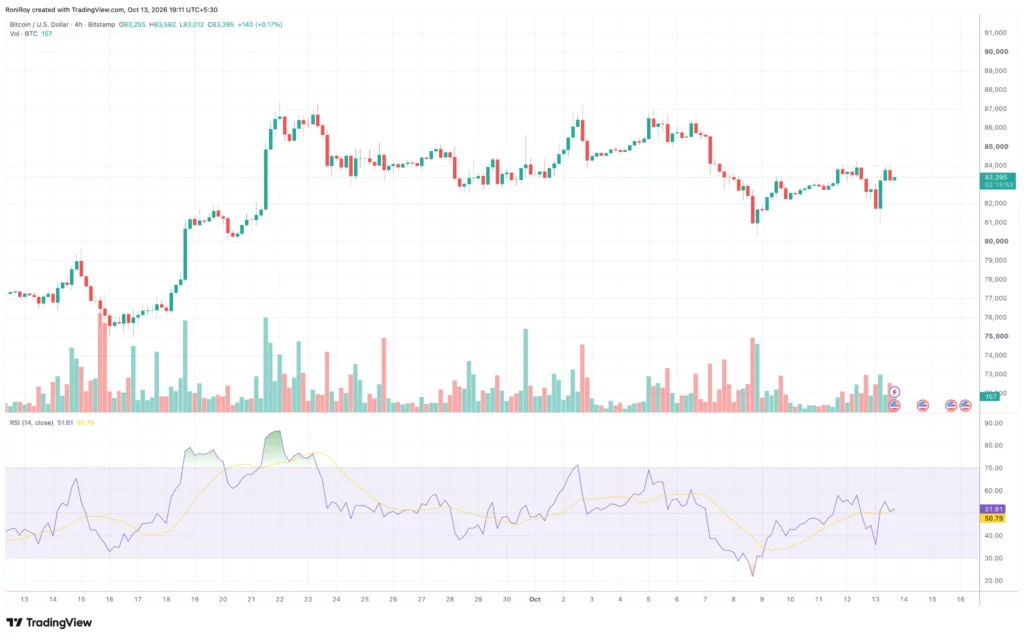
At the time of analysis, BTC was trading around $83,395, with the latest four hour candle reaching a high of $83,582 and a low of $83,012.
The Relative Strength Index stood at 51.81, slightly above its moving average of 50.79.
An RSI reading just above 50 indicates that buying momentum has improved following the recent selloff, but the indicator remains well below the 70 level generally associated with overbought conditions.
The RSI had fallen below 30 during the earlier decline toward $81,000, before recovering as buyers returned at lower prices.
Its latest reading suggests that selling pressure has eased, although momentum has not yet strengthened enough to confirm a decisive recovery.
Price action presents a similar picture.
Bitcoin has repeatedly approached $84,000 over recent sessions without establishing a sustained move above it. The latest rebound followed another brief decline toward $81,000, where buyers stepped in and pushed the price back above $83,000.
Trading volume increased during the recovery, but the subsequent candles have remained relatively small compared with the larger moves recorded during the preceding selloff.
Meanwhile, indicators showed a mildly bullish outlook at the time of writing, with 10 technical indicators flashing buy signals against four bearish readings.
The daily exponential moving averages remained bullish, while the 14 day RSI stood at a neutral 52.42. The indicators placed immediate support near $82,871 and the next major resistance at $87,061, with Bitcoin still trading below its Bollinger Bands midpoint of $83,939.
Immediate resistance remains between $84,000 and $84,500. A sustained break above that region could allow Bitcoin to challenge $85,000, followed by the previous trading area between $86,000 and $87,000.
On the downside, $82,000 remains the first important support level. A move below it would put the recent $81,000 low back in focus, while a deeper decline could bring the psychological $80,000 level into play.
The October 14 US inflation release remains the next major scheduled economic event, with analysts identifying $80,000 and $86,000 as potential price levels depending on the inflation outcome.
According to BTSE chief operating officer Jeff Mei, stronger than expected inflation could push Bitcoin below $80,000, while softer figures could support a recovery above $86,000.
Read more: Ledger suspends retail sales in Germany as wallet implant probe continues