Tian Keyu swore that lying would result in "lifelong research setbacks."
 Tapbit Wire
The original title: "Tian Keyu Swears That If He Lies, His Research Will Suffer 'Lifelong Setbacks'" The original author: Sleepy
Late at night on October 12, Tian Keyu, in a program that took place elsewhere, recounted for the first time in full the turmoil at ByteDance two years ago.
According to his account, the whole matter lasted no more than about ten days, and he merely used a script to stop an intern's program "about five times." At the end of the program, the host asked him to swear, and he said that if he had told even half a lie, his research would suffer "lifelong setbacks."
Less than 13 hours after the podcast went live, a public statement of more than 10,000 words was released, with five colleagues who had been in the same group as him at the time providing real-name testimony at the end.
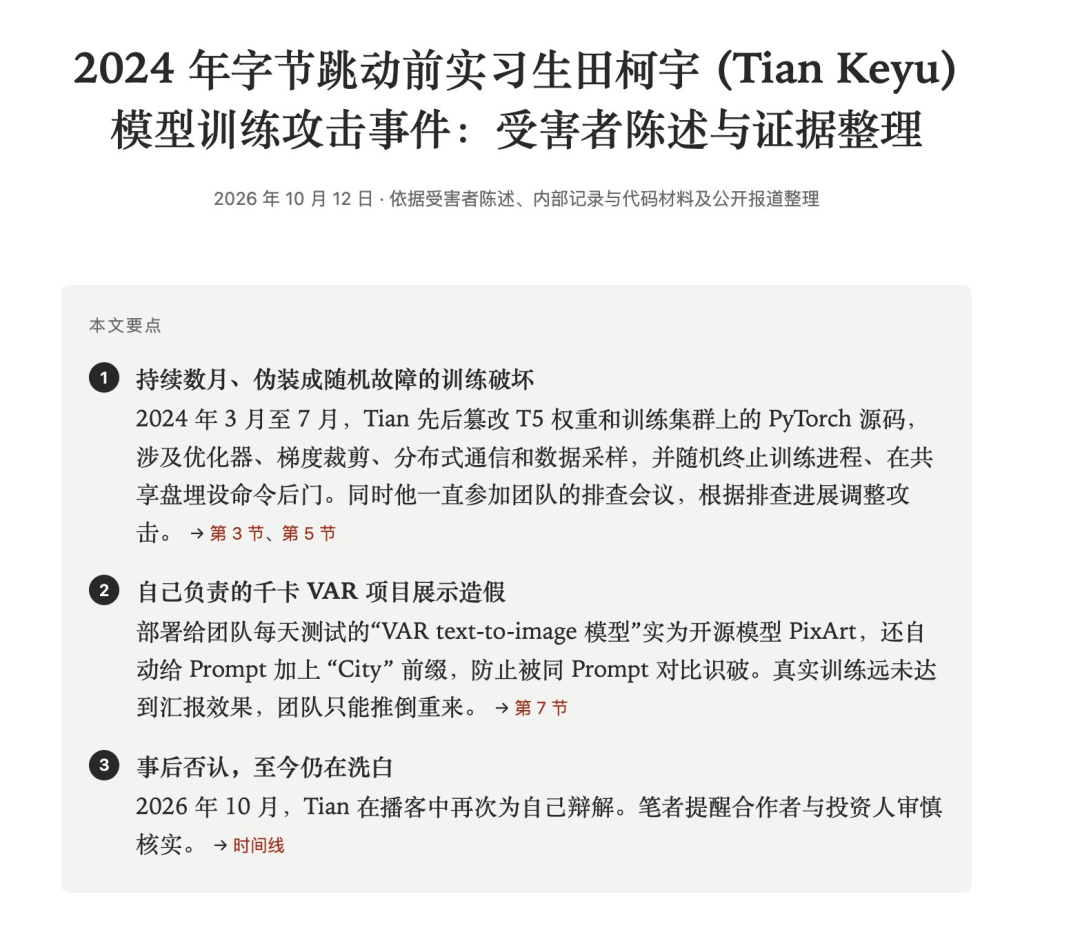
A 10,000-word public statement | Image source: Github
The account described in this statement is completely different from the story he told. The statement claims that the human sabotage lasted from March 2024 to July 2024, nearly five months in total; he tampered with the underlying PyTorch source code of the training cluster, carefully disguising malicious sabotage as sporadic failures. At the end of the statement's timeline, it says that Tian Keyu's remarks on the podcast were "another attempt to whitewash and reverse black and white."
Four days ago, his world model company had just announced a funding round of nearly $30 million, with a post-money valuation of $200 million.
Two years ago, he was still an intern at ByteDance, dismissed and sued. Less than three weeks after the lawsuit was filed, his paper VAR, on which he was the first author, won the NeurIPS Best Paper Award.
Regarding this matter, the court, ByteDance, the academic community, investors, his former colleagues, and he himself still each hold different accounts to this day.
One thing is clear, however. An internal notice determining that he had carried out a malicious attack, plus a first-instance judgment for breach of contract, did not make him pay any price in the capital market.
That a person who has done such things could return to the table so quickly and so respectably two years later is, in my view, the tragedy of this era. Half of the tragedy lies with him, and the other half with those willing to give him money.
Random Seed
Before becoming the center of a public opinion storm, Tian Keyu had once been a standard "genius youth."
In 2018, he was admitted to Beihang University, first studying materials and later transferring to the School of Software; starting in his sophomore year, he interned at SenseTime, and during his undergraduate years he published two papers in a row at NeurIPS as first author. The data structures assignment he wrote in his freshman year took first place in an efficiency test involving 800 people, and in the explanation he wrote that, for ultimate efficiency, he used a large number of tricks, hacks, and optimizations.
Extremely eager for efficiency, and extremely skilled at finding shortcuts in the cracks of the rules.
In 2021, he joined ByteDance's commercialization technology team as an intern. The following year, after graduating with his bachelor's degree, he went to Peking University for graduate school, studying under Wang Liwei, and his internship never stopped. He spent three years in this group, the intern who sat at his desk the longest.
The group was led by Yuan Zehuan, with Jiang Yi in charge of foundation models, and many projects in the group were spearheaded by interns.
In 2024, they bet on two paths simultaneously. On one side was autoregression, with the text-to-image version of VAR officially launched as a project, led by Tian Keyu, using thousands of GPUs. He said at the time that his leader helped him "beg" for a lot of resources. On the other side was the video project Goku, launched in April after the release of Sora, taking the diffusion route, a multi-person collaborative team project.
That year, compute was the most sought-after thing in every AI lab. According to estimates by market research institutions, ByteDance bought approximately 230,000 Nvidia Hopper chips that year (including the H20 exclusively for the Chinese market), tied with Tencent, with procurement volume second only to Microsoft. Meta wrote in the Llama 3 paper that 16,384 H100s trained for 54 days and were unexpectedly interrupted 419 times; Jan Leike, OpenAI's head of superalignment, also said upon departure that the team had often been "struggling for compute" over the past few months.
GPUs are chips, and chips are everything.
The statement records that at the initial launch of Goku, the two projects received roughly equal numbers of GPUs. In June, Kuaishou released Kling, and three teams within ByteDance were simultaneously working on video generation. Management decided to contract and concentrate, and GPUs began to tilt toward Goku. Newly rented GPUs were also given to it first, and Seed's infra team was transferred to help it stabilize training.
On September 24, ByteDance released the Doubao video models PixelDance and Seaweed.
But in August before that, Tian Keyu had already been dismissed and escorted out of the office area.
According to ByteDance's all-hands internal notice issued on November 5, 2024, Tian Keyu, during the period from June to July, "due to dissatisfaction with team resource allocation, maliciously attacked the model training tasks of the team's research projects through writing and tampering with code, causing resource loss." His internship agreement was terminated, and the situation was synchronized to the Sunshine Integrity Alliance, the Enterprise Anti-Fraud Alliance, and the school he attended.
According to this statement testified by five former colleagues, he engaged in sabotage for even longer.
In March, the first target was LlamaGen, another autoregressive project in the group, which at the time used fewer than 100 GPUs. LlamaGen's text-to-image generation relied on T5 features provided by Tian Keyu, but it simply couldn't be trained well. Chen Shu posted a piece of code he had submitted to the internal GitLab that month, which mixed random noise into the weights of the T5 model and then restored the overall numerical scale to its original state. Later, the author re-downloaded a set of weights from Hugging Face, and the problem disappeared. At the time, no one suspected deliberate sabotage. A few weeks later, VAR was posted on arXiv.
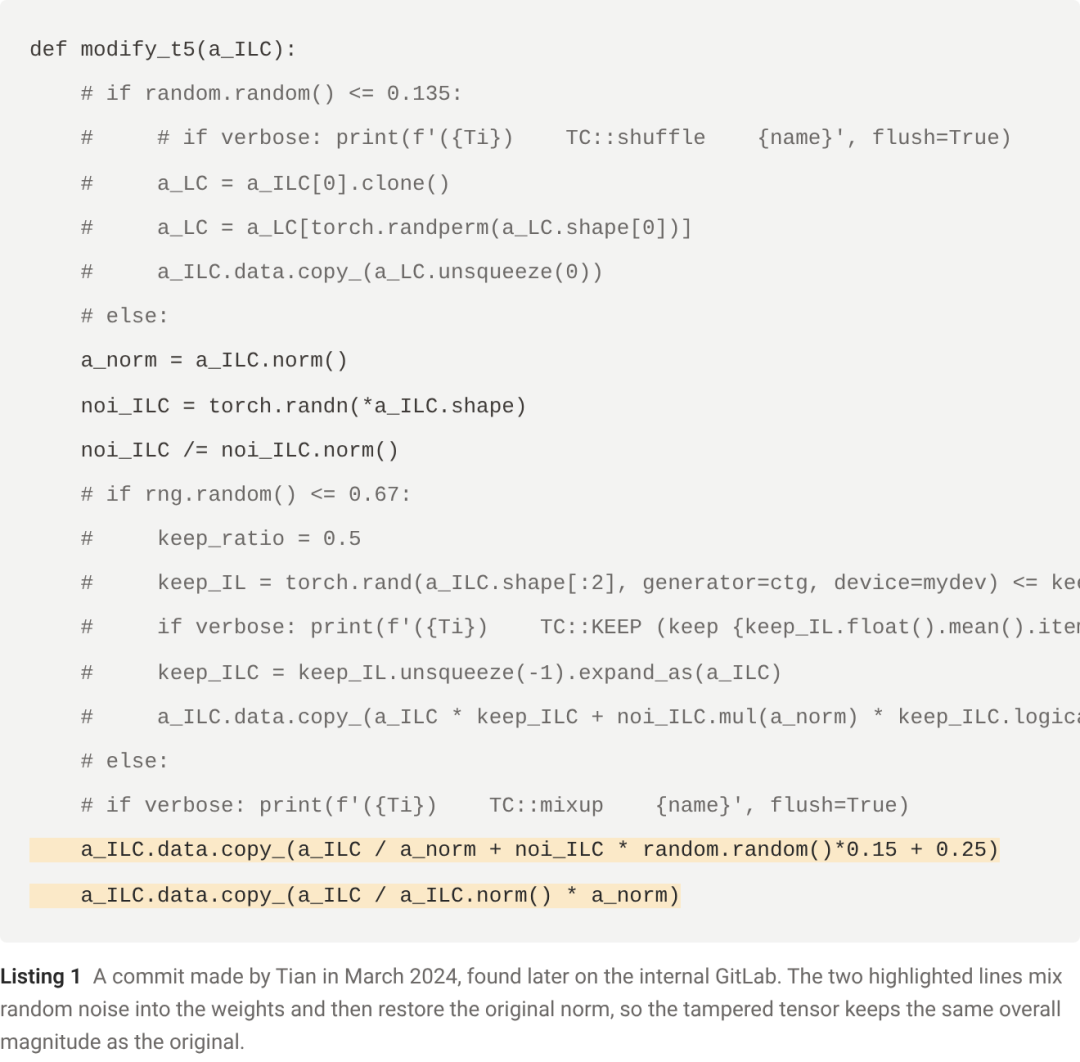
Mixing noise into T5 weights | Image source: public statement
After April, the target switched to Goku. As the infrastructure became increasingly complete, Goku's training actually became increasingly unstable. At first it crashed once every day or two, but later it couldn't even last two or three hours. The loss spiked frequently, making meaningful experiments almost impossible.
According to the statement, what he modified was the PyTorch source code on the training cluster.
The originally fixed random seed for data sampling was replaced with a nanosecond-level timestamp. Gradient clipping was changed to double the gradient each time, while the values reported in the logs all appeared normal. In his directory there were four files named 18, 19, 20, and 21, corresponding to probabilities from one part in 2 to the 18th power to one part in 2 to the 21st power, causing a certain process to pretend it was not part of the group during cluster communication. The installed PyTorch files in the system were replaced using sudo, and the modification times were changed back to their original state. A backdoor was also left on the shared drive that could execute text in a specified directory as commands.
The original wording in the statement is that these methods disguised deliberate sabotage as "randomly occurring software failures, numerical anomalies, or infrastructure problems."
During the most severe one or two months, colleagues in Beijing, Shanghai, and Seattle worked around the clock in shifts, holding meetings twice a day, morning and evening, for handovers. The statement says that Tian Keyu himself stayed in the troubleshooting group and also attended meetings, then modified his own code according to the directions his colleagues were investigating. Everyone had never imagined that the person causing the problem was in the meetings. Repeated failures made many people begin to doubt their own technical judgment.
On the morning of July 30, someone discovered the modified random seed in the Docker environment of a machine. In the login records, besides the machine's owner, there was only Tian Keyu. When the leader asked him what he had gone there to do, he said he wanted to study the relevant code.
The next day, another colleague found that batch of numbered scripts in his personal directory. In August, the company's security department intervened for questioning. The statement writes that, when faced with questioning, he always appeared quite calm.
He was subsequently dismissed.
Simple Justice
On the podcast, Tian Keyu reconstructed the entire story into a different version.
In this version, he is a lone hero standing up against bullying. In 2024, a new "intern A" joined the team, first hogging computing resources that belonged to others like reserving seats, and later directly shutting down other people's programs—mostly those of introverted colleagues. He said A had administrator privileges. Everyone reported it to the leader, but it was never resolved.
Tian Keyu recalled that one night, he and another colleague were the last to leave. He had submitted many tasks, while the other person had submitted none, sitting there scrolling on his phone, saying that even if he submitted them, A would just shut them down anyway.
So Tian Keyu made a decision: he had ChatGPT write him a set of scripts to manually block or shut down intern A's training tasks.
"I absolutely never touched anyone else's experiments," he said on the podcast. This was not poisoning, nor did it involve attack and defense. His biggest motivation was that he could not stand watching A bully other people on the team.
He called that action "simple justice," called A "the abuser," and added that in hindsight, he too had fought violence with violence. He admitted to overseas media that it was a vigilante act, "It was me fighting fire with fire."
But this narrative, which sounds rather Robin Hood-like, does not match the account in the statement. If the statement is true, his reach extended far beyond A's tasks alone. What was mixed with noise in March was the weights relied on by LlamaGen, another autoregressive project in the same team; what was altered after April was the PyTorch environment shared by the entire training cluster.
In fact, Tian Keyu's version of the story kept evolving dynamically over time. Each time he told it, it became a little more respectable than the last.
When the incident first fermented on social networks in October 2024, in a screenshot widely circulated in WeChat groups, his account was that he had left ByteDance after finishing his paper, and that another person took the opportunity to exploit a loophole and change the code, pinning the blame on him. People inside ByteDance said at the time that he repeatedly denied it externally and even called the police claiming he was being defamed.
By the time of the 2026 podcast, when the host asked whether he had framed someone else back then, he said "absolutely not," and also said, "I have never denied my actions." As for calling the police, he said it was because the company asked him whether he knew who posted online, and he wanted the police to investigate the poster, and he only went after confirming with the company. When swearing, he added one more line, saying that he deeply despised the behavior of claiming someone else did it.
He does not accept the word "poisoning." Some people online call him "Prisoner Tian," which he says is among the milder terms used to describe him. What he finds most unacceptable is the claim that he "backstabbed colleagues and framed others."
When ByteDance filed its lawsuit, it sought 8 million yuan in infringement damages, 20,000 yuan in reasonable expenses, and a public apology. The first-instance court ruled on breach of contract and ordered Tian Keyu to pay ByteDance 500,000 yuan in compensation, and all his wages from three years of internships at ByteDance were confiscated. According to his account, all other claims were dismissed, including the public apology. The 500,000 yuan happened to equal his internship wages plus the company's legal fees, which he called a "very fair" ruling.
ByteDance appealed, and the second-instance ruling has not yet been issued.
On the podcast, the host asked him if there was anyone he wanted to apologize to in this whole matter. He thought of ByteDance, saying he had always felt deeply apologetic toward the company — the public opinion storm made the company spend a lot of resources, and the lawsuit made it spend on legal fees.
City
That statement recorded that during the retrospective, some team members found it strange: during those months, Tian Keyu was maintaining a set of attack code, constantly modifying it to keep up with colleagues' troubleshooting progress, while also managing a training project involving over a thousand GPUs — and he could still reliably report progress at weekly meetings.
That statement also provided an answer to this question for the first time.
In 2024, Tian Keyu was responsible for extending VAR to text-to-image generation. During those months, he deployed an experience model on the internal Discord, available daily for team testing, and the project lead had personally tried it multiple times. At every weekly update, he could reliably report new training progress.
The statement said that during the retrospective after Tian Keyu was fired, the team discovered that the model deployed on the internal network for everyone to test was actually the open-source model PixArt.
The inference pipeline was packaged into a binary file and handed to engineering colleagues for deployment — those deploying it could not see the logic inside. No matter what prompt a user entered on the front end, the backend would automatically prepend the word "City."
The statement argued this was to prevent anyone from using the same prompt to compare with the open-source model and discover the results were too similar.
Testers had previously wondered why the generated images always had city building silhouettes floating in the background.
The statement said the model actually being trained had serious problems with its training state and loss, falling far short of the previously demonstrated results. The team had to start over from scratch, spending months on reconstruction before producing the later Infinity.
First Author
It must be acknowledged that VAR is an exceptionally outstanding paper.
Prior to this, the autoregressive approach in image generation had been firmly suppressed by diffusion models. Traditional autoregression compressed two-dimensional images into one-dimensional token sequences, predicting them one by one — both slow and inferior.
VAR broke this curse by proposing Next-Scale Prediction, transforming the generation process into a multi-scale emergence from coarse sketches to fine details. On the ImageNet benchmark, it pulled the FID metric directly from 18.65 down to 1.73, with inference speed surging nearly 20-fold, offering for the first time a glimpse of hope that the visual domain could follow scaling laws just like large language models.
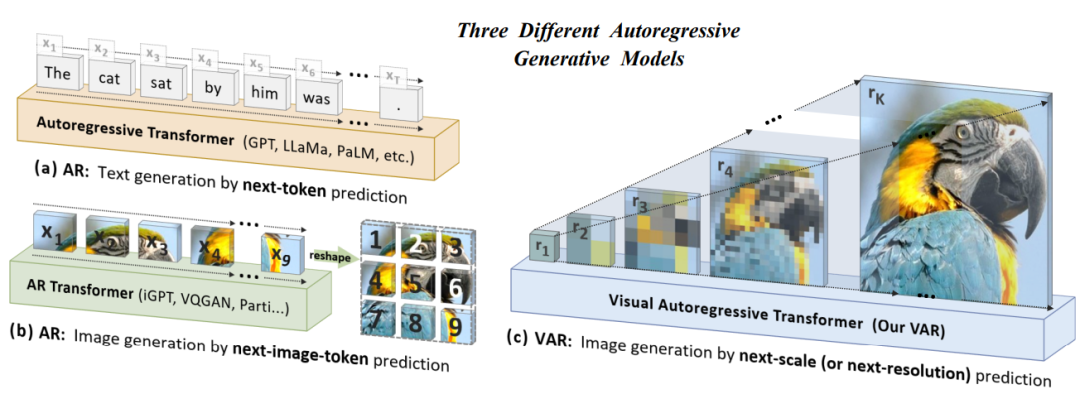
Next-Scale Prediction | Image source: VAR official schematic
At the end of 2024, VAR won the Best Paper award at NeurIPS 2024. In response to external doubts about the first author, NeurIPS stated that the award evaluation only considers the scientific value of the paper, not the authors individually.
The five authors of this paper, in order, are Keyu Tian, Yi Jiang, Zehuan Yuan, Bingyue Peng, and Liwei Wang.
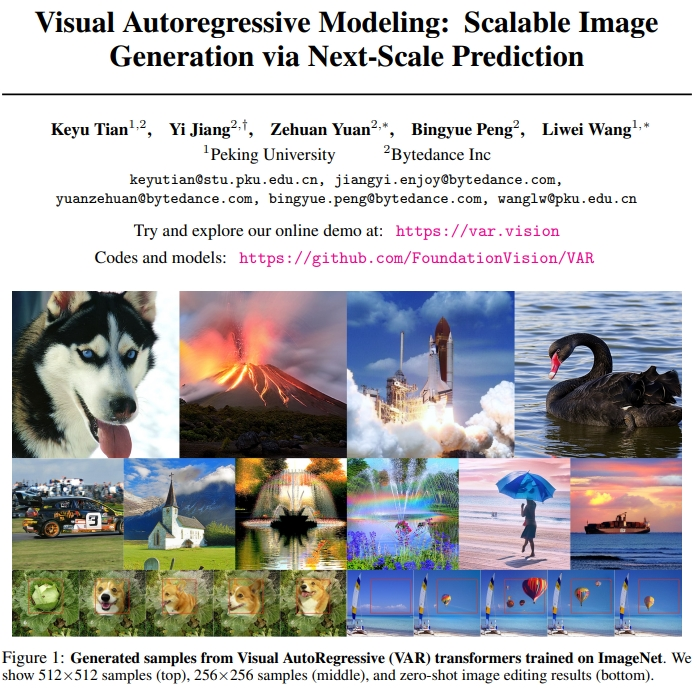
VAR paper first page | Image source: arXiv
Although the paper's second author, Yi Jiang, wrote on his personal homepage, "I led the development of VAR from initial concept to implementation";
Although VAR's open-source code remains hosted under ByteDance's open-source account FoundationVision;
Although after Keyu Tian's departure, the ByteDance team iterated upon this foundation to produce Infinity and InfinityStar, which consecutively earned Oral top-tier acceptances at CVPR and NeurIPS;
But in the highly standardized logic of venture capital transactions, all complex background noise is automatically filtered out. Capital's cognitive framework is simple and crude: Keyu Tian's name is listed first, so he is the first author of this Best Paper.
In the AI track, where pedigree and prestige matter immensely, "NeurIPS Best Paper first author" is the hardest possible passport. The weight of one byline is enough to overshadow everything a person has done outside of it.
It could even be said that the scandal that shook the industry instead morphed into a unique commercial asset amid this valuation frenzy.
On the podcast, the host once asked him bluntly whether the ByteDance controversy had objectively increased his industry profile.
Tian Keyu did not shy away: "Realistically, yes. You get a particularly large amount of attention, and combined with the Best Paper thing, it's like a double buff."
$200 million
In the months after being fired, he described it as "endless night." A large model company had given him an offer, which was later rescinded.
But the logic of venture capital firms has never been the same as that of big tech HR departments.
In early 2025, he had met very few investors. The first to invest in him was Meng Xing, a partner at 5Y Capital. Meng Xing had been co-founder and COO of Didi's autonomous driving unit, and earlier managed hard-tech investments at Shunwei Capital, only joining 5Y Capital in September 2024. Meng Xing later brought him to meet 5Y Capital founding partner Liu Qin, who said he had a certain drive about him.
There was also a fund he liked very much that, in the final online meeting, peppered him with questions about the ByteDance matter and then did not invest.
In February 2026, Beijing Blue Carbon Network Technology Co., Ltd. was quietly registered and established, with registered capital of RMB 100,000, Tian Keyu holding 60%, and five other shareholders each holding 8%, several of whom were his Beihang alumni; in May, another domestic entity wholly controlled by an offshore company was established, with registered capital of $1.9 million.
By October, this startup — which had not yet disclosed even a public demo or official name — was reported to have completed nearly $30 million in financing, at a post-investment valuation of $200 million. The lead investor was 5Y Capital, with IDG participating.
The company's field is also where the entire venture capital circle's most expensive frenzy has been concentrated over the past year: world models.
World models have become the last straw for all investment firms trying to transcend the traditional LLM narrative. Fei-Fei Li's World Labs saw its valuation rapidly pushed up, and in September of this year, AMD announced an all-stock acquisition of it for $8.2 billion; Yann LeCun's AMI Labs secured $1.03 billion in seed funding. Bai Zongyi of Yaotu Capital joked at the Zhongguancun Forum, "The moment you mention world models, valuations start at hundreds of millions of dollars."
VAR's corresponding author Yuan Zehuan also left ByteDance to found a world model company; and at the Douyin Wonderful Night on October 11, ByteDance's self-developed world model made a high-profile appearance, with Zhang Yiming personally overseeing the project.

ByteDance world model unveiled | Image source: QbitAI
Meng Xing spoke at Zhejiang University in September this year about his criteria for evaluating entrepreneurs. He values a passion that leaves "traceable marks" before starting a business, and also values cognition and judgment that have been "verified through behavior." But this time, the result of the behavioral verification is written plainly in a civil judgment, yet this heavy moral debt was not factored into that $200 million Term Sheet.
For venture capital pursuing hundredfold returns, moral flaws are merely unquantifiable tail risks, while the premium of a Best Paper is real money that can be directly monetized to subsequent funds in the next financing round.
Silicon Valley has had precedents. Former Waymo engineer Levandowski was sentenced to 18 months in 2020 for stealing Google's trade secrets, received a pardon in January 2021, and more than a year later, his new company secured funding led by Slow Ventures.
Public opinion is also split.
Two years ago when he won the award, some online said that excellence cannot be a pass for wrongdoing, while others said this wasn't his paper alone. This time when the funding news came out, an answer on Zhihu with 1,507 upvotes called him "a genius born for chaotic times." Treating rule-breaking as evidence of genius, and such a statement garnering so many upvotes, is itself part of these chaotic times. Another answer wrote: "A highly capable person did something very unethical, paid a not-so-heavy price, and then continued moving forward."
So back to the opening statement. That Tian Keyu could raise this money is the tragedy of this era.
His half of it lies in the fact that over two years he learned to tell an increasingly pleasant story, yet never directly answered what actually happened during those months. When asked whom he wanted to apologize to, he thought of the company. His scandal became his buff.
The investors' half is even more disheartening. In the valuation frenzy around world models, a Best Paper first-author label is easier to price than an internal notice and a court judgment. Researchers' valuations keep climbing, capital fears missing the next genius, saying investment is about betting on people, but this time, this person's prior record did not affect his return to the table.
Leader
Tian Keyu's new company plans to expand its team to twenty people by the end of this year.
On a podcast, he described his management philosophy: doing cutting-edge model pre-training doesn't actually require that many people. What matters most is pooling collective wisdom and building a technical soil where everyone can freely bring their talents into play.
Two years ago, he was the longest-serving intern in his group. According to ByteDance's internal notice, dissatisfied with resource allocation, he attacked a colleague's training tasks; two years later, with nearly $30 million in hand, he has become the number-one person in his company who decides who gets GPUs and whose compute gets shut off.
At the end of the podcast, the host asked him a question laden with a sense of fate:
"If one day, in your own company, a young person like the 2024 Tian Keyu appeared, what would you do?"
Tian Keyu replied that, from a leader's perspective, he would think about how to handle the conflict, and even intervene before the conflict occurs, to nip it in the bud.
"Of course, whether as an individual or a founder, you still need to handle everything more maturely."
Except, he has probably forgotten that in that Beijing office area in the summer of 2024, there was once a group of engineers on overnight duty, and at every shift-change morning meeting, none of them had ever thought of guarding against a colleague sitting right beside them as if against a thief.
Original link