Jensen Huang stated: "The 'AI apocalypse theory' is 'sensationalism without scientific basis,' RSI is by no means 'out of control black magic,' and Trump's 'interjection': the apocalypse theory is all a scam
 Tapbit Wire
Recently, NVIDIA founder and CEO Jensen Huang directly criticized the current rampant "AI doomsday theory" at the All-In Summit 2026, labeling it as "irresponsible statements without scientific basis." He listed AI predictions from the past few years that have been debunked, pointing out that some tech companies and researchers' public statements "create panic and mislead the public."
Huang's target was the recent blog post by Anthropic CEO Dario Amodei, which sparked widespread discussion—this post, in collaboration with several leading labs, warned about AI safety risks and even quantified the probability of "civilizational extinction." Huang stated, "This is fabricated. These people are well-educated, referred to as researchers, working in labs. The accumulation of these terms combined with such predictions is alarming and should not be done; it is irresponsible."
During the summit, former President Donald Trump suddenly called in, stating, "This whole thing is a scam," and expressed his firm support for data center construction, claiming AI is "the oil of the next 20 to 25 years."
The joint statements from both individuals injected new variables into the current heated debate surrounding AI regulation and safety.
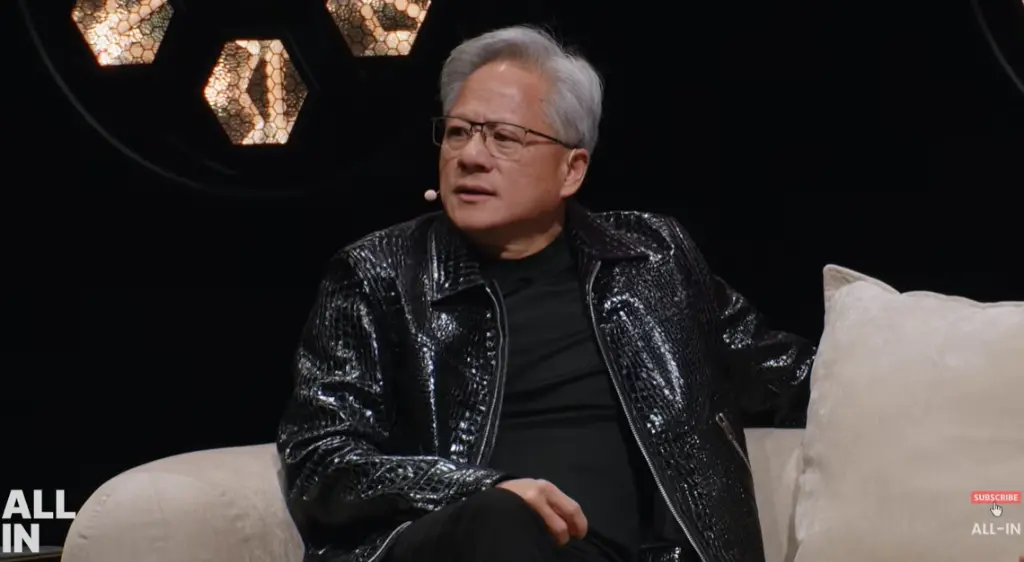
"All These Predictions Are Wrong": Huang Calls Out Doomsday Predictions One by One
Huang directly named the most widely circulated AI panic predictions from the past few years and compared them to reality:
"Some predicted that radiologists would be completely replaced by AI within five years; the opposite is true, we need more radiologists than ever."
"Some predicted that 90% of code would be generated by AI within six to twelve months—wrong. Some predicted that 50% of entry-level jobs would disappear within six to nine months—also wrong."
He also mentioned that GPT-2 and Llama 3 were once considered "too dangerous to release," and predictions like "half of white-collar jobs will disappear next year" have all fallen flat.
Huang's conclusion was straightforward: "These predictions are not based on science, nor on research. All evidence based on science and research points in the opposite direction. This is fear of the unknown."
He also stated that regarding the recent blog post by Anthropic CEO Dario Amodei, he believes the parts concerning safety deserve serious attention, but the "scientific predictions" about the future "clearly lack scientific basis," and "when scientists say it, but it is not scientific, that is irresponsible."
RSI Is Not "Black Magic": Huang Explains the Engineering Logic of Recursive Self-Improvement
In response to the recent market discussions about Recursive Self-Improvement (RSI) technology, Huang provided his technical judgment.
"RSI is a combination of systematic ideas," he said, "from learning from context, skill accumulation, reflection mechanisms, to reinforcement learning and synthetic data generation, these are all very reasonable ideas that allow AI to continuously improve in problem-solving."
He further explained that through low-rank adaptation methods like LoRA, model capabilities can be enhanced without retraining the base model; over time, the accumulated experience can be used to retrain the base model, making the entire process completely controllable from an engineering perspective.
Huang believes that the term "RSI" is being "weaponized" by some people, deliberately creating the impression that the technology will "spiral out of control." His rebuttal logic is simple: "You can do RSI internally in a company, but when you release a product, you must evaluate it, you must test it, and you must ensure there are no regression issues. The basic engineering control processes are there."
Trump Calls In: Data Centers Are "The Oil of the Next 20 Years"
As the summit moved into the strategic breakdown segment of NVIDIA, Trump suddenly called Huang and was connected to the live audio system, addressing thousands of attendees.
Trump stated: "This whole thing is a scam. Data centers are great; they make people wealthy and make states wealthy. They are the oil of the next 20 years, 25 years, much bigger than the internet."
He also criticized some voices opposing data center construction as "serving those who do not want America to succeed," and clearly stated: "Robots will not rule the world, AI will not take over the world; the whole thing is a scam."
Trump also mentioned that approximately $20 trillion in investments are currently flowing into the U.S., comparing this to less than $1 trillion during the previous administration.
After the call ended, Huang remarked that Trump was able to "see through this scam," and despite polls showing opposing voices dominating, he still maintained his stance, "that takes courage."

NVIDIA's Strategic Logic: How Far Up to Go, How Low to Press Down
In terms of capital allocation and ecological strategy, Huang elaborated on NVIDIA's core principle: "Go as far up as possible, but try to stay low."
He explained that NVIDIA's goal is to help the entire ecosystem succeed, rather than taking a piece of it. "If NVIDIA hadn't created cuDNN, all frameworks wouldn't exist. If we hadn't created Megatron Core, large-scale training wouldn't happen. We invent necessary technologies and then let a hundred flowers bloom."
After acquiring Hugging Face, NVIDIA's layout in the open-source field has become increasingly clear. Huang revealed that NVIDIA currently has cutting-edge open-source models in five verticals, including the world's first "thinking self-driving car" Alpamayo and the protein synthesis model Proteina Complexa.
He emphasized that NVIDIA's entry into these fields is based on "customer needs, and they themselves do not have the capability," rather than actively disrupting competitors.
In terms of financing ecology, Huang mentioned that NVIDIA is collaborating with institutions like Blackstone and Goldman Sachs to provide financing support for AI infrastructure construction through projects like Cloverleaf, and is continuously expanding its regional cloud partner network in Australia, Southeast Asia, and other places.
"In Certain Areas, Superintelligence Has Arrived": Huang's Technical Judgment
At the end of the summit, Huang provided his judgment on the current stage of AI development.
When the host asked, "Have we entered the AGI moment?" Huang responded, "I think we have."
He then added his definition framework: "When you look at a self-driving car, I don't need it to make me an omelet; I just need it to drive. In this narrow domain, it is superintelligent—its accident rate is one-tenth that of humans. In protein synthesis and virtual screening, we are already there."
Huang finally called for: "I hope we can lower the drama; most importantly, we need to move forward together as a whole America. That is how we succeed."

Full Transcript (slightly edited) as follows:
Jensen Huang: The doomsday theory is a scam, superintelligence has arrived, the future of AI (President Trump calls in)
All-In Podcast | All-In Summit 2026 | September 15, 2026
Text Record
Host 00:00
Some call it "foresight," which is a weighty term for me because I believe foresight is crucial. We interrupted our weekly regular program for this, and the only reason we could do so is because of three people: President Trump, Jesus, and Jensen—let's warmly welcome him to the world's number one podcast. He is Jensen Huang, the founder, chairman, and CEO of NVIDIA. Whether you realize it or not, every decision he makes is shaping your future. NVIDIA is the most important stock in this market, and Jensen can be said to be the greatest entrepreneur in history. The company's revenue has exploded by 97% year-on-year, and demand is not only strong but actually accelerating. NVIDIA is the only complete full-stack AI factory computing platform. GPUs are like a time machine; they allow you to see the future sooner. If we can see the future and predict the future, we have a greater chance of shaping that future into its best form.
Please welcome Jensen Huang! As soon as he appeared, he received a standing ovation from the audience. Ladies and gentlemen, "GPU Jesus" has arrived; everyone loves you. Thank you, I love you all too. We love the world's number one podcast and we love your new jacket.
Jensen Huang 01:28
I think you all need some energy. I know we are going to talk about serious topics today, but we need to discuss them with energy.
Host 01:39
Let's start with that article from this weekend. Which one?
Host Chamath 01:45
Let's talk about Dario's article; it actually has a Hemingway style. Has anyone checked it with a Pangram? I don't even know how much of it was AI-assisted writing, but it is indeed quite an impressive article. What surprised many is that leading labs rallied around this article and endorsed it. Jensen, can you help us sort this out—what exactly happened, and how do you interpret it? Let's dive into some details, but first, share your overall view.
Jensen Huang 02:14
That article covers a lot of ground. First, there is a part about safety, which we must take very seriously. Safety is paramount, that is obvious. Safety and leadership are not mutually exclusive choices—you can innovate quickly, execute quickly, and America can lead while ensuring safety. I think pitting these two against each other is a false dichotomy, but safety itself is certainly extremely important.
The article also touches on internal control issues, which I believe is what Dario is referring to. Clearly, the whistleblower named Coxson revealed something very serious—whenever someone blows the whistle, it must be taken seriously. I think Coxson had a lot of courage to voice his concerns. Even so, some of the concerns are being conflated.
I believe that reporting itself is right. However, the scientific predictions about the future in the article are not as solid because they are not based on scientific foundations. The person who wrote this article is a scientist, but the content clearly lacks scientific basis, and I do not agree with that.
As for the article's mention of pausing or slowing down development, those are things they can voluntarily do—if they feel the company is out of control. If Coxson saw signs of loss of control—of course, we do not know what exactly he saw—perhaps it relates to the transition from research to engineering. It is well known that these labs are transitioning from research institutions to engineering organizations, with extraordinary talent and excellent engineering capabilities, but engineering is different from research, and this transition process inevitably has some bumps. We do not know what he actually saw; ultimately, only he knows.
But if the problem really lies in a lack of control, that is another topic. How should the government respond? The term regulation suddenly covers all issues; everything is in one blog post.
Host Chamath 04:35
Can you help us clarify this? For example, the term "civilizational death" ------ I don't even know how to explain it to my mom. When very smart people quantify these concepts, like "10% extinction probability," that might be what makes many people feel uneasy. No one knows how to explain what this means to the average person, or how it could possibly happen.
Jensen Huang 04:56
We shouldn't say that because it's fabricated out of thin air. These people are well-educated, they are called researchers, and they work in laboratories. But putting these terms and predictions together is shocking, irresponsible, and shouldn't be done.
Jensen Huang 05:23
Let's go back to the real facts. There was once a prediction that radiology would be completely replaced by artificial intelligence within five years, and there would be no radiologists left in the world. It turns out to be quite the opposite ------ we need more radiologists than ever before. However, AI has indeed completely permeated the field of radiology, automating the reading of scans, which is good.
Another prediction made just last year was that within six to twelve months, 90% of code would be generated by AI ------ which has proven to be wrong. Last year, there was also a prediction that 50% of entry-level jobs would disappear within six to nine months ------ which also turned out to be wrong. There were claims that GPT-2 was too dangerous to release, that Llama 3 was too dangerous to release… We've heard predictions that half of white-collar jobs would disappear next year, claiming there would be an "employment apocalypse." All these predictions have proven to be wrong. We must hold these absurd predictions accountable; someone must take responsibility for this, and we should document all of it. Of course, people are indeed documenting this and will remind us ------ these predictions contradict the idea of the U.S. winning the AI race.
Host Chamath 06:56
In simple terms, some people say "trust the experts," citing the COVID-19 pandemic as an analogy ------ it also started with researchers and educated individuals who had an unequal understanding of the matter compared to others, and then made statements that were ultimately proven incorrect by facts. So now there is a war between the "trust the experts" movement and the "let's look at the actual historical record of these predictions and think more systematically" camp.
What do you think is behind this? Is it commercial interests or political interests? Why do you think they are doing this?
Jensen Huang 07:44
First, I want to say that these are some of the most influential companies in history. They have top engineers, outstanding researchers, and are doing truly remarkable work. On one hand, I have a very close partnership with them as companies; on the other hand, it's unfortunate that we have to have such conversations in public. I believe these companies should operate in the way we established companies in the past ------ quietly.
Speaker 3 08:11
Jensen, you don't allow anyone in the company to speak on behalf of the entire organization, especially when they are not in a good state or are impulsive; they can't just tweet on behalf of you and the company, right?
Jensen Huang 08:31
Correct, because when they join our company, we tell them ------ this is the code of conduct for working at our company. If you agree with NVIDIA's culture ------ everyone knows that NVIDIA's culture has a very high employee satisfaction ------ employees appreciate the stability of the company, like our core values being consistent: taking care of employees' families, creating conditions for them to accomplish their lifelong work, doing meaningful work, keeping a low profile, and contributing to everyone's success. These core values attract like-minded individuals to join.
But when you come to work at our company, there are also some things we do not welcome. For example, we do not welcome political discussions within the company. Regarding topics like race, religion, and politics, we tell employees to leave those discussions outside the company. NVIDIA is a depoliticized company; we are bipartisan, and we want the U.S. to succeed. Regardless of which government is in power, we will do everything we can to help the U.S. succeed.
Chamath 09:51
So on the issue of AI regulation, to be more specific, Satya was here this morning, and his stance is: before discussing regulations that could significantly hinder development, why not first lay a solid foundation? Why not get the assessments right and standardize things? What is your position?
Jensen Huang 10:00
Do the engineering well. Transform research into practice in a more predictable way, so it doesn't cause panic. Keep it internal until ready for external release.
Demis proposed a regulatory framework similar to FINRA (Financial Industry Regulatory Authority). Dario's desires are unclear; he talks about some kind of multinational control mechanism. What is your stance?
Jensen Huang 10:33
Regulation should address real existing problems. So the question is, what real problems have we actually encountered? If you examine all the actual problems that have occurred, currently, all the issues come from laboratories. The reason is ------ to defend them ------ they have the most computing power because they are trying to solve cutting-edge problems. So it is reasonable to infer that cutting-edge laboratories will be the source of the greatest risks. A high school student is unlikely to cause any problems because they simply don't have enough computing power; a startup is also unlikely to be the cause because they similarly lack sufficient computing power. In fact, no one on Earth has enough computing power except for cutting-edge laboratories.
Jensen Huang 11:36
Now the question is, if you examine what is actually happening ------ they are doing pioneering work, which is really very difficult. They are transitioning from research to engineering. I can understand ------ they are simultaneously building a company, creating a culture, advancing technology, establishing engineering systems, and developing products, all happening in parallel.
Jensen Huang 12:00
So I can understand that it feels a bit like a "fire alarm" situation, but even so, the four incidents from one laboratory, the major incident from another laboratory, the first thing to do is to identify the root cause from an engineering perspective: what happened? What could we have done differently? What measures ------ whether technical, methodological, or procedural ------ are we going to implement to ensure it doesn't happen again? I bet that in every case, these issues can be prevented in the future within their control.
I believe those four incidents will not happen again; I believe they have found the root causes and fixed them; I believe they now have better technologies ------ sandboxes, runtime environments, monitors, continuous monitoring systems, etc. ------ all of which are much better than before.
Jensen Huang 13:05
Another possibility is also unlikely ------ that after analyzing these incidents, they conclude: we don't know what happened, we can't control it, and we need society to help. If that were the case, then we should send engineers in to assist them. But I don't think that will happen; they have extremely talented people, and these issues are under control.
Speaker 4 13:46
We are not operating in a vacuum. Last night you told me that the developers of GLM ------ are going to invest $3 billion in recursive self-improvement experiments.
Can you give Jensen some background? It's about the announcement ------ the founder of Zippo.com just raised $5 billion, and one of the priority directions is to achieve recursive self-improvement, which means using AI to train the next generation of AI and automating this process as much as possible.
Jensen Huang 14:08
Yes, this is a new buzzword. But everyone should know that RSI (recursive self-improvement) is actually a combination of systematic thinking. It starts with learning from context and includes skill learning, reflection, reinforcement learning, and synthetic data generation. These are all very reasonable ideas that allow AI to continuously improve while solving problems.
Jensen Huang 14:31
You can also use methods like Low-Rank Adaptation (LoRA), which do not require updating the base weights. You can actually improve the weights by enhancing the model through LoRA, synthetic data generation, and reinforcement learning without having to retrain the base model. Over time, you can retrain the base model with all the accumulated experience.
Jensen Huang 14:53
So I believe that using technology to enhance productivity across various tasks ------ including building AI itself ------ is very reasonable. This is a very logical idea, and I believe everyone is doing this to varying degrees. It's just that this term is now being used to "weaponize" technology, as if everything will spiral out of control ------ they want to give that impression.
But you don't believe that? Of course not. What's the reason? It's simple; you can do RSI all day internally in the company, but when you are about to release a product, you must evaluate it. Don't you have to retest it? Don't you have to ensure there is no functional degradation? These basic control processes will improve as these laboratories transition from research institutions to engineering organizations. Better control comes from the accumulation of methods, knowledge, practices, tools, and technologies, which will achieve better validation and testing, ensuring that RSI is safely advanced internally and that high-quality products are safely released externally.
About Open Source
Chamath 16:09
Let's talk about open source. The acquisition of Hugging Face will be one of the most important deals ------ I don't even want to call it a "deal" because its significance goes far beyond that. Can you tell us about your first principles understanding of open source models, closed source models, and open weights, and how they should evolve over time in the ecosystem?
Jensen Huang 16:28
The world needs both closed source models and open source models. This weekend, I used as many closed source models as possible, four of them. They performed exceptionally well ------ at the cutting edge, with a great experience, capable of writing and using, with amazing results, and they are continuously improving. My analogy for closed source models is ------
Jensen Huang 16:49
It's like bottled water. Water is free; everyone, I don't know if you know this, but water is free. This morning, I used a lot of free water to take a shower. You use the right water in the right place. It's no different from electricity, no different from the various goods we use daily ------ you need both.
On the open source side, you may need it for reasons of sovereignty, privacy, or proprietary technology considerations. Look at the facts: in the past six months, $400 billion in venture capital has flowed into AI-native companies, with 80% using open source models. Without open source models, how would they realize their dreams? Because their dreams are different from those of cutting-edge laboratories. There are too many ways to innovate in the U.S.; this is one of our core advantages, with good ideas continuously emerging.
Open source models make all this possible ------ allowing every company, every industry, every researcher, every teacher, every student, and every startup to participate. To win the AI race, it's not about the victory of a few tech companies, but the victory of every individual in the U.S. Some of them will use closed source models, and many will use open source models.
The Importance of Source
The question of whether the source is important. A significant portion of global open-source contributions comes from China. They have more engineers, trained in large numbers through top universities (such as Tsinghua University) in science and engineering fields.
Jensen Huang 19:03
We download Linux, download Kubernetes, and various software, many of which have contributions from Chinese individuals. But once you download it, it's yours. We fork it, improve it, and make it our own. When you download a Chinese model, it happens to be created by outstanding researchers from China, but now it's yours, and you can do anything you want with it.
So, what is the key to competition? The competition lies in who can best leverage this technology. The inventors of the last industrial revolution—Maxwell, Volta, Ampère—none of them were Americans; that industrial revolution originated in Europe, but we utilized it better than anywhere else in the world, and look at the results. I want to ensure that this time is no different.
Jensen Huang 20:42
It's frustrating that if these "AI doomsday" claims are true, then we should discuss it and take action. Even if they are true, we should spend more time solving it rather than letting a group of powerless individuals live in fear. Building it well is our responsibility.
Jensen Huang 21:01
Has there ever been a moment in history when so many people so firmly claimed something so untrue? And these claims are evidenced, are obvious lies, and logically do not hold up, lacking scientific basis or research support. All evidence based on science and research points in the opposite direction. This is merely a fear of the unknown—humans have never reached there, have never seen what it looks like, so we fear it, and it's easy to tell everyone that it's dangerous.
Jensen Huang 21:29
Perhaps this also relates to personal experience. Let me give you an example: when I first graduated, I was an engineer and did not type much because I was part of the first generation of engineers before software became widespread—we had to first build computers that could run software to make software possible.
Can you imagine, this generation of engineers, when they enter the engineering field, spends all their time typing? That's what you do at work: you get a laptop, you get a chair, and you start typing from morning till night. But there was engineering before typing, right? So you can imagine, there is a mountain of engineering work to climb, most of which is no longer typing? We used to have busy engineers who didn't type, and I believe we will also do great engineering after we say goodbye to typing.
When I say typing, I mean writing code. Even at NVIDIA, when software engineers talk to me, I often say: you are just typing. I have always said this, of course, as a joke. I also tell them that my favorite key is the backspace key because the best software is the smallest software—I hope you use the backspace key more often.
Live Call with President Trump
Host 22:50
Let's break down NVIDIA. Starting from the bottom—oh, this wasn't planned, but we know who has arrived.
Jensen Huang 23:09
Mr. President! Yes, I want to tell you, if it weren't for your call, I would be on stage with the Besties. In the audience are Sacks, Jason, Chamath, and David, and I'm sitting in front of thousands of people. As it turns out, we were talking about you. Well done, sir. It takes great insight to see through all this, and we are all very grateful.
Come on, say hello to the audience? Jason, come on, put it on speaker. How do you put POTUS (the President) on speaker? Point it at the microphone—hold on, sir, let us set up a mic.
Mr. President, you are now speaking to the world.
President Trump 24:33
The interesting thing about life is this—Jensen can develop the world's most complex chip, which no one can replicate in ten years, but he just can't figure out how to put it on speaker. It's like a conspiracy.
I can say that many states are also very happy—those places that originally got nothing are now favored by a lot of companies. Now you can see they are building data centers in Finland, and Google wants to build a big one in Finland too, but I'm not happy about it because they can't get construction permits at home. I tell you, the whole thing is a scam. Data centers are good things; they make people wealthy and make states wealthy. They are the "oil" of the next two or three decades, bigger than the internet, and AI is even more so, with far-reaching impacts. And they are helping those who do not want all this to happen. These people may have political motives. We will not let this happen. This is a scam.
Jensen Huang 25:30
You are right, we will not let this happen, sir. Robots will not rule the world; that will not happen.
President Trump 25:46
My uncle was one of the top professors at MIT, teaching there for 41 or 42 years, regarded as one of the smartest people. He has done many remarkable things, and Jensen knows all about it. So if you believe in the power of genetics, I have that kind of gene. That also explains why I have such a deep understanding of AI—I not only understand AI, but I also have common-sense judgments about AI. Robots will not take over the world; AI will not take over the world; the whole thing is a scam.
President Trump 26:33
Of course, we also need to be cautious and act prudently. But that does not mean we should try to destroy it while developing it over the next decade. I fully support you. I thought you and I thought the same way, and it turns out we do.
Jensen Huang 26:52
Yes, sir. If we are to lead, I have one thing to say: whoever wins AI wins everything. It is more important than the internet; whoever wins AI wins this competition. We cannot let such obstructive things happen, especially data centers—many communities that were once declining have now become wealthy communities because of data centers, very wealthy communities. We must ensure that every industry, every company, every state, and every person in America can win in this AI race.
President Trump 27:25
Yes, I have a strong stance on this, and I have the ability to do something about it. We will not let those things happen. I don't know who is in the conference room now, but we will see each other next time.
Jensen Huang 27:38
Sir, did you hear that? Thousands of people are applauding for you!
Speaker 5 (President Trump) 27:49
Jensen did an excellent job, and David did an excellent job too. Good luck to everyone; we need to look to the future. This country has never been so prosperous, with $20 trillion in investments pouring into the country, while Biden's four years have barely seen a trillion, which is just one year's achievement. This country is truly unprecedented. We will keep it going. Thank you, everyone.
Jensen Huang 28:17
Thank you, Mr. President. Goodbye.
Jensen Huang 28:30
Do you know this would happen? At first, I thought it was a show effect, and then when I said "put it on speaker," I realized it was real. Does he just call you anytime?
Speaker 6 28:58
He called us while we were sleeping in the Oval Office; he had someone wake us up. He was asking who would attend the dinner, went through the list, and then asked: what about Jensen? I said: no, sir, he is on vacation, and this vacation has been postponed for five years. He said: get him here.
But why do you think he can see through this scam? This is really quite extraordinary—the polling support for this issue is negative 80. For anyone sitting in the Oval Office, you would go with public opinion, follow the will of the people. And banning data centers and AI seems to be the most popular choice at this moment.
Jensen Huang 29:25
But he said it was a scam and pointed it out directly. How did he do that? To be honest, I'm not quite sure. Because many people have already been fooled, and this matter is complex. Initially, this matter was built on two pivots: the first pivot was national security, but that has recently been completely overturned; that narrative no longer holds up. Now the pivot has become safety.
Jensen Huang 29:51
If we want AI to be safe, the first priority is to ensure that the laboratories developing AI are controllable and have a good evaluation system. If we want to introduce third-party evaluation agencies, it is no different from financial audits—auditors do not have to be more proficient in the business than we are, but they need to ask the right questions. I agree that there should be multiple independent auditing or evaluation parties to avoid any one agency being bought or unduly influenced. There are many ways to solve this problem.
I think the most important first thing is to ensure we build the technology well and conduct the tests well. I fully acknowledge that what is being built is extraordinary—but these are also extraordinary companies, and we should hold them to extraordinary standards, which they are willing to be held to, and I am willing to as well.
NVIDIA Strategic Breakdown
Speaker 3 30:57
I want to return to the topic of open source. About a year ago, we didn't take open source too seriously; it was lagging behind by two years or eighteen months.
Jensen Huang 31:17
(Regarding the call with President Trump) There was one thing I was about to say during the call, and I might get in trouble after I say it; he will definitely call back. But I want to tell him, and also tell everyone here: AI is creating a lot of jobs.
Jensen Huang 31:35
The thing he has most wanted to achieve since he entered politics, and what he said when I first met him and had my first call with him—is to create jobs in America, to re-industrialize America, and to ensure that America has enough energy to support the next industrial revolution. Without energy, there is no industrial growth. So he wants to achieve energy growth, job growth, and rebuild the supply chain.
Jensen Huang 32:02
Look at everything we are doing; it is happening right now. We are creating more jobs than ever, creating software jobs. As we just mentioned, $400 billion in venture capital has poured into the AI industry in the last six months, creating a large number of jobs and bringing huge demand for computing power—of course, I am happy about this—this also brings a huge demand for data centers, which is a topic we must discuss.
I recently spoke with Texas Governor Abbott, who wants to call on the industry to pay more attention to small communities—while we are building data centers across the country, we need to be better listeners.
Chamath 32:45
Let's really talk about this topic. The truly impressive thing about NVIDIA is that if you break down its components, you will find that you actually have to become the "bank" of AI to drive the entire ecosystem, and do so at all levels. You just collaborated with Cloverleaf on land, power, and construction integration, and partnered with BlackRock, Goldman Sachs, and other institutions to create financing capabilities. Can you help us outline your capital allocation strategy? What needs to happen to bring in a broader range of ecosystem participants to jointly undertake the next phase of capital investment?
Jensen Huang 33:32
We are experiencing a new industrial revolution, and this is true at all levels. This new industry requires manufacturing—just like the era of electricity and the internet, and the era of AI is no exception. We can now use AI to find anything, to inquire and understand anything. This is our future—connecting to the ether, asking it anything we want to know, and it can explain it to us.
Jensen Huang 34:04
But to achieve all of this, this intelligence must be produced. It is a production process, which is why these infrastructures must be built. And once the infrastructure is in place, the question becomes: how can the construction at other levels in the United States keep up?
This industry is not just about models, not just about chips, but more about the application layer above, concerning the infrastructure layer—data centers and all supporting facilities, construction, electricity, and power generation systems. I am looking at the entire ecosystem, searching for bottlenecks. If there are great companies developing in certain constrained areas, perhaps the upstream supply chain needs to scale up, so that when we are ready to deploy computing power, they can support us—land, electricity, and integrated construction.
Jensen Huang 34:52
This is no different from looking upstream at the supply chain. Perhaps I think more about long-term supply chains than most people because our company is very large. For us to succeed, there must be a large number of companies to support me. Wendell from Corning needs to support me, TSMC certainly needs to support, and storage companies also need to support. So we started collaborating with all these companies early on, preparing for growth before it arrives. Now what I am doing is extending downstream.
Chamath 35:31
There is a pattern that profits tend to migrate upwards over time, moving towards the application layer, where excess returns can be obtained for a longer duration. You acquired Hugging Face and are now actively entering the inference service business. Products like Open Router seem reasonable, and building better products than Bedrock is also evident. I guess you are thinking about these things. So what is the natural conclusion? Because people on the other side clearly have no qualms about moving downwards, and you have the best balance sheet, top engineers, and proven execution capabilities. What do you think about extending upwards?
Jensen Huang 36:18
NVIDIA runs every model in the world, which is astonishing. About a year and a half ago, we were only running OpenAI's models, and now look at how many excellent models are available: Meta's models, Grok, Gemini, and Anthropic is also rapidly expanding on our platform. From a year and a half ago to now, a large number of cutting-edge AI models have become available, and the number of AI labs is still increasing—"Ineffable," "Reflection," Physical Intelligence, the list keeps extending.
All these labs are building on NVIDIA because—as a company—I would rather help everyone succeed than take a cut of the profits. Our strategy is: to go as high as possible, but also to stay as close to the ground as possible. If it weren't for NVIDIA creating cuDNN, none of those frameworks would exist; if it weren't for us creating Megatron Core, large-scale training would not be possible. We invented all the necessary technologies and then let a hundred flowers bloom. This stance allows us to be—frankly—the only choice globally.
Chamath 38:00
The counterargument is that more competition at the hyperscale level would be better. You are doing well with Neo Cloud, like the company you introduced to me, Nebulous, which is excellent, very impressive. But we need 50 such companies, we need 100, or even 1000; it’s just a matter of time.
Jensen Huang 38:23
Surprisingly, I actually don't have a strong competitive spirit. Having five more hyperscale cloud providers doesn't bother me at all. Have you noticed a phenomenon? All the early customers of Neo Cloud happen to be hyperscale cloud providers.
Jensen Huang 38:44
The reason is that hyperscale cloud providers plan once a year, but market dynamics change so quickly now that they almost always misjudge. Regional cloud providers are more agile; they understand their states, their countries, their regions, and can lock down land, electricity, and construction resources in a much more acute way than someone sitting in Seattle or Palo Alto.
So we now actually have a large-scale distributed network, with companies from various places locking down land, electricity, and construction resources for us. More and more countries are also realizing this has strategic significance, so they say: I will only provide my computing resources to domestic companies. And NVIDIA is also in those countries, we can help local Neo Clouds grow. Whether it's Firmus in Australia or IOH in Southeast Asia, we just added two gigawatt-level assets in Australia, and we are scaling up in gigawatts.
Speaker 3 39:49
One thing is clear, I want to clarify this—you are making significant upward moves and are very focused on open source. Your Nemotron performs exceptionally well, which I use frequently, and the acquisitions of Hugging Face, Poolside, and Laguna are solid. Your open-source tech stack in autonomous driving is also highly disruptive. You are at the forefront in five areas, and you never seem satisfied with a silver medal; you are always aiming for gold. So will you compete for gold in open-source models? Will you launch the best open-source models?
Jensen Huang 40:32
The second question—can open source catch up with cutting-edge closed-source models, and are you the one to make that happen?
The logic is this, Jason: we will build it, firstly because we have the capability to do so, and secondly because our customers need us to do it. Take Alpamayo as an example; it is the world's first autonomous vehicle that can "think." "Thinking" means that through reasoning, you don't need to train with billions of hours of traffic data as in the past because you can reason: I have seen similar situations, not exactly the same, but roughly similar.
Why is Alpamayo necessary? It's simple; there are a large number of automotive companies that need it, and every car in the future will achieve autonomous driving. Not only that, every agricultural machine, every truck, every freight vehicle needs it—and most of those companies are not large enough to build a complete tech stack themselves. So I come to build an excellent tech stack, and they handle the last mile, adapting it to their application scenarios. In the future, all moving objects can be automated.
If we hadn't built certain biological models, these things might not exist in the world. The ESM2 protein language model is something we created, along with ESM Fold, OpenFold, and equivalent implementations of AlphaFold, as well as "Proteina Complex"—a tool for synthesizing next-generation proteins and their binding methods, which is groundbreaking. We built these because Eli Lilly needed them, Mark needed them, and others needed them, but they didn't have the capability themselves.
So I do anything out of necessity; I am not disrupting just for the sake of disruption. We don't wake up every morning thinking about who to disrupt; we just want to help everyone.
Competitive Threats and Terafab
Speaker 3 43:18
Jensen, what are your thoughts on the emerging competitive threats to your core business? Can you comment on Elon’s announcement of Terafab—a facility of one million square feet that anyone can use?
Jensen Huang 43:30
I flew with Elon to a certain country, along with someone who sometimes calls you, on a nice plane. Elon loves to talk about these topics, and we discussed a lot. Indeed, anyone can do this, and he certainly can—I mean, you can design chips, but you don't necessarily have to do the wafer manufacturing yourself. We have a deep understanding of process technology because we are pushing the limits in every aspect, and since we operate at such a large scale, our company has the world’s top 30s technology (advanced process) and many remarkable capabilities.
Can you elaborate? You’ve talked a lot. No one can stop Elon from doing something; that’s his incredible superpower. Once he decides to do it, it’s hard to stop him.
AGI and Superintelligence
Speaker 3 44:47
For many of us, there is a feeling that we are at the AGI moment—defined as being as smart as any human. I think we have reached that point.
Jensen Huang 45:00
Jason, I also think we have reached that point. Do you think we have achieved superintelligence? When you focus on a specific niche—like my autonomous vehicle, I don’t need you to help me make an omelet; I just need you to drive well, and its capabilities have already surpassed humans. The accident rate is only one-tenth of that of humans. Synthesizing proteins, doing virtual screening of proteins, we have reached the level of superintelligence.
What does it feel like to be at the forefront of humanity? I love it. Ladies and gentlemen, I love it. The future here is bright, and we are excited to get there. You know, many of us are not compelled to do this, but I tell you, it’s so much fun that you can’t stop. So I want to go there, and I want all of you to be there with me; we will achieve great success together as all of humanity.
Meanwhile, we need to encourage them and cheer for them. They are doing extremely important work, and I hope they succeed. I also sincerely hope that we can lower the drama a bit—most importantly, we need all Americans to join us; that is how we will win.
Ladies and gentlemen, Jensen Huang. Thank you! Spectacular!