Arc Mainnet Countdown: A Rundown of Launchpads and Platform Tokens Worth Watching in the Ecosystem
 Tapbit Wire
On September 16, Arc, the public blockchain built directly by Circle, will officially open its mainnet to the public.
This was originally a grand narrative belonging to traditional financial giants: the entire chain uses USDC as gas fees and pricing standard,emphasizing sub-second deterministic finality; the list of initial validators prominently includes BlackRock, Visa, Mastercard, Standard Chartered, and DTCC. In the pre-sale, institutions bet on this chain's future with a $3 billion FDV.
However, with 48 hours left until the mainnet launch, what is stirring up capital is not institutional narratives, but rather the covert battle for token issuance rights among on-chain retail investors. Current data also proves this. On September 14, user enthusiasm for pre-positioning in Circle's Arc chain ecosystem continued to heat up, with the premium for related USDC exchange once reaching 1.8 times.
Institutions are responsible for building the settlement and compliance framework in the whitepaper, while Degens are fiercely competing for the "right to collect fees" on this platform. PONS on the Robinhood Chain has already demonstrated the wealth creation effect; whoever controls the token issuance gateway can siphon off the fattest fees.
Currently, Arc has opened early deployment to over a hundred institutions and ecosystem builders. On social media and in various trading groups, the real FOMO is around new launchpads, with hopes that a leading Meme coin will emerge from among them.
But on Arc, while everything seems to be about building "the next Pump.fun," the underlying capital pipelines are completely different. We have compiled some current market information and summarized the key launchpads as follows.
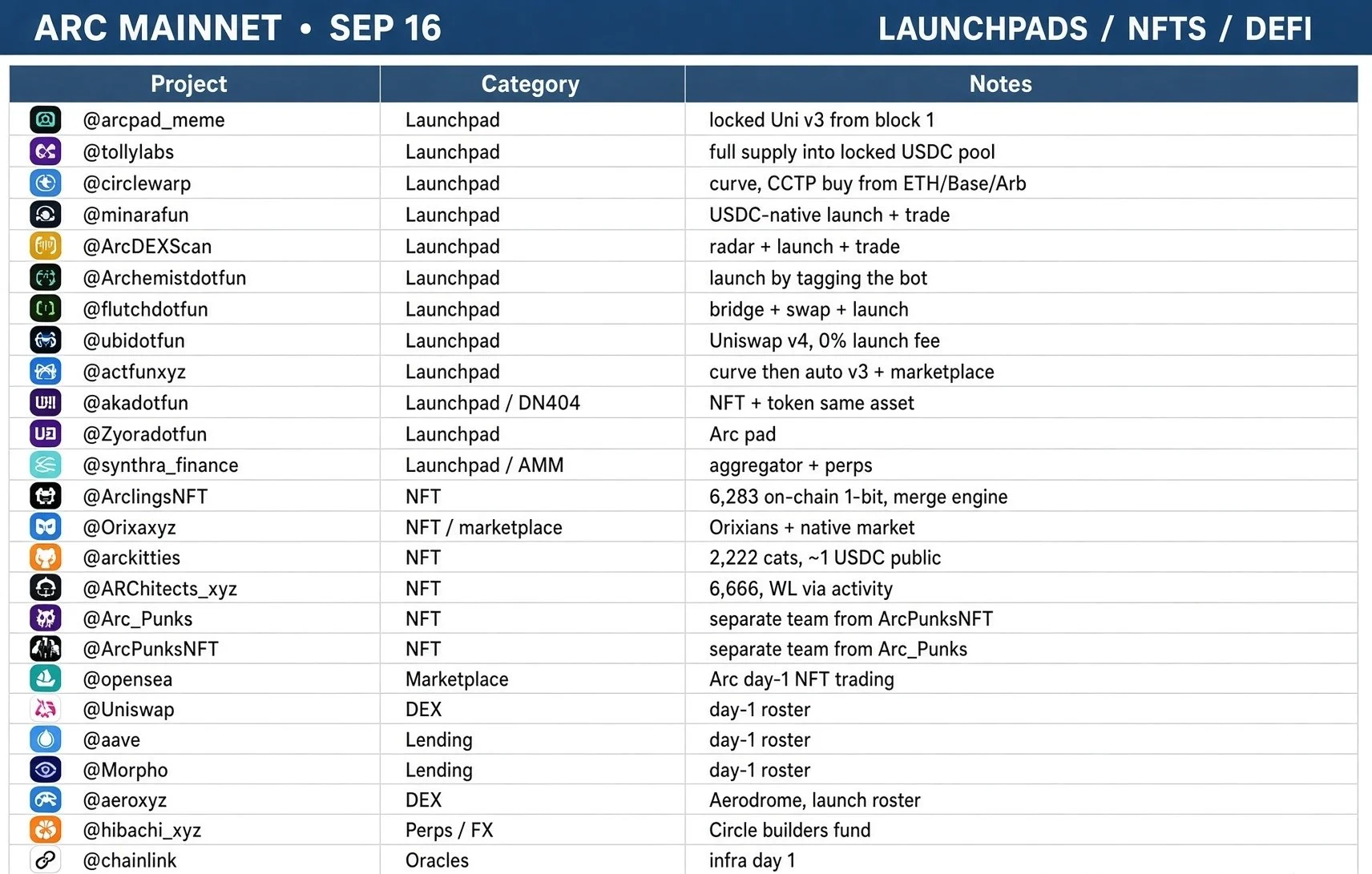
(Source: Twitter user @TheMaran)
However, it must first be clarified that since Arc's public mainnet only opens on September 16, how did the trading volumes of tens of thousands to millions of dollars, which are being circulated for these launchpads in the community, come about?
The answer lies in the underlying test channel.
Arc had previously opened a "private mainnet (early deployment environment)" to over a hundred institutions and ecosystem partners. The trading data currently being showcased in various lists are all "snapshots" taken within this closed environment, which is not yet open to the public.
Correspondingly, the platform tokens of these launchpads are also issued on Arc's private mainnet, Chain ID 5042. This chain is actually running; contracts, pools, and trades are all real deployments, but access permissions are not open to the public.
The "public mainnet" on September 16 simply opens the gate to this same chain. Therefore, these platform tokens will still exist after the 16th, and the pools will continue, which is why people are willing to position themselves in advance.
So, these early data only prove that "this launchpad's pipeline can function," and absolutely do not mean it already possesses the speculative density of a real market.
With this premise understood, let's look at the different gameplay and styles of the various launchpads currently on Arc.
Model 1: Lock Pool Upon Token Issuance, Rejecting Bonding Curves
Representative Projects:
Tolly (@tollylabs)
ArcPad (@arcpad_meme)
This approach is the most direct, without the lengthy process of Pump.fun where tokens must fill market cap in an internal pool before "graduating." After a creator issues a token, the entire supply goes directly into a permanently locked USDC liquidity pool, tradable from the first block.
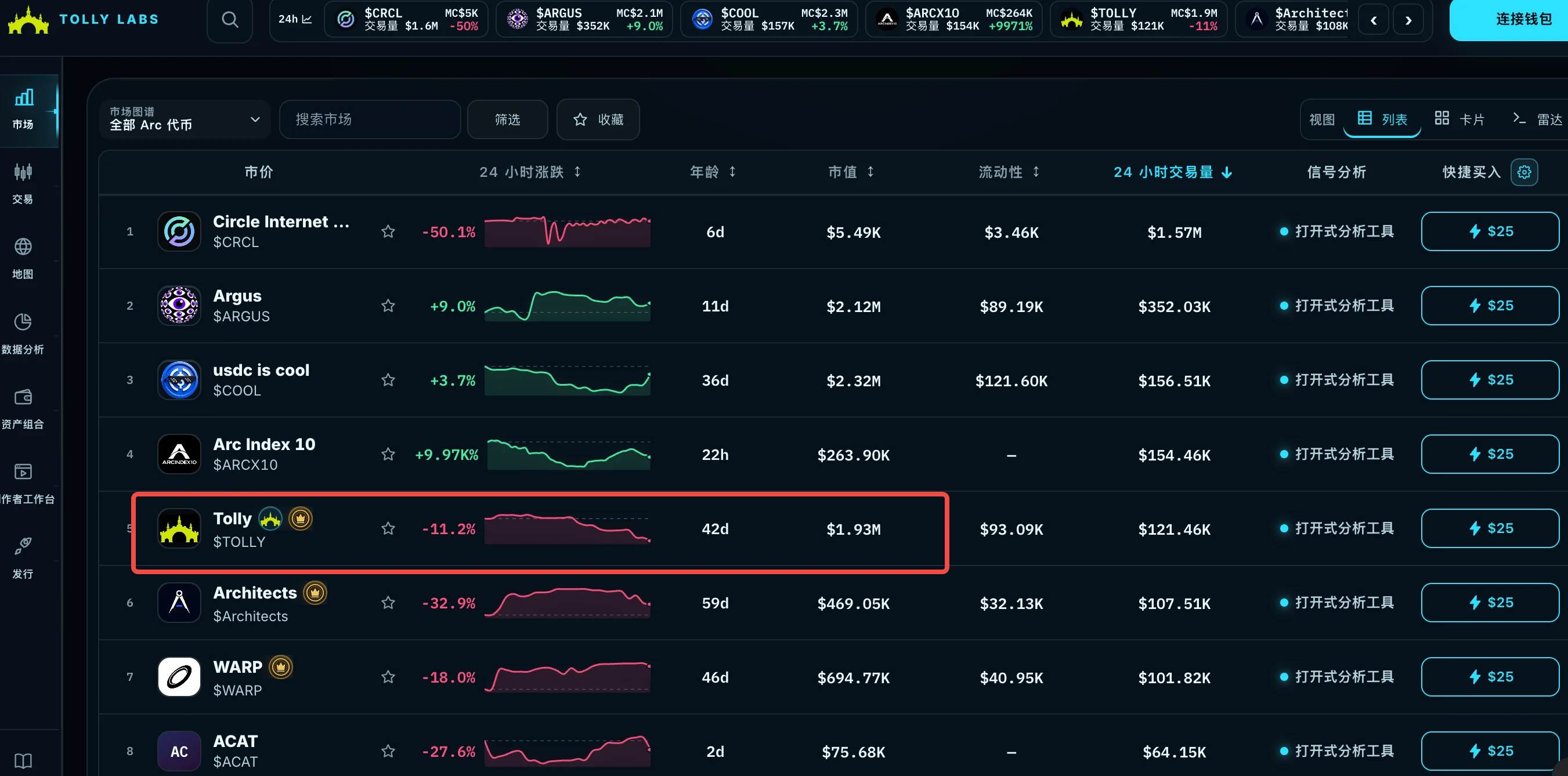
Tolly (@tollylabs): Currently has the strongest real trading data in the pre-deployment environment. Its buy-side fee is approximately 1%, precisely split (about 64% to the creator, 12% to the holder reward pool, 10% to the protocol, and the rest for buyback and burn).
Data Snapshot: Cumulative trading volume in the early environment is approximately $1.8 million. Its platform token $TOLLY once reached a market cap high of about $2.47 million.
Platform Token TOLLY (Contract: 0xbc43ce8dec648ea298c4275559b81d6261c90b67)
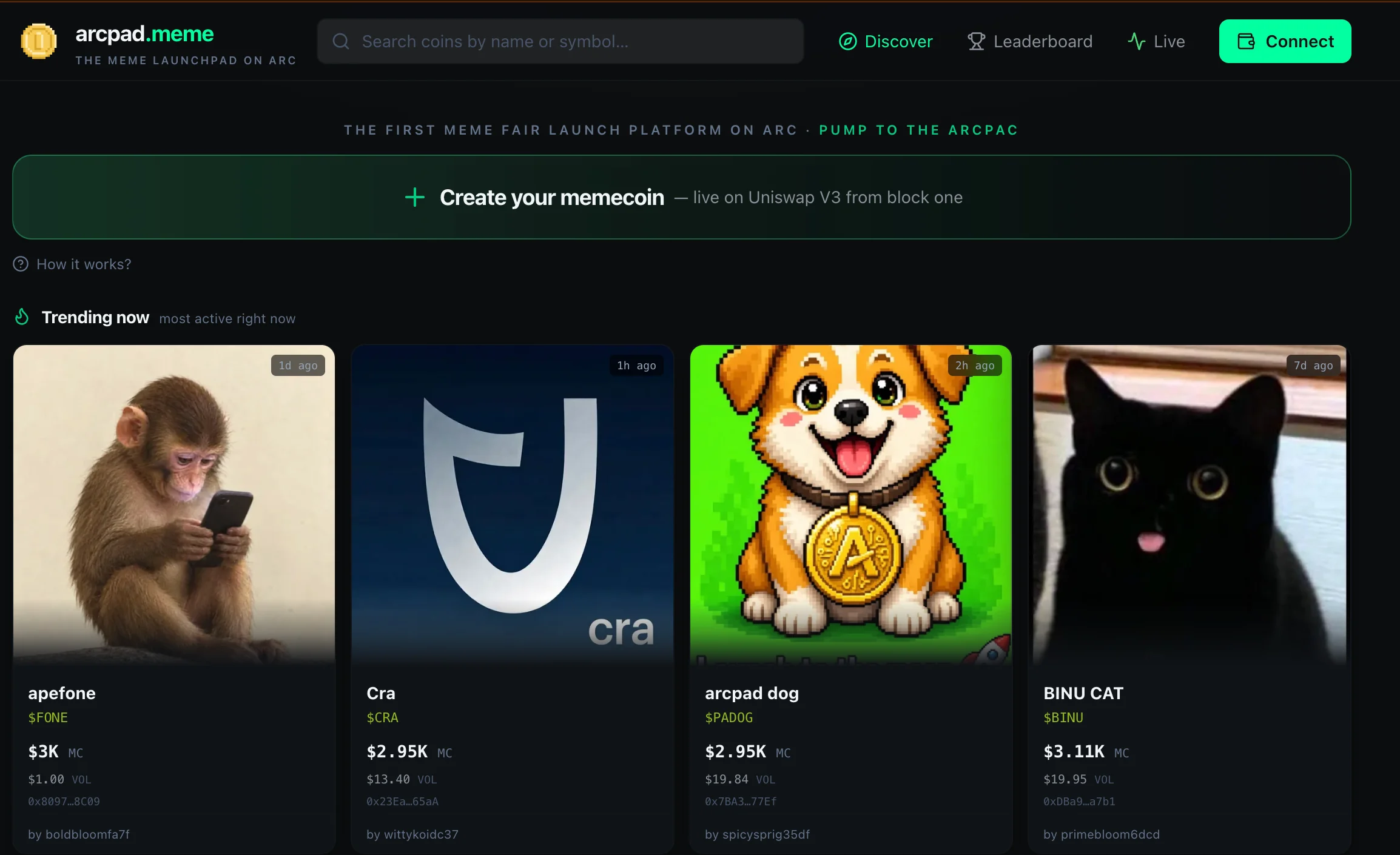
ArcPad (@arcpad_meme): Has a cleaner architecture. No internal pool; the entire supply is directly made into a single-sided Uniswap V3 position locked in a fee locker. The anti-sniping limit for a single address is set at 2%.
Data Snapshot: The cost of cleanliness is extreme difficulty in cold start. The early environment shows only about 15 tokens, with total trading volume under $30,000. The launch list on the official website has about 20 tokens, all with a market cap of around $3,000, individual trades only tens to twenty dollars, essentially in a state of neglect.
Model 2: Bonding Curve Graduation Faction, the Classic Pump.fun Path
Representative Projects:
Warp (@circlewarp)
Flipt (@Fliptfun)
This faction copies Pump.fun's approach: tokens first trade on an internal bonding curve, and after the market cap reaches a threshold, they "graduate" and liquidity migrates to a DEX. The advantage is that new tokens have the internal pool to support their cold start; the disadvantage is that the graduation rate determines everything, and tokens stuck on the curve are corpses that never made it.
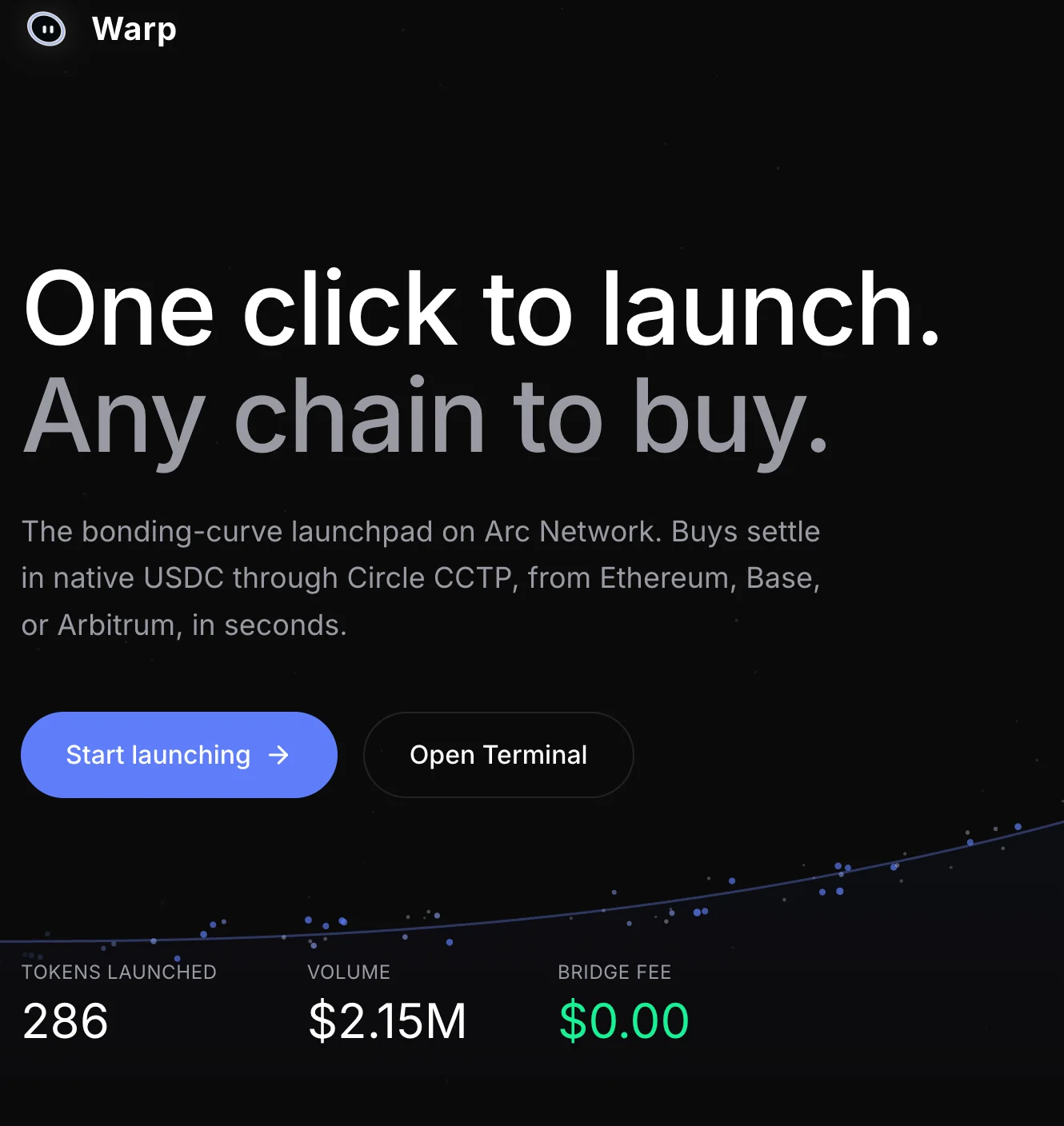
Warp (@circlewarp): Currently the only curve launchpad on Arc that has completed a full graduation process. It uses a USDC-denominated bonding curve. Once the market cap hits approximately $69,000, it automatically migrates to its own WarpDex, and the LP is burned. Another card it plays is cross-chain: using Circle's CCTP protocol, USDC from Ethereum, Base, and Arbitrum can be used to buy new tokens on Arc with one click, and the page shows zero bridge fees.
Data Snapshot: The official website shows 286 tokens launched, with a cumulative trading volume of $2.15 million. However, breaking it down, about 84% of the volume comes from its own platform token WARP. Only 1 token has successfully graduated in six weeks. The graduation threshold is too high for a cold-start meme, which is its biggest problem.
Platform Token WARP (Contract: 0x384c60f98ecd4c26345499345c03d677e40f115e), market cap approximately $870,000.
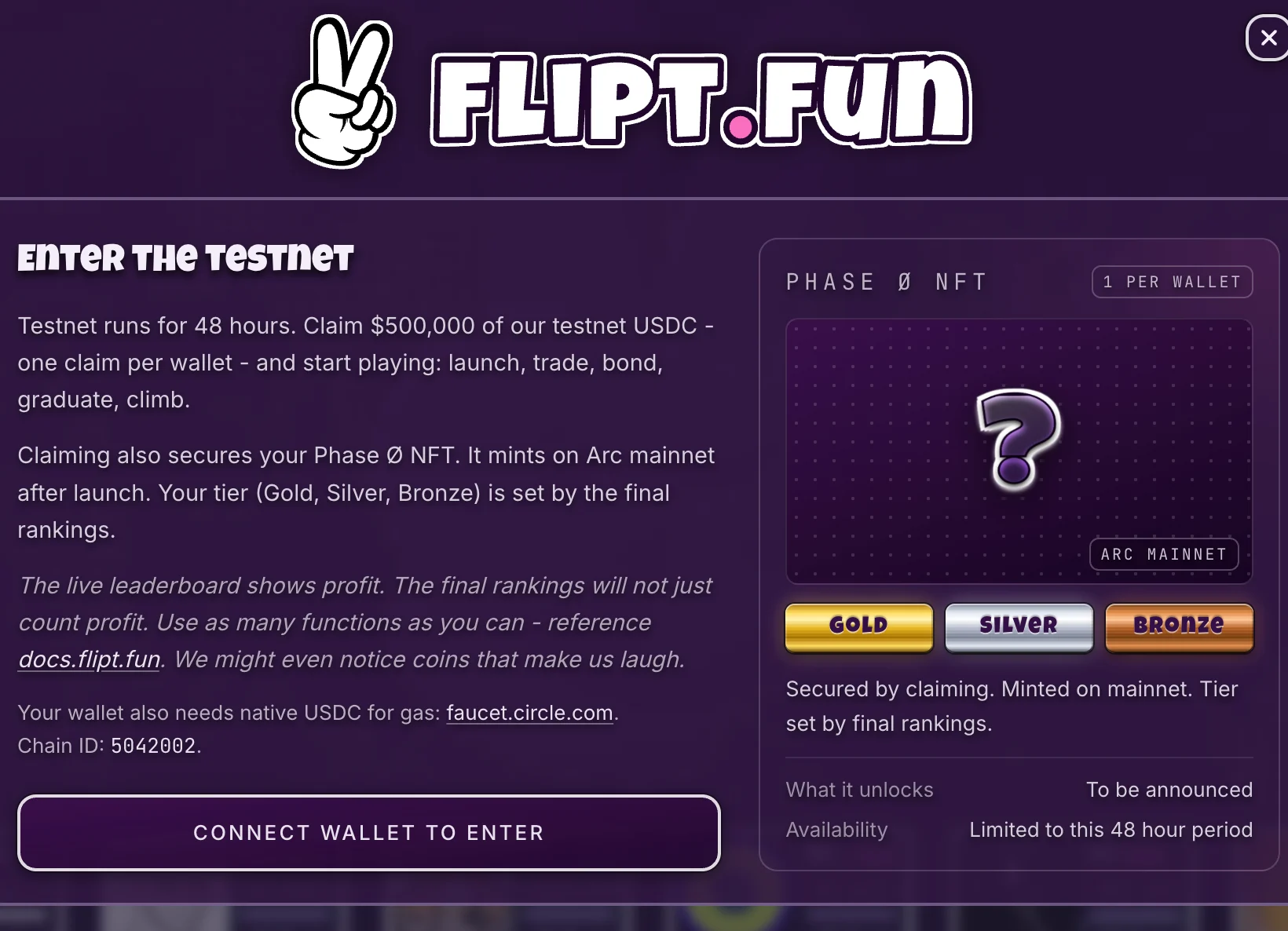
Flipt (@Fliptfun): The mainnet isn't live yet, but the testnet is open, and it currently has the highest interaction activity. It made a key modification to the curve: buyers don't receive a balance that can be dumped anytime; instead, they get a bonded position. After graduation, they share the pool's fees proportionally. To exit, they must publicly queue for 90 seconds, making large withdrawals visible to everyone. Dumping has changed from a backroom operation to an open card.
Data Snapshot: The graduation fundraising line is approximately $6,375, the graduation market cap is about $30,000, the curve trading fee is 1.25%, of which 0.75% is distributed to bonders. The testnet window is 48 hours, each wallet can claim 500,000 test USDC, and based on final rankings, gold, silver, and bronze tier NFTs are awarded, mintable after the mainnet launch.
Platform Token: None currently.
Model 3: Social Bot Faction, Issue a Token Just by Shouting on X
Representative Project: Archemist (@Archemistdotfun)
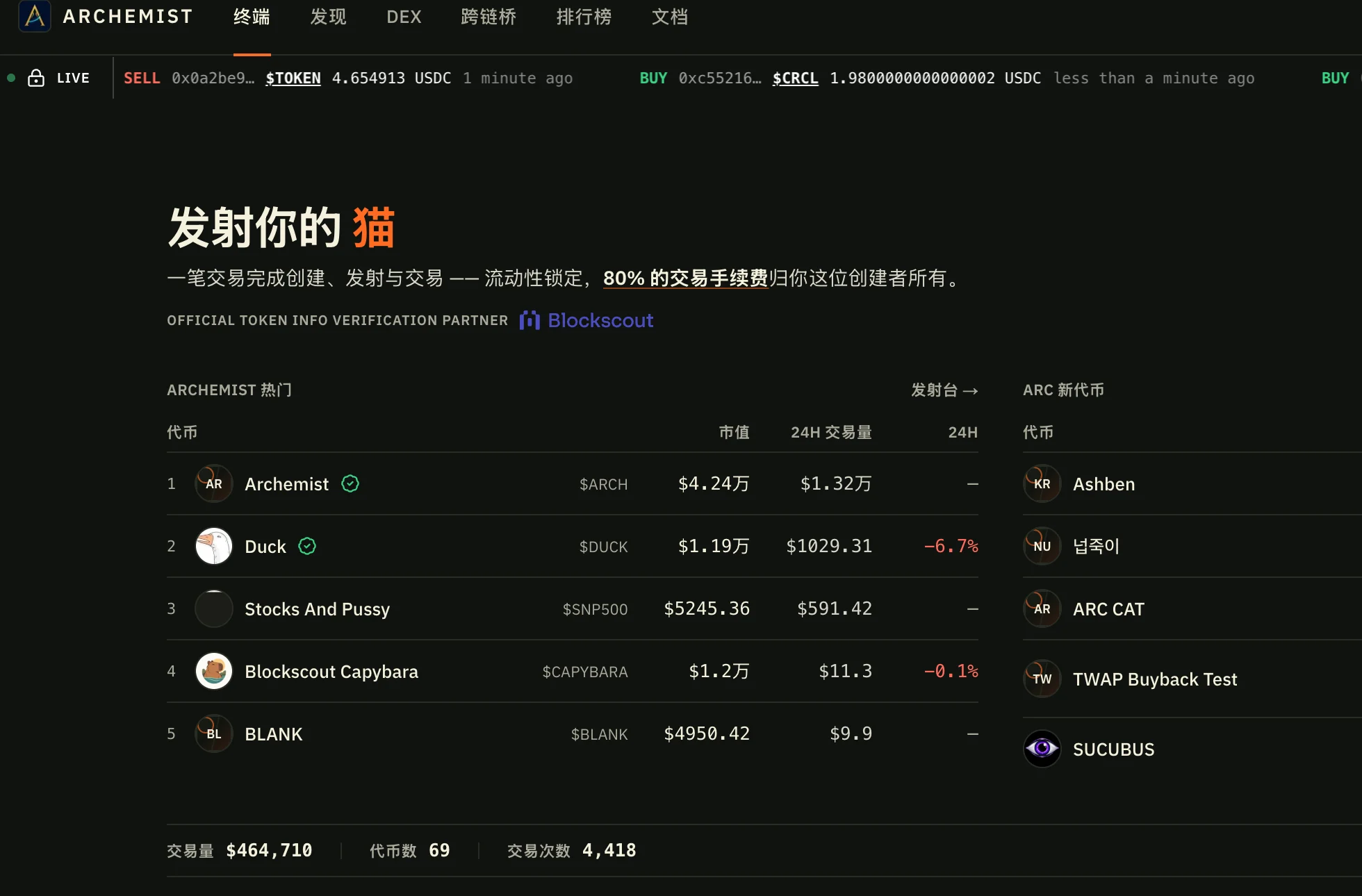
This faction lowers the barrier to issuing tokens to the minimum. No need to open a website; just @ the bot on X, and a single tweet can complete creation, launch, and trading, with liquidity automatically locked.
Another card it plays is creator revenue sharing, taking up to 80% of trading fees, clearly aimed at attracting token issuers.
Data Snapshot: Cumulative trading volume in the early environment is approximately $337,000, with about 49 tokens launched. About 77% of the volume depends on its own platform token ARCH. The official website homepage shows it has partnered with block explorer Blockscout for token information verification, allowing contract information for each token to be verified directly on the explorer.
It's worth noting that at the time of writing, its official website counter showed zero trading volume and zero tokens, likely due to a data reset before the mainnet switch, reducing the reference value of early trading data.
Platform Token: ARCH contract address and market cap are not publicly verifiable; they need to be reconfirmed after the mainnet launch.
Model 4: Uniswap V4 Faction, Embedding Dividends into the Trading Layer
Representative Projects: ubi.fun (@ubidotfun), Minara (@minarafun)
This camp is betting on Uniswap V4. V4's Hook mechanism allows launchpads to embed rules such as dynamic fees, holder dividends, and automatic buybacks directly into the trading layer, eliminating the need for token taxes. Its technical narrative is the most cutting-edge among the camps, but its current state is also the coldest.
ubi.fun (@ubidotfun): Claims to be the only Uniswap V4 launchpad on Arc, with zero fees for token creation, trading fees distributed to creators and eligible holders, and a direction of "universal dividends for holders." The official website clearly states there is currently no platform token.
Data snapshot: No platform token yet. On the official website's activity feed, most transactions are small purchases ranging from tens to two hundred dollars. The most recent launch was 6 days ago. According to third-party statistics, only 3 tokens have been launched cumulatively, with total trading volume of approximately $4,800, and the holder reward pool once held only $1.38. The mechanism looks good on paper, but no funds have yet been willing to enter for verification.
Minara (@minarafun): Also based on Uniswap V4, focusing on USDC native liquidity and low-friction token issuance. There are rumors in the community about a "Circle Ventures background," but the project team has not confirmed this, so treat it as a rumor for now. The official website is live, but the token list is currently mostly empty.
Data snapshot: No platform token yet, no trading data yet. It's worth noting that third-party reviews point out that its rules allow creators to take up to approximately 80% of the allocation at launch. This design is unfriendly to buyers and is worth monitoring closely after the mainnet goes live.
Model Five: Token-Equity Pairing and Others
The review includes two names whose gameplay differs from the four factions above, with different risk levels, so they must be singled out.
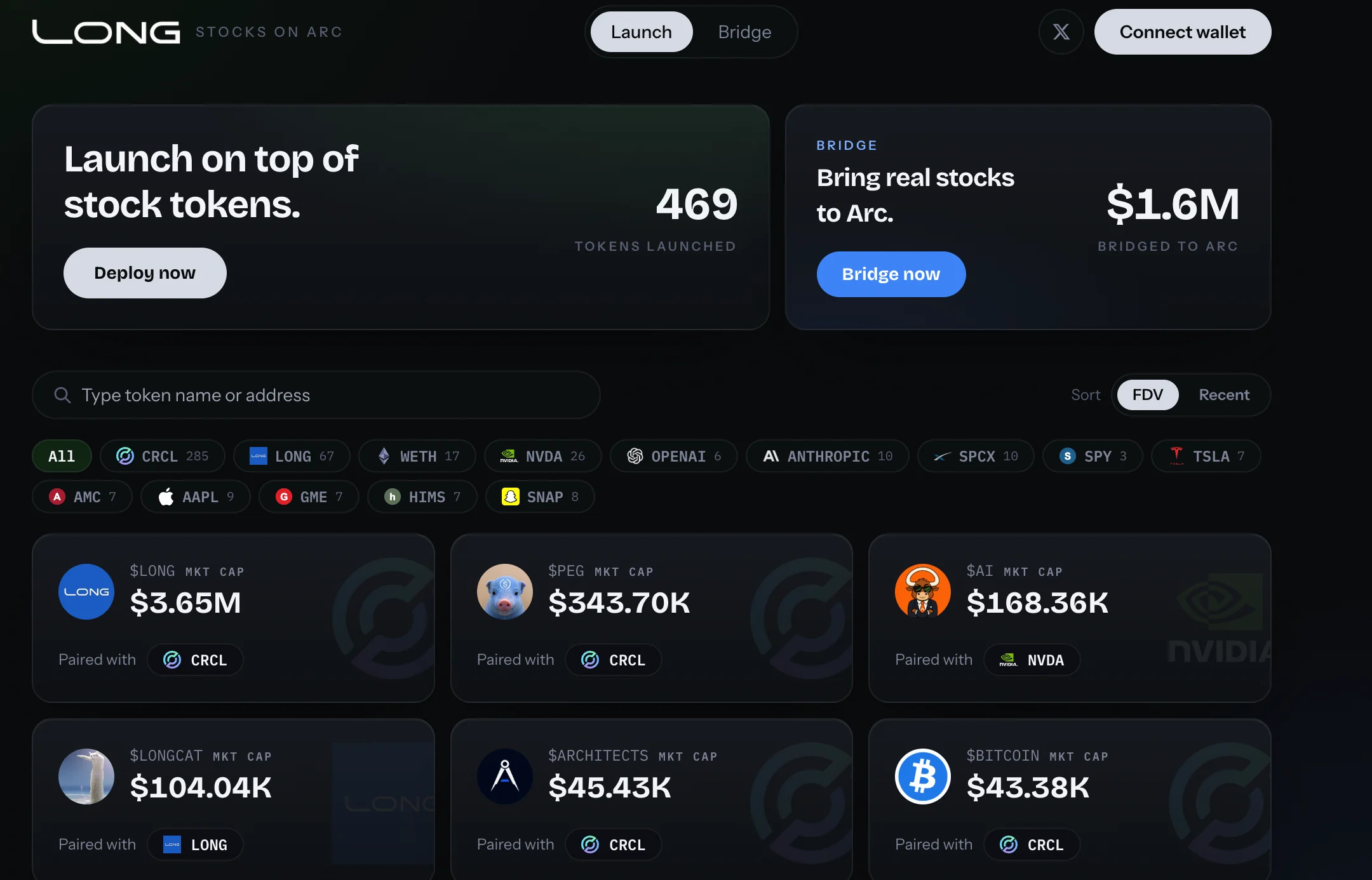
Long.supply (@Longdotsupply): It doesn't do "meme vs. USDC," but rather "meme vs. equity tokens."
The gameplay involves first bringing equity tokens (CRCL, NVDA, and even the unlisted Anthropic) into Arc via its own cross-chain bridge, then pairing memes with these equity tokens to form trading pairs.
The official website shows that the platform token LONG (contract: 0x2164bb17a2d38c1b5170e987b2c0416df1efc752) has a market cap of approximately $3.61 million, the highest among all launchpad platform tokens currently, with funds in the bridge showing approximately $1.6 million.
However, a noteworthy issue is where these "equities" come from. They are not compliant equity tokens like those on Robinhood, but rather tokens minted by the project team itself: who holds the underlying assets, whether they can be redeemed for real equities, and whether the bridge can be unilaterally shut down by the team, all remain unanswered publicly. Further observation can be made after the mainnet goes live.
act.fun (@actfunxyz): A launchpad that hadn't opened for business before.
The one that best times its moves. The platform is already running: its platform token ACT pre-sale was completed on its own platform, ending today (September 14). Both tiers of the $30,000 target were fully subscribed: the Architect tier with an FDV of $50,000, and the Public tier with an FDV of $200,000.
The ACT contract has been announced (0x177b47be2782575284211A000EDA4112807288a5), with the official launch set for September 16, the day the mainnet opens, with claims and refunds opening simultaneously. This effectively means selling a round of its platform token before the mainnet gates open.
However, on-chain code checks show that the contract Owner still retains emergency withdrawal privileges. The pre-sale being fully subscribed indicates genuine hype, but until the permissions are renounced, the promise of "LP locking" remains just a promise.
Additionally, the page has a bit of an AI Coding feel to it...
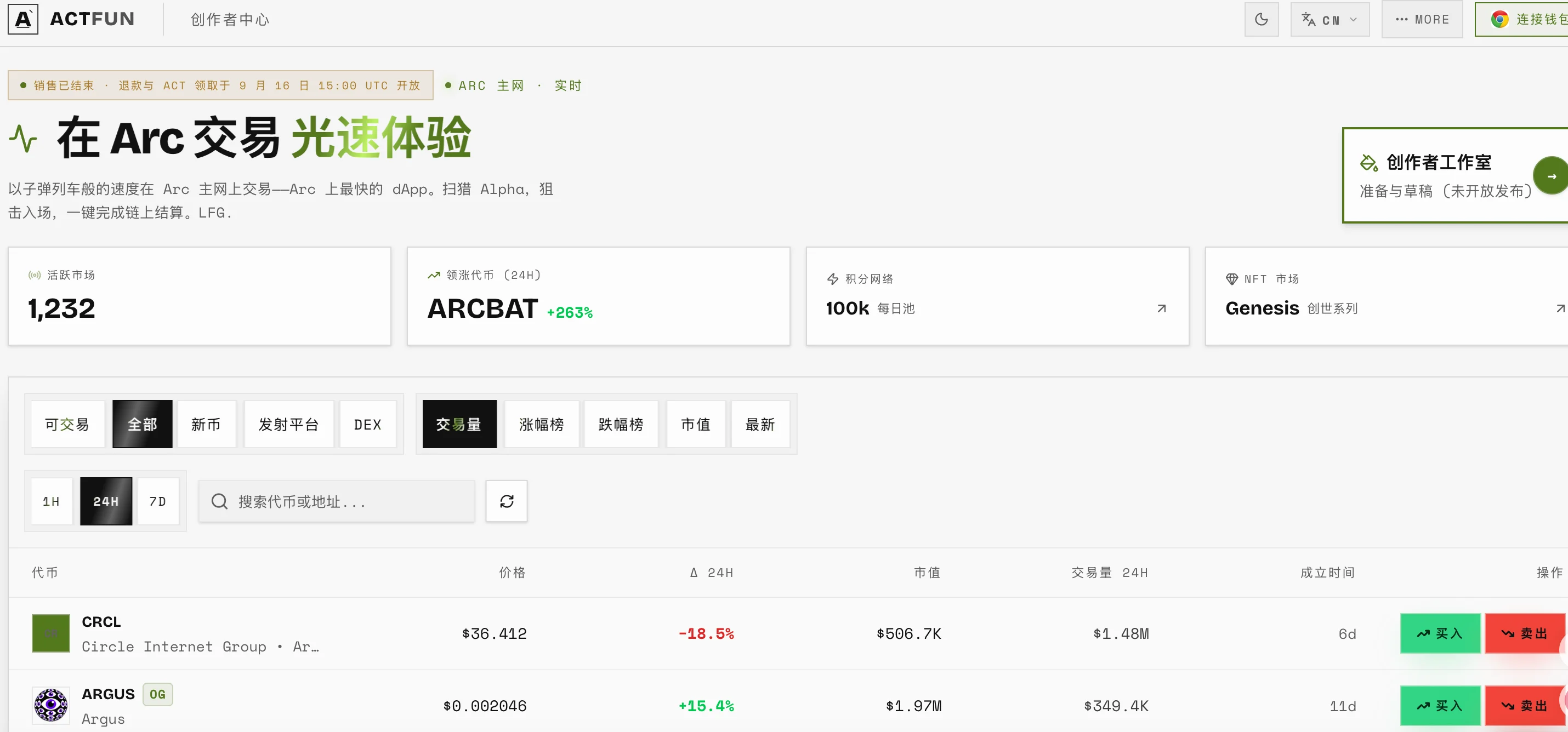
Reviewing this far, it's clear that all current trading volume and market caps are previews run in a closed environment by a few hundred addresses that paid a premium to enter. The real test will be when the gates open on the 16th.
Due to space constraints, there are some other promising projects that couldn't be covered in more detail. Currently, some analysts in the community have compiled a list, rating the launchpads, providing a reference for everyone's research.
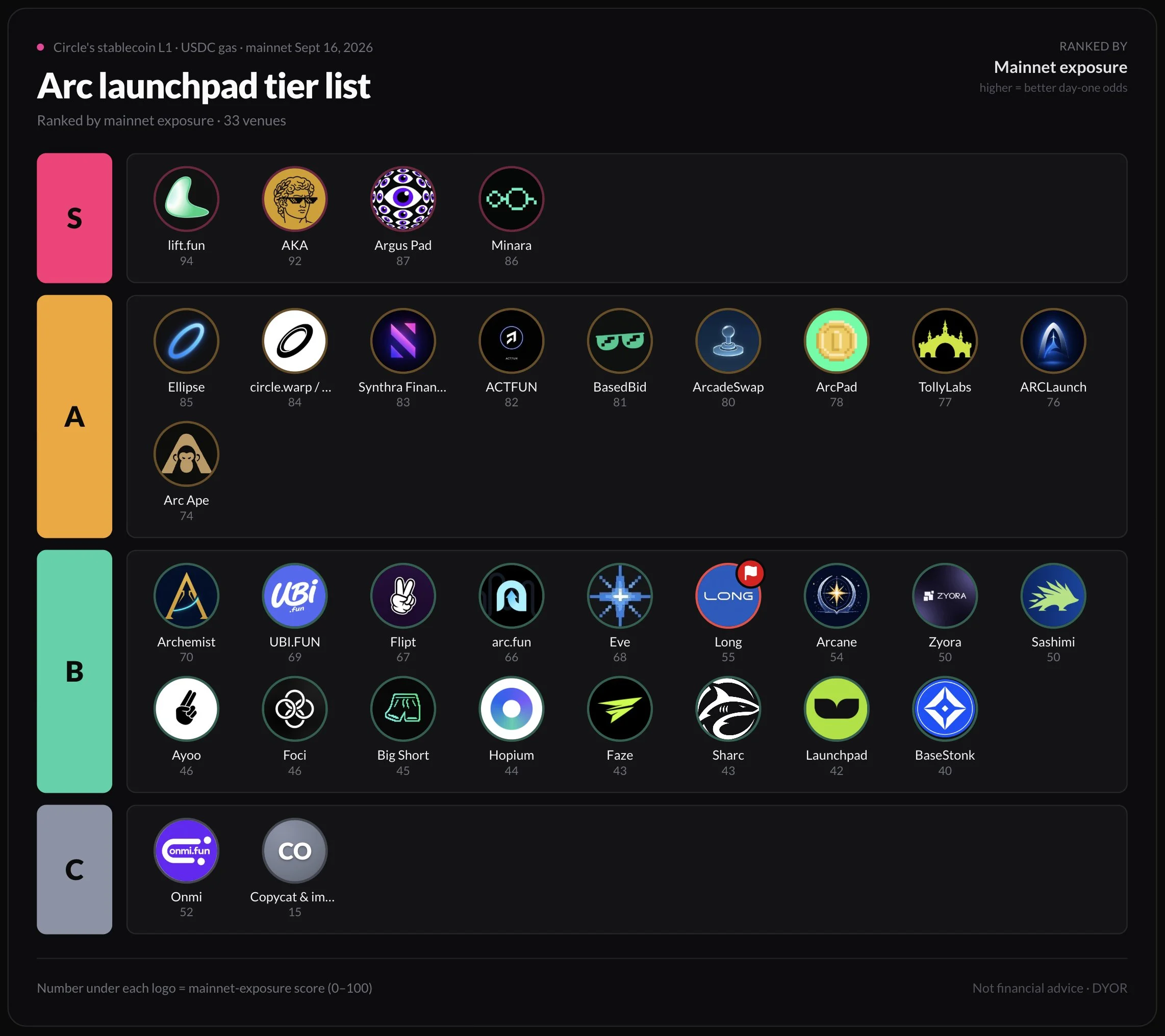
(Source: @Nick_Researcher)
Overall, regarding these platforms, we can focus on the following points for these projects:
First, watch which launchpad sees the first independent trading volume for a "non-platform token."
Currently, the volume for Tolly, Warp, and Archemist is deeply tied to their own platform tokens. Whoever can first launch a meme that trades based on its own hype, independent of the platform token, will be the true faucet.
Second, watch for promise fulfillment.
Flipt's mainnet, act.fun's LP locking and permission renunciation, aka.fun's "see you on the 16th" — these statements will be verified or disproven within 48 hours.
Third, will the Arc chain itself falter?
Whether the official RPC, explorer, and Uniswap are truly open to the public, and whether USDC can flow in and out smoothly, are all unknowns. We've seen too many amateur operations; despite top-tier institutional backing, how it actually performs will be seen on the day.
Finally, as usual, a reminder: All projects mentioned in this article are in an extremely early stage. Most contracts have not been audited. Pre-mainnet data does not represent public mainnet performance. Crypto projects carry significant risk, so please DYOR.