After the Golden Week holiday, US Treasuries are still "in the ICU": How does Wall Street see it now?
 Tapbit Wire
As Chinese investors return to the market after the National Day Golden Week holiday, they will undoubtedly find one scene almost identical to what they saw before the break — bonds in developed markets, led by US Treasuries, are still facing heavy selling pressure...
Market data shows that on Wednesday, as the latest round of global bond selling intensified, the 10-year US Treasury yield at one point rose to as high as 5.36%, while the 30-year US Treasury yield reached 5.73% — both hitting their highest levels since 2002. At the same time, benchmark government bond yields in France and Italy also rose sharply. The UK 30-year government bond yield even touched its highest level since 1998.
When bond prices fall, their yields rise. Although later on Thursday, after the US Treasury auctioned $39 billion worth of 10-year notes that saw strong demand, long-dated US Treasury yields pulled back somewhat in the New York afternoon session. Still, the auction's awarded yield came in at a high 5.3%, the highest stop-out rate for any 10-year US Treasury auction since November 2000.
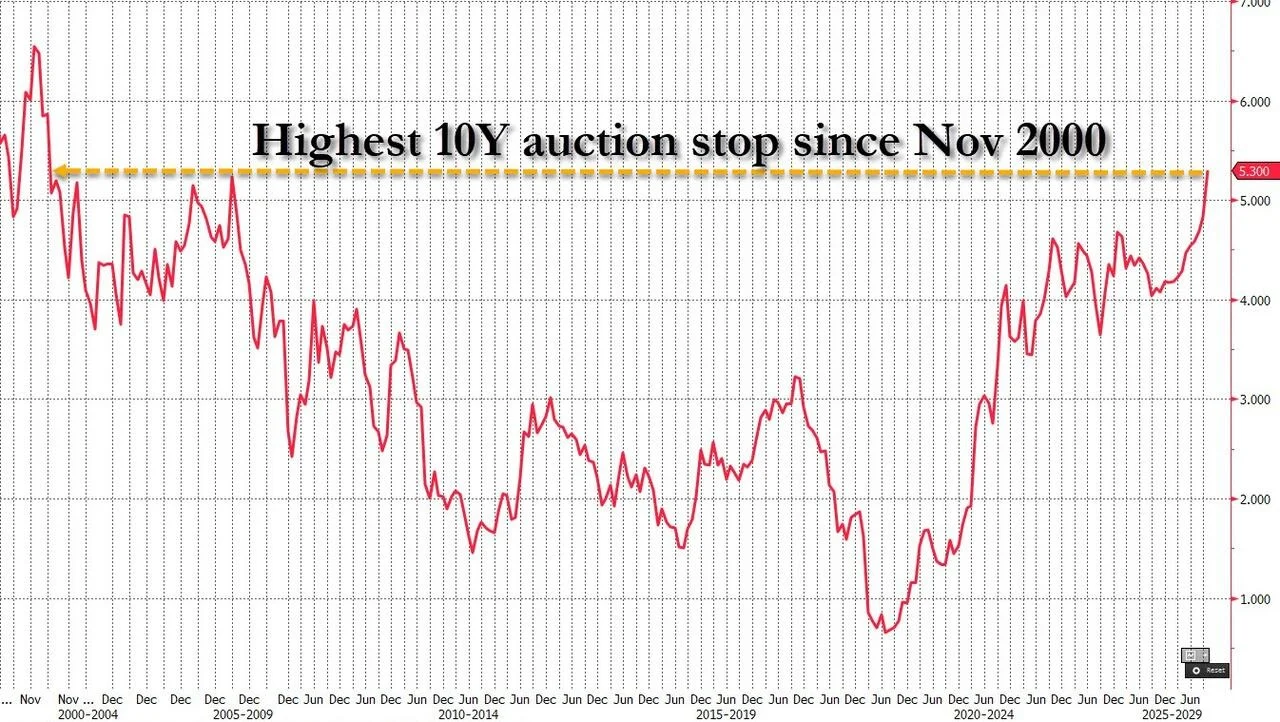
On Thursday, the US Treasury will also conduct a $22 billion 30-year bond auction, whose issuance yield may likewise be the highest since 2000. After that, the US Treasury will carry out long-dated bond buybacks — potentially repurchasing up to another $6 billion of bonds with maturities of 20 to 30 years.
It can be said that during this National Day holiday, when Chinese investors were away, the pressure on global bond markets did not ease much; instead, more epicenters of the storm emerged.
On Fed policy expectations, since the September FOMC meeting, market expectations for another Fed rate hike in October have fluctuated several times. LSEG data shows the market currently sees a 22% probability of an October hike, down sharply from roughly 70% at the start of last week, though the market still expects several hikes over the coming year.
After Iran stepped up attacks on oil tankers passing through the Strait of Hormuz in recent days and pushed oil prices higher, geopolitics also remains a key focus for global bond markets. Throughout the entire Golden Week holiday, Brent crude continued to hover at elevated levels near the $100 mark.
First Abu Dhabi Bank chief economist Simon Ballard said, "Clearly, the shadow cast by the geopolitical landscape, along with the persistently high price pressures associated with it and the rise in government bond yields, continues to weigh on market sentiment and overall risk appetite."
Meanwhile, France's budget negotiations and the nationwide protests that followed have put European markets on edge, and have made French government bonds the "new epicenter" of the global long-dated bond crisis.
Tradeweb data shows the 10-year French government bond yield surged nearly 14 basis points on Wednesday to 4.889%. By comparison, the 10-year German government bond yield rose only 3.3 basis points to 3.507%; the spread between 10-year French and German government bond yields was last at 139 basis points, once again approaching the peak of nearly 159 basis points touched last Friday.
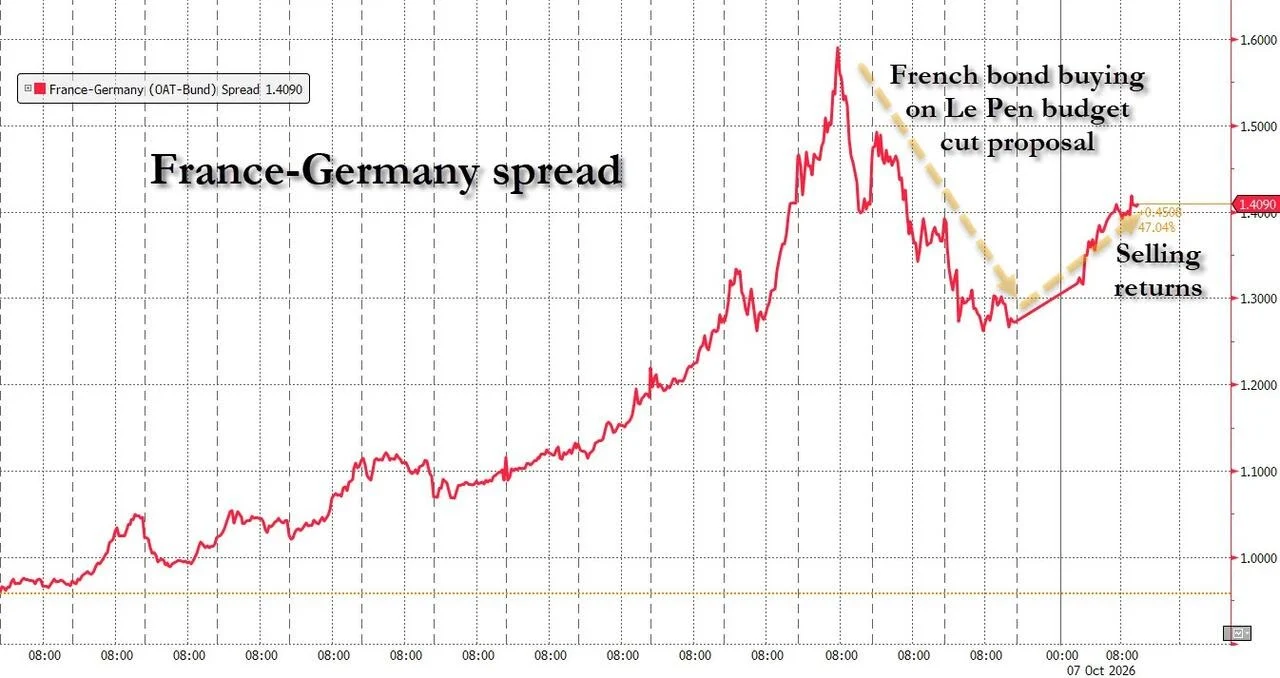
"France is rapidly becoming the focal point of the European bond sell-off," said Mitch Reznick, head of cross-border credit at Federated Hermes Limited, in a report. "The speed of this move matters. Investors are selling French government bonds and rotating into higher-quality German government bonds, which is further widening the yield spread between the two."
How does Wall Street see the bond market's direction now?
At present, there is still a clear divide among Wall Street strategists over whether US Treasury yields will fall sharply by year-end or set new highs.
The bond bulls, led by Goldman Sachs Group's William Marshall, remain firmly bullish on yields moving lower. They are betting that the market has overreacted to concerns about persistently high inflation and massive government debt, which could lay the groundwork for a potential year-end rebound in US Treasuries. However, bears such as Anshul Pradhan, head of US rates research at Barclays Capital, remain firmly opposed, arguing that yields will continue to climb and stay elevated for a long time.
At the same time, this does not mean either side thinks the future path will be easy to predict.
Right now, a host of uncertainties is clouding the bond market outlook: the energy price shock from the Iran war, the Fed's policy path of pivoting back to rate hikes, and the booming AI wave that continues to inject strong momentum into the economy... These uncertainties have all made it far more difficult to judge where the bond market is headed.
The bearish camp
Barclays Capital has now raised its forecast for the 10-year US Treasury yield in the third quarter of 2027 from 5% to 5.25%, and believes there is little reason in the near term to push yields lower.
"As long as the US economy remains resilient, we don't see a specific catalyst right now for yields to fall below 5%," wrote Anshul Pradhan, head of US rates research at Barclays Capital, in a recent report. If the US economy stays resilient, the 30-year Treasury yield could hit 6%.
"The market is still pricing in a long-run neutral rate of roughly 3.5%, and we think there is room for productivity to surprise to the upside over time. If that happens, the market could reprice this long-run rate higher. In our view, that would push the 30-year yield toward 6%, or at least make 6% the fair value yield for the 30-year bond."
Analysts at Denmark's Danske Bank also believe long-dated US Treasuries face the risk of further pressure.
"The pressure is concentrated at the long end of the US Treasury yield curve, driven not only by heavy US Treasury supply but also by the impact of bond issuance from hyperscale cloud service providers," wrote Danske Bank chief analyst Jens Peter Sorensen in a report. "As investors demand a higher term premium at the long end, we do see a risk that 10-year and 30-year US Treasury yields could reach 6%."
In addition, Bank of America currently forecasts the 10-year US Treasury yield will be at 5% by year-end, consistent with its economists' view of the rate path — namely, that the Fed will hike at its next two meetings in October and December, bringing the economy back to an "equilibrium" state. However, the team led by Mark Cabana, co-head of global rates strategy at Bank of America, has already put forward a series of trade recommendations based on the assumption that yields may continue to rise.
He said, "We think it is still too early to trade against the trend. Although our yield forecast is lower, and although we are still judging based on a baseline scenario for the US economy, from the perspective of the balance of risks, we think the probability of rates moving higher is currently greater than moving lower."
The bullish camp
Of course, some market participants now also believe that long-dated yields gradually approaching the 6% mark may already be attractive enough to drive a year-end rebound in the bond market. Wednesday's strong 10-year Treasury auction highlighted that some investors are snapping up long-dated bonds.
Goldman Sachs expects the 10-year US Treasury yield to fall to 4.75% by year-end, giving back nearly 60 basis points from Wednesday's high.
Goldman Sachs head of US rates strategy William Marshall said, "I think the positive medium-term outlook we currently hold remains justified. Underlying inflationary pressures are already fairly well contained. And the reasons inflation is currently elevated are either issues like tariffs that are largely in the past, or events like the 'ongoing conflict' in Iran. Our base-case forecast is that these factors will eventually ease, at which point the market's focus will return to more fundamental structural basics."
JPMorgan, meanwhile, expects the 10-year US Treasury yield to fall to 5.05% by year-end, which would mark the yield's "first return to fair value in six months."
In addition, Morgan Stanley expects the 10-year US Treasury yield to fall to 4.8% by year-end.
Morgan Stanley rates strategist Martin Tobias noted, "The hawkish sentiment currently priced into the market is far more pessimistic than our economics team's probability-weighted expectations for the Fed's path. By comparison, the bearish baseline (adverse scenario) we set for the 10-year Treasury is 5.25%, yet the spot market has already fully priced in this pessimistic expectation; conversely, the bullish baseline (favorable scenario) of a deep recession triggered by a global crude oil crisis corresponds to a yield falling to 3.8%. Given that forward contracts in the market have actually already priced in bearish expectations, we believe the risk skew for Treasury yields favors a move lower."