
The creator economy has always had a value problem. Creators build audiences, publish content, start trends, and shape online culture. But most of the financial upside still flows through centralized platforms, advertising systems, sponsorships, and algorithms that creators do not control.
ZORA is trying to change that. Instead of treating posts, profiles, memes, and cultural moments as content that only generates likes or views, ZORA is turning them into on-chain assets that can be created, traded, and monetized.
That is why ZORA has become one of the more interesting SocialFi and creator economy experiments in crypto.
But the market is still cautious. CoinGecko recently showed ZORA with a market cap around $28.65 million, 24-hour trading volume around $17.16 million, and about 4.5 billion ZORA circulating out of a maximum supply of 10 billion. It also showed ZORA trading roughly 95.6% below its all-time high of $0.1456.
That tells us something important. ZORA has a strong narrative, but the token still needs stronger market confirmation.
What Is ZORA?
ZORA started as a crypto-native creator platform and protocol, but its direction has expanded beyond traditional NFTs.
Today, the project sits at the intersection of SocialFi, tokenized content, creator monetization, and attention markets. Its main idea is simple: online creativity and attention can become programmable markets.
Instead of only posting content and hoping platforms reward engagement, creators can launch coins around their profiles and content. Communities can participate earlier. Traders can speculate on cultural momentum. Developers can build around the creator economy layer.
This makes ZORA different from a standard NFT marketplace. The project is not only about collecting digital art. It is about turning creator activity and internet attention into financial rails.
Creator Coins Are the Core Product
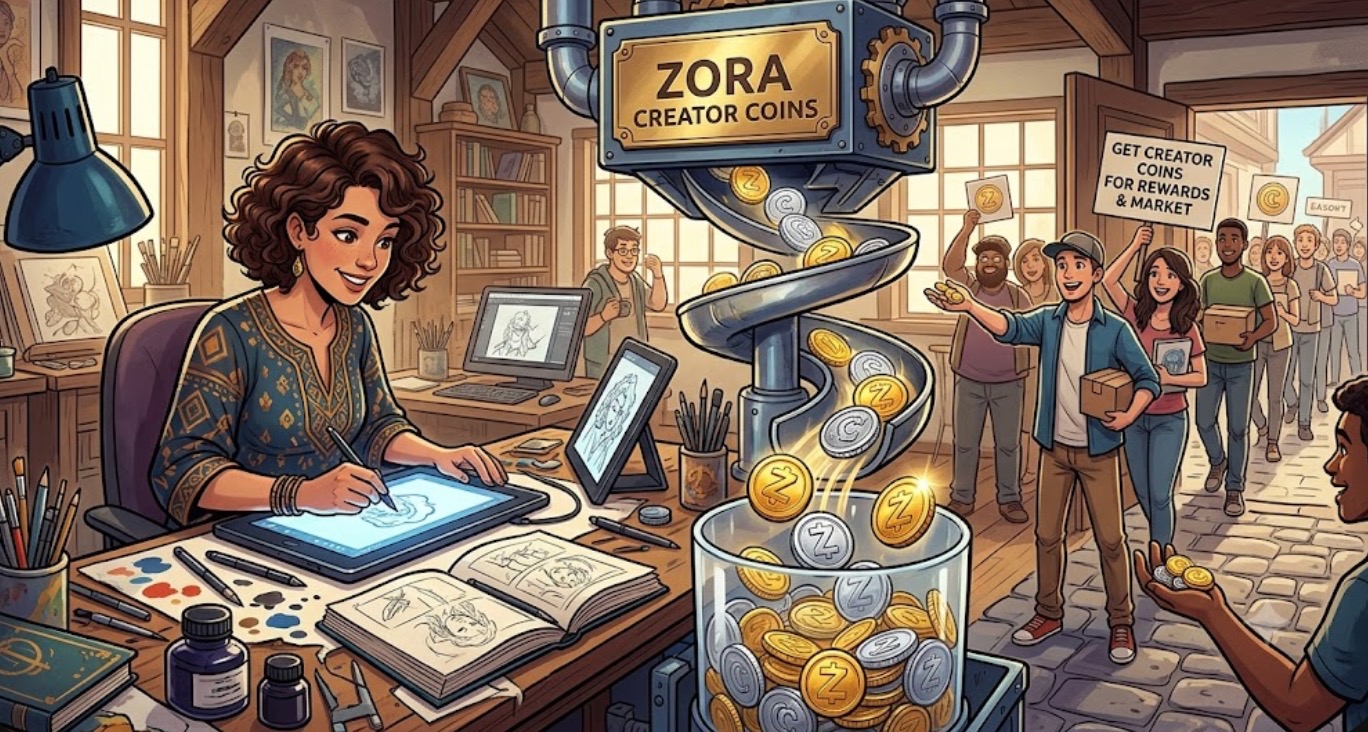
Creator Coins are one of ZORA’s most important features.
ZORA’s own support documentation describes Creator Coins as profile-level coins. In simple terms, a creator’s profile can have its own coin, and posts can be paired with that creator coin. ZORA’s creator page says each profile becomes a tradable Creator Coin with 1 billion total supply, and 50% of that supply flows to the creator over five years.
This creates a new incentive model. A creator does not only earn from ads, subscriptions, sponsorships, or NFT drops. They may also earn from market activity around their profile and content.
ZORA’s reward documentation shows that Creator Coins and Pair / Content Coins carry a 1% trading fee, with 0.5%going to the creator and 0.2% going to market contribution. Trend Coins have a lower 0.01% trading fee, and their initial market is deployed by ZORA with all supply going directly into the market.
That is the business model in one sentence: ZORA wants creators to earn from the markets formed around their work.
Attention Markets Push the Idea Further
ZORA’s Attention Markets take the creator coin idea into a more speculative area.
CoinDesk reported in February 2026 that ZORA launched Attention Markets on Solana, allowing users to trade tokens tied to internet trends, memes, topics, hashtags, and cultural moments. The report described the product as a way to trade social-media traction and noted that anyone could pay 1 SOL to create a market. It also warned that early trading was thin and volatile.
This is where ZORA becomes more than creator monetization. It becomes an attention economy marketplace. If a meme is rising, users can trade it. If a cultural moment is gaining traction, a market can form around it. If online attention becomes valuable, ZORA wants that attention to become liquid.
The idea is powerful, but risky. Attention moves quickly. It can spike in hours and disappear the next day. That makes Attention Markets exciting for traders, but also difficult to value.
Why Solana Matters
ZORA’s move into Solana is important because attention markets need speed, low fees, and fast user behavior. Solana is already one of the most active ecosystems for meme coins, speculative markets, and rapid token launches. That makes it a natural environment for attention-based trading.
CoinDesk noted that ZORA’s move onto Solana marked a shift beyond its NFT and creator roots, while also drawing criticism from some Base community members because ZORA had been closely associated with Base creator products.
This creates a two-chain strategy. Base can remain important for creator tools and ZORA’s social layer. Solana can support faster-moving attention markets and trend-based speculation.
If ZORA can connect both sides well, it may gain access to two different audiences: creators on one side and high-velocity crypto traders on the other.
ZORA Is Not Just Another SocialFi Project
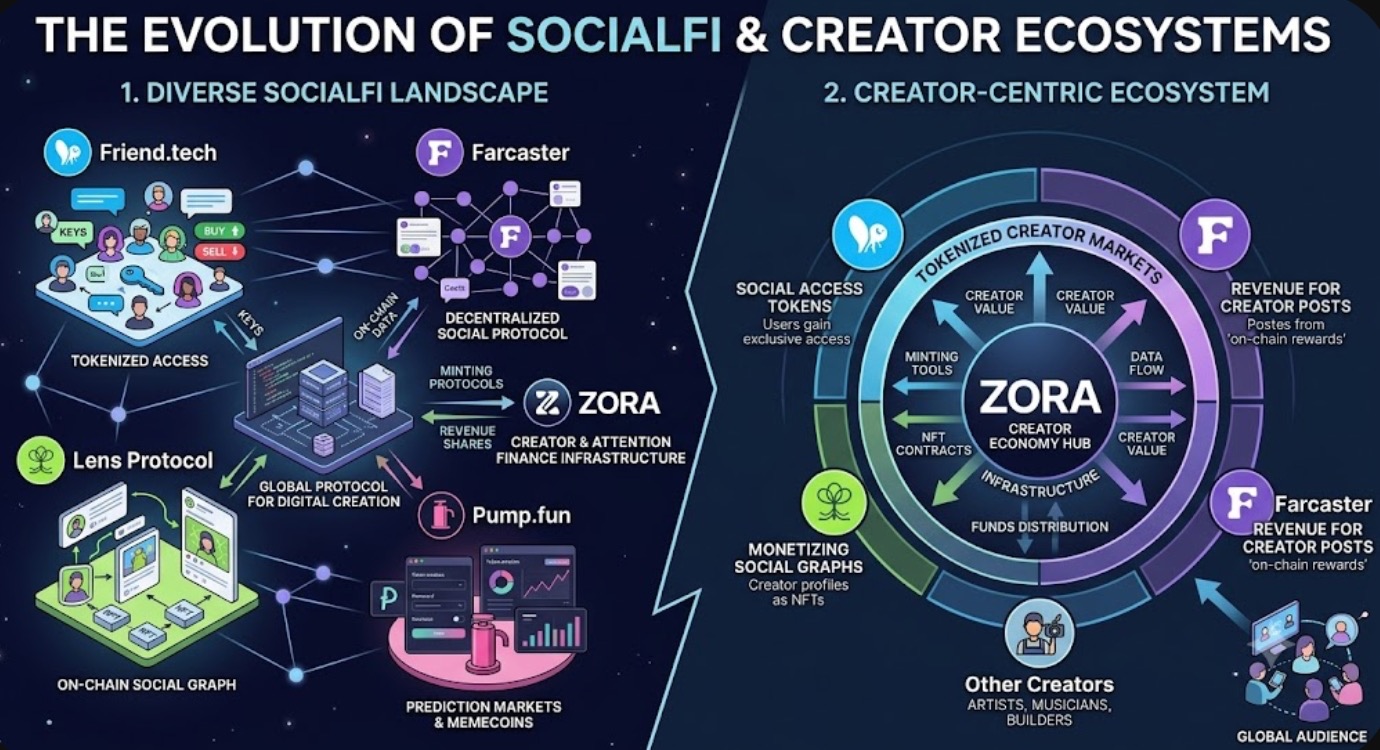
ZORA is often grouped with SocialFi, but its model is more specific. Friend.tech focused heavily on social access. Farcaster is a decentralized social protocol. Lens is more focused on social graph infrastructure. Pump.fun made token creation extremely easy and fast. ZORA sits somewhere different.
Its focus is creator-linked markets. That means profiles, posts, content, and trends can become tradable assets. This is not only about messaging or following people. It is about financializing cultural attention.
That is both ZORA’s opportunity and its biggest risk. If users like the idea of trading creator momentum, ZORA could become a major on-chain creator economy platform. If users see it as pure speculation around content, the model may struggle to retain long-term trust.
The Token Still Faces Market Pressure
The product story is interesting, but the token story remains more cautious.
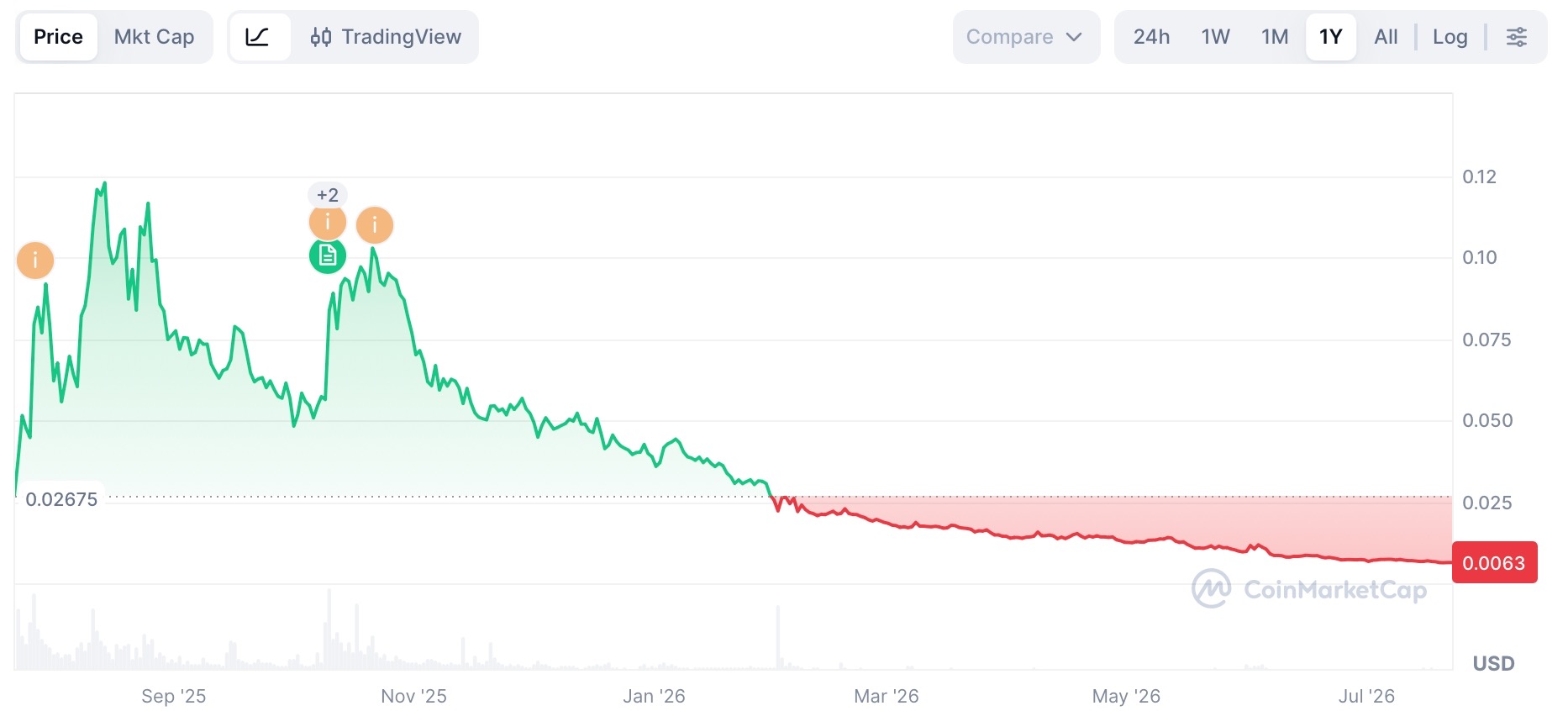
CoinGecko data shows ZORA still trading far below its historical high. A token down more than 95% from its peak needs more than a good narrative. It needs renewed demand, stronger liquidity, and evidence that product usage can support long-term value.
Token supply is another factor. Tokenomist shows ZORA has a maximum supply of 10 billion, with about 4.47 billion ZORA, or 44.70% of total supply, currently unlocked. The remaining tokens are scheduled to unlock through 2029. Tokenomist also lists ZORA allocations as 26.1% Investors, 20% Treasury, 20% Incentives, 18.9% Team, 10% Airdrop, and 5% Liquidity.
The next scheduled ZORA unlock is listed for July 30, 2026, with tokens released to investors.
That does not mean price must fall. But it does mean traders should watch supply events carefully. Unlocks can affect sentiment, especially when a token is already trading far below its high.
ZORA Price Outlook: Three Scenarios
Base Case: Product Grows, Token Consolidates
In the base case, ZORA continues building Creator Coins and Attention Markets, but the token remains range-bound because traders wait for stronger usage data and clearer post-unlock market behavior.
This would mean the project stays relevant, but the token does not immediately regain its previous valuation.
Bull Case: Creator Income Becomes the Breakthrough
In the bullish scenario, creators begin using ZORA because the platform gives them real earnings from profile coins, content coins, and trading activity. Attention Markets also find stronger liquidity on Solana.
If this happens, ZORA could become one of the leading on-chain creator economy platforms. The key bullish signal would be sustainable creator income, not just trading volume.
Bear Case: Attention Fades
In the bearish scenario, creator coins and trend coins become short-lived speculative markets. Users trade the hype, then leave. Liquidity thins, token unlocks pressure sentiment, and creator adoption remains limited.
In that case, ZORA may remain an interesting idea without enough market demand to support a stronger recovery.
Tapbit View
ZORA is one of the more serious experiments in the on-chain creator economy. Its strength is that it is not simply trying to rebuild a social network on-chain. It is trying to create markets around creators, posts, memes, and attention itself.
That is a bold idea. But bold ideas still need market proof.
For Tapbit users, the key question is not whether ZORA has an interesting narrative. It does. The real question is whether Creator Coins, Content Coins, and Attention Markets can create sustainable creator income, real user retention, and enough liquidity to survive beyond short-term speculation.
ZORA is not only a SocialFi token. It is a test of whether internet attention can become a durable on-chain market.
Traders can track live market conditions through the Tapbit homepage. Existing users can access their accounts through Tapbit login, while new users can begin from the Tapbit registration page.
Frequently Asked Questions (FAQ)
What is ZORA?
ZORA is an on-chain creator economy platform that lets users create, trade, and monetize creator-linked coins, content coins, and attention markets.
What are Creator Coins?
Creator Coins are profile-level coins connected to ZORA user profiles. ZORA says each profile has a tradable Creator Coin with 1 billion total supply, with 50% flowing to the creator over five years.
What are Attention Markets?
Attention Markets are ZORA markets that let users trade tokens tied to internet trends, memes, topics, and cultural moments. ZORA launched Attention Markets on Solana in February 2026.


