

Robert Kiyosaki is once again warning that the financial system is sitting on a major bubble.
That message is not new. The author of Rich Dad Poor Dad has spent years criticizing fiat money, excessive debt, central banks, and what he calls trust-based financial assets. His preferred alternatives are also familiar: Bitcoin, gold, and silver.
What makes his latest comments relevant is timing. Bitcoin has recently recovered back above the $65,000 area, ETF flows have started to improve, and traders are once again debating whether BTC can reclaim a stronger market structure. At the same time, inflation, government debt, interest-rate uncertainty, and policy risk remain part of the macro backdrop.
That gives Kiyosaki’s warning a clear market angle. His message supports the long-running argument that Bitcoin can act as a hedge against fiat currency risk. But traders should be careful. A crash warning is not a price signal, and an extreme Bitcoin target is not a trading plan.
For BTC, the next move still depends on liquidity.
What Kiyosaki Is Saying Now

Kiyosaki’s latest view is aggressive. Benzinga reported that he has warned about what he sees as the “biggest bubble in history,” while projecting highly bullish long-term targets for hard assets and crypto. His targets included Bitcoin at $750,000, Ethereum at $95,000, gold at $35,000 per ounce, and silver at $200 per ounce after the bubble breaks. He also said he does not know what specific event will pop the bubble.
That last point matters.
Kiyosaki is not offering a precise timeline. He is presenting a worldview: debt is too high, fiat money is weakening, and investors should own assets that cannot be printed by governments.
This is why his framework keeps returning to Bitcoin, gold, and silver. Gold has a long history as a store of value. Silver has both monetary and industrial narratives. Bitcoin has fixed supply, decentralized settlement, and growing institutional access through ETFs and regulated venues.
The argument is simple: when confidence in paper claims weakens, hard assets become more attractive.
But the market is rarely that simple.
Why His Warning Resonates With Bitcoin Traders
Bitcoin traders pay attention to Kiyosaki because his message overlaps with Bitcoin’s strongest long-term narrative.
BTC was built around scarcity. There will only ever be 21 million coins. It is not issued by a central bank. It does not rely on a government balance sheet. It can be transferred globally without traditional banking rails.
That makes Bitcoin appealing to investors who worry about inflation, debt expansion, currency debasement, or financial repression.
Kiyosaki’s crash warnings fit neatly into that story. If investors lose confidence in traditional assets, Bitcoin could attract more demand as a non-sovereign asset. If governments keep running large deficits, BTC’s fixed supply may look more attractive. If interest-rate expectations shift lower, risk assets and alternative stores of value may benefit.
But this is still a narrative. A strong narrative can support long-term conviction, but it does not guarantee short-term upside. Bitcoin remains volatile. It can sell off during liquidity shocks. It can fall when ETF demand weakens. It can struggle when the dollar strengthens or rate expectations rise.
That is why traders need confirmation beyond famous predictions.
Bitcoin’s Current Setup Is Better, but Not Fully Confirmed
Bitcoin has improved from its recent weakness.
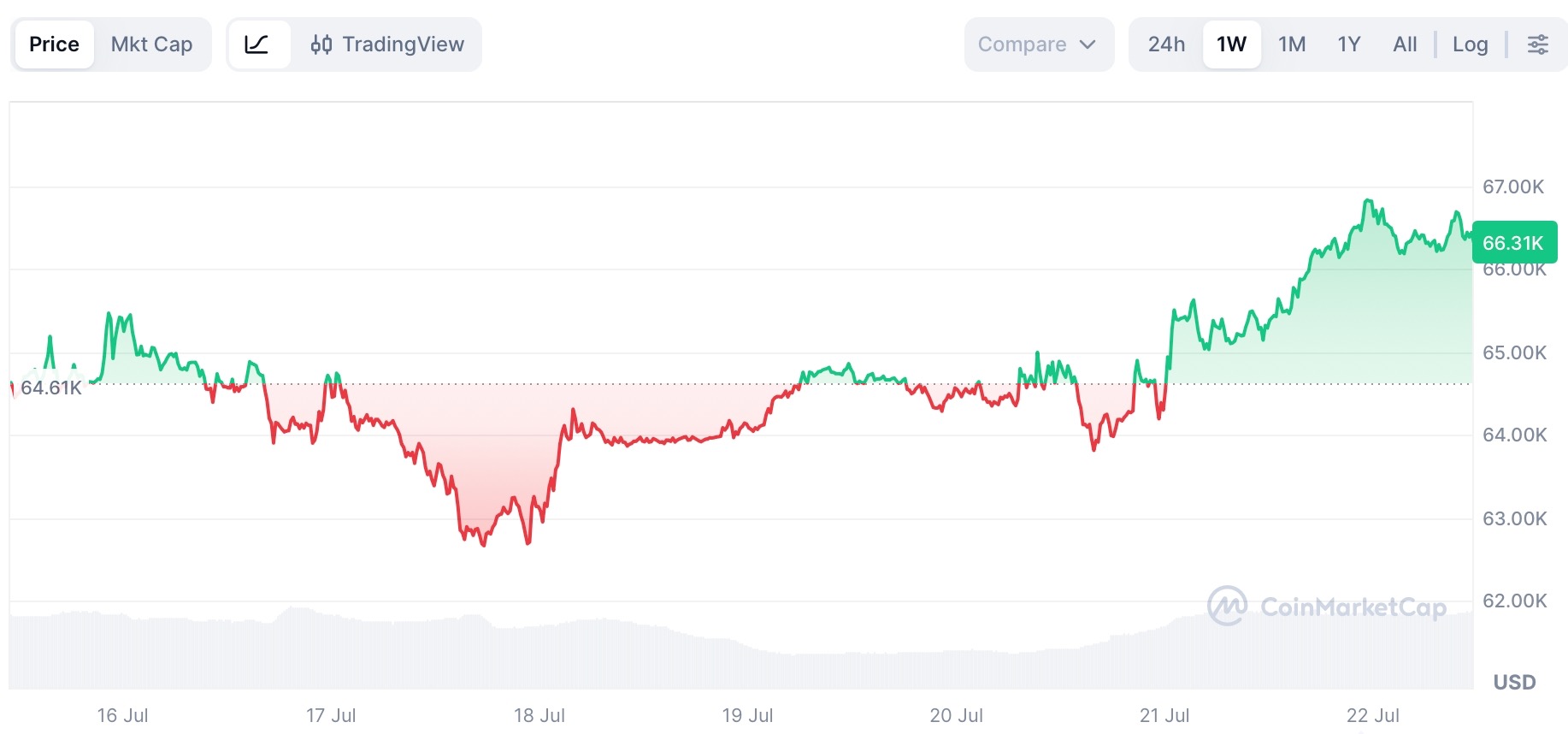
Barron’s reported that BTC traded around $66,443 on July 21, 2026, its highest level since June 2. The same report cited Bitfinex analysts who pointed to the $68,000 region as an important resistance area, partly because many short-term holders may be near breakeven there.
That makes the current market structure interesting.
BTC has recovered, but it is approaching a level where sellers may appear. Some traders who bought higher may use the rally to exit at breakeven. Others may wait for a clean breakout before adding exposure.
Bitfinex’s latest market note also described Bitcoin’s backdrop as “fragile but constructive.” It said BTC recorded a third consecutive positive weekly close and that key resistance levels had converged around the $67,900–$68,300 corridor. Bitfinex added that a sustained move above that range, supported by stronger spot demand, would strengthen the recovery case.
That is the real test. Bitcoin does not just need a headline. It needs buyers.
ETF Flows Matter More Than Celebrity Forecasts
One reason BTC recovered is that ETF demand has started to look better.
Investopedia reported that Bitcoin moved back above $65,000 after a cooler-than-expected U.S. CPI report helped risk appetite, while renewed optimism around crypto legislation also supported sentiment. The report also noted about $181 million in spot Bitcoin ETF net inflows during the move.
This is more important than Kiyosaki’s price target. ETF flows show whether institutions are actually allocating capital. Spot volume shows whether demand is broadening. Price structure shows whether buyers are strong enough to hold key levels.
Kiyosaki can argue that Bitcoin should benefit from fiat risk. But the market still needs evidence that money is moving into BTC.
That evidence comes from flows. If ETF inflows continue, BTC’s recovery becomes more credible. If flows fade, the rally may become another short-term bounce inside a broader range.
The Hard-Asset Story Has Limits
Bitcoin, gold, and silver are often grouped together as hard assets. That grouping makes sense at a high level. All three are used by investors who worry about currency debasement, financial instability, or excessive debt. But they do not always trade the same way.
Gold is usually treated as a defensive asset. Silver can behave like both a precious metal and an industrial commodity. Bitcoin often behaves like a hybrid: part store-of-value narrative, part high-volatility risk asset, part liquidity-sensitive technology trade.
That means BTC may benefit from hard-asset demand over time, while still falling sharply during short-term market stress.
This is where Kiyosaki’s message can be useful but incomplete. He is right to focus on long-term risks such as debt, inflation, and currency weakness. But traders also need to watch positioning, leverage, ETF flows, real yields, dollar strength, and liquidity conditions.
Bitcoin can be a hedge in one environment and a risk asset in another.
Price Predictions Should Be Treated Carefully
There is another reason to avoid taking Kiyosaki’s targets too literally.
Bitcoin price prediction is difficult even for sophisticated models. A 2026 academic survey on Bitcoin price prediction found that the field still lacks consensus on whether models can consistently outperform a simple “today’s price” baseline over one- to six-month horizons. The study also noted that many popular valuation approaches struggle under formal testing or across different market regimes.
That does not mean all forecasts are useless. It means traders should treat forecasts as scenarios, not facts.
Kiyosaki’s $750,000 Bitcoin target is a scenario built on a very specific worldview: a major financial bubble breaks, fiat confidence declines, and capital rotates aggressively into Bitcoin and hard assets.
The better approach is to use his warning as a reminder to think about risk, not as a reason to chase price.
Tapbit View
Kiyosaki’s crash warning is useful, but not because it gives traders a perfect forecast. It is useful because it highlights the debate that continues to shape Bitcoin’s long-term identity.
Is BTC just a speculative technology asset? Or is it becoming a serious hedge against fiat currency risk, debt expansion, and declining trust in traditional financial systems?
The answer may be both.
Bitcoin has a hard-asset narrative, but it still trades with liquidity conditions. It attracts long-term believers, but it also reacts to ETF flows, inflation data, rate expectations, and technical resistance.
For Tapbit users, the key takeaway is simple: Do not trade the prediction. Trade the confirmation. Kiyosaki’s warning may explain why some investors want Bitcoin. But BTC still needs inflows, volume, and price strength to prove that the market agrees.
Traders can track live market conditions through the Tapbit homepage. Existing users can access their accounts through Tapbit login, while new users can begin from the Tapbit registration page.
Frequently Asked Questions (FAQ)
What did Robert Kiyosaki recently say about Bitcoin?
Robert Kiyosaki warned about what he sees as a major financial bubble and projected aggressive long-term targets for hard assets, including Bitcoin at $750,000, gold at $35,000 per ounce, silver at $200, and Ethereum at $95,000 after a bubble burst.
Should traders treat Kiyosaki’s Bitcoin target as a guarantee?
No. His target should be viewed as a scenario based on his long-term view of debt, fiat currency risk, and hard assets. It is not a guaranteed outcome or a short-term trading signal.
Why does Kiyosaki like Bitcoin?
Kiyosaki favors Bitcoin because of its fixed supply, decentralized design, and role as a potential hedge against fiat currency debasement and financial-system risk.


