
World Liberty Financial is a U.S.-based decentralized finance (DeFi) platform launched in 2024 with direct involvement from Donald Trump and his family. Its mission is to bring DeFi to mainstream users while reinforcing the role of the U.S. dollar in the digital asset economy.
Instead of relying on banks or centralized intermediaries, World Liberty Financial is built around smart contracts and community governance. Users interact with the protocol directly, vote on changes, and help steer the direction of the ecosystem through a dedicated governance token, WLFI.
-
Decentralized by design: Key parameters and upgrades are governed by token holders rather than a single centralized authority.
-
Dollar-focused vision: The platform emphasizes USD-backed assets and stablecoins to support the dollar’s role in global finance.
-
Governance-first approach: The WLFI token is explicitly designed for voting and proposals, not for speculative trading.
-
U.S. corporate structure: The project is incorporated in Delaware and positions itself as compliant with U.S. securities and investor rules.
The protocol’s on-chain activity, treasury, and portfolio allocations can be tracked via blockchain analytics tools, giving users transparency into World Liberty Financial’s holdings and overall footprint in the crypto markets.
What is WLFI Token?
The WLFI token sits at the center of World Liberty Financial’s governance model. Rather than functioning as a traditional tradable crypto asset, WLFI operates more like a digital voting credential that determines how much influence you have over key decisions.
What WLFI Tokens Do
-
One token, one vote: Each WLFI token corresponds to a unit of voting power in the protocol’s governance system. However, no single wallet can exercise more than 5% of the total voting power, even if it holds more tokens.
-
Proposal rights: WLFI holders can submit and sponsor governance proposals, ranging from technical upgrades to new product lines, fee changes, or strategic partnerships.
-
Direction of the protocol: Through voting, holders help define the evolution of World Liberty Financial’s products, risk parameters, and priorities, giving the community a formal say in how the project grows.
In practice, holding WLFI is less about capital gains and more about political power within the protocol. Your tokens give you a seat at the table when major decisions are made.
Important WLFI Token Details
-
Network: WLFI is issued on the Ethereum blockchain, leveraging its established infrastructure and wallet ecosystem.
-
Total supply: 100 billion WLFI tokens are created according to the project’s tokenomics documents.
-
Non-transferable status: WLFI is designed to be non-transferable. You cannot freely send or sell it on secondary markets, and transfers are technically restricted at the smart contract level.
-
Governance-only function: The token does not promise dividends, profit sharing, or yield. Its primary and stated purpose is voting and governance participation.
Because WLFI is non-transferable, it behaves differently from most crypto assets. Users acquire WLFI to participate in governance, not to trade it on exchanges or treat it as a speculative investment. Wallet interfaces connected to the platform let holders check their WLFI balance and confirm that their tokens are ready to vote in upcoming proposals.
How World Liberty Financial Works
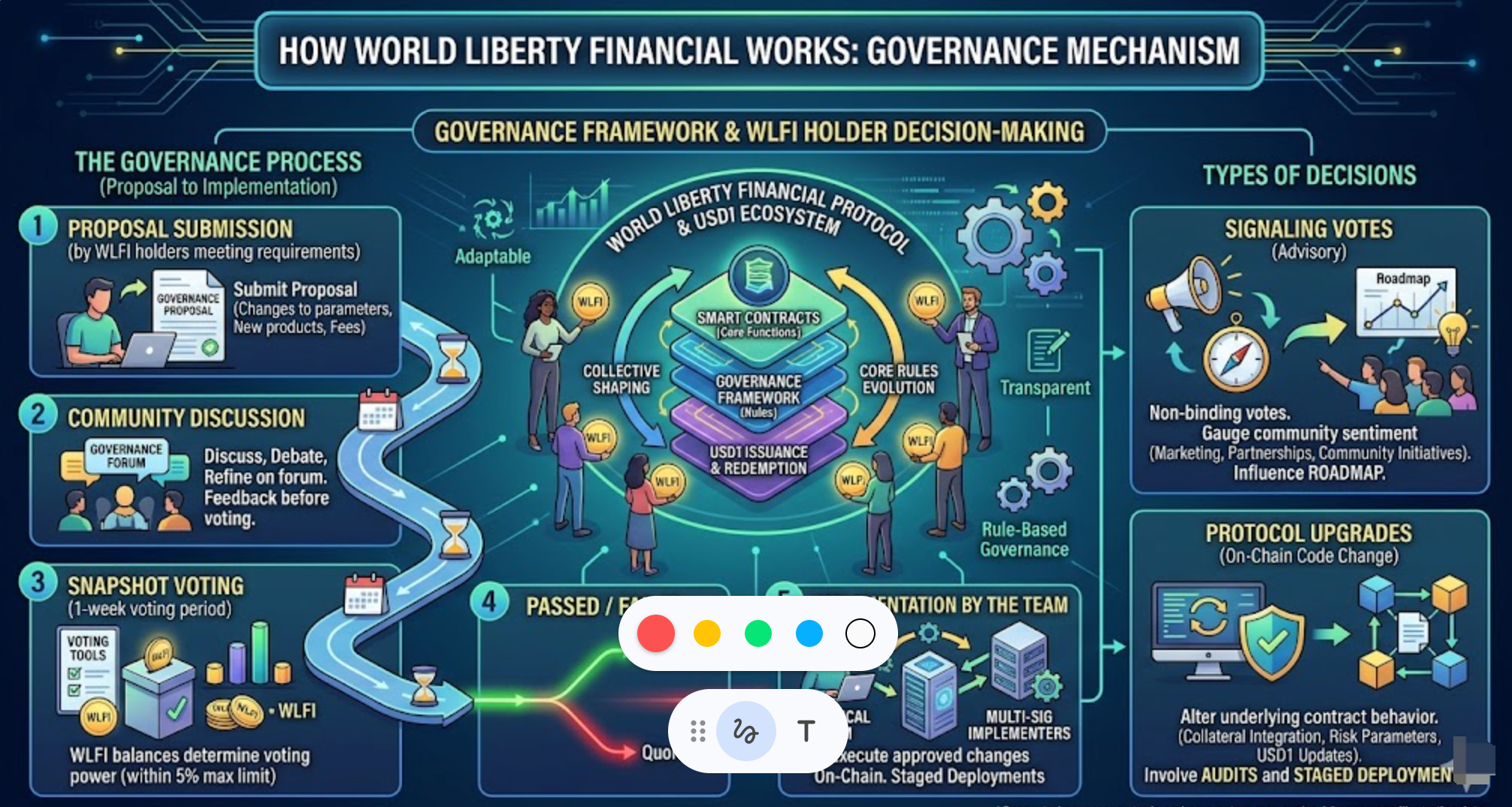
World Liberty Financial relies on a governance framework where WLFI holders collectively shape the protocol. Smart contracts handle core functions, but the rules those contracts follow can evolve over time through structured community decision-making.
The Governance Process
-
Proposal submission: Any WLFI holder meeting minimum requirements can submit a proposal. Proposals might address changes to protocol parameters, the introduction of new products, or adjustments to fee structures.
-
Community discussion: Draft proposals are shared on a dedicated governance forum, where community members analyze, debate, and refine them. This stage allows feedback before formal voting begins.
-
Snapshot voting: Once finalized, proposals move to a voting phase using tools such as Snapshot. WLFI balances in connected wallets determine each participant’s voting power, within the 5% maximum limit per holder.
-
Implementation by the team: If a proposal passes the defined quorum and majority thresholds, the technical team or designated multisig implementers carry out the changes on-chain.
Most proposals follow a standard one-week voting period. This gives the community time to review the issue, mobilize discussion, and cast votes without feeling rushed.
Types of Decisions
-
Protocol upgrades: These decisions alter how the underlying contracts behave. Examples include risk parameter adjustments, integration of new collateral types, or updates to how USD1 is issued and redeemed. Because these changes can materially affect user funds, they typically involve audits and staged deployments.
-
Signaling votes: Not every vote directly changes code. Some proposals are advisory, helping the team gauge sentiment on marketing strategies, new partnerships, exchange listings, or community initiatives. While non-binding in a strict technical sense, they heavily influence the roadmap.
Together, these mechanisms aim to keep World Liberty Financial adaptable while still anchored in transparent, rule-based governance that WLFI holders can see and influence.
Donald Trump and Team’s Role in World Liberty Financial
A defining feature of World Liberty Financial is its association with Donald Trump and his family, who bring mainstream visibility and a national policy narrative to what is otherwise a technical DeFi protocol.
Key Figures and Roles
-
Donald J. Trump – Chief Crypto Advocate: Trump is presented as the figurehead championing the vision of making the United States a leading hub for crypto and digital assets. His role is primarily directional and promotional, tying the protocol to broader economic and political messaging.
-
Eric Trump – Web3 Ambassador: Eric Trump is described as being involved in day-to-day strategic work and outreach, helping to connect the protocol with partners, communities, and media.
-
Donald Trump Jr. – Web3 Ambassador: Donald Trump Jr. supports ecosystem promotion and community relations, amplifying awareness among retail and politically engaged audiences.
-
Barron Trump – DeFi Visionary: Barron Trump is positioned as a DeFi-focused strategist, offering input on how decentralized financial products should evolve within the World Liberty Financial framework.
Alongside the Trump family, the founding team includes crypto entrepreneurs such as Chase Herro and Zachary Folkman, whose backgrounds in digital assets and fund management complement the project’s political brand with operational and technical expertise.
Business Structure and Ownership
A core Trump-affiliated business entity reportedly owns a majority equity stake in World Liberty Financial and receives a large share of revenue generated by WLFI token sales. Early allocations also granted the Trump family a substantial WLFI balance as initial supporters.
Because WLFI is subject to a 5% maximum voting cap per holder, even large allocations do not directly translate into absolute on-chain control. However, they do ensure the family and affiliated entities retain significant influence over governance outcomes.
This blend of political brand power, corporate ownership, and community voting is central to how World Liberty Financial attempts to bridge traditional finance, U.S. policy narratives, and crypto-native governance.
Recent Developments and Ecosystem Growth
World Liberty Financial’s momentum is driven by the rollout of its stablecoin, institutional interest, and ongoing technical expansion.
USD1 Stablecoin Launch and Adoption
The launch of USD1 marked a core milestone for the ecosystem. Issued by a regulated custodian and backed by U.S. government money market funds and cash equivalents, USD1 is designed as a high-quality, dollar-pegged asset suitable for both retail and institutional users.
Within weeks of launch, USD1’s circulation reportedly grew into the billions of dollars, placing it among the more rapidly scaling stablecoins on the market. That growth has helped position World Liberty Financial as a potential pillar of on-chain dollar liquidity.
Major Investments and Partnerships
-
Strategic token purchases: High-profile figures in the crypto industry have reportedly purchased substantial WLFI allocations and taken advisory roles, signaling confidence in the project’s long-term vision.
-
Institutional USD1 deployments: Investment entities linked to Middle Eastern capital have announced plans to deploy billions of dollars in USD1 for financing transactions and exchange deals, highlighting the stablecoin’s institutional ambitions.
Platform Expansion and Security
-
Multi-chain integrations: USD1 is in the process of being integrated across several blockchain networks, including programmable smart contract platforms, to broaden its use in DeFi applications.
-
Ongoing audits and monitoring: The protocol continues to engage external firms for security reviews and employs monitoring tools to detect anomalies, helping to reduce smart contract risk.
-
Governance refinements: Based on community feedback, proposal standards and voting thresholds have been iterated to improve clarity and participation rates.
Market Positioning
World Liberty Financial frames itself as a bridge between institutional capital, U.S.-aligned financial policy, and on-chain liquidity. Its combination of a governance-only token, a dollar-backed stablecoin, and a politically prominent leadership brand has drawn attention from both retail users and larger investors looking for structured exposure to DeFi.
Risks and Important Considerations
Despite its high profile, World Liberty Financial carries the same core risks as other crypto projects, along with some design-specific trade-offs. Understanding these is essential before you engage with the ecosystem.
Investment and Economic Risks
-
No guaranteed returns: WLFI does not entitle holders to dividends, profit distributions, or interest. Owning WLFI is about governance participation, not income generation.
-
Non-transferable governance token: Because WLFI cannot be freely traded, there is no liquid secondary market where you can easily sell your holdings. This is a deliberate design choice that limits speculation but also reduces financial flexibility.
-
Crypto market volatility: Assets associated with the ecosystem, including any tradable tokens or USD1 trading pairs, remain exposed to broader crypto and macroeconomic volatility.
-
Regulatory uncertainty: Future U.S. or international regulations could affect how WLFI tokens are treated, who can access the platform, and how stablecoins like USD1 are issued and used.
WLFI should not be viewed as a stock or equity instrument. It does not represent ownership of World Liberty Financial’s corporate entity or guarantee any claim on revenues.
Technical and Smart Contract Risks
-
Residual smart contract vulnerabilities: Even after audits, smart contracts can contain undiscovered bugs that might be exploited, potentially leading to loss of funds or protocol disruptions.
-
Third-party dependencies: The platform relies on underlying blockchains, oracles, custodians, and infrastructure providers. Failures or hacks affecting any of these components can impact users.
-
Governance outcomes: Democratic governance does not guarantee outcomes you agree with. Passed proposals may change risk parameters, integrations, or incentives in ways that conflict with your preferences.
Operational and Compliance Considerations
-
Accredited investor requirements: U.S.-based participants often need to meet accredited investor criteria, such as income or net-worth thresholds, to access certain offerings.
-
KYC and AML checks: All users must complete identity verification and compliance checks, which means the platform is not anonymous.
-
Geographic restrictions: Regulatory or internal policy constraints may prevent users from specific jurisdictions from participating in some or all of the ecosystem.
Due Diligence
Before acquiring WLFI or interacting with USD1 and related products, you should carefully review official documentation, legal disclosures, and independent analyses. Only commit capital you can afford to lose, and consider consulting a financial or legal professional familiar with digital assets.
The Future of World Liberty Financial
World Liberty Financial occupies a distinctive space at the intersection of politics, regulation, and DeFi. Its success will depend on whether it can maintain robust security, sustain user and institutional demand for USD1, and keep governance aligned with both community expectations and regulatory realities.
Key variables to monitor include how U.S. and global regulators treat dollar-backed stablecoins, whether multi-chain deployments of USD1 gain traction in DeFi protocols, and how effectively the governance framework balances insider influence with grassroots participation.
If these factors evolve favorably, World Liberty Financial could become an influential player in the on-chain dollar ecosystem, offering a structured way for users and institutions to access DeFi services under a U.S.-centric brand.
If you want to engage with stablecoins and other digital assets in a liquid, exchange environment, you can start trading on Tapbit in minutes. New users can explore markets, review our trading fees, and check available welcome rewards while they continue to build their understanding of projects like World Liberty Financial and the broader DeFi landscape.
FAQ
Is World Liberty Financial legitimate?
World Liberty Financial presents itself as a formal U.S. corporate entity with governance contracts that have undergone third-party security audits. It is connected to well-known public figures and has attracted institutional-scale interest in its stablecoin. Nonetheless, like all DeFi projects, it carries technology, regulatory, and market risks that users must evaluate independently.
How is World Liberty Financial different from typical crypto projects?
-
U.S. base of operations: It emphasizes domestic incorporation and regulatory alignment instead of offshore structures.
-
Dollar-first strategy: Its core products are designed to support, not replace, the U.S. dollar through USD-backed stablecoins.
-
High-profile branding: Direct association with the Trump family gives it a mainstream political and media profile that most DeFi projects lack.
-
Governance-only token: WLFI is non-transferable and explicitly framed as a voting tool, not a profit-sharing or yield-bearing asset.
What are the long-term goals of the project?
The project’s stated ambitions include helping the United States act as a leading hub for crypto, promoting dollar-based stablecoins as the backbone of on-chain finance, and building a community-governed protocol that can serve both retail users and institutions looking for compliant, USD-aligned DeFi infrastructure.
Who can participate?
Participation rules depend on jurisdiction. In general, U.S. residents are expected to meet accredited investor standards for certain offerings, while non-U.S. users must qualify as non-U.S. persons under applicable securities rules. All users must be adults, complete KYC, and ensure that engagement with World Liberty Financial complies with local law.
How does governance work in practice?
Governance typically follows a cycle of forum discussion, proposal refinement, Snapshot-style voting based on WLFI balances, and implementation by the technical or operations team. Most votes run for about a week, giving WLFI holders time to review and participate.
If you are interested in broader crypto learning beyond this project, Tapbit’s comprehensive guides can help you understand core concepts such as stablecoins, futures, and risk management before you trade.


