

Polkadot spent 2026 tackling DOT's biggest criticism: its supply model. They introduced a hard cap, cut issuance, made staking more flexible—and even got a spot ETF listed in the US.
The market's response? Brutal.
As of August 11, DOT sits around $0.81—roughly 98.5% below its November 2021 peak of $54.98, and barely above its all-time low from July 31.
So here's the puzzle: development hasn't stopped, but it hasn't brought demand back either. The gap between what Polkadot is building and what the market actually wants remains wide open.
DOT’s Supply Model Has Changed

For years, DOT’s uncapped inflation was a frequent concern among holders. New tokens were issued to support staking and network security, but the expanding supply also diluted investors who did not participate in staking.
Polkadot changed that framework in March 2026. The new system caps total supply at 2.1 billion DOT. Initial emissions were reduced by 53.6%, with further reductions scheduled every two years.
The reform also introduced a Dynamic Allocation Pool. Instead of relying on the previous treasury burn model, newly issued DOT and certain protocol revenues can be directed toward validators, nominators, ecosystem funding and strategic reserves through governance.
This is a meaningful structural change. Investors can now model DOT’s future supply with more certainty, and the pace of dilution is lower than it was under the previous system.
It does not, however, make DOT immediately scarce. New tokens will continue to enter circulation until the cap is approached. A slower supply increase can reduce selling pressure, but it cannot create demand by itself.
Staking Has Become More Flexible
Polkadot also changed parts of its staking system in 2026. The planned reforms included reducing the unbonding period from 28 days to roughly 24 to 48 hours and removing slashing exposure for nominators.
The shorter exit period matters because users no longer need to keep their DOT locked for nearly a month after deciding to unstake. That can make staking more practical for holders who want to retain access to their assets.
Polkadot’s official website currently reports approximately 826 million DOT staked, representing about 51% of supply. A high staking rate can reduce the amount of DOT immediately available for sale, but it also raises another question: how much DOT is being held for network participation, and how much is staked primarily to offset issuance?
The answer depends on whether the network develops stronger sources of demand beyond staking rewards.
The Polkadot ETF Is Real, but Demand Remains Modest
Institutional access has also improved. The 21Shares Polkadot ETF, trading under the ticker TDOT, began trading on Nasdaq on March 6, 2026. The fund holds spot DOT and may stake part of its holdings when the sponsor considers it legally and operationally appropriate. Its listing is confirmed by Nasdaq.
TDOT gives US investors a regulated way to gain exposure to DOT without managing private keys or using a crypto exchange. That is a genuine change from earlier market cycles.
Still, access should not be confused with demand. TDOT held approximately $7.1 million in net assets as of July 27. That is a relatively small amount compared with major Bitcoin and Ethereum investment products.
The ETF therefore supports the case that DOT is becoming more accessible to traditional investors. It does not yet show that institutions are allocating significant capital to Polkadot.
Why Has DOT Remained Weak?
The supply reform addresses dilution, while TDOT addresses market access. Neither directly answers the most important question: what creates recurring demand for DOT?
DOT is used for staking, governance and purchasing network resources. Its long-term value case depends on developers building products that attract users, transactions and capital to the Polkadot ecosystem.
That process has been slower than many investors expected.
Polkadot faces intense competition from Ethereum and its Layer 2 networks, Solana, Cosmos and newer smart contract platforms. Developers have more infrastructure choices than they did when Polkadot launched, and users tend to follow applications and liquidity rather than blockchain architecture.
Polkadot’s technology may be sophisticated, but the market is asking for visible results. That means applications people regularly use, stablecoin liquidity, active DeFi markets and transaction demand that reaches beyond staking and governance.
Until those indicators improve, lower issuance may reduce a headwind without creating a new growth engine.
Polkadot Products Devnet Is Progress, Not Mainnet Adoption
One recent development is the launch of the Polkadot Products Devnet.
The public developer preview allows builders to test web applications, .dot domains, storage services and platform tools. The Devnet operates on the community-run Paseo network rather than Polkadot mainnet.
This distinction matters. A developer preview can help teams test products and improve the user experience, but it is not evidence that those products have attracted paying users or meaningful liquidity.
The next step is converting that development environment into applications that people return to. User retention, transaction activity and economic demand will matter more than the number of features announced.
Where Does JAM Fit Into the Story?
JAM, short for Join-Accumulate Machine, is intended to become the next generation of Polkadot’s core architecture. It aims to provide a more flexible environment for blockchain services and decentralized computation.
JAM is important to Polkadot’s long-term roadmap, but it may not be a completed catalyst.
Polkadot’s developer documentation says JAM is planned as a single, complete upgrade rather than a series of small releases. At the time of writing, there was not enough official evidence to describe JAM as fully deployed on Polkadot mainnet.
That leaves JAM in the execution stage. Traders should watch for completed technical milestones, governance approval, mainnet deployment and, eventually, services that use the new architecture. Until then, JAM remains a promising design rather than a proven source of DOT demand.
Can DOT Return to Its Previous High?
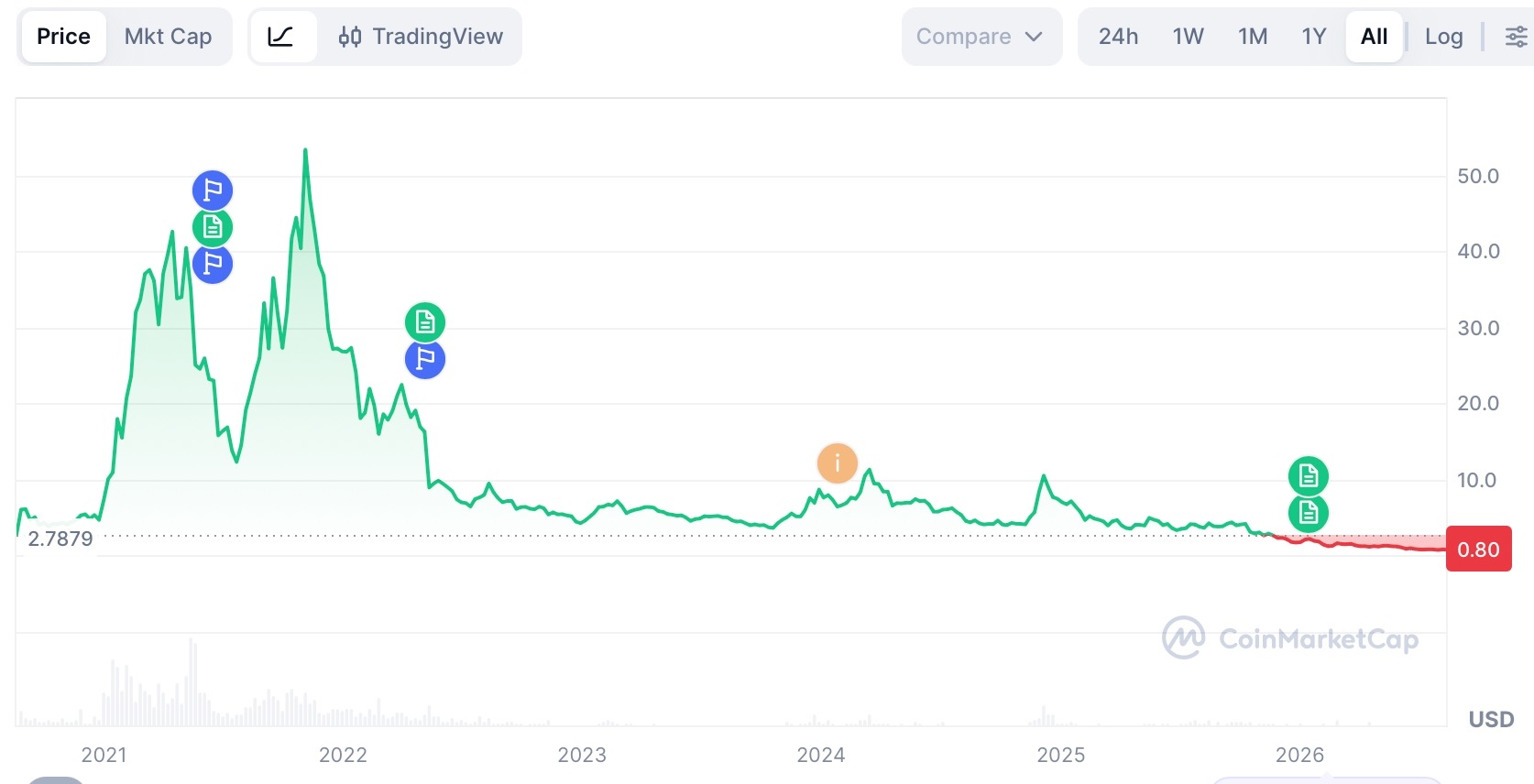
A return to $54.98 would require DOT to rise by more than 60 times from its August 2026 price. That does not make recovery mathematically impossible, but it shows why comparisons with the previous record need context.
DOT’s circulating supply is much larger than it was during the 2021 bull market. Returning to the same token price would therefore require a substantially larger market capitalization.
The competitive environment has also changed. Polkadot is no longer being valued in a market with only a few major smart contract ecosystems. It must now compete for developers, users and liquidity against a much broader group of networks.
Price forecasts ranging from a few dollars to more than $30 say little without explaining the market capitalization, adoption and liquidity required to support them. A more useful approach is to track whether the network is producing measurable demand.
What Could Improve the Outlook?
The supply cap gives Polkadot a more predictable monetary foundation. What it needs next is evidence that the ecosystem can use that foundation effectively.
A stronger outlook would likely involve growth in active applications, stablecoin supply, DeFi liquidity and transaction activity. Rising assets under management in TDOT would provide another sign that regulated investor access is turning into actual allocation.
Progress on JAM could also change the discussion, but only after deployment and adoption become visible. The same applies to Polkadot Products: a successful developer environment matters most when it produces applications with recurring users.
Price can move before all of these signals appear, particularly in a broad altcoin rally. Sustaining that move would require more than sentiment.
What Matters Now
Polkadot made some real moves in 2026. The 2.1B DOT cap, reduced issuance, revamped staking, and a Nasdaq-listed ETF—these are facts, not promises.
But the hard work starts after the upgrades.
DOT is still hovering near its floor. The market hasn't bought the idea that better tokenomics will boost demand. Polkadot now needs to prove its tech can actually support real products, attract liquidity, and generate activity that makes people want to hold DOT.
That's the metric to watch—not price projections, but whether adoption finally starts to catch up with the tech.
Readers can follow digital asset research and broader market coverage through Tapbit. Existing users can log in here, while new users can create an account.
Frequently Asked Questions
What is Polkadot?
Polkadot is a blockchain platform designed to let different networks share security and exchange information. Its native token, DOT, is used for staking, governance and access to network resources.
Why is DOT trading near its all-time low?
DOT has struggled with weak altcoin demand, competition from other blockchain ecosystems and limited evidence that Polkadot’s technical development is producing sustained user growth. The larger circulating supply also makes comparisons with DOT’s 2021 price less straightforward.
What is the maximum supply of DOT?
Polkadot introduced a maximum supply of 2.1 billion DOT in 2026. The previous model did not include a fixed supply cap.


