

XST and Akash Network’s AKT both use the AI-infrastructure narrative, but they represent very different investment propositions. XSolutAI’s XST is an early-stage Solana token whose value currently depends heavily on expectations, social attention, and future product claims. AKT supports an operating decentralized cloud marketplace where developers can rent CPU and GPU resources from independent providers.
The simple distinction is that XST offers greater speculative uncertainty, while AKT has more verifiable infrastructure and token utility. Users can also create a Tapbit account to explore supported crypto markets and risk-management tools. This does not imply that XST or AKT is listed on Tapbit.
XST Coin vs Akash Network: Quick Comparison
| Category | XSolutAI (XST) | Akash Network (AKT) |
|---|---|---|
| Primary narrative | Tokenized AI infrastructure | Decentralized cloud computing |
| Development stage | Early and difficult to verify | Operational marketplace |
| Network | Solana | Cosmos SDK-based Akash blockchain |
| Core token role | Proposed ecosystem utility | Staking, governance, gas, and network security |
| Working product | Limited public evidence | CPU and GPU deployment marketplace |
| Contract risk | High due to multiple XST tokens | Established native network asset |
| Liquidity profile | Potentially thin and fragmented | Broader, more mature market |
| Investment character | Narrative-driven speculation | Infrastructure adoption thesis |
The comparison is not simply about which token could rise faster. It is about whether a token’s valuation is supported by an operating network, measurable demand, and clearly defined economic functions.
What Is XSolutAI and the XST Token?
XSolutAI presents itself as a marketplace for physical AI infrastructure. Its stated focus includes data centers, energy, cooling, semiconductors, fiber, construction, land, and security—the resources needed to build and operate AI systems.
This is a compelling narrative because AI growth depends on more than software. It requires GPUs, electricity, networking equipment, and physical facilities. Tokenizing access to those resources could theoretically connect capital, infrastructure providers, and users.
The problem is that a promising concept is not the same as a functioning marketplace. Public information does not yet provide the same level of verifiable deployments, provider activity, developer documentation, or token utility found in more established decentralized-compute networks.
Investors should also verify the exact token contract. Several unrelated crypto assets use the XST ticker, including Stealth and SORA-related assets. A name or logo alone cannot confirm that a wallet or liquidity pool contains the intended XSolutAI token.
What Is Akash Network?
Akash Network is a decentralized cloud-computing marketplace. Developers define the CPU, memory, storage, or GPU resources they require, and independent providers compete to host the workload.
A user can select a provider based on price, location, available hardware, and reputation. Once a bid is accepted, the application runs through a lease managed by the Akash network.
According to the official Akash documentation, supported workloads include websites, APIs, databases, game servers, AI models, machine-learning applications, and GPU-intensive deployments. The network also provides deployment consoles, command-line tools, software development kits, and provider documentation.
That does not guarantee commercial success, but it gives investors something concrete to evaluate: functioning software, active providers, deployments, leases, technical releases, and network governance.
AKT Utility vs XST’s Proposed Utility
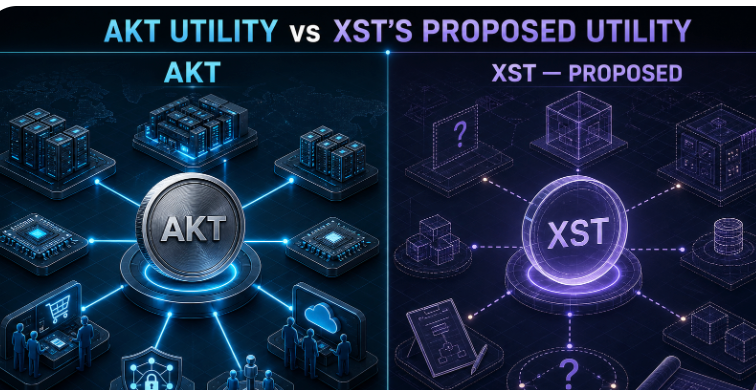
AKT has several identifiable functions within the Akash ecosystem. Validators and delegators stake it to secure the network, holders can participate in governance, and AKT pays blockchain gas fees. Providers also temporarily lock AKT during bids and active leases.
Akash has introduced ACT, a dollar-pegged compute credit designed to make deployment costs more predictable. Users can obtain ACT through supported payment flows, while AKT remains central to security, governance, and gas.
XST’s proposed utility is less mature. Its investment case assumes that the planned AI-infrastructure marketplace will create meaningful reasons to acquire or use the token. Until those mechanisms are live and widely adopted, demand may be driven primarily by market narratives rather than recurring platform activity.
Why AKT Represents Real Compute Infrastructure
- Infrastructure providers advertise CPU, GPU, storage, and networking capacity.
- Developers submit deployment requirements.
- Providers compete through bids.
- Users select a provider and open a lease.
- Applications run on provider-operated infrastructure.
- Payments and marketplace activity are coordinated through the network.
Akash’s 2026 roadmap also covers virtual machines, home-node participation, managed services, provider incentives, shared security, hardware verification, and confidential computing.
Some roadmap items remain experimental or incomplete. Akash still faces competition from centralized cloud providers and other decentralized-compute networks. Nevertheless, its thesis can be evaluated through product usage and technical execution rather than branding alone.
Why XST Could Still Outperform During an AI Token Rally
A more established project is not guaranteed to deliver the largest percentage return. Small tokens can rise faster because relatively modest buying pressure may move their prices dramatically.
XST could outperform temporarily if AI-infrastructure tokens become a dominant theme, social attention brings new buyers, the project announces product milestones, liquidity improves, or the token develops verifiable platform utility.
The same structure creates substantial downside. Thin liquidity means a small number of sellers may reverse a rally. A displayed market capitalization can also exaggerate the value investors could realistically exit at if available liquidity is limited.
Main Risks for XST and AKT
| Risk | XST | AKT |
|---|---|---|
| Product execution | Very high | Moderate |
| Token identity confusion | Very high | Low |
| Liquidity and slippage | Potentially severe | Lower, but still material |
| Infrastructure adoption | Unproven | Operating but competitive |
| Token-value capture | Unclear | Better defined but evolving |
| Price volatility | Extreme | High |
| Technical complexity | Solana contract and pool checks | Provider, validator, and network risks |
AKT’s stronger fundamentals do not eliminate investment risk. Decentralized computing must compete on price, reliability, security, hardware availability, and ease of use. The introduction of a stable compute credit may also change how directly marketplace demand affects AKT.
XST has an additional evidence problem: investors must establish which contract is authentic, whether its stated utility is operational, and whether trading activity is supported by adequate liquidity.
Which AI Token Is Better for Beginners?
AKT is the more defensible choice for beginners comparing only these two assets. It has an operating network, identifiable token functions, extensive documentation, and measurable infrastructure activity.
XST is better understood as an early speculative bet. It may offer greater percentage upside if its narrative gains traction, but the probability of severe losses is also higher. Beginners should not confuse a low token price or small market capitalization with undervaluation.
Conclusion
XST Coin vs Akash Network is ultimately a comparison between an emerging AI-infrastructure narrative and an operating decentralized compute marketplace. XSolutAI could attract speculative demand if AI-token enthusiasm continues, but its contract identity, liquidity, execution, and value-capture model require careful verification.
Akash Network offers stronger evidence of real utility through compute providers, leases, GPU deployments, staking, governance, and network fees. For most beginners, AKT presents the clearer investment case. XST should be treated as a much smaller, high-risk speculative position until the project demonstrates functioning utility and sustainable liquidity.
Frequently Asked Questions
Is XST the same as Akash Network?
No. XST is associated with the early-stage XSolutAI project on Solana, while AKT is the native token of the Akash decentralized cloud network.
Does Akash Network provide real GPU computing?
Yes. Akash providers can offer CPU and GPU capacity for AI models, rendering, applications, databases, and other computing workloads.
Does XST represent ownership of AI infrastructure?
There is insufficient evidence to treat XST as ownership of data centers, GPUs, energy facilities, or related companies.
Could XST outperform AKT?
It could during a speculative rally because smaller, less-liquid tokens can move quickly. That same structure also creates greater slippage and crash risk.
Is AKT a low-risk investment?
No. AKT has more verifiable utility than XST, but it remains a volatile crypto asset exposed to adoption, competition, governance, staking, and token-economic risks.


