

Why Crypto Is Up Today
Why crypto is up today is one of the market's main questions after Bitcoin's sharp June and early-July weakness. On July 3, 2026, the crypto market is seeing a relief rebound, with Bitcoin trading around $61,500 in recent market coverage after testing lower levels earlier in the week.
The move looks like a mix of bargain hunting, short covering, and improving risk appetite. But the bigger question for traders is whether the rebound is strong enough to become a trend or just a temporary bounce inside a broader correction.
That distinction matters because crypto often produces sharp relief rallies after heavy selloffs. When leverage is flushed out and sentiment becomes extremely negative, even modest good news can trigger a fast move higher. Traders who were short may close positions, market makers may rebalance, and sidelined buyers may step in near perceived support. This can lift prices quickly without necessarily changing the longer-term trend.
So the better question is not only why crypto is up today, but also whether the market is showing signs of sustainable demand. A healthier recovery usually includes rising spot volume, improving breadth across major tokens, and calmer funding conditions. A weaker recovery is mostly driven by short liquidations and fades near the first resistance zone.
Crypto Market Today: The Main Drivers
The crypto market today is being shaped by several forces at once:
| Driver | Why It Matters |
|---|---|
| Bitcoin rebound | BTC often leads market direction after major selloffs |
| Short covering | Bearish traders may close positions after fast declines |
| Macro expectations | Softer rate expectations can support risk assets |
| ETF flow watch | Bitcoin ETF inflows or outflows can affect sentiment |
| Holiday liquidity | U.S. market holidays can make crypto moves sharper |
These forces do not all point in the same direction. That is why traders should separate a rebound from a confirmed reversal.
The macro backdrop is also important. Crypto has become more sensitive to interest-rate expectations, dollar strength, and U.S. equity sentiment. If traders believe financial conditions may become easier, risk assets often benefit. If the dollar strengthens or rate expectations turn hawkish again, the rebound can lose momentum.
The ETF flow channel is another key driver. Bitcoin ETF outflows can pressure sentiment because they suggest institutional demand is weakening. Stabilizing or improving flows can have the opposite effect. For a market that has recently traded around fear, even a slowdown in bad news can be enough to support a bounce.
Bitcoin's Role in the Rebound
Bitcoin remains the key signal. When BTC stabilizes after a selloff, traders often rotate back into Ethereum, Solana, AI tokens, meme coins, and high-beta altcoins. When BTC fails to hold support, the same assets can reverse quickly.
This is where Bitcoin dominance matters. A BTC-led bounce can either restore confidence across the market or pull liquidity away from smaller tokens. Tapbit Learn's Bitcoin dominance guide explains how that relationship works.
Traders should also watch whether Bitcoin is reclaiming levels that previously acted as support. A move from panic lows back toward the low-$60K zone is constructive, but it does not automatically erase the prior selloff. A stronger signal would be BTC holding higher lows over multiple sessions while volatility cools and buyers defend dips.
Altcoin participation is the second test. If Ethereum, Solana, XRP, AI tokens, and other large sectors begin rising together, the rally has more market breadth. If Bitcoin rises while smaller assets stay weak, the market may still be in a defensive phase where capital is hiding in the most liquid asset.
How Traders Can Track BTC Futures on Tapbit
For users who want to monitor the move directly, Tapbit offers BTC derivatives access through BTC futures trading. Futures are leveraged products and do not represent direct BTC ownership, so position sizing and risk controls matter.
- Open the BTC futures page and review the live price, funding, and order book.
- Check whether volume supports the move or whether the rebound looks thin.
- Choose margin, leverage, and order type carefully.
- Set TP/SL before opening a long or short position.
New users can create an account, then review trading fees before placing any order.
Because futures can magnify both gains and losses, the practical goal is not to predict every tick. It is to build a decision framework. For example, a trader might only consider a long setup if BTC holds above a defined support zone and funding remains reasonable. A short setup might require a failed breakout, declining volume, or renewed ETF outflow pressure.
This is especially useful during holiday or low-liquidity sessions. A fast candle can look convincing on the chart, but if order-book depth is thin, the move may not be durable. Reviewing funding, liquidation zones, and volume helps separate real demand from temporary positioning pressure.
What Could Confirm the Crypto Bounce?
The strongest confirmation would be a higher daily close, rising spot demand, and improving breadth across large-cap tokens. If Bitcoin holds above the recent rebound zone and ETF flow data stabilizes, traders may become more comfortable calling the move a short-term recovery.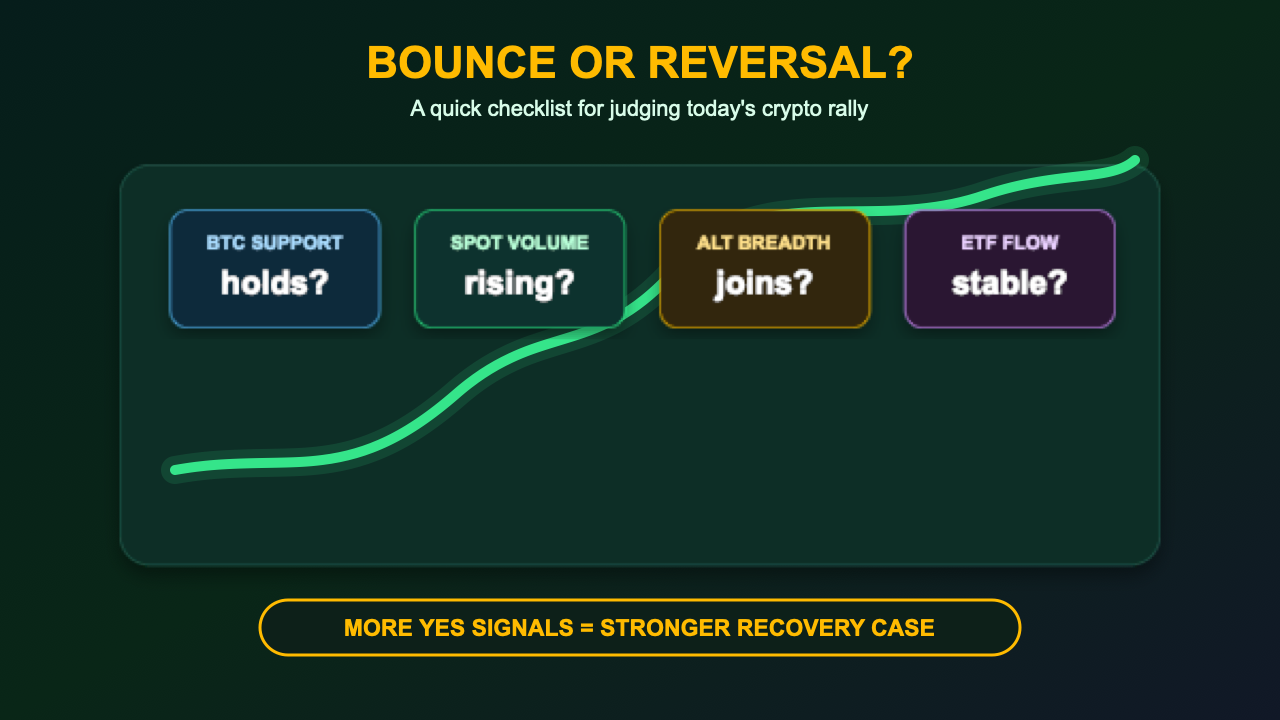
Weak confirmation would look different: BTC rises on thin holiday liquidity, altcoins lag, and sellers return near resistance. In that case, why crypto is up today may have a simple answer: a technical bounce after oversold conditions, not a durable trend.
For sentiment context, the crypto fear and greed index can help traders see whether the market is moving from extreme fear toward neutral.
A simple confirmation checklist can help:
- BTC holds above the rebound zone rather than giving back the move within hours.
- Spot volume improves, not just derivatives volume.
- Funding stays balanced, suggesting the rally is not purely overleveraged.
- Large-cap altcoins participate, showing broader risk appetite.
- ETF flow headlines stabilize, reducing institutional selling pressure.
No single signal is perfect. But when several of these signals align, the case for a recovery becomes stronger.
What Comes Next?
The next phase depends on Bitcoin's ability to hold recovery levels and whether macro headlines support risk assets. Traders should watch BTC price, ETF flows, liquidation data, funding rates, and whether altcoins join the move.
In short, why crypto is up today is mostly a rebound story. The crypto market today is improving, but confirmation still matters. A clean BTC hold above short-term support would strengthen the case for recovery; a failed bounce would keep the market defensive.
For readers looking for a practical conclusion, the market is no longer in the same panic state as the selloff lows, but it is not yet in a fully confirmed uptrend either. The balanced view is to treat the move as a tradable rebound first, then upgrade the view only if BTC holds support and broader crypto participation improves.
FAQ
Why is crypto up today?
Crypto is up today because Bitcoin is rebounding after a sharp selloff, while traders respond to short covering, macro expectations, and improved risk appetite.
Is the crypto market recovering?
It is recovering in the short term, but a stronger reversal needs confirmation from volume, BTC support, and broader altcoin participation.
Why does Bitcoin lead crypto rebounds?
Bitcoin has the largest market share and deepest liquidity, so it often sets the direction for the wider crypto market.
Should traders buy every crypto rebound?
No. Traders should check volume, risk controls, and whether the move is a bounce or a confirmed trend.
Where can I track crypto market data?
You can use Tapbit's market data page to monitor price moves, volume, and broader crypto conditions.


