
VeChain (VET) is a blockchain platform focused on enterprise adoption and supply chain optimization. Unlike general-purpose blockchains, VeChain bridges the gap between digital assets and real-world business applications. By integrating IoT devices with its blockchain, VeChain enables companies to track, authenticate, and manage products and data efficiently and transparently.
This introduction gives investors and tech enthusiasts a snapshot of VeChain’s purpose, highlighting its real-world utility, corporate adoption, and dual-token economy, which together make it a unique player in the blockchain ecosystem.
What is VeChain (VET)?
VeChain is a blockchain platform built for supply chain management and business processes. It uses distributed ledger technology to make information flow smoother and add transparency, traceability, and efficiency to logistics, production, and enterprise operations.
The VeChain ecosystem combines smart contracts with IoT (Internet of Things) technology. That lets businesses track products and verify data across their supply chains.
Key Overview of VeChain
|
Feature |
Description |
|
Token Name |
VeChain (VET) |
|
Blockchain |
VeChainThor |
|
Token Type |
Utility & Governance Token |
|
Launch Year |
2015 |
|
Founders |
Sunny Lu & Jay Zhang |
|
Main Use Case |
Supply chain management, asset tracking, enterprise solutions |
|
Consensus Mechanism |
Proof of Authority (PoA) |
|
Dual Token System |
VET (value transfer) & VTHO (transaction gas fees) |
What is a VET Token?
VET is the main utility and value token of the VeChain ecosystem.
-
Purpose: Transfer value and participate in the VeChainThor blockchain economy.
-
Dual token system:
-
VET – stores value and can generate VTHO.
-
VTHO – pays for transaction fees (like Ethereum gas).
This setup separates the cost of using the network from VET’s market price, which helps keep transaction fees stable.
Who Created VeChain?
VeChain was founded by Sunny Lu, former CIO of Louis Vuitton China, and Jay Zhang. Their background blends enterprise IT, blockchain, and business operations. The goal was to bridge blockchain technology with real‑world enterprise use cases – not just build another crypto token.
How Does VeChain Work?
VeChain runs on the VeChainThor blockchain, which combines several pieces.
-
Proof of Authority (PoA) – Selected authority nodes validate transactions instead of mining. This is faster and more energy‑efficient.
-
Dual token economy – VET generates VTHO, which is burned to run smart contracts and transactions.
-
IoT integration – RFID tags, NFC chips, and QR codes connect physical products to blockchain records.
-
Enterprise solutions – Custom modules for logistics, product verification, anti‑counterfeiting, and carbon tracking.
Example: A luxury bag maker puts an NFC chip on each product. The chip records manufacturing, shipping, and sale events on VeChain’s blockchain. A customer can scan the bag with a phone to check if it is real.
Why Does Crypto Have Value?
|
Factor |
Explanation |
|
Utility |
Required for transactions and smart contracts via VTHO generation |
|
Enterprise adoption |
Used by companies like Walmart China, BMW, DNV, and LVMH for supply chain tracking |
|
Scarcity |
Total supply is fixed at 86.7 billion VET |
|
Network effect |
More enterprise partners = more demand for VET and VTHO |
Will VET Ever Reach $1?
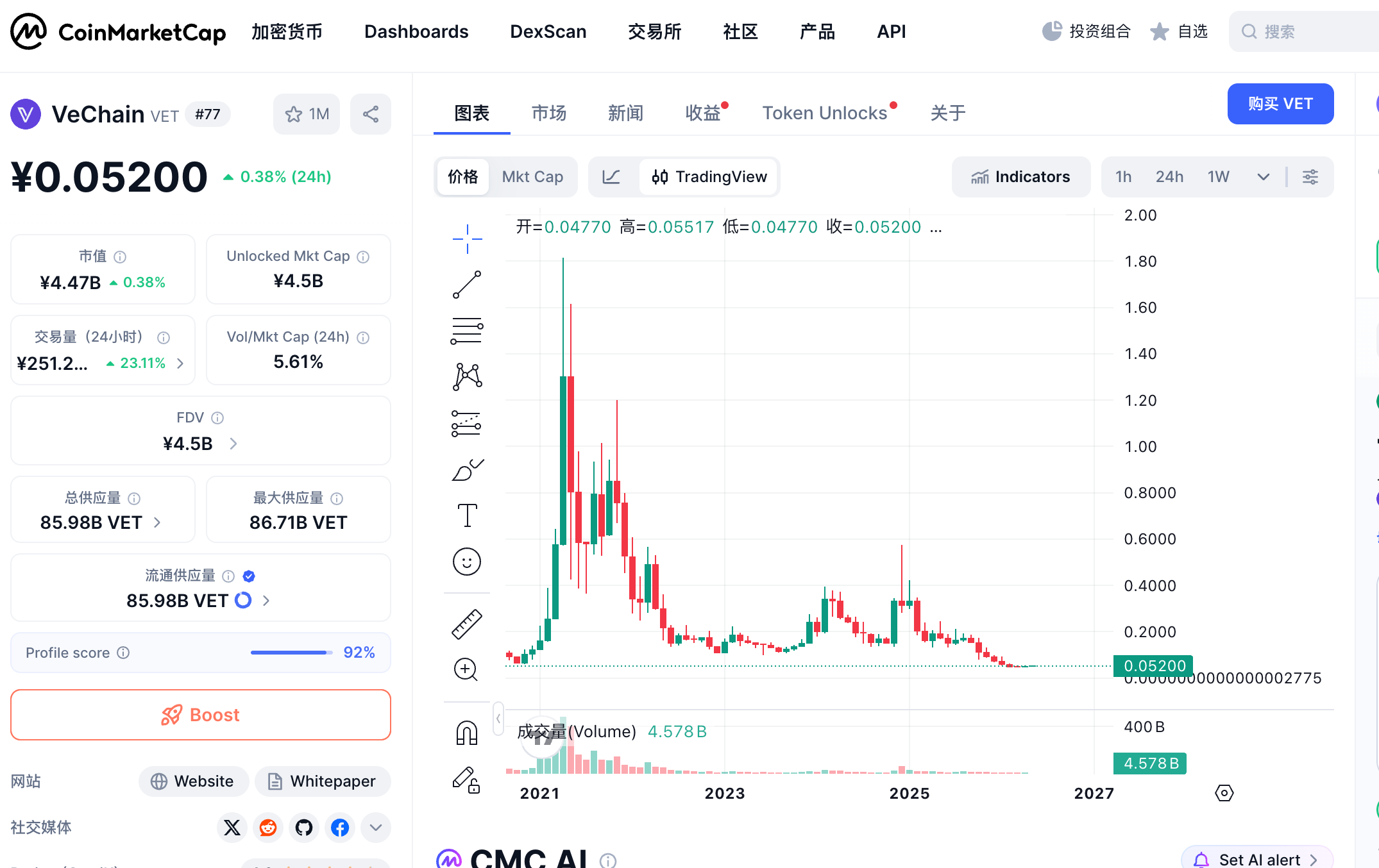
That depends on a few things: market cap, adoption, supply, and overall crypto market trends. With a circulating supply of over 86 billion VET, hitting
1wouldmeanamarketcapabove
1wouldmeanamarketcapabove86 billion. That is a high bar without massive global adoption. Some analysts say long‑term adoption could push the price up, but $1 is seen as an ambitious target in the near to medium term.
Has VeChain Got a Future?
Yes, VeChain has reasonable long‑term potential for several reasons.
-
Enterprise integration – Real use cases in supply chains, logistics, and anti‑counterfeiting.
-
Partnerships – Collaborations with major corporations and governments.
-
Sustainability and ESG tracking – Carbon credit platforms and sustainable supply chains are becoming more relevant.
-
Scalability – Proof of Authority allows faster and cheaper transactions than Proof of Work.
That said, future success still depends on continuous adoption and market sentiment.
Is a VET Token a Good Investment?
|
Factor |
Consideration |
|
Pros |
Strong enterprise adoption, real‑world use cases, dual token system for fee stability |
|
Cons |
Highly competitive blockchain market, price volatility, crypto market speculation |
|
Investment type |
Long‑term, adoption‑driven – not short‑term speculation |
|
Risk |
Medium to high, because price depends on enterprise uptake and market trends |
Do your own research. Know your risk tolerance.
FAQ
What is VeChainThor?
VeChainThor is the blockchain platform that powers VET and enterprise solutions. It uses Proof of Authority for consensus.
What is the difference between VET and VTHO?
VET is the main value token. Holding VET generates VTHO over time. VTHO is used to pay transaction fees on VeChainThor.
Can I stake VET?
Yes. VET holders passively earn VTHO. Some exchanges and wallets also offer staking‑like programs with extra rewards.
What companies use VeChain?
Notable partners include Walmart China, BMW, DNV, LVMH, and many supply chain and logistics providers.
Is VeChain a safe investment?
VeChain is less risky than most meme coins because it has real‑world adoption. But like any crypto, it is volatile. Do your own research before investing.


