
What is SOX stock? The short answer is that SOX is not actually one stock. SOX is the ticker used for the PHLX Semiconductor Sector Index, a widely followed benchmark for the U.S. semiconductor industry. Nasdaq describes it as a modified market-capitalization-weighted index made up of 30 companies primarily involved in semiconductor design, distribution, manufacturing and sales.
The phrase “SOX stock” is common in search because users often see the SOX ticker beside a changing market value and assume it works like a company share. It does not. Understanding what is SOX stock therefore starts with the distinction between an index, an ETF and a derivative.
What Is SOX Stock?
SOX is a sector index. An index is a calculated benchmark that combines the performance of multiple securities according to a methodology. Investors use it to answer questions such as: Are semiconductor stocks outperforming the broader technology market? Is the chip cycle strengthening? Are AI-related gains broad or concentrated in only a few companies?
Nasdaq says the PHLX Semiconductor Sector Index began in 1993. Its methodology selects major U.S.-listed semiconductor companies and uses a modified market-cap weighting approach. The index currently contains 30 components.
This is the most important answer to what is SOX stock: there is no individual SOX company whose earnings, balance sheet and management team determine the index value. SOX moves because the semiconductor companies inside the benchmark move.
What Does the SOX Index Track?
SOX covers several parts of the semiconductor ecosystem. Its constituents can include companies involved in chip design, memory, manufacturing, equipment, networking and other semiconductor-related businesses. That makes the index useful as a broad temperature check for the chip sector.
The benchmark has become especially important during the AI investment cycle. Demand for GPUs, accelerators, HBM, networking equipment and storage products can affect different semiconductor companies at different times. SOX aggregates those moves into one sector-level indicator.
Because the index is weighted rather than equally distributed, large semiconductor companies can have more influence than smaller constituents. That is another reason what is SOX stock should not be answered as though the ticker represented one company.
SOX vs SOXX vs SOXL vs SOXS
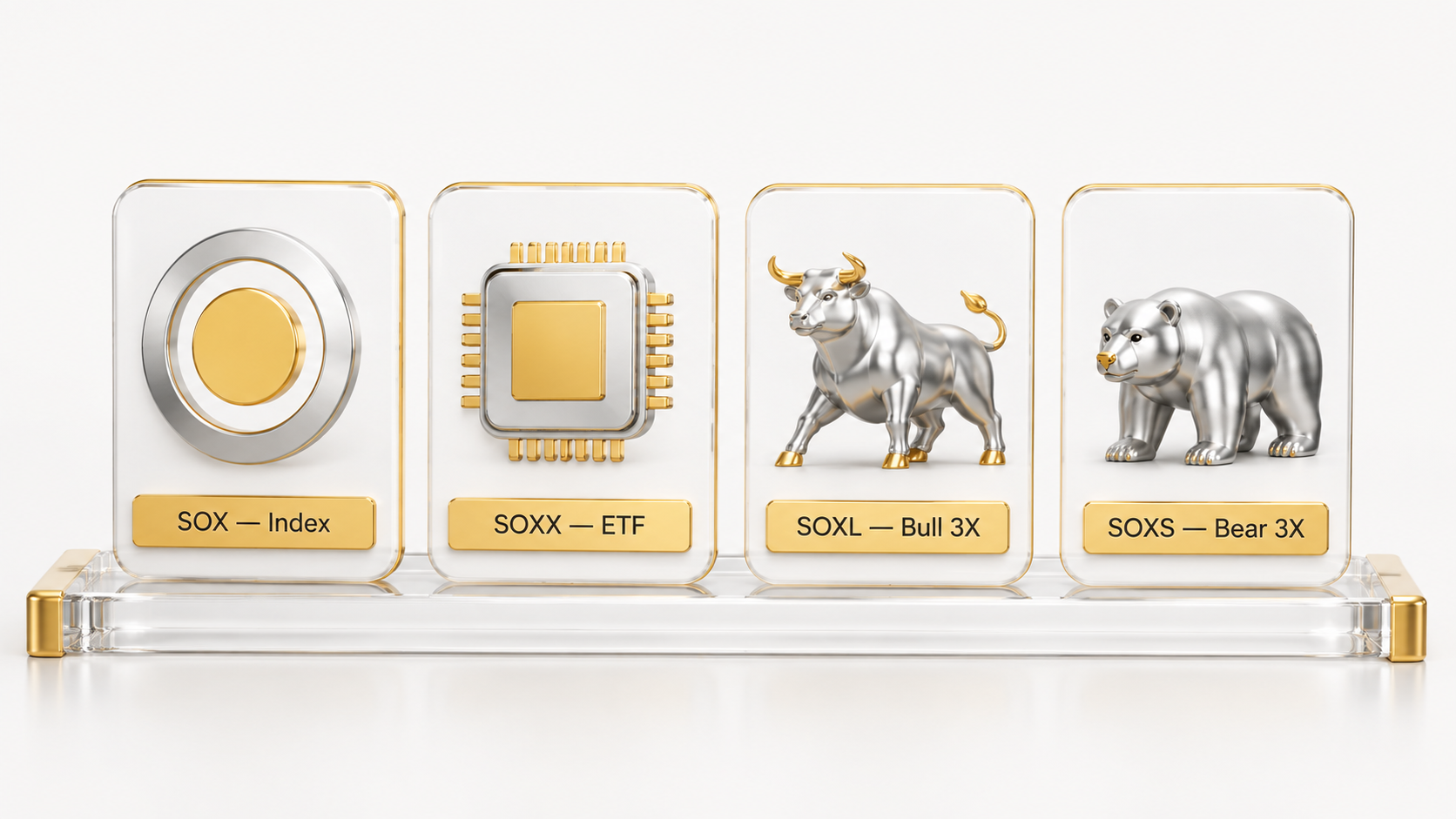
| Ticker | Type | What It Does |
|---|---|---|
| SOX | Index | Tracks a basket of major semiconductor companies. |
| SOXX | ETF | Provides tradable long exposure to a semiconductor equity portfolio. |
| SOXL | Leveraged ETF | Targets amplified bullish daily semiconductor exposure. |
| SOXS | Inverse leveraged ETF | Targets roughly -300% of its semiconductor benchmark's daily performance. |
The similar tickers create obvious confusion. SOX is the index benchmark. SOXX is an exchange-traded fund. SOXL and SOXS are leveraged daily products. They can all react to the semiconductor sector, but their structures, risks and holding behavior are different.
Why Does the SOX Index Matter?
The semiconductor sector sits near the center of modern technology spending. Chips power smartphones, cloud computing, artificial intelligence, automobiles, industrial systems and data centers. When SOX rises broadly, investors may interpret the move as improving expectations for technology demand. When the index falls sharply, it can signal concern about the chip cycle, valuation or macro conditions.
SOX also matters because semiconductors often lead broader technology sentiment. A strong semiconductor tape can support Nasdaq-related risk appetite, while a sudden chip selloff can spill into other growth sectors.
For beginners asking what is SOX stock, the simplest way to think about it is: SOX is a scoreboard for a major part of the semiconductor market rather than a stock you can own directly.
How Does SOXS Work?
SOXS is designed for bearish daily semiconductor exposure. The fund seeks approximately -300% of its benchmark's daily performance before fees and expenses. If the benchmark falls 2% in one day, the target daily move for SOXS is roughly +6%. If the benchmark rises 2%, the target is roughly -6%.
That does not mean SOXS will always equal exactly negative three times the benchmark over a week or a month. The fund resets daily, so compounding matters. In a volatile sideways market, the path of returns can create results that differ materially from a simple -3x long-term calculation.
Can You Buy the SOX Index Directly?
You generally cannot buy an index itself the same way you buy one company share. Indexes are benchmarks. Investors usually obtain exposure through ETFs, options, futures or other derivatives linked to a semiconductor benchmark.
This distinction is central to what is SOX stock. A quote for the index tells you where the benchmark stands; an ETF or derivative is the actual tradable instrument.
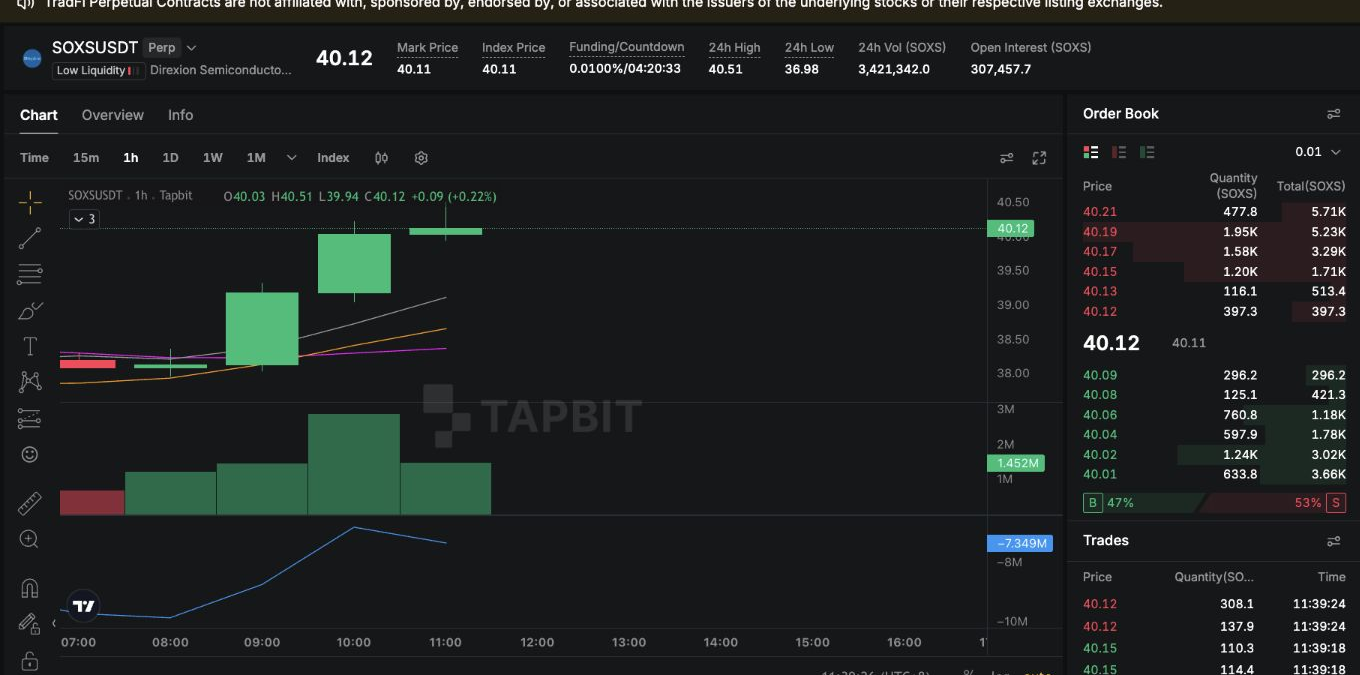
How to Trade SOXS-USDT on Tapbit
Tapbit offers SOXS-USDT perpetual futures. The contract provides derivative price exposure linked to SOXS. It is not direct ownership of the SOXS ETF and does not give ETF distributions, voting rights or direct ownership of any semiconductor company.
-
Create an account or log in.
-
Open the SOXS-USDT contract and review the contract name, mark price, index price and funding countdown.
-
Select Limit, Market or Trigger, choose quantity, leverage and margin mode, then Open Long or Open Short.
-
Add TP/SL and monitor margin, liquidation risk, Positions, Open Orders and Trigger Orders.
When Might Traders Watch SOXS?
SOXS can attract attention when semiconductor stocks are falling, when chip earnings disappoint or when investors expect a short-term decline in technology risk appetite. Because the product uses daily leverage, timing and risk management are especially important.
A trader who is bearish on the chip sector for one session faces a different problem from an investor who expects the sector to be weak over several months. Longer holding periods introduce more compounding risk, so SOXS should not be treated as a simple permanent short position on SOX.
Another useful way to answer what is SOX stock is to ask what type of exposure a user actually wants: a benchmark reading, a long semiconductor ETF, or leveraged directional exposure. That choice determines whether SOX, SOXX, SOXL or SOXS is the relevant instrument.
For anyone still asking what is SOX stock, the key rule is simple: verify the product type before interpreting the ticker.
Bottom Line
So, what is SOX stock? SOX is not a stock at all. It is the 30-component PHLX Semiconductor Sector Index used to track major semiconductor companies. SOXX is a tradable ETF, while SOXL and SOXS are daily leveraged products. Tapbit's SOXS-USDT is another layer: a perpetual derivative linked to SOXS price exposure. Knowing which instrument you are looking at is essential before interpreting a quote or placing a trade.
FAQ
Is SOX a stock?
No. SOX is the PHLX Semiconductor Sector Index.
What does SOX stand for in the stock market?
SOX is the ticker commonly used for the PHLX Semiconductor Sector Index, a benchmark for major semiconductor companies.
What is the difference between SOX and SOXS?
SOX is an index. SOXS is a leveraged inverse ETF designed to target roughly -300% of a semiconductor benchmark's daily move.
Is SOXS designed for long-term holding?
It is designed around a daily objective. Daily resetting and compounding can make long holding periods behave differently from a simple -3x calculation.


