
When someone searches "what is MONI," they are rarely just looking for a price ticker. MONI is the governance and premium asset layer at the core of Monsta Infinite — a decentralized MMORPG built on BNB Smart Chain and its own dedicated sidechain. Understanding what MONI is means understanding how the game works, how its economy is structured, and why the token exists in the first place.
This guide covers everything you need to know about what MONI is and how it functions: its core token utility, how it differs from the ecosystem's second token STT, how the gameplay loop operates, and how to buy, earn, or stake MONI in 2026. It also takes an honest look at where Monsta Infinite stands today, after multiple market cycles have separated projects with genuine infrastructure from those that were purely speculative.
In a GameFi landscape that has shed most of its early hype, Monsta Infinite remains one of the projects still actively running. MONI remains the key to participating in its ecosystem at the governance and premium level.
What Is MONI — The Token Defined
So, what is MONI exactly? MONI — short for Monsta Infinite Token — is a BEP-20 governance token deployed on BNB Smart Chain. Unlike many in-game currencies that can be minted without limit, MONI carries a hard supply cap of 270,000,000 tokens. No additional MONI will ever be created. This fixed ceiling is one of its most consequential economic properties.
Within the Monsta Infinite ecosystem, MONI serves four distinct functions:
Governance (Monsta DAO). MONI holders can vote on game parameters, treasury allocations, and protocol-level decisions, giving long-term holders a direct stake in how the ecosystem evolves.
Staking (Monsta Vault). Users can lock MONI into designated staking pools to earn rewards that accumulate over time. Longer lock-up periods generally correspond to higher reward rates, incentivizing long-term alignment over short-term speculation.
Cloning (Token Sink). Creating new Monsta NFTs requires burning a defined quantity of MONI alongside STT. This mechanic ties player growth directly to MONI demand, creating an ongoing absorption layer as the player base expands.
High-Value Marketplace Currency. Premium NFTs — including rare Monstas and certain land assets — are priced in MONI, reinforcing its role as the ecosystem's hard asset rather than a routine transactional token.
MONI is distinct from STT, the ecosystem's second token, which handles everyday in-game spending. That distinction is covered in detail in Section 3.
For the latest MONI price and market data, visit CoinMarketCap or CoinGecko at any time. For official project information and announcements, refer to the Monsta Infinite official website.
What Is Monsta Infinite — The Game Behind MONI
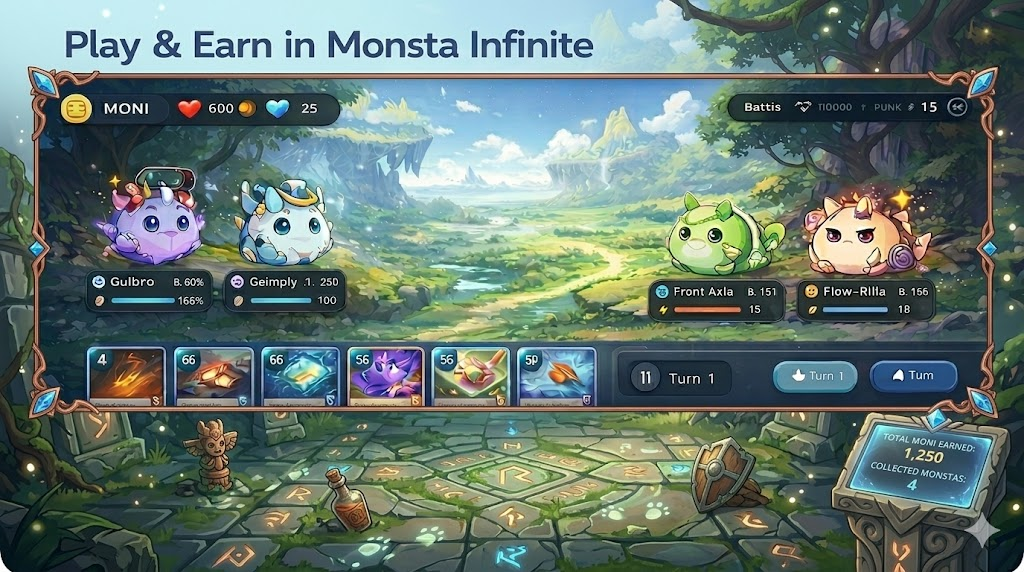
To fully understand what MONI is and where its value comes from, you first need to understand the game it powers. Monsta Infinite is a decentralized MMORPG set on the planet Shani, where a species of collectible creatures called Monstas defend their world against entities known as Jilaka. This narrative framework supports a full range of PvE encounters, character progression systems, and competitive PvP modes.
The Gameplay Loop
Players begin by assembling a team of three Monstas, ranging from accessible entry-level units to rare, high-stat NFTs with significant secondary market value. Once a team is formed, the core gameplay loop unfolds across four stages:
Combat blends turn-based card mechanics with match-three puzzle elements, requiring both strategic planning and quick pattern recognition. This design makes matches substantially harder to automate and rewards active player engagement. An ELO-based matchmaking system ensures PvP fairness by pairing players of comparable skill levels.
PvE modes focus on resource gathering. Successful encounters yield STT and crafting materials essential for progression. PvP modes offer ranked competition, with seasonal leaderboard performance determining eligibility for MONI rewards at the top tiers.
Evolution and upgrades allow players to spend STT and materials to enhance Monsta body parts, skills, and overall combat capability — increasing both in-game performance and the potential secondary market value of those NFTs.
Technical Infrastructure
Monsta Infinite originally launched on BNB Smart Chain but now primarily operates on Monsta Chain, its own dedicated sidechain. This infrastructure decision is significant: it keeps transaction costs for routine gameplay actions — hatching eggs, upgrading parts, claiming rewards — extremely low, avoiding the situation where micro-earnings are consumed by gas fees on a high-fee mainnet. Bridges connect Monsta Chain back to BNB Smart Chain, allowing MONI and other assets to move freely between the game environment and the broader DeFi ecosystem.
Compared to earlier P2E titles that required significant upfront capital and generated high gas costs, Monsta Infinite was deliberately designed for lower barriers to entry — a direct response to lessons learned from the 2021 GameFi cycle.
MONI vs STT — How the Dual-Token Economy Works
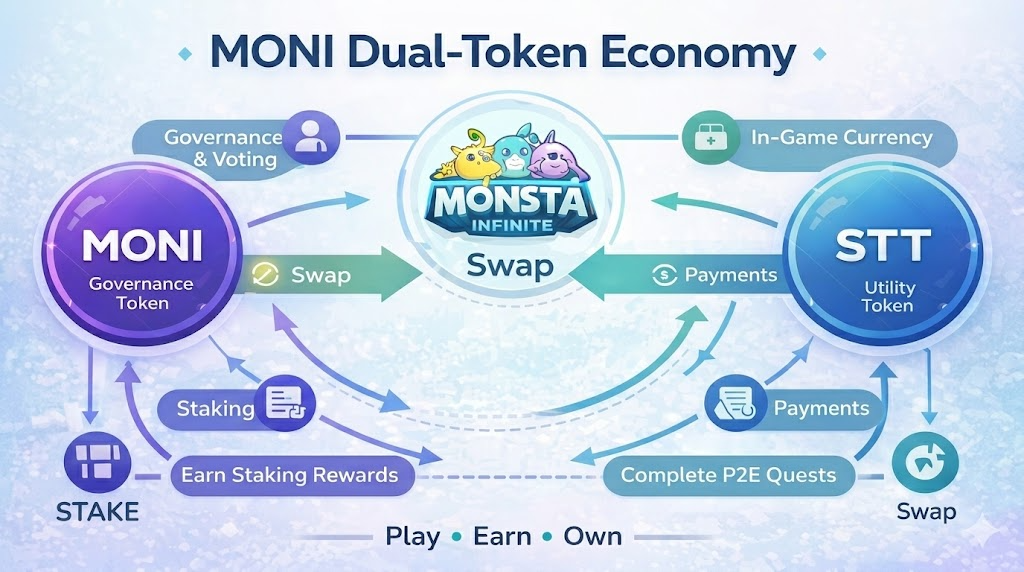
One of Monsta Infinite's foundational design decisions is its dual-token structure. Early P2E games used a single currency for both governance and daily in-game spending — a model that produced severe inflation and contributed to the collapse of several high-profile projects. Monsta Infinite separates these functions into two tokens with clearly distinct roles.
MONI — The Hard Asset
MONI is the ecosystem's fixed-supply, governance-layer token. With a cap of 270,000,000 tokens, it cannot be diluted by daily reward emissions. Its primary acquisition routes are PvP seasonal rankings, staking returns, and secondary market purchases. Because MONI is scarce and tied to governance decisions, it functions more like equity in the ecosystem than a routine reward token.
STT — The Utility Token
STT (Stamen Tellus) is the uncapped utility token designed for everyday consumption. Players earn STT through PvE battles, quests, and selling in-game items, and spend it on upgrading Monsta components, purchasing consumables, and routine marketplace activity. Because STT is earned and spent at high volume, its supply needs to be flexible — which is precisely why it cannot simultaneously serve a governance function.
Where the Two Tokens Intersect
The most critical intersection point is the cloning mechanic. Creating a new Monsta NFT requires a defined quantity of both STT and MONI. This binds the two tokens together: players looking to expand their roster must hold both, generating natural MONI demand even from users who primarily interact with the game through STT. Every cloning event consumes MONI — some directed to the treasury, some burned outright — linking gameplay activity directly to MONI tokenomics.
This architecture was intentional. By keeping governance and premium actions within a capped token while routing inflationary reward pressure through an uncapped utility token, Monsta Infinite aims to avoid the pattern seen in single-token P2E games, where reward emissions steadily devalue the only currency in circulation.
MONI Tokenomics and Token Sink Mechanics
Supply Structure
The total MONI supply is fixed at 270,000,000 tokens. According to official documentation, the allocation breakdown is approximately:
-
Play-to-Earn Rewards: 25% — allocated to seasonal and gameplay-based reward pools
-
Staking Incentives: 24% — released through Monsta Vault staking programs
-
Team: 16% — subject to vesting schedules
-
Marketing: 9% — used for community growth and partnership initiatives
-
Private Sale: 6% — early investor allocation
-
Remaining allocations — ecosystem development, treasury, and public distribution
No tokens beyond this cap will ever be minted. All new MONI entering circulation comes exclusively from pre-allocated pools, not from open-ended issuance.
Token Sink Mechanics
A token sink is any mechanism that removes tokens from active circulation, counteracting the inflationary pressure generated by reward emissions. Monsta Infinite operates several:
Cloning is the primary sink. Each cloning event consumes a fixed MONI quantity, and each Monsta has a maximum number of times it can be cloned — preventing NFT oversupply while ensuring that growing player populations generate proportionally increasing MONI demand. Tokens consumed in cloning flow partly to the treasury and partly to direct burns.
Monsta Vault staking removes MONI from liquid circulation for defined lock-up periods, reducing available supply while rewarding long-term holders. Longer lock-up periods are incentivized with higher yields.
Land and premium marketplace activity routes additional MONI into the ecosystem treasury. MONI holders, through DAO governance, determine how these funds are deployed — toward game development, new incentive programs, or ecosystem expansion.
Taken together, these mechanics mean that MONI consumption scales with actual game usage. More players cloning means more MONI burned. More users staking means more MONI locked. Whether these sinks are sufficient to offset selling pressure ultimately depends on the size and growth of the active player base — the single most important fundamental metric for evaluating MONI in 2026. For broader context on token sink design across the GameFi sector, the DappRadar Blockchain Games Industry Report provides a systematic overview of how leading projects structure their consumption mechanics.
How to Get, Buy, and Stake MONI in 2026
There are three primary ways to acquire MONI: purchasing it through an exchange, earning it through gameplay, or generating additional yield by staking MONI you already hold.
Path 1: Buy Through an Exchange
MONI is available on both centralized exchanges (CEXs) and decentralized exchanges (DEXs). On the DEX side, PancakeSwap on BNB Smart Chain and JuggySwap on Monsta Chain are the main trading venues. JuggySwap is the native ecosystem DEX and integrates directly with the Monsta Wallet.
For new users, the most common approach is to first acquire BNB or a stablecoin such as USDT on a reliable centralized exchange, then swap into MONI on a DEX. TapBit is a straightforward option for this first step — purchase BNB or USDT there, withdraw to your wallet, and then complete the swap on PancakeSwap or JuggySwap. Before trading, review TapBit's fee structure to understand maker and taker rates, and check TapBit's proof of reserves for platform transparency.
Step-by-Step: Buying MONI via DEX
-
Install a compatible wallet — MetaMask or the native Monsta Wallet — and configure it for BNB Smart Chain (Chain ID: 56).
-
Register a TapBit account, purchase BNB or USDT, and withdraw to your wallet address.
-
Navigate to PancakeSwap or JuggySwap, connect your wallet, and swap BNB or your stablecoin for MONI.
-
Before confirming, verify the MONI contract address: 0x9573c88ae3e37508f87649f87c4dd5373c9f31e0. This step is critical — counterfeit tokens with identical or similar names do circulate. Cross-reference the address directly on the BscScan contract page to confirm authenticity against on-chain data.
-
Optionally, bridge your MONI to Monsta Chain via the official bridge if you plan to use it directly within the game.
You can monitor MONI's live price throughout this process on CoinMarketCap or CoinGecko to time your swap accordingly.
Path 2: Earn Through Gameplay
Players who compete in PvP ranked modes can earn MONI through seasonal reward distributions. Performance-based earnings depend on final leaderboard placement at the close of each season. Ecosystem incentive programs and community events also periodically distribute MONI to active participants.
Path 3: Stake Existing MONI
-
Navigate to the Monsta Vault interface within the Monsta Infinite ecosystem.
-
Select a staking pool and choose your preferred lock-up period — longer durations typically correspond to higher reward rates.
-
Approve the smart contract interaction in your wallet.
-
Confirm the staking transaction on-chain. Rewards accrue over time and can be tracked through the Vault dashboard.
-
When ready to exit, follow the interface instructions to unstake and claim accumulated rewards.
Security Reminder
Always write your wallet recovery phrase on paper and store it offline. Never save it in cloud storage, email, screenshots, or messaging applications. For substantial MONI or NFT holdings, consider pairing your software wallet with a hardware wallet for an additional layer of protection. If you have questions during the process of acquiring BNB or USDT, TapBit's 24/7 support team is available to assist. High-volume traders can also review TapBit's VIP tier benefits for reduced fees on larger positions.
MONI in 2026 — Where the Project Stands
The GameFi Landscape After the Hype Cycle
The 2021–2022 GameFi boom generated hundreds of P2E projects. By 2026, the overwhelming majority have gone inactive, been abandoned by their development teams, or lost their player base entirely. The projects that survived tend to share a set of common traits: genuine underlying infrastructure, a playable game that does not depend solely on token price appreciation, and an economic model that does not collapse when new-user growth slows.
Monsta Infinite belongs to this smaller category of survivors.
Why Monsta Infinite Has Remained Active
Monsta Chain continues to operate, processing gameplay transactions at minimal cost. The dual-token structure — one of its key advantages over single-token P2E designs — has held across multiple market cycles without requiring emergency restructuring. The scholarship ecosystem remains live, allowing asset owners to lend Monstas to players who cannot afford upfront entry costs, supporting a broader user base than ownership-only participation models. The Monsta DAO continues to vote on ecosystem parameters, and the development team has shipped ongoing updates, including cloning framework revisions and land-related mechanics that deepen the token sink structure.
MONI's Current Market Profile
MONI's 2026 price profile reflects the realities of a post-hype GameFi asset reaching a degree of maturity. One fact worth stating clearly: MONI experienced a drawdown of more than 90% from its 2021 peak, consistent with the trajectory of the vast majority of GameFi tokens during the same period. This historical data does not predict future performance, but it illustrates the extreme volatility characteristics of this asset class in unambiguous terms. Current market cap figures place MONI in the small-cap range relative to leading DeFi and Layer 1 tokens — meaning both higher potential upside and proportionally larger downside risk in either direction. For current figures, CoinMarketCap and CoinGecko are the most reliable references.
The most informative metrics to track are not price movements alone. Cloning activity volume, Monsta Vault total value locked (TVL), active wallet counts on Monsta Chain, and JuggySwap trading volume provide a clearer picture of whether the ecosystem's token sinks are generating real on-chain demand — or whether the project is in gradual decline.
Investor Perspective and Risk Disclosure
For investors, MONI offers targeted exposure to a specific GameFi universe with a defined supply cap and embedded consumption mechanics. That structural position is more defensible than uncapped utility tokens with no burn mechanisms. However, the GameFi segment as a whole commands significantly less attention and capital in 2026 than it did at its peak, and Monsta Infinite faces competition from a newer generation of blockchain games with more advanced infrastructure and larger initial development budgets.
The honest assessment: MONI's long-term value depends more on whether Monsta Infinite can sustain and grow its active player base than on any technical indicator or market narrative. Player growth drives cloning demand, and cloning demand is what makes the token sink mechanics function as designed. If the player base stagnates, the economic model faces headwinds regardless of how well it is structured on paper.
Anyone considering a position in MONI should prioritize on-chain activity metrics over price charts, and allocate only capital they can afford to lose in its entirety.
FAQ
What is MONI used for in Monsta Infinite?
MONI is the governance and premium token of the Monsta Infinite ecosystem. It is used to vote on ecosystem decisions through the Monsta DAO, stake in the Monsta Vault for additional yield, pay part of the cost to clone new Monsta NFTs, and purchase high-value items and assets on the marketplace. It serves as the ecosystem's hard asset layer, with a clearly distinct role from the everyday utility token STT.
What is the difference between MONI and STT?
MONI is a capped governance token with a maximum supply of 270 million, used for staking, voting, cloning, and premium marketplace transactions. STT is an uncapped utility token earned through PvE gameplay and spent on routine in-game actions such as upgrading Monsta parts and purchasing consumables. The separation is intentional: it prevents the inflation required to sustain active gameplay rewards from diluting the governance and value-storage functions that MONI is designed to serve.
How can I earn MONI without buying it?
The primary in-game path is competitive PvP. Players who finish a ranked season at sufficiently high leaderboard positions qualify for MONI distributions from the seasonal reward pool. Periodic ecosystem incentive programs and community events also distribute MONI to active participants. Staking existing MONI in the Monsta Vault is another method of generating additional MONI over time, though it requires holding some MONI as a starting point.
Is Monsta Infinite free to play?
Not entirely, but it was designed to be significantly more accessible than many early P2E titles. Starting play requires three Monstas — while rare NFTs can carry a high price, standard units are priced with a broader audience in mind. The scholarship system allows asset owners to lend Monstas to players in exchange for a share of in-game rewards, further reducing the barrier to participation. Because gameplay takes place on Monsta Chain, transaction fees for common in-game actions are minimal.


