

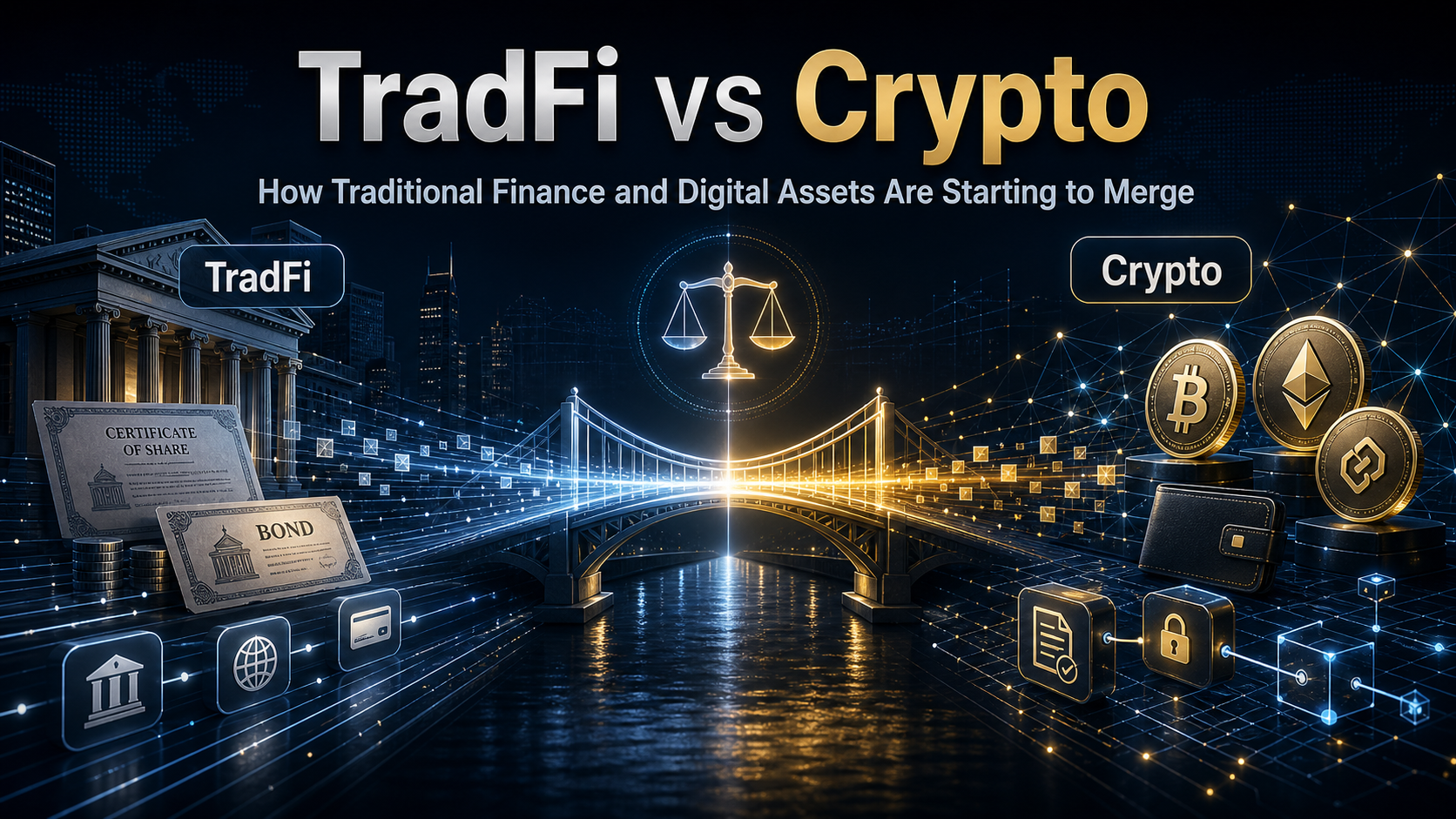
TradFi and crypto are no longer completely separate worlds. Traditional finance still controls most global capital through banks, brokers, asset managers, exchanges, and payment systems, while crypto has created a parallel financial layer built on blockchains, wallets, tokens, and smart contracts.
The real trend is not simply “TradFi versus crypto.” It is convergence. Bitcoin ETFs, stablecoins, tokenized treasuries, real-world assets, institutional custody, and tokenized stocks show that traditional institutions are increasingly using crypto rails without fully abandoning regulation, compliance, or centralized oversight.
For investors, the key question is how this merger changes market structure. Crypto brings speed, transparency, programmability, and 24/7 settlement. TradFi brings scale, regulation, liquidity, legal frameworks, and access to institutional capital.
What Is TradFi?
TradFi, short for traditional finance, refers to the established financial system built around banks, brokers, exchanges, asset managers, payment processors, insurers, clearing houses, and regulators. It is the system most people use when they receive salaries, swipe cards, apply for loans, buy stocks, invest in funds, or hold money in bank accounts.
The defining feature of TradFi is intermediation. Users do not directly settle most financial activity themselves. A bank processes payments. A broker handles stock trades. A custodian holds assets. A clearing house manages settlement. Regulators supervise institutions and set rules for market conduct.
This system can be slow and expensive, but it also provides legal structure. If a bank transfer fails, there may be customer support. If a broker collapses, there may be investor protection rules. If a listed company lies to shareholders, regulators and courts can intervene.
TradFi is not just old technology. It is a legal and institutional machine designed to manage trust at scale.
What Is Crypto?
Crypto is a financial and technological system built around blockchains. Instead of relying entirely on banks or brokers, crypto allows users to hold and transfer digital assets through wallets, public networks, and smart contracts.
Bitcoin introduced the idea of a scarce digital asset that could move without a central bank. Ethereum expanded the idea by making blockchain programmable, allowing developers to build decentralized exchanges, lending protocols, stablecoins, NFTs, and tokenized assets.
Crypto's defining feature is direct ownership. A user can hold assets in a wallet without a bank account. A smart contract can execute a trade without a broker. A stablecoin can move across borders without a traditional wire transfer.
But this freedom comes with responsibility. If a user loses a private key, sends funds to the wrong address, or interacts with a malicious contract, there may be no reversal process. Crypto reduces dependence on institutions, but it also reduces the safety net those institutions provide.
TradFi vs Crypto: The Core Difference
The deepest difference between TradFi and crypto is how each system creates trust.
TradFi creates trust through institutions, regulation, contracts, legal enforcement, and reputation. Users trust banks because banks are licensed. Investors trust brokers because brokers are regulated. Markets trust clearing houses because they are part of a supervised settlement system.
Crypto creates trust through code, cryptography, network incentives, and transparent ledgers. Users do not need to trust a bank to verify a Bitcoin transaction. They can check the blockchain. Smart contracts can enforce rules automatically. Token ownership can be visible on-chain.
Neither model is perfect. TradFi can be opaque, slow, and gatekept. Crypto can be volatile, technically complex, and vulnerable to scams. TradFi asks users to trust institutions. Crypto asks users to trust systems, code, and their own operational discipline.
That tradeoff is why the two systems are starting to blend.
Why TradFi Is Moving Into Crypto
Traditional finance did not ignore crypto forever because the technology solved real market problems.
Settlement is one example. In many traditional markets, settlement can take one or two business days. Blockchain-based settlement can happen much faster, and stablecoins can move value globally outside banking hours.
Asset distribution is another example. Tokenization makes it possible to represent treasuries, funds, real estate claims, private credit, or equities as digital tokens. That could eventually make markets more accessible, more programmable, and easier to settle.
Institutional demand also matters. Once investors wanted Bitcoin exposure, asset managers needed regulated wrappers. Spot Bitcoin ETFs and crypto custody services are examples of TradFi absorbing crypto demand into familiar structures.
TradFi is not adopting crypto because it wants to become fully decentralized. It is adopting crypto where blockchain rails create efficiency, new products, or new revenue.
Why Crypto Needs TradFi
Crypto was born partly as a response to traditional finance, but it still benefits from TradFi in important ways.
Institutional capital brings liquidity. Regulated ETFs make Bitcoin and Ethereum easier for retirement accounts, financial advisers, and traditional investors to access. Banks and custodians can make large investors more comfortable holding digital assets.
TradFi also brings legal clarity. Crypto markets often struggle because users do not know which assets are securities, which platforms are compliant, or which protections apply. Traditional financial frameworks can reduce uncertainty, even if they also limit some of crypto's original openness.
For crypto to become mainstream, it needs more than ideology. It needs reliable custody, accounting standards, risk controls, compliance, tax reporting, and investor protections. These are boring pieces of infrastructure, but they are exactly what large markets require.
The Rise of Tokenization
Tokenization may be the most important bridge between TradFi and crypto.
A tokenized asset is a traditional asset represented on a blockchain. This could include U.S. Treasuries, money market funds, stocks, bonds, real estate claims, commodities, or private credit.
The promise is not just that assets become digital. Most financial assets are already digital in practice. The real promise is that tokenized assets can become programmable, composable, and easier to settle across platforms.
For example, a tokenized treasury product could potentially move between wallets, be used as collateral, settle quickly, and interact with DeFi protocols. A tokenized stock could theoretically trade around the clock, although regulatory and custody questions remain complex.
This is where TradFi and crypto become difficult to separate. The asset may be traditional, but the infrastructure may be blockchain-based.
Stablecoins as the First Real Bridge
Stablecoins are already one of the clearest examples of TradFi and crypto convergence.
A stablecoin usually represents a digital token backed by fiat assets such as cash, Treasury bills, or short-term instruments. Users can move stablecoins on blockchains, but the reserves often sit inside traditional financial institutions.
This makes stablecoins hybrid products. They use crypto rails but depend on TradFi banking, custody, audits, and regulation.
Stablecoins are important because they solve a practical problem: moving dollar-denominated value quickly across digital markets. They are used for trading, payments, remittances, DeFi, and cross-border settlement.
If crypto is the new financial layer, stablecoins are one of the main bridges connecting it to the old one.
ETFs and the Institutionalization of Crypto
Crypto ETFs represent the opposite direction of convergence. Instead of putting TradFi assets on-chain, ETFs put crypto exposure into TradFi wrappers.
A spot Bitcoin ETF allows investors to gain Bitcoin exposure through a brokerage account without managing wallets, private keys, or blockchain transactions. This reduces technical friction and makes crypto easier for traditional portfolios.
But it also changes the nature of ownership. ETF holders do not directly hold Bitcoin in a personal wallet. They hold shares of a regulated fund that tracks Bitcoin exposure. That is more convenient, but less native to crypto's self-custody ethos.
This is the tradeoff at the center of institutional crypto adoption: easier access often means more intermediation.
DeFi vs TradFi: Competition or Infrastructure?
Decentralized finance, or DeFi, is often described as a competitor to traditional finance. In some ways, it is. DeFi protocols can offer token swaps, lending, borrowing, derivatives, and yield markets without traditional intermediaries.
But DeFi may also become infrastructure for new kinds of financial activity. Automated market makers, on-chain collateral, transparent liquidation systems, and programmable settlement can inspire or support future financial products.
The challenge is risk. DeFi has suffered from hacks, governance failures, oracle issues, liquidity shocks, and unsustainable yield models. TradFi institutions may like the efficiency of DeFi, but they usually require stronger controls before using it at scale.
The likely future is not that DeFi replaces banks entirely. A more realistic outcome is that parts of DeFi become integrated into regulated products, while more experimental DeFi remains separate.
What TradFi and Crypto Convergence Means for Investors
For investors, the TradFi-crypto merger changes how markets behave.
Crypto assets may become more sensitive to macro conditions because institutional investors trade them alongside stocks, bonds, and ETFs. Bitcoin may still have crypto-native cycles, but it also reacts to interest rates, liquidity, ETF flows, and risk appetite.
Traditional assets may also become more accessible through tokenization. If tokenized treasuries, stocks, or private credit grow, investors may see more financial products that trade on blockchain rails.
The opportunity is broader access and faster infrastructure. The risk is complexity. A tokenized product may look simple, but users still need to understand custody, legal claims, redemption rights, counterparty risk, and smart contract risk.
Where Tapbit Fits In
For users learning how digital asset markets connect with broader financial trends, Tapbit provides a general entry point to explore crypto markets through its market access page. Users can also check platform campaigns and rewards through the Tapbit rewards page.
These resources can help users follow the market side of crypto, but investors should still research each asset, product, or tokenized instrument carefully before taking risk.
Final Verdict
TradFi and crypto started from very different assumptions. TradFi is built on institutions, regulation, and legal trust. Crypto is built on blockchains, code, and direct ownership.
But the market is moving toward convergence. ETFs bring crypto into brokerage accounts. Stablecoins bring fiat value onto blockchains. Tokenization brings traditional assets into crypto infrastructure. Institutional custody brings banks and asset managers into digital assets.
The future is not simply TradFi replacing crypto or crypto replacing TradFi. The more important story is the creation of a hybrid financial system where regulated institutions, blockchain networks, tokenized assets, and digital wallets increasingly interact.
For users and investors, the opportunity is real. So are the risks. Understanding both systems is becoming more important than choosing only one side.
FAQ
What does TradFi mean?
TradFi means traditional finance, including banks, brokers, exchanges, asset managers, payment systems, insurers, and regulated financial institutions.
What is the main difference between TradFi and crypto?
TradFi relies on institutions and legal frameworks. Crypto relies on blockchains, wallets, smart contracts, and cryptographic verification.
Is crypto replacing TradFi?
Crypto is not fully replacing TradFi. The stronger trend is convergence through ETFs, stablecoins, tokenization, custody, and institutional blockchain adoption.
Why are banks interested in crypto?
Banks and financial institutions are interested in crypto because blockchain technology can improve settlement, asset distribution, custody models, and digital market access.
What is tokenization?
Tokenization is the process of representing traditional assets such as bonds, treasuries, stocks, funds, or real estate on a blockchain.
Are stablecoins TradFi or crypto?
Stablecoins are hybrid products. They move on crypto rails but often rely on traditional financial reserves, banks, custodians, and regulatory frameworks.
What is the biggest risk of TradFi and crypto convergence?
The biggest risk is complexity. Users may face both traditional counterparty risk and crypto-specific risks such as smart contract bugs, wallet loss, and liquidity shocks.


