
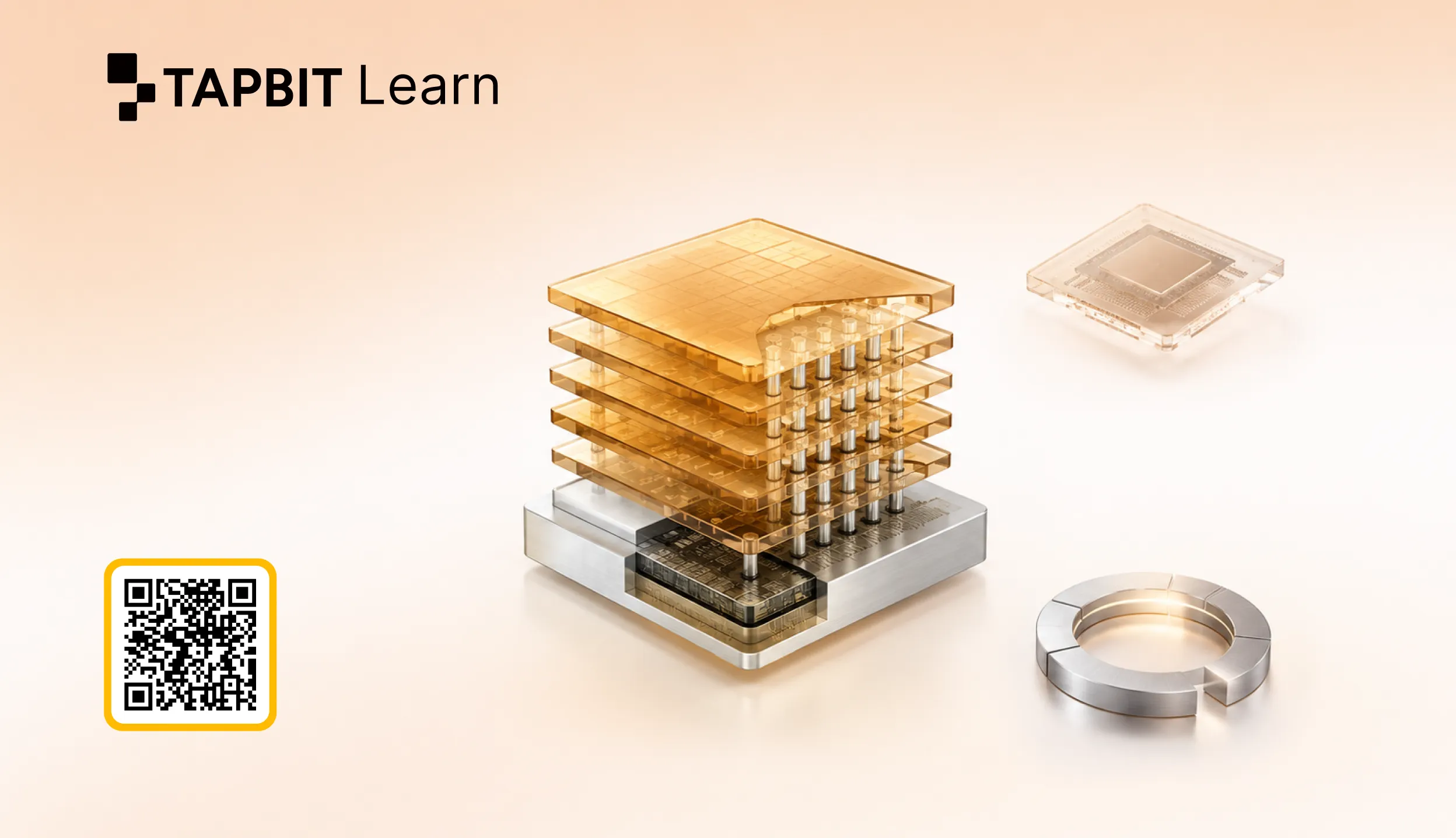
High bandwidth memory, usually shortened to HBM, is a type of computer memory built to move very large amounts of data between memory and a processor at high speed. It is most commonly associated with AI accelerators, high-performance computing and advanced graphics systems.
The simplest way to understand HBM is to imagine a processor as a powerful factory and data as the raw material. A faster factory is not useful if the road bringing materials to it is too narrow. HBM creates a much wider road, allowing more data to arrive at the processor at the same time.
HBM is not a GPU, a cryptocurrency or a storage drive. It is a specialized form of dynamic random-access memory, or DRAM, placed very close to a processor inside an advanced package.
What Does High Bandwidth Memory Mean?
“Bandwidth” describes how much data can move through a connection during a period of time. Higher bandwidth means the memory can send and receive more information per second.
Conventional memory often sits farther from the processor and uses a narrower interface. It can still be fast, but it may need higher clock speeds and more power to move the same amount of data. HBM uses a different approach: it places stacked memory close to the processor and connects it through a very wide interface.
This design is especially useful for workloads that process many operations in parallel. AI model training, scientific simulation and large-scale data analytics all need frequent access to large datasets.
Why AI Chips Need More Memory Bandwidth
AI accelerators perform huge numbers of mathematical operations. During training, they repeatedly load model weights, process inputs and update parameters. During inference, they must retrieve model data and produce answers quickly.
If the processor finishes one calculation and must wait for the next block of data, some of its expensive computing capacity is wasted. This is often called a memory bottleneck.
HBM helps reduce that bottleneck in three ways:
- It moves more data at once through a wide interface.
- It sits physically close to the processor.
- It can provide strong performance per watt, which matters in power-limited data centers.
That is why HBM has become important to modern AI chip stocks. Memory supply, qualification and pricing can influence how many complete AI systems can be delivered.
How Does HBM Work?
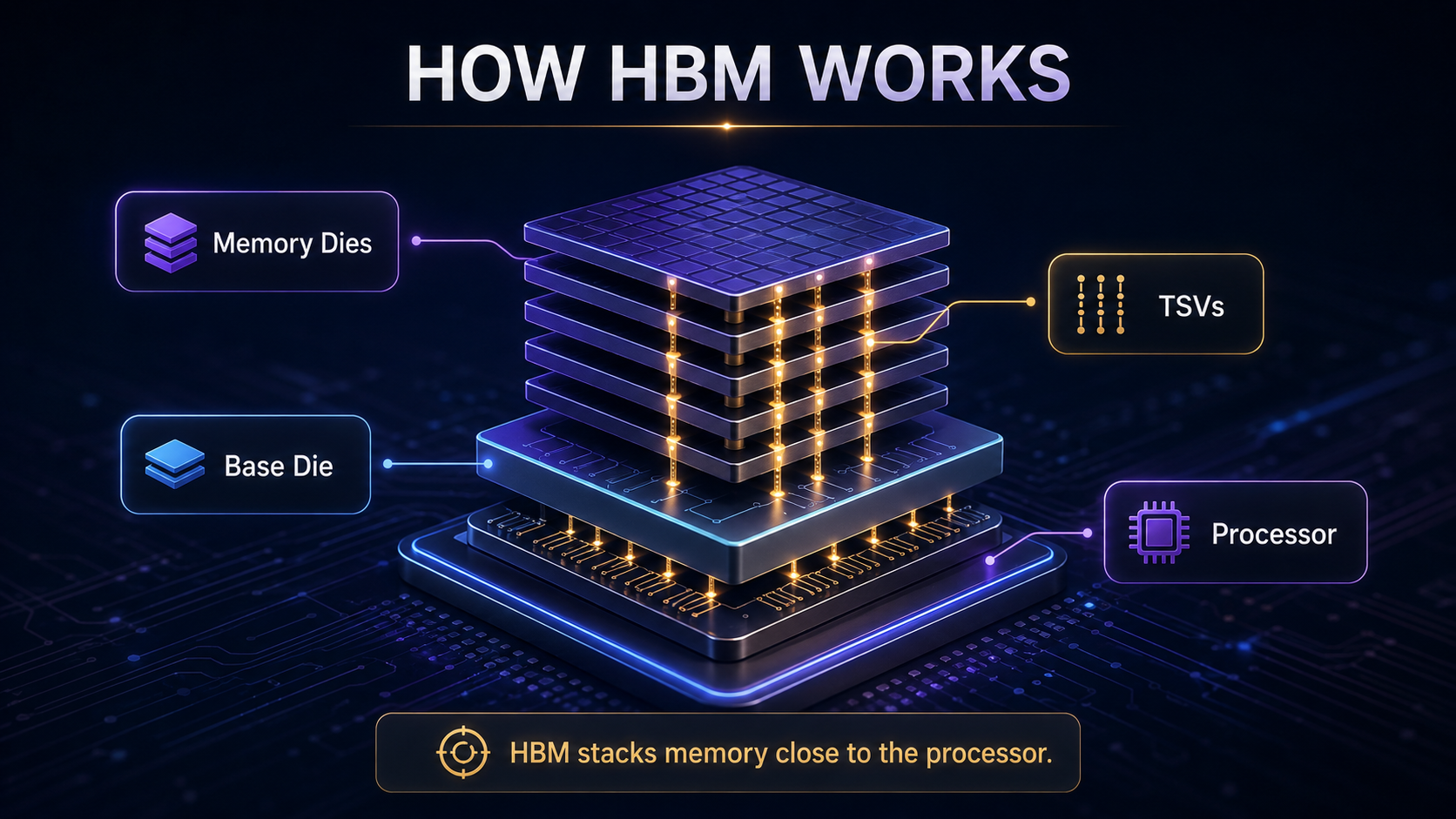
HBM combines several technologies. The key idea is vertical stacking.
Stacked Memory Dies
A memory die is a thin piece of silicon containing memory cells. Instead of placing many dies side by side, HBM stacks them on top of each other. This creates a compact structure with high capacity close to the processor.
The dies must be extremely thin and precisely aligned. If one layer has a serious defect, the complete stack may not meet the required performance or reliability standard.
Through-Silicon Vias
Through-silicon vias, or TSVs, are tiny vertical electrical connections that pass through the memory dies. They allow data and power to move through the stack.
Traditional chips mostly communicate across a flat surface. TSVs add a vertical path. This shortens some connections and allows the stacked layers to behave as one integrated memory system.
Wide Memory Interface
HBM uses many data connections between the memory and processor. The interface is much wider than the connection used by ordinary system memory. That is the source of the high bandwidth.
A wide interface can move more data without relying only on extremely high clock speed. This can improve energy efficiency, although the complete package remains complex and expensive.
Where Is HBM Placed?
HBM is normally placed beside a GPU or AI accelerator on the same advanced package. A silicon interposer or another advanced connection structure links the memory stacks to the processor.
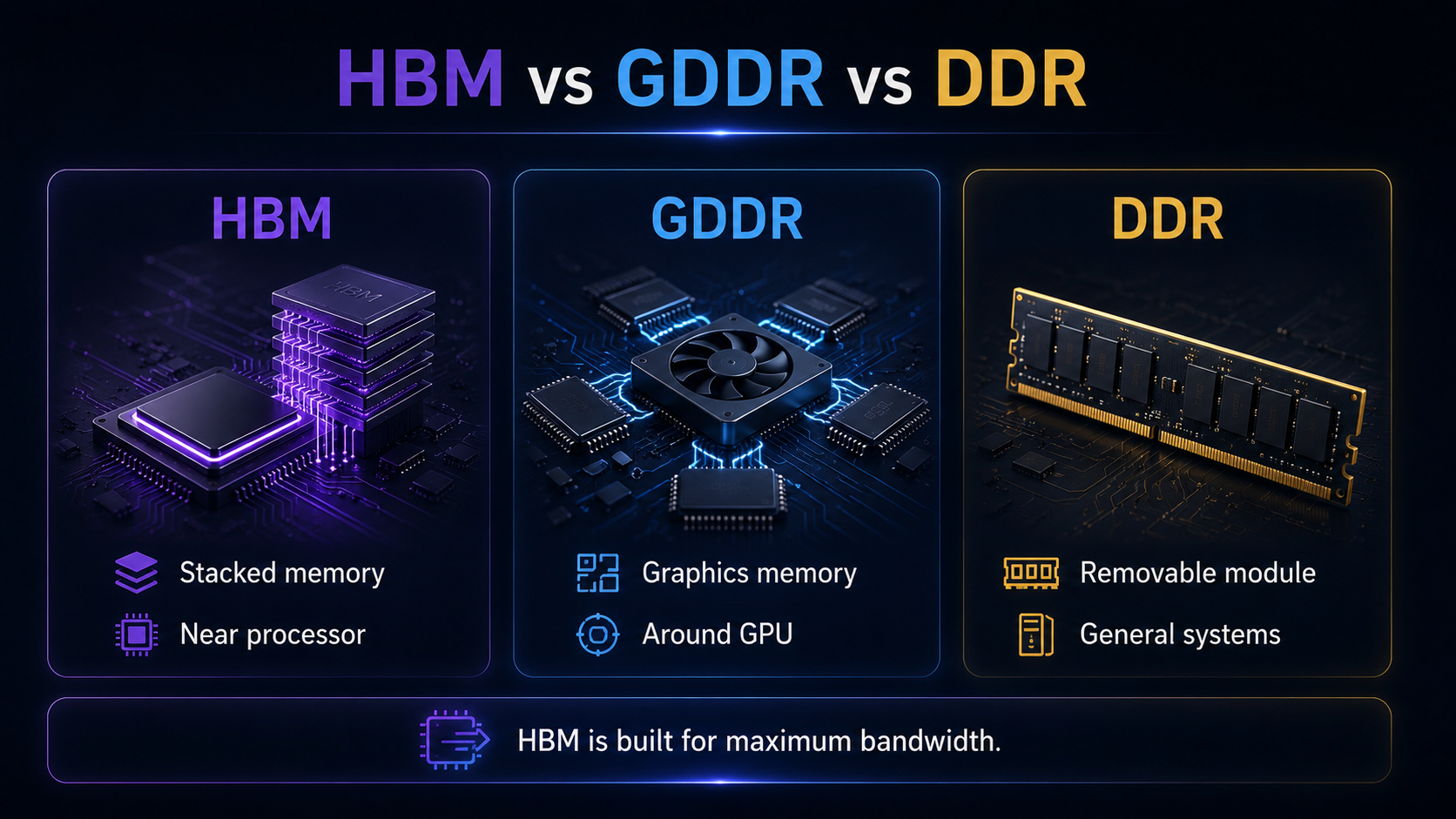
This is different from ordinary desktop memory. DDR modules are usually installed in slots on a motherboard. HBM is integrated much more closely with the processor, so users cannot normally remove or upgrade it separately.
HBM vs DDR vs GDDR
| Feature | HBM | GDDR | DDR |
|---|---|---|---|
| Main use | AI accelerators and high-performance computing | Graphics cards and gaming GPUs | General system memory for CPUs |
| Physical design | Vertically stacked near processor | Separate chips around GPU | Modules connected to motherboard |
| Interface | Very wide | Narrower but high-speed | Designed for general-purpose systems |
| Bandwidth | Very high | High | Lower than specialized GPU memory |
| Power efficiency | Strong for data movement | Varies by generation | Optimized for broad system use |
| Cost and complexity | High | Medium | Generally lower |
| Upgradeability | Normally integrated in package | Normally fixed on graphics card | Often user-replaceable |
HBM is not automatically “better” for every computer. A normal laptop or server may not need its bandwidth or cost. DDR remains practical for general computing, while GDDR offers a balance for many graphics products. HBM is most valuable when bandwidth and energy efficiency justify advanced packaging.
HBM Generations Explained
HBM has developed through several generations, including HBM, HBM2, HBM2E, HBM3, HBM3E and HBM4. Each generation generally aims to improve some combination of bandwidth, capacity, power efficiency, stack design and system integration.
HBM3E is used in current high-performance AI systems. HBM4 moves toward an even wider interface and more complex base-die logic. This increases potential performance but also makes manufacturing and co-design more difficult.
HBM4E is a later roadmap step intended for future AI systems. Product names do not guarantee immediate mass production. A new generation must move through engineering, sampling, qualification and volume manufacturing.
Advantages of High Bandwidth Memory
Very High Data Throughput
HBM can deliver large amounts of data to a processor, helping parallel computing workloads operate more efficiently.
Compact Physical Footprint
Stacking memory vertically uses less package area than placing the same number of chips side by side.
Energy Efficiency
Moving data over shorter connections and using a wide interface can reduce the energy required per unit of data. This matters because electricity and cooling are major constraints for AI data centers.
System-Level Performance
HBM can increase the useful performance of an accelerator. A processor with more theoretical computing power may not deliver better real-world results if memory cannot keep up.
Limitations of HBM
HBM also has important disadvantages.
- High cost: stacked memory and advanced packaging are expensive.
- Manufacturing complexity: thin dies, TSVs and bonding require precise production.
- Yield risk: a defect can reduce the value of an entire stack.
- Thermal challenges: densely packed components generate heat that must be managed.
- Limited suppliers: only a small group of companies can manufacture HBM at scale.
- Long qualification cycles: customers test reliability before using a product in expensive AI systems.
These constraints explain why HBM supply can remain tight even when manufacturers are investing heavily.
Who Makes High Bandwidth Memory?
The three main large-scale HBM manufacturers are SK Hynix, Samsung and Micron.
SK Hynix has built a leading position in HBM and has announced progress in HBM4 and HBM4E. Micron is expanding HBM production and packaging capacity while integrating the product into its broader DRAM business. Samsung has large manufacturing resources and is working to improve product qualification and execution.
Nvidia is not a main HBM manufacturer. It designs AI accelerators and systems that use HBM supplied by memory companies. The relationship is important: a GPU supplier may need specific memory performance, capacity and packaging to deliver a complete product.
Why HBM Matters to Investors
HBM has changed how the market values some memory companies. Traditional DRAM and NAND are highly cyclical. HBM can provide a more specialized product with stronger pricing and closer customer relationships.
That does not remove the cycle. If too much capacity is built or AI spending slows, pricing can weaken. Investors should follow HBM shipments, gross margins, capital expenditure, customer qualification and the broader semiconductor stocks market.
Can HBM-Related Markets Be Traded on Tapbit?
Tapbit lists confirmed stock-linked futures markets related to major HBM and AI companies, including SKHYNIX-USDT, MU-USDT and NVDA-USDT.
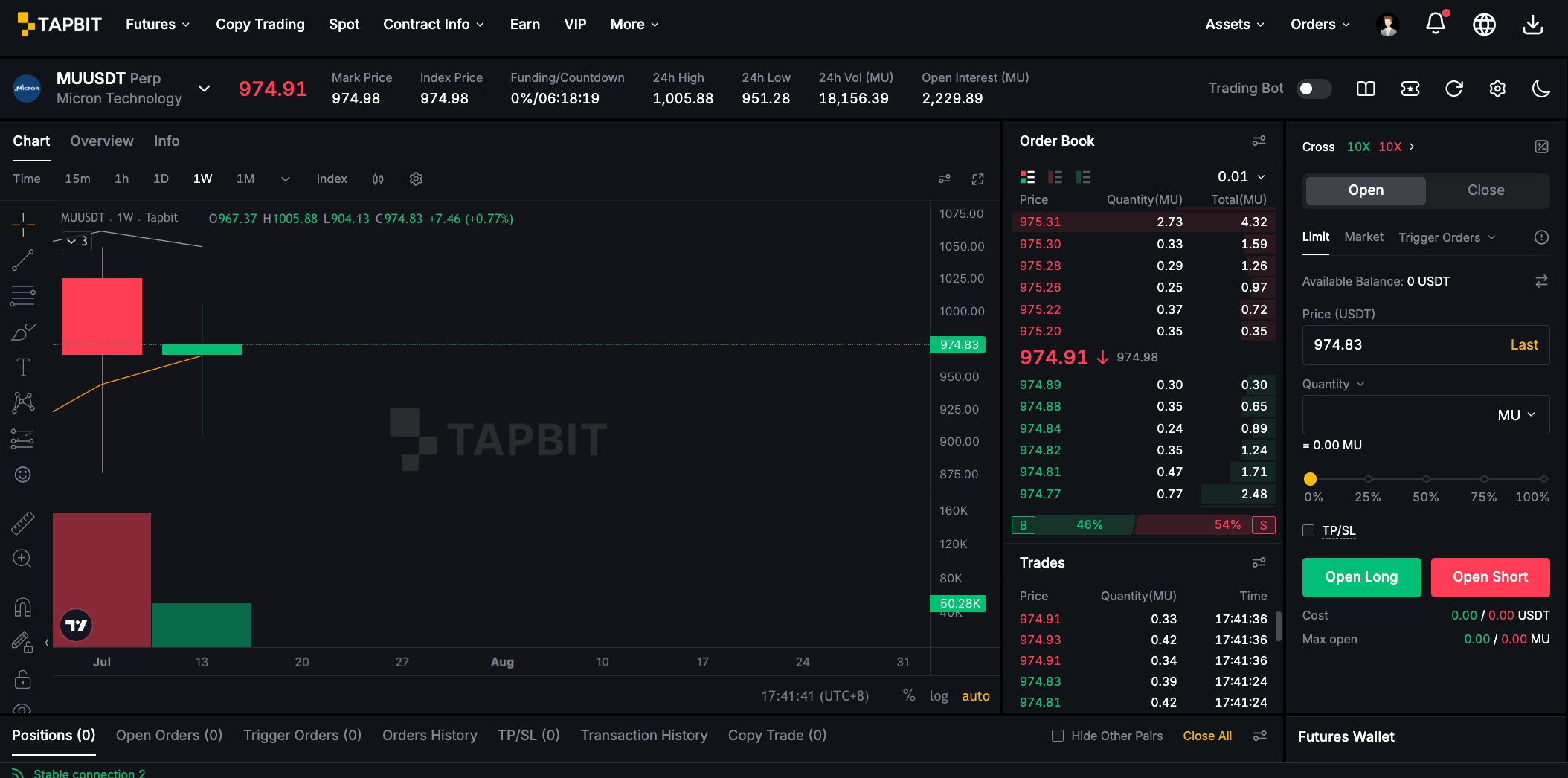
These products are derivatives. They provide price exposure but are not direct ownership of the companies and do not provide voting rights or dividends. Users can create an account and review product specifications, funding, leverage, liquidity and regional availability.
Final Definition
High bandwidth memory is stacked DRAM designed to move large amounts of data between memory and a processor. It uses vertical dies, TSV connections and a wide interface to provide the bandwidth needed by AI accelerators and high-performance systems.
HBM is valuable because computing performance increasingly depends on data movement, not only processor speed. Its main trade-off is complexity: it is fast and efficient, but expensive, difficult to manufacture and closely tied to advanced packaging.
FAQ
What does HBM stand for?
HBM stands for high bandwidth memory.
Is HBM faster than GDDR?
HBM generally provides much higher total bandwidth through a very wide interface. GDDR can still be more practical and less expensive for many graphics products.
Why is HBM expensive?
It requires advanced DRAM, thin stacked dies, TSV connections, complex bonding, advanced packaging, testing and high manufacturing yields.
Does Nvidia manufacture HBM?
No. Nvidia designs accelerators and systems that use HBM. Major HBM suppliers include SK Hynix, Samsung and Micron.
What is the difference between HBM3E and HBM4?
HBM4 is a newer generation designed for higher bandwidth and deeper system integration. It also introduces greater base-die and packaging complexity.


