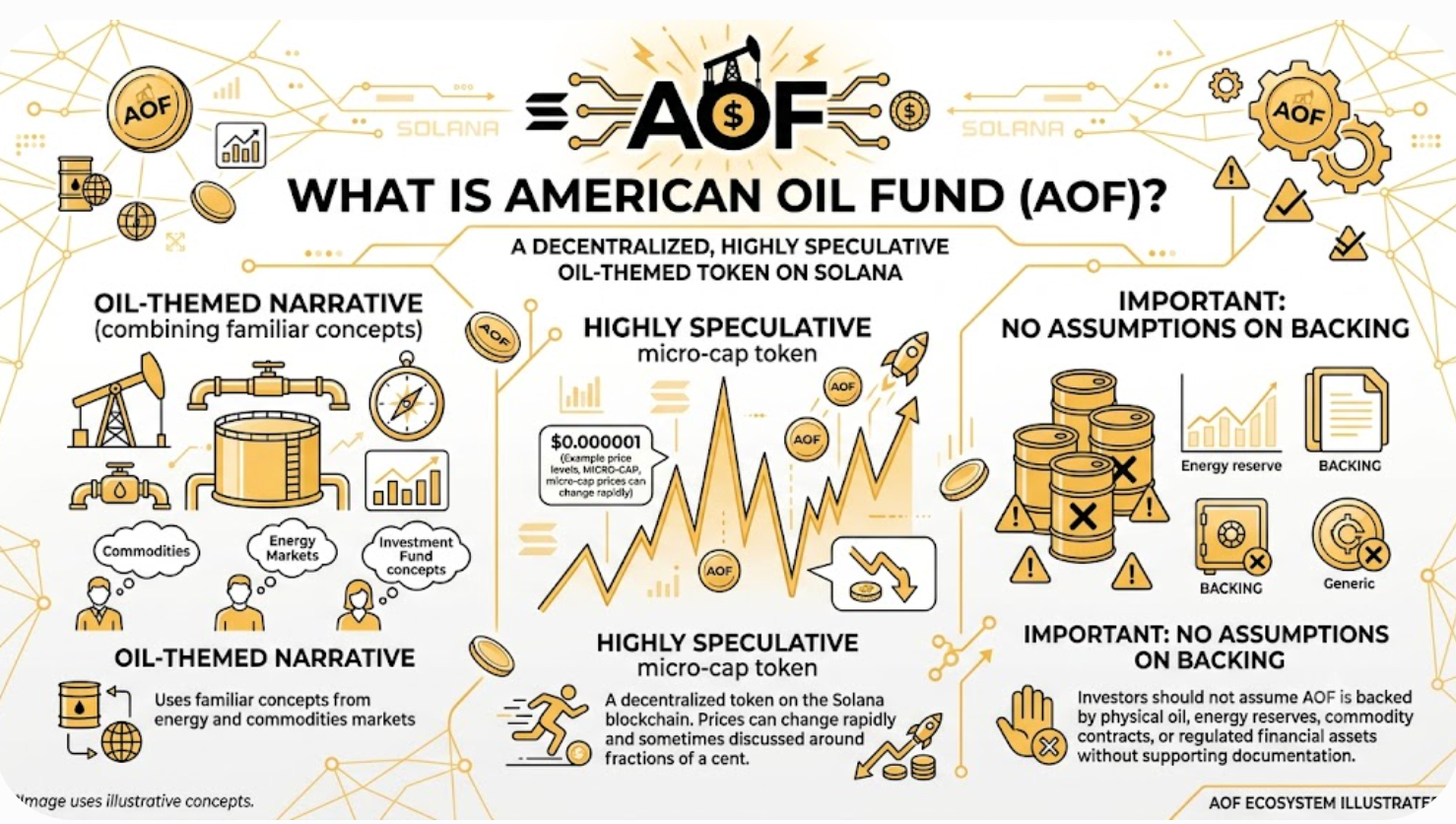
American Oil Fund, commonly referred to as AOF, is a decentralized cryptocurrency token on the Solana blockchain. It uses an oil-themed financial narrative that combines familiar concepts from commodities, energy markets, and traditional investment funds.
AOF is highly speculative. It may trade for a very small fraction of a cent, with prices sometimes discussed around levels such as $0.000001 per token. This figure should be treated only as an example because micro-cap token prices can change rapidly.
The project’s name may sound like an oil investment fund, but investors should not assume AOF is backed by physical oil, energy reserves, commodity contracts, or regulated financial assets without supporting documentation.
AOF Token Overview
| Project Element | Description |
|---|---|
| Token Name | American Oil Fund |
| Symbol | AOF |
| Blockchain | Solana |
| Asset Type | Decentralized cryptocurrency token |
| Main Narrative | Oil, commodities, and fund-style branding |
| Typical Profile | Low-price, low-cap speculative token |
| Risk Level | Very high |
AOF’s market value is likely driven primarily by liquidity, community interest, holder activity, and speculative demand rather than movements in the physical oil market.
Does AOF’s Low Price Make It Cheap?
A very low token price can make AOF appear inexpensive, but unit price alone says little about valuation.
A token priced at $0.000001 is not necessarily cheaper than a token priced at $1. Investors must also consider circulating supply and total supply.
Market Capitalization = Token Price × Circulating Supply
If a token has an extremely large supply, it can have a tiny unit price while still carrying a substantial valuation. Conversely, a small market capitalization may indicate that the token has limited liquidity and market participation.
| Metric | Why It Matters |
|---|---|
| Token Price | Shows the cost of one token |
| Circulating Supply | Determines how many tokens are available |
| Market Capitalization | Provides a broader valuation measure |
| Liquidity | Indicates how easily the token can be traded |
| Fully Diluted Value | Estimates valuation using maximum supply |
Investors should therefore avoid buying AOF simply because several zeros appear after the decimal point.
Is AOF Backed by Real Oil?
Investors should not assume AOF is backed by real oil unless the project publishes verifiable evidence.
An oil-backed token would normally require details about asset ownership, custody, storage, independent audits, pricing mechanisms, redemption rights, and legal investor claims.
Without those disclosures, AOF should be treated as an oil-themed crypto token rather than a tokenized commodity product.
Evidence to look for includes verified oil reserve disclosures, independent audits, custody documentation, legal registration, redemption mechanisms, public team information, and regulatory disclosures.
A professional-sounding name is a market narrative, not proof of asset backing.
Why AOF Can Be Highly Volatile
Low-cap Solana tokens can experience rapid price changes because relatively small trades may have a large effect on the market.
When liquidity is limited, a new buyer can push the price sharply higher. The same structure can create severe losses when holders attempt to sell.
| Risk Factor | Potential Effect |
|---|---|
| Low Market Cap | Greater sensitivity to small trades |
| Thin Liquidity | High slippage and difficult exits |
| Whale Concentration | Large holders may control price action |
| Low Trading Volume | Unstable price discovery |
| Social Media Hype | Short-lived speculative rallies |
| Liquidity Removal | Sudden market collapse |
AOF may rise quickly during an oil-related narrative cycle, but those gains can reverse just as quickly.
AOF and the Solana Ecosystem
Solana is widely used for emerging tokens because it provides fast transactions and relatively low network fees. This makes decentralized trading accessible, but it also makes creating copycat tokens easier.
Before trading AOF, users should verify the correct contract address. Searching only by token name or ticker is risky because unrelated projects can use the same symbol.
The contract should be checked through the project’s verified channels and a reputable Solana block explorer.
How to Research AOF Before Trading
A research-first approach is particularly important for micro-cap tokens.
Investors should review the official contract address, current liquidity, recent trading volume, holder distribution, top-wallet activity, mint and freeze authorities, liquidity lock status, project website and social channels, and evidence supporting oil-related claims.
Users researching broader digital asset markets can explore available tools through the Tapbit platform. If AOF is not directly listed, investors should not substitute a similarly named token without verifying its contract.
Is AOF a Good Investment?
AOF may appeal to traders who follow Solana micro-cap tokens, commodity narratives, and short-term market momentum. Its small capitalization could create significant upside if demand and liquidity increase.
However, the same characteristics create substantial downside risk. A low market cap does not guarantee future growth, and a tiny token price does not mean AOF can easily reach one cent or one dollar.
For beginners, AOF is better classified as a high-risk speculative token than a conventional investment. Any exposure should account for the possibility of losing the full amount committed.
Can AOF Reach $0.01?
A price target must be evaluated against token supply rather than considered in isolation.
If AOF trades near $0.000001, reaching $0.01 would represent an increase of approximately 10,000 times. Whether that is mathematically realistic depends on circulating supply, required market capitalization, liquidity, and future demand.
Investors should calculate the implied market cap at every price target. Forecasts that ignore token supply can create unrealistic expectations.
Conclusion
American Oil Fund (AOF) is a speculative Solana token using oil and fund-related branding. Its low unit price and market capitalization may attract traders looking for early-stage opportunities, but those same features create severe volatility and liquidity risk.
Investors should not assume AOF represents ownership of oil or participation in a regulated fund. Until asset backing and legal rights are independently verified, it should be evaluated as a decentralized crypto token.
Users can also visit the Tapbit rewards page to explore broader platform campaigns while maintaining strict risk controls for micro-cap assets.
FAQ
What is AOF crypto?
AOF stands for American Oil Fund and is described as a decentralized token on the Solana blockchain.
Is AOF backed by oil?
Investors should not assume AOF holds physical oil unless reserve, custody, audit, and legal documentation are verified.
Why is AOF’s price so low?
The unit price may reflect its token supply, low market capitalization, limited liquidity, and speculative demand.
Does a low AOF price mean it is undervalued?
No. Investors must consider market capitalization, circulating supply, liquidity, and project fundamentals.
Is AOF risky?
Yes. AOF carries substantial volatility, liquidity, concentration, transparency, and contract-verification risks.


