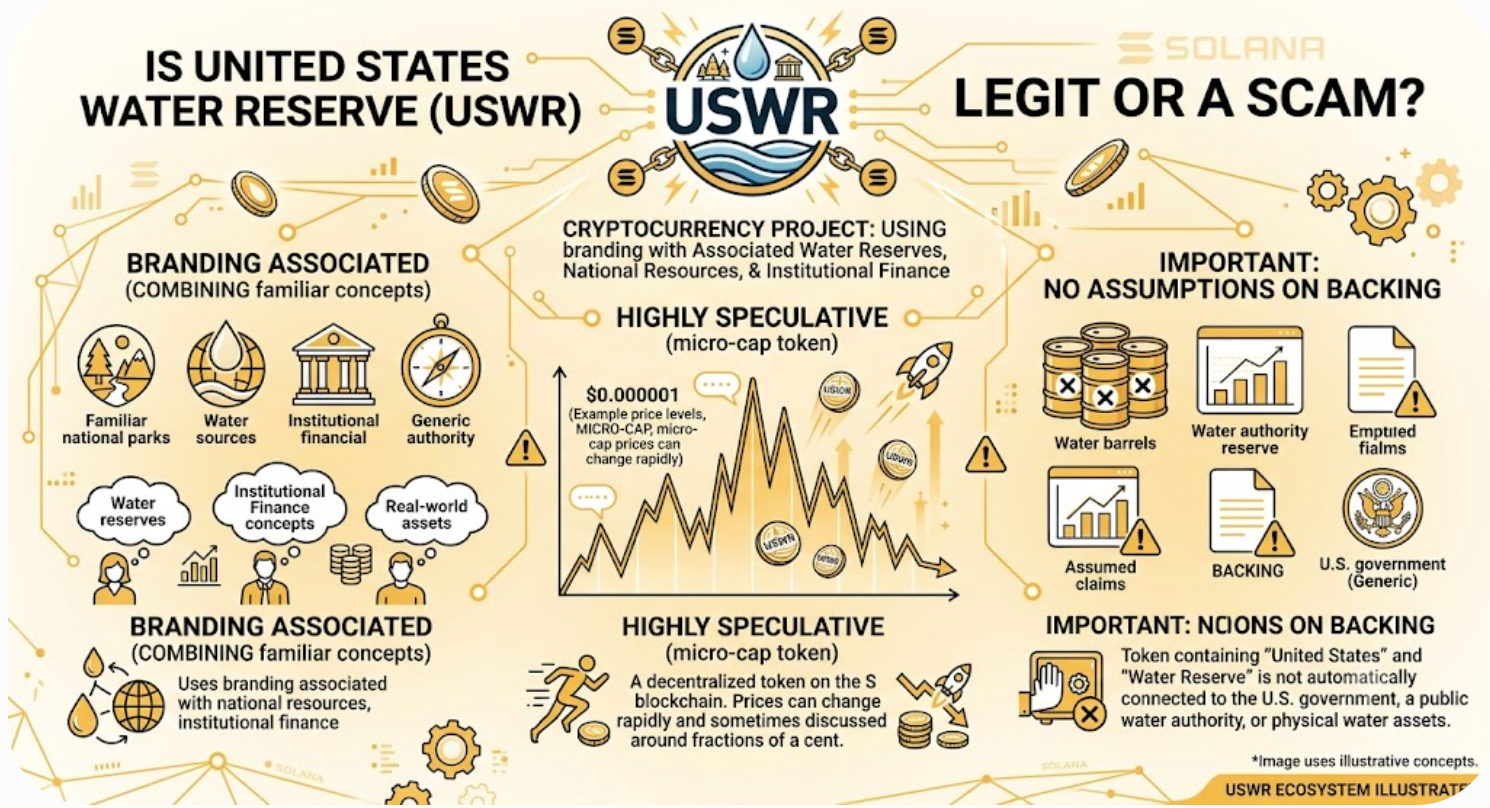
United States Water Reserve, commonly known as USWR, is a cryptocurrency project that uses branding associated with water reserves, national resources, and institutional finance.
This combination can attract investors interested in real-world assets and commodity-related crypto projects. It can also create confusion. A token containing the words United States and Water Reserve is not automatically connected to the U.S. government, a public water authority, or physical water assets.
There is not enough information in a token name or price chart to conclusively call USWR legitimate or fraudulent. Investors should instead examine whether the project’s claims can be independently verified.
What Is USWR Coin?
USWR appears to position itself around the idea of water as a scarce and valuable resource. This narrative may place it near the broader real-world asset sector, where projects attempt to connect blockchain tokens with commodities, property, credit, or other off-chain assets.
| Project Element | What Investors Should Determine |
|---|---|
| Token Name | United States Water Reserve |
| Symbol | USWR |
| Main Narrative | Water reserves and real-world resources |
| Government Connection | Must be independently verified |
| Physical Asset Backing | Requires audits and ownership evidence |
| Legal Investor Rights | Must be documented |
| Risk Level | Highly speculative until verified |
The central question is not whether water is valuable. It is whether owning USWR gives the holder an enforceable claim on anything valuable.
Is USWR Affiliated With the U.S. Government?
Investors should not assume USWR has a government affiliation unless an official government agency confirms that relationship.
Using national terminology, flags, seals, institutional language, or government-style branding does not prove authorization. A genuine public-sector relationship should be supported by official announcements, identifiable agreements, legal entities, and links from recognized government websites.
Claims found only on social media, promotional graphics, or community messages are not sufficient evidence.
Is USWR Backed by Water Reserves?
A water-backed token would require considerably more than a marketing statement.
Investors should expect documentation explaining who legally owns the water rights or reserves, where the assets are located, how the reserves are measured, which organization provides custody, how frequently the assets are audited, whether token holders have redemption rights, what happens if the operating company fails, and which jurisdiction governs investor claims.
Without these details, USWR should be treated as a water-themed cryptocurrency rather than an asset-backed water investment.
How to Check the USWR Contract
Contract verification is the first technical step. Tokens with similar names or tickers can exist on different blockchains, and fraudulent copycats may imitate a trending project.
Investors should obtain the contract address from the project’s verified channels and compare it with the address shown by the trading platform or blockchain explorer.
| Contract Area | Potential Warning Sign |
|---|---|
| Mint Authority | Operators can create unlimited tokens |
| Freeze Authority | Selected wallets can be restricted |
| Transfer Controls | Holders may be unable to sell |
| Trading Tax | Excessive or changeable transaction fees |
| Upgradeable Contract | Important rules can be changed later |
| Ownership Status | One wallet retains extensive control |
A tradable token is not automatically a safe token. Contract permissions can create risks that are not visible from the price chart.
Liquidity and Selling Risk
A token may show a rapidly rising price while having very little usable liquidity. If the liquidity pool is small, investors may be able to buy USWR but struggle to sell without causing severe slippage.
Important liquidity questions include how much real liquidity is available, whether liquidity is locked, whether the project team can withdraw it, whether volume comes from many traders or a few wallets, whether normal-sized positions can be sold, and whether trading activity is organic.
Low liquidity can turn an apparent profit into a number that cannot be realized.
Holder Distribution and Insider Risk
Wallet concentration is another important legitimacy check. If a few wallets control most of USWR’s supply, they may be able to influence price or create sudden selling pressure.
Investors should review the largest holders and identify wallets associated with the deployer, project treasury, liquidity pool, marketing allocation, or early insiders.
Concentrated ownership does not prove a scam, but undisclosed concentration substantially increases risk.
USWR Scam Warning Signs
No single warning sign proves fraudulent intent. Several warning signs appearing together, however, should make investors cautious.
| Risk Signal | Why It Matters |
|---|---|
| Anonymous Operators | Accountability is limited |
| Government-Style Branding | May create a false impression of endorsement |
| No Independent Audit | Asset and contract claims remain unverified |
| Guaranteed Returns | Legitimate markets cannot guarantee profit |
| Locked Selling | May indicate a honeypot mechanism |
| Removable Liquidity | Creates rug-pull risk |
| Fake Partnerships | Misleads investors about credibility |
| Aggressive Urgency | Pressures users to buy without research |
Investors should also avoid connecting wallets through unsolicited links, fake airdrops, or unofficial USWR websites.
How to Verify Whether USWR Is Legitimate
A responsible review should cover legal, technical, and market evidence.
- Verify the correct contract address.
- Identify the legal entity and project operators.
- Check official government-affiliation claims.
- Review asset-backing and custody documents.
- Look for independent contract and reserve audits.
- Examine holder distribution and deployer wallets.
- Test whether tokens can be sold.
- Review liquidity depth and lock conditions.
- Confirm what legal rights the token provides.
- Treat unverified claims as marketing, not fact.
Users researching speculative digital assets can explore broader market tools through the Tapbit platform. If USWR is unavailable, do not purchase a similarly named token without verifying its contract.
Is USWR a Good Investment?
USWR may appeal to traders who follow real-world asset narratives, resource-related tokens, and emerging micro-cap markets. Water scarcity is a legitimate global issue, but a relevant narrative does not automatically create a sound investment.
USWR’s investment case depends on transparent operators, meaningful utility, credible legal documentation, sufficient liquidity, and independently verified asset claims.
Without that evidence, USWR should be considered a high-risk speculative token. Investors should never commit money based only on institutional-sounding branding or the expectation that water scarcity will increase the token’s price.
Final Verdict
USWR cannot be declared legitimate simply because it uses the name United States Water Reserve. It also should not be definitively called a scam without evidence of deception or fraudulent conduct.
The appropriate conclusion is that USWR remains unverified until investors can confirm its legal structure, government claims, contract permissions, liquidity, holder distribution, and physical asset backing.
Until those checks are satisfied, investors should approach USWR cautiously and assume they could lose their entire position.
Users can also visit the Tapbit rewards page for broader platform information while maintaining strict risk controls.
FAQ
Is USWR an official U.S. government token?
Do not assume a government connection unless it is confirmed through recognized official channels.
Is USWR backed by physical water?
Asset backing requires verified ownership records, custody details, audits, and enforceable redemption rights.
Does a tradable USWR token prove it is legitimate?
No. A token can trade while still carrying contract, liquidity, ownership, and transparency risks.
What are the main USWR warning signs?
Key concerns include anonymous operators, unverifiable partnerships, removable liquidity, concentrated ownership, and unclear asset claims.
What should investors verify first?
Start with the correct contract address, selling functionality, liquidity, holder distribution, and project legal documentation.


