

What Is United States Water Reserve (USWR)?
United States Water Reserve, commonly known as USWR, is a cryptocurrency token built around a water reserve narrative. The name sounds institutional and resource-focused, which can make it attractive to traders looking for meme coins tied to real-world asset themes.
However, investors should be careful with the wording. “United States,” “water,” and “reserve” do not automatically mean government backing, legal reserve ownership, regulated custody, or asset-backed value. Unless verified documentation proves otherwise, USWR should be treated as a speculative crypto token rather than a real water reserve product.
For users who want to follow broader crypto market trends, compare emerging narratives, and access trading tools, the Tapbit registration page can be used as a general market entry point. Users can also explore platform features through Tapbit reward campaigns. This does not mean USWR is listed, supported, or available to buy on Tapbit.
USWR Price Prediction 2026-2030: The Core Question
The main question behind most USWR searches is simple: can USWR reach $1 by 2030?
The short answer is that it could happen only in an aggressive bull-case scenario. A move to $1 would require strong speculative demand, deep liquidity, wide holder growth, sustained social attention, and a market environment that rewards resource-themed meme coins. Without those conditions, $1 is not a realistic base-case forecast.
Price predictions for small or emerging tokens should be treated as scenario analysis, not certainty. USWR may rise sharply if the narrative catches fire, but it can also fall quickly if liquidity disappears or early buyers take profits.
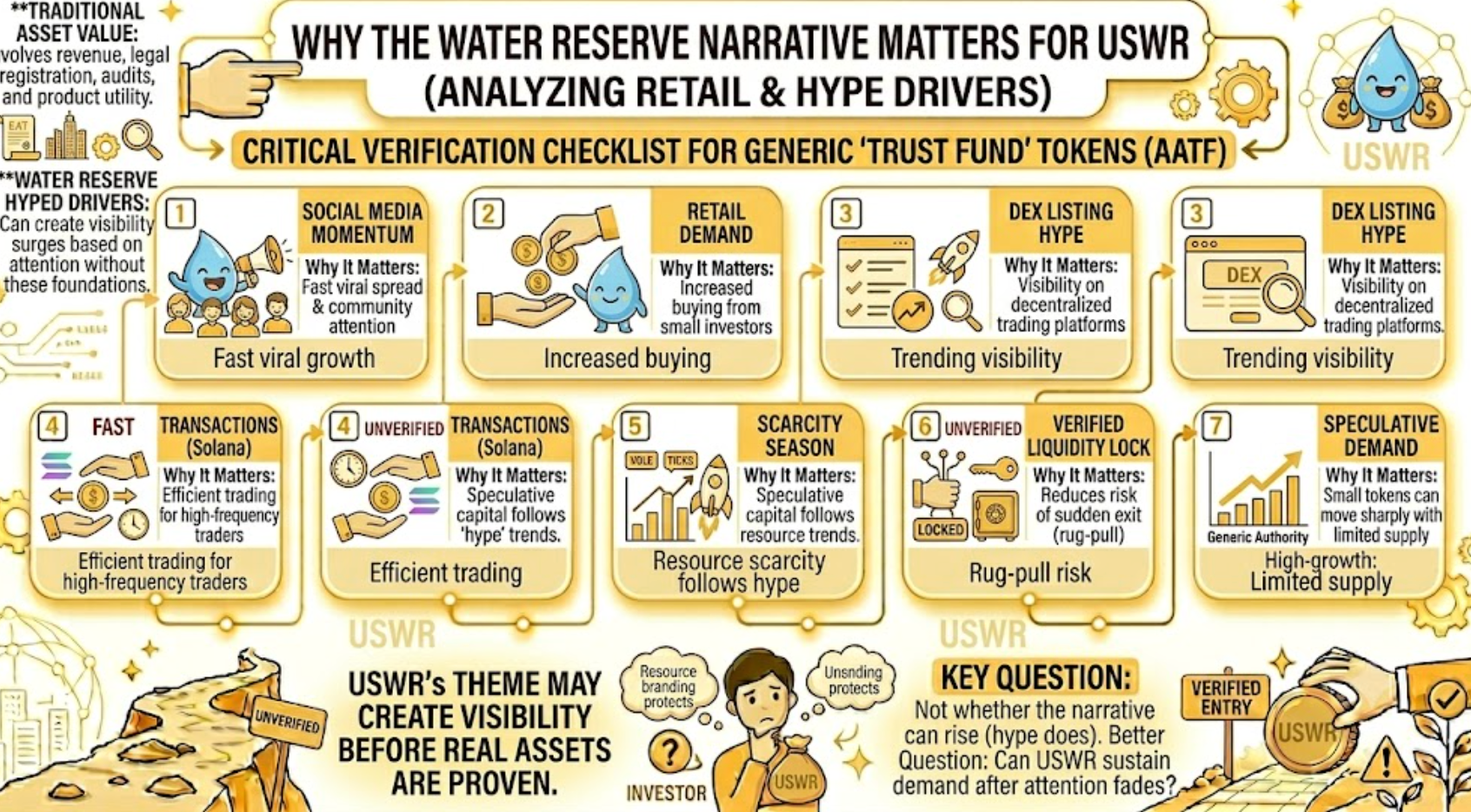
Why the Water Reserve Narrative Matters for USWR
Crypto markets often move on narratives before fundamentals. USWR benefits from a theme that is easy to understand: water is a real-world resource, and scarcity narratives can attract investor attention.
That does not mean the token has real-world backing. The water reserve theme may help USWR gain visibility, but investors still need to ask whether the project has verified reserves, audited tokenomics, a transparent team, and credible utility. If those pieces are missing, the token’s value is mainly narrative-driven.
USWR Price Prediction 2026: Early Volatility and Narrative Testing
In 2026, USWR’s price outlook will likely depend on whether it can move beyond short-term hype. If trading volume grows, liquidity improves, and more holders join, the token could see speculative rallies.
The bear case is just as clear. If the project fails to prove transparency or if traders realize that the reserve branding has no verified backing, USWR may struggle to hold price gains. For 2026, the most important signals are liquidity depth, holder distribution, and whether the token can maintain attention after its first hype cycle.
USWR Price Prediction 2027-2028: Can the Market Still Care?
By 2027 and 2028, the question becomes whether USWR can remain relevant. Many meme coins get attention quickly but fade once market attention moves elsewhere. To survive beyond the first cycle, USWR would need consistent community activity and clearer project communication.
If real-world asset narratives continue to grow and water-related crypto stories gain traction, USWR could benefit from renewed interest. But if the token remains only a name with limited transparency, its upside may depend entirely on short bursts of speculative trading.
USWR Price Prediction 2029-2030: Can USWR Reach $1?
For USWR to reach $1 by 2030, the token would need to become much larger than a typical short-lived meme coin. It would need meaningful market depth, broader exchange visibility, stronger demand, and a narrative that remains convincing for several years.
A $1 target is possible only if USWR attracts enough buyers to support a large market capitalization. If the token supply is high, the market cap required for $1 could be extremely large. That is why investors should compare price targets with circulating supply instead of looking at the price alone.
What Market Cap Would USWR Need to Reach $1?
The formula is simple:
Market Cap = Token Price x Circulating Supply
If USWR has a circulating supply of 1 billion tokens, a $1 price would imply a $1 billion market cap. If the circulating supply is higher, the required market cap would also be higher.
This is one of the most important parts of any USWR price prediction. A low token price can look cheap, but if supply is large, even a small price target may require a huge valuation. Investors should check both circulating supply and fully diluted valuation before assuming $1 is realistic.
Bull Case for USWR Reaching $1 by 2030
The bull case depends on sustained narrative strength. If USWR becomes one of the better-known resource-themed meme coins, attracts stronger liquidity, gains more holders, and benefits from a broader crypto bull market, the token could see major upside.
Transparency would also help. If the project publishes clearer tokenomics, improves communication, avoids misleading reserve claims, and builds trust with users, the market may be more willing to price in long-term upside.
In this scenario, $1 becomes a high-risk upside target. It is not impossible, but it requires several strong catalysts working together.
Bear Case for USWR Price 2026-2030
The bear case is that USWR remains a speculative token with limited proof behind the branding. If there are no verified reserves, no audited backing, no clear utility, and weak liquidity, the water reserve narrative may not be enough to support long-term price growth.
Holder concentration is another concern. If a small number of wallets control a large share of supply, price action can become unstable. Sudden sell pressure from early holders can quickly erase gains, especially in thin markets.
In the bear case, USWR may experience occasional pumps but fail to build a durable trend toward $1.
Is USWR a Good Investment for 2026-2030?
USWR may be interesting for traders who follow high-risk meme coin narratives, but it is not suitable for investors seeking predictable returns or verified asset backing.
Before considering exposure, users should verify the contract address, liquidity, trading volume, holder distribution, project website, community activity, and any claims about water reserves. If the project cannot provide credible evidence, investors should treat it as a speculative meme-style asset.
For most beginners, the safer approach is to watch USWR from a research perspective rather than assume it will reach $1.
Final Verdict: Can USWR Reach $1 by 2030?
USWR could reach $1 by 2030 only if speculative demand, liquidity, and the water reserve meme narrative continue to grow significantly. However, without verified reserves, audited tokenomics, or official backing, a $1 target should be treated as a high-risk upside scenario rather than a realistic base-case forecast.
The best way to evaluate USWR is through evidence, not branding. If liquidity improves, holders grow, and the project becomes more transparent, the bullish case becomes stronger. If not, the $1 target is likely to remain more of a speculative headline than a grounded forecast.
FAQ
What is USWR coin?
USWR stands for United States Water Reserve and is a crypto token using water reserve branding and resource-themed market narratives.
Can USWR reach $1 by 2030?
USWR can reach $1 only in an aggressive bull-case scenario with major liquidity growth, strong demand, and sustained market attention.
What is the USWR price prediction for 2026?
In 2026, USWR’s price outlook depends mainly on trading volume, liquidity, holder growth, and whether the water reserve narrative remains active.
Is USWR backed by real water reserves?
Investors should not assume USWR is backed by real water reserves unless verified audits, legal documents, and custody disclosures are publicly available.
What market cap does USWR need to reach $1?
It depends on circulating supply. If USWR has 1 billion tokens in circulation, a $1 price would require a $1 billion market cap.
Is USWR a good investment?
USWR is highly speculative. It may appeal to risk-tolerant traders, but users should verify liquidity, tokenomics, and project claims before buying.


