

Oil Price Today: What Happened?
Oil price today has returned to the center of global market attention. Brent crude is trading near $78.65 per barrel, up roughly 9% for the week, as renewed Gulf tensions raise concern about energy supply, inflation, and shipping risk. The move is not just an oil-market story. It affects equities, bonds, currencies, crypto, and central-bank expectations.
The immediate driver is geopolitical risk. When conflict risk rises around the Gulf, traders quickly price a higher probability of supply disruption, tanker delays, insurance costs, and risk premiums in crude. Even if physical supply is not immediately lost, the market often pays more for uncertainty. That is why oil can rise before a confirmed shortage appears.
Investor’s Business Daily also highlighted oil strength tied to Iran-related headlines, while noting that U.S. market futures were mixed and investors were still watching geopolitical risk, energy prices, and Federal Reserve minutes. This combination explains why markets can look contradictory: oil rises, chip stocks rebound, Nasdaq improves, but broader risk appetite remains cautious.

Why Higher Oil Prices Matter Beyond Energy Stocks
Oil is a macro asset because it touches almost every part of the economy. Higher crude prices can raise transportation costs, fuel costs, input costs, and inflation expectations. That can pressure consumers and companies at the same time.
For central banks, oil creates a policy problem. If oil rises because of supply risk, higher interest rates cannot produce more oil. But central banks still have to respond if energy prices feed into broader inflation expectations. That is why oil shocks can push bond yields higher even when growth worries increase.
This matters for equities. Higher yields can make expensive growth stocks harder to justify. Higher fuel costs can hurt airlines, logistics, autos, chemicals, and retailers. At the same time, energy producers and refiners may outperform because higher oil and better refining margins can improve earnings expectations.
This is also why oil can explain differences inside the stock market. If QQQ is stronger than SPY, the market may be rewarding AI and tech-specific catalysts while still discounting broader macro pressure. Tech can rebound while the wider market stays cautious. That is exactly the kind of split traders need to notice.
Oil Price Today and Crypto: Why BTC May Lag a Tech Rebound
A common question today is why Bitcoin did not simply follow Nvidia higher. The answer is that crypto trades on liquidity and risk appetite, not only technology optimism. Nvidia can rally because of company-specific news, semiconductor demand, or China-related chip headlines. Bitcoin still has to deal with bond yields, dollar strength, ETF flows, and macro uncertainty.
When oil rises sharply, crypto can face two headwinds. First, inflation worries can reduce expectations for easier monetary policy. Second, investors may reduce exposure to volatile assets until the geopolitical situation is clearer. That does not mean Bitcoin must fall every time oil rises, but it does mean BTC may lag a tech-led rebound.
This is where market structure matters. If BTC is already dealing with weak ETF flows, high volatility, or poor sentiment, an oil shock can make recovery harder. Guides such as bitcoin ETF outflows and why bitcoin dropping today show how institutional flows and macro stress can combine.
The key point is simple: Nvidia strength is a stock-specific signal. Oil strength is a macro signal. When those signals conflict, crypto may wait for confirmation before following equities higher.
Energy Stocks, Refiners and the Cross-Market Rotation
Higher crude does not affect all stocks equally. Energy producers can benefit from higher selling prices. Refiners can benefit when crack spreads improve. Companies tied to fuel demand, shipping, and transportation may face margin pressure. This creates sector rotation.
Investor’s Business Daily noted that refiners such as Valero and HF Sinclair were among the few gainers during the oil-driven market stress. That makes sense. Refiners can benefit when product margins improve, even as higher fuel prices pressure other industries.
For crypto traders, this rotation matters because it shows where capital is hiding. In a normal risk-on rally, traders may buy high-beta tech, crypto, and speculative growth together. In an oil shock, capital may become more selective. It may buy energy winners, defensive assets, or specific AI leaders while avoiding weaker parts of the market.
This explains why SPY can underperform QQQ. QQQ has more exposure to mega-cap tech and AI leaders. SPY includes a broader market mix, including sectors that may suffer from higher oil and yields. If the market is only buying a narrow group of AI names, it is not the same as a broad bull move.
How to Track WTI Oil Exposure on Tapbit
Readers who want to monitor oil-linked market exposure can use Tapbit’s WTI oil futures page: OIL(WTI)-USD. This is a TradFi-style derivative market, not physical oil ownership and not an oil-backed crypto token.
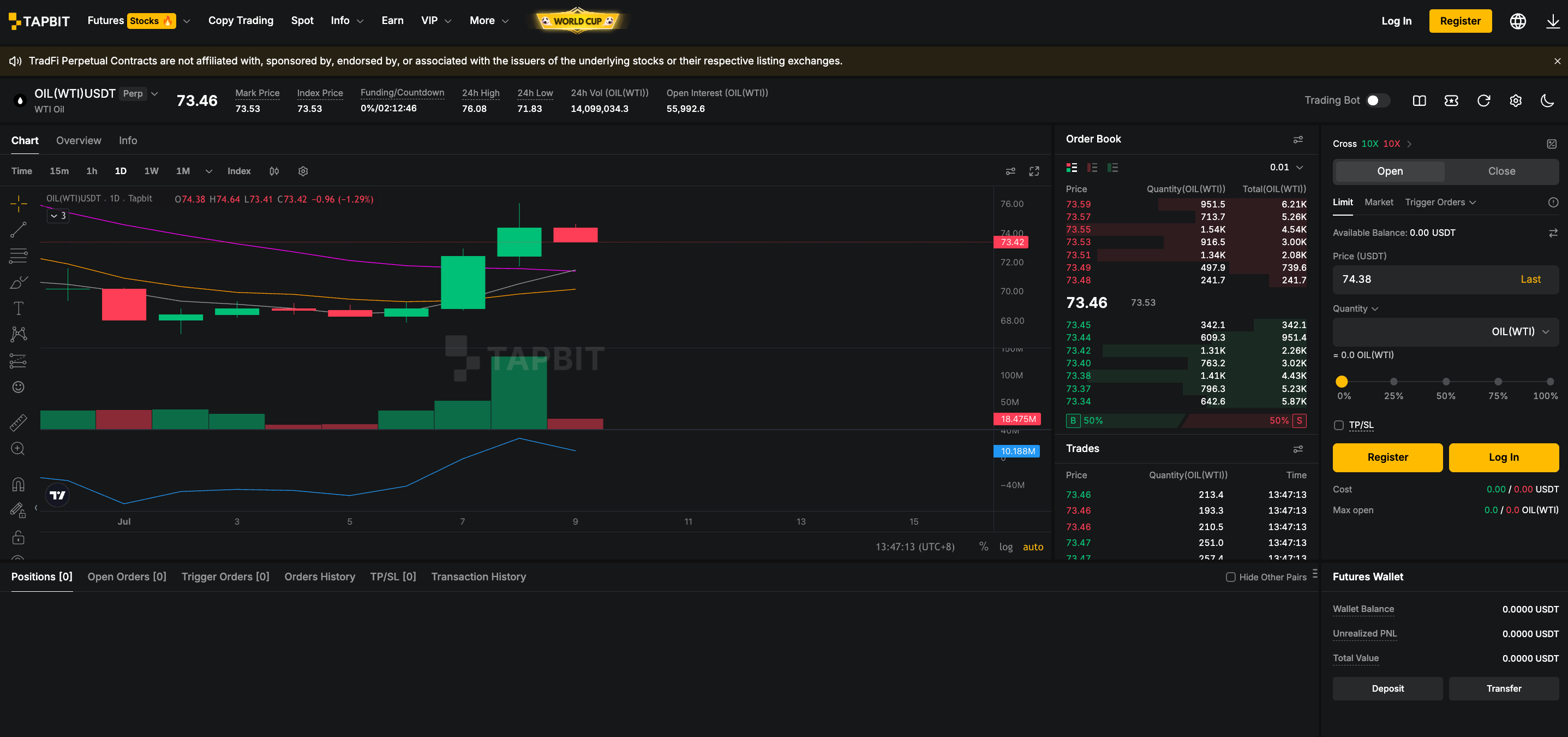
A simple trading workflow:
- Open the WTI oil futures page and confirm the exact contract details.
- Check last price, 24H change, volume, and the order book.
- Compare WTI with Brent headlines, dollar strength, and bond yields.
- Choose margin, leverage, order type, and TP/SL before opening a long or short.
Because oil can gap on geopolitical headlines, position sizing matters. A headline around the Gulf, OPEC policy, shipping routes, or U.S. inventories can move prices quickly. Futures and derivatives can amplify both gains and losses.
New users can create an account, review trading fees, and use customer support if they need platform help.
What to Watch Next for Oil Price Today
The next oil move depends on four signals.
First, watch whether Brent holds above the mid-to-high $70s. If Brent stabilizes near $78-$80, markets may treat the move as a persistent risk premium. If it quickly falls back, the shock may look more temporary.
Second, watch Gulf shipping and military headlines. Oil traders price not only actual supply loss but the probability of future disruption. Even a small change in perceived risk can move crude.
Third, watch bond yields. If oil pushes yields higher, equity and crypto valuations may remain under pressure. If yields stay contained, markets may absorb the oil move more easily.
Fourth, watch inventory and demand data. If the oil rally is driven only by geopolitics while demand weakens, the upside may be capped. If geopolitical risk meets tight inventories, the move can become more durable.
There are also three cross-market confirmations worth watching. A wider Brent-WTI spread can show that global supply risk is being priced more aggressively than U.S. domestic crude. A stronger U.S. dollar can reduce commodity demand and pressure risk assets at the same time. Refining margins can show whether higher crude is translating into broader energy-sector strength or simply creating cost pressure for consumers. When all three move together, oil becomes more than a commodity headline. It becomes a signal for inflation expectations, Fed policy, and liquidity conditions.
The bottom line: oil price today is a macro pressure point. Brent near $78.65 and a weekly gain near 9% tells investors that energy risk is back. Until oil stabilizes, markets may continue to favor selective AI winners and energy-linked names while treating broader equities and crypto with caution. For crypto, the key is whether BTC can absorb higher yields, stabilize flows, and prove that the oil shock is not tightening liquidity further.
FAQ
Why is oil price rising today?
Oil is rising because renewed Gulf tensions have increased the risk premium in crude markets, raising concern about supply disruption and shipping risk.
Why does oil affect Bitcoin?
Oil affects inflation expectations, bond yields, and risk appetite. If higher oil makes investors more defensive, Bitcoin and altcoins may face pressure.
Is Brent the same as WTI?
No. Brent is a global benchmark, while WTI is a U.S. crude benchmark. They often move together but can trade at different prices.
Can energy stocks rise while the broader market falls?
Yes. Producers and refiners can benefit from higher oil or stronger margins even when transport, consumer, and growth sectors weaken.
Is Tapbit OIL(WTI)-USD the same as an oil token?
No. It is an oil market-linked derivative product, not physical oil ownership and not a tokenized oil reserve.


