
The SK Hynix stock price is back near the center of the AI-memory debate after one of the most volatile stretches in Korean equities this year. As of August 12, 2026, the Seoul-listed shares were trading around ₩1.76 million, after a sharp July correction and a flash-crash episode on Korea's alternative trading venue.
SK Hynix is still one of the most important suppliers in the HBM market, but the SK Hynix stock price now reflects a more demanding setup. Investors are balancing powerful AI infrastructure demand against a stock that had already risen dramatically, higher market volatility, leverage unwinds and the risk that future HBM capacity eventually catches up with demand.
SK Hynix Stock Price Today: What the ₩1.76M Area Shows
The current area is important because the stock has already fallen far from its 2026 high while remaining well above levels seen before the AI-memory boom accelerated. A recent market snapshot showed the shares around ₩1.76M, with an intraday range roughly between ₩1.71M and ₩1.82M. That makes the SK Hynix stock price a useful test of whether forced selling is ending or simply pausing.
Tapbit Learn previously examined the first leg of the decline in its SK Hynix stock selloff analysis. The difference now is that the market has gone through a much deeper reset. The KOSPI has experienced unusually high volatility, and memory-related stocks have been hit by both valuation compression and leverage reduction.
Why Did the SK Hynix Stock Price Fall So Hard?
The selloff was not caused by one single fundamental shock. Part of the decline reflected profit-taking after an enormous run in Korean AI stocks. Part reflected leveraged positioning being unwound as volatility rose. A flash crash on Nextrade also showed how fragile price discovery can become when liquidity is thin and a relatively small order hits the market at the wrong moment.
There was also a broader semiconductor reset. Investors became more sensitive to capital spending, competitive supply and whether current AI demand can remain strong enough to justify aggressive assumptions. For a stock that had already become a flagship AI trade, that change in expectations was enough to pressure the SK Hynix stock price even without a collapse in HBM orders.
Why HBM Demand Still Supports the 2026 Outlook
The core bull case remains HBM. AI accelerators need enormous memory bandwidth, and HBM is designed to move data to advanced processors far faster than conventional memory architectures. SK Hynix has been a major beneficiary because HBM production requires advanced DRAM, stacking, packaging, yield control and lengthy customer qualification.
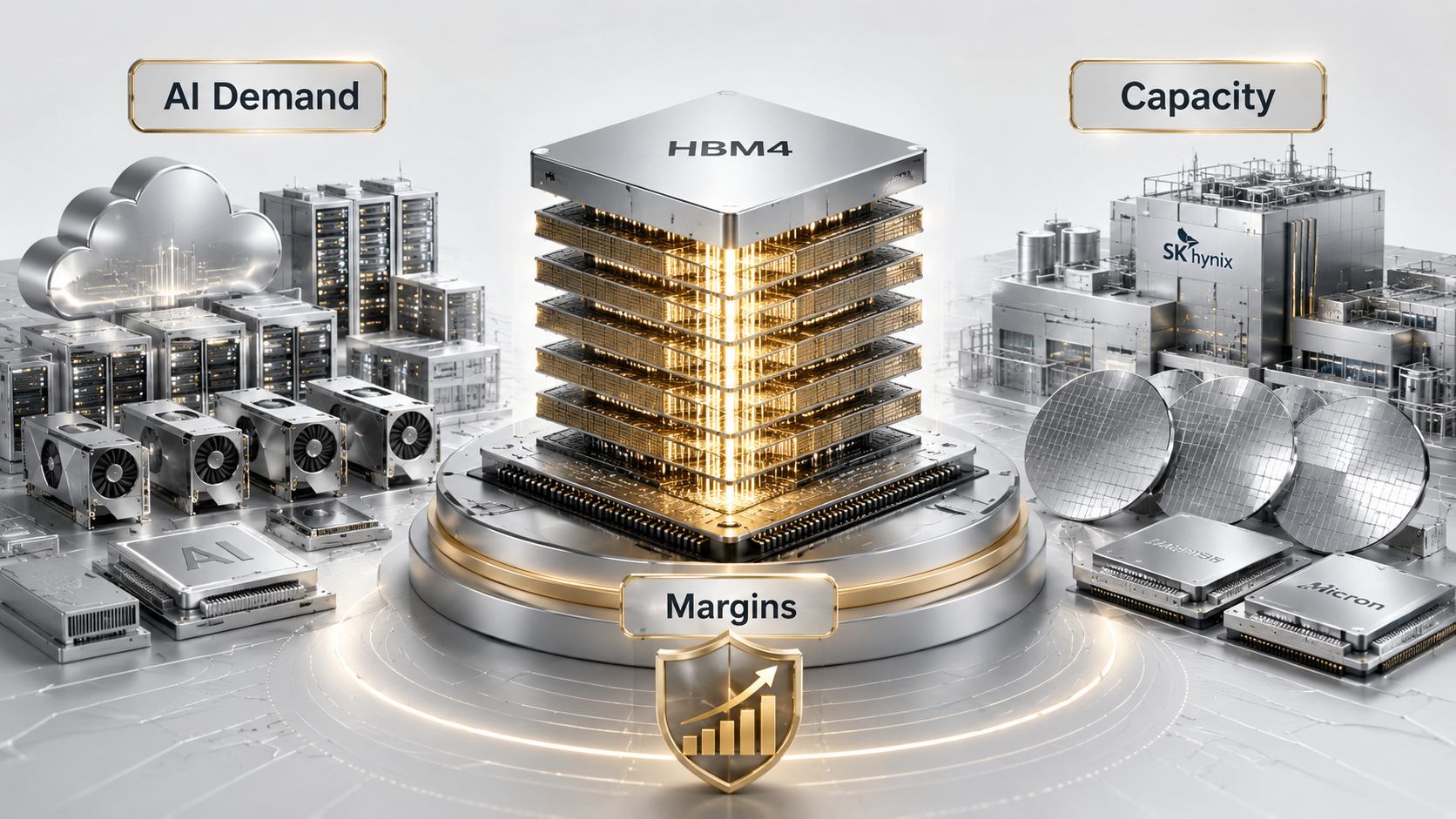
That complexity makes supply difficult to expand instantly. Tapbit Learn's HBM memory outlook explains why AI memory can remain tight even when producers announce more capacity. The key question for the SK Hynix stock price is whether HBM3E and HBM4 demand stays strong enough to protect pricing and margins as supply expands.
Longer term, the memory cycle is also broadening. AI servers need HBM, but data centers still consume conventional DRAM and storage products. That can help memory producers when demand expands across multiple product categories rather than depending on one premium niche.
What Could Drive an SK Hynix Recovery?
A stronger recovery would need several signals to line up. First, hyperscaler AI spending would need to stay elevated. Second, customer qualification for next-generation HBM products would need to remain on schedule. Third, the Korean market would need to show that the leverage unwind is stabilizing instead of producing repeated forced-selling events.
Investors should also watch competitors. Micron and Samsung are both investing aggressively in advanced memory, while Chinese producers are trying to close the technology gap. The SK Hynix stock price can still rise in a growing market, but the premium investors are willing to pay may narrow if competitors gain share faster than expected.
SK Hynix Stock Price: Bull, Base and Bear Scenarios
| Scenario | What Would Need to Happen | Market Implication |
|---|---|---|
| Bull Case | HBM demand stays tight, HBM4 execution is strong, AI capex remains elevated and Korean deleveraging fades. | The stock could reclaim the ₩1.90M area and rebuild toward higher 2026 resistance. |
| Base Case | Memory growth stays healthy but valuation remains compressed after the selloff. | The SK Hynix stock price may consolidate while earnings catch up with prior expectations. |
| Bear Case | AI capex slows, HBM supply normalizes faster than expected or market leverage unwinds again. | A break below current support could reopen a deeper correction. |
Support, Resistance and Confirmation Levels
For the near term, the ₩1.70M–₩1.75M area is an important support zone because it overlaps the latest trading range and recent attempts to stabilize. A sustained move back above roughly ₩1.82M would be the first constructive signal, while a stronger recovery through the ₩1.90M area would suggest buyers are regaining control.
The SK Hynix stock price outlook would weaken if the shares repeatedly fail near resistance and then close decisively below ₩1.70M. In that case, traders could begin watching the ₩1.55M–₩1.60M region as a lower reference area. These are market-structure zones rather than guarantees, so they should be refreshed against the live chart before any trade.
Broader confirmation also matters. If the KOSPI, semiconductor peers and HBM-linked names stabilize together, an SK Hynix rebound is more credible than a single isolated green session. Tapbit Learn's semiconductor stock outlook provides a wider sector framework.
How to Trade SKHYNIX-USDT on Tapbit
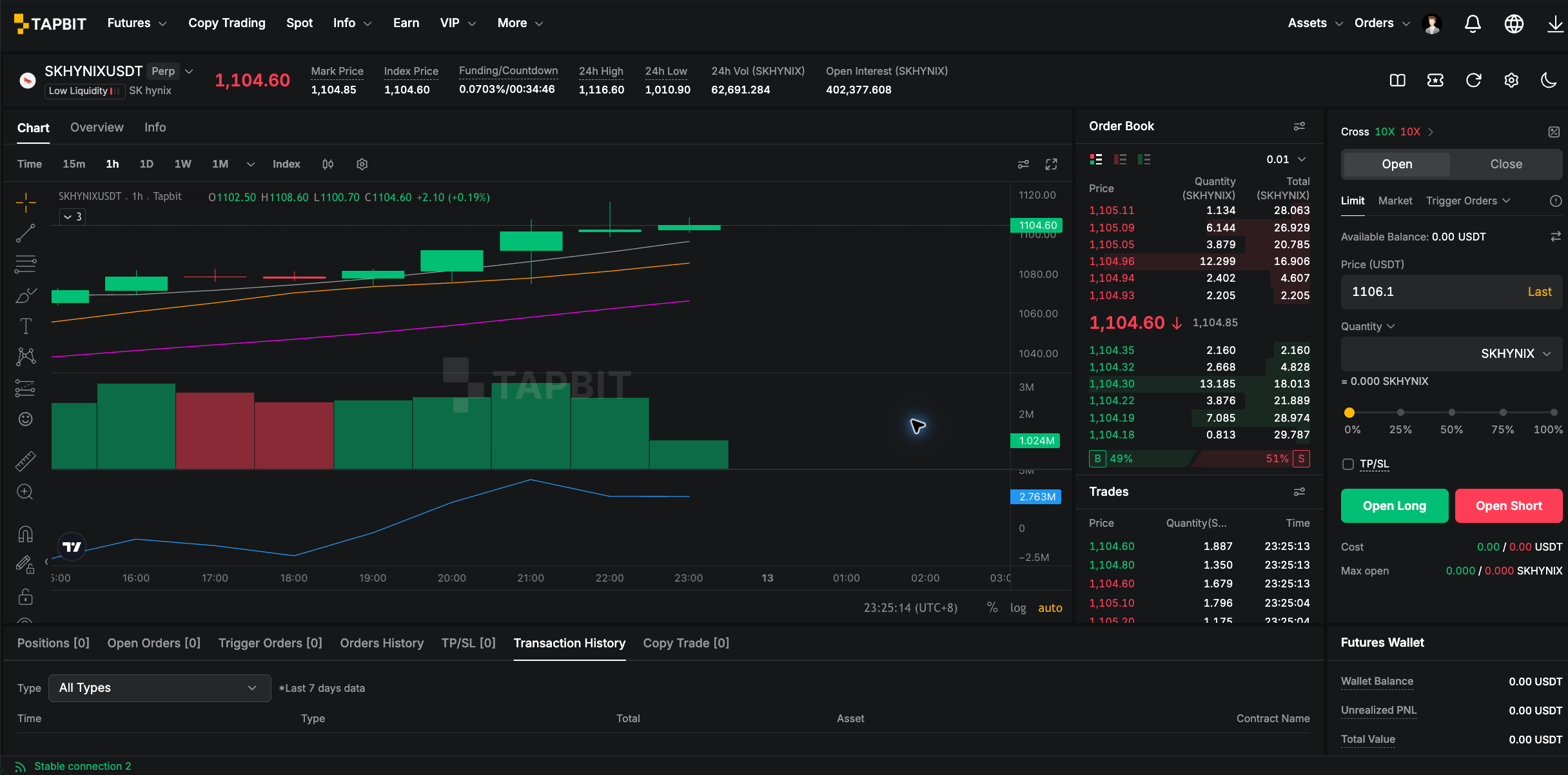
Tapbit offers SKHYNIX-USDT perpetual futures for traders seeking price exposure linked to SK Hynix. This is a stock-linked derivative, not direct ownership of the underlying Korean shares. It does not provide shareholder voting rights, equity ownership or dividends.
-
Create an account or log in to Tapbit.
-
Open the SKHYNIX-USDT contract page and check the contract name, mark price, index price and funding countdown.
-
Select Limit, Market or Trigger order, enter price and quantity, review leverage and margin mode, then choose Open Long or Open Short.
-
Add TP/SL, confirm required margin and monitor Positions, Open Orders, Trigger Orders and liquidation risk.
FAQ
Why is the SK Hynix stock price so volatile in 2026?
The stock combines strong AI-memory fundamentals with heavy positioning, a high-beta Korean equity market and rapidly changing expectations for HBM demand. That combination can amplify both rallies and selloffs.
Is HBM demand still bullish for SK Hynix?
Structurally, HBM remains a major growth driver. The harder question is whether future demand, pricing and margins can continue beating the expectations already reflected in the stock.
What would confirm a recovery?
A sustained move above the ₩1.82M–₩1.90M area, improving semiconductor breadth and continued strong HBM demand would make the recovery case more convincing.
Bottom Line
The SK Hynix stock price near ₩1.76M reflects a market trying to separate a strong long-term HBM story from an overheated 2026 trading structure. The fundamental AI-memory thesis remains intact, but the next phase depends more on execution, margins and healthier market positioning than on narrative alone. A durable recovery needs both strong HBM data and better price confirmation; a renewed break below support would signal that the deleveraging cycle is not finished.


