

Schneider Electric raised its 2026 outlook after a strong third quarter. Its organic revenue was €11.46 billion, up 16.9% year over year. The updated Schneider Electric 2026 outlook reflects strong demand that includes data-center infrastructure.
What changed?
| 2026 target | Previous | Updated |
|---|---|---|
| Organic revenue growth | 10%–13% | 12%–14% |
| Adjusted EBITDA growth | 14%–19% | 18%–21% |
Third-quarter revenue also topped the €11.13 billion average in the company-provided analyst consensus. Organic growth removes the effect of currency and acquisitions, making it easier to compare underlying operations.

How AI data-center spending reaches Schneider
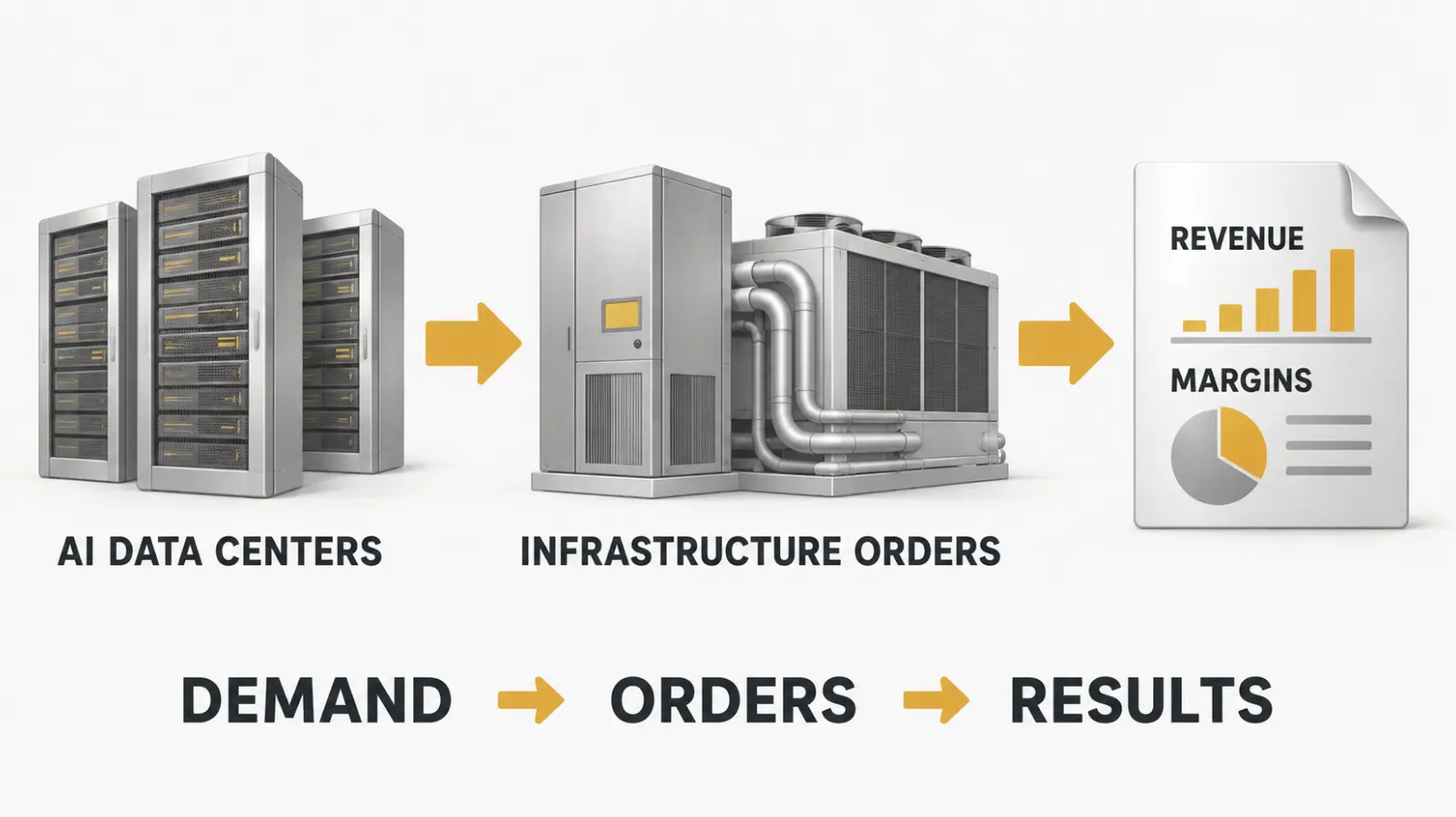
AI workloads run on computer clusters that use electricity and produce heat. Data centers need systems to distribute power, manage temperature, and keep equipment operating. Schneider is not a chip designer; it supplies parts of this supporting infrastructure.
- Chipmakers sell computing hardware.
- Memory and server companies assemble systems for customers.
- Power and cooling suppliers equip the facilities that house the systems.

These businesses can benefit from one spending cycle, but their revenue timing differs. A project may be announced long before construction and equipment delivery. For related background, see Tapbit Learn’s AI chip stocks and AI stock market overview.
What should investors watch?
- Organic revenue: Does growth stay near the updated target?
- Profitability: Do margins keep pace with sales?
- Order timing: Are announced projects turning into equipment orders?
- Business mix: Is growth broad or concentrated in data centers?
Delays, power availability, permitting, financing, competition, and costs can change the outlook. A raised forecast is positive business news, but it does not guarantee a higher share price.
Why revenue growth is only one part of the picture
Revenue measures sales over a period. It does not show how much cash the company collected, how much it spent to produce equipment, or how much profit remained. That is why investors read revenue growth together with margins, working capital, and cash flow.
For infrastructure suppliers, timing can be important. A company may buy components and prepare equipment before it receives the final payment from a customer. If projects grow quickly, inventory and receivables can rise too. That does not automatically signal a problem, but it makes cash conversion worth tracking.
Adjusted EBITDA growth is one measure of operating performance, but it excludes financing costs, tax, depreciation, and amortization. It should be read with other reported measures rather than treated as a complete picture of earnings. The updated 18%–21% target gives investors a benchmark to compare with later results.
How to judge whether the data-center demand is durable
One strong quarter confirms that demand was high during that period. A durable cycle requires more evidence. Investors can look for repeated order growth, customer projects moving into construction, and demand spread across multiple cloud and enterprise buyers.
- Order quality: Are orders tied to funded projects and realistic delivery schedules?
- Customer breadth: Is demand coming from several buyers rather than a small number of large projects?
- Delivery conversion: Are orders becoming revenue on schedule?
- Profit conversion: Are margins and cash flow keeping up with sales?
These checks help separate a broad infrastructure cycle from a short burst of project spending. They also explain why a supplier’s share price can react differently from a chipmaker’s even when both benefit from AI investment.
What the outlook does—and does not—tell us
The updated Schneider Electric 2026 outlook is management’s forecast for the business, not a promise. It raises the bar for future quarters: investors will compare new results with the stronger targets and with market expectations.
The company’s role in data centers gives it exposure to AI investment, but its broader industrial and energy operations also matter. A slowdown in one customer group could be partly balanced by another, while weak demand across several end markets could make the targets harder to meet.
The practical takeaway is straightforward: Schneider’s latest results show strong sales and higher expectations. The next proof points are order conversion, margin performance, and cash generation. Those measures are more informative than AI headlines alone.
Another useful comparison is the difference between reported and organic growth. Reported revenue includes currency movements and acquisitions, while the organic figure isolates underlying growth more closely. Investors should use the company’s stated basis when comparing the new targets with earlier periods.
Because the updated guidance is a range, results do not need to land at its midpoint to meet the outlook. However, a result near the lower end may receive a different market response if analysts were expecting stronger data-center demand. Comparing the company’s range with market expectations helps explain that reaction.
Related market exposure on Tapbit
No Schneider Electric contract was verified. Readers tracking nearby AI themes can review NVDA-USDT or SMCI-USDT. These track Nvidia and Super Micro Computer, not Schneider.
- Log in and confirm regional availability.
- Check reference price, funding, margin rules, and market status.
- Choose order type and size; set risk limits.
- Review fees, margin, and liquidation price before monitoring the position.
FAQ
Why did Schneider raise its outlook?
Strong Q3 revenue and demand, including data-center demand, supported the increase.
Does Schneider make AI chips?
No. It supplies electrical and industrial infrastructure.
Does a higher outlook guarantee a higher stock price?
No. Valuation, expectations, costs, and market conditions also affect shares.
Sources: Reuters; Schneider Electric Investor Relations.


