
The name can be misleading. PYPLON may look like a “PayPal coin” at first glance, but that is not what it is. It is not issued by PayPal. It is not PayPal’s official cryptocurrency. It is not a payment token for PayPal users.
PYPLON is a tokenized stock product linked to PayPal Holdings stock, PYPL.
That difference matters. For crypto traders, PYPLON is part of a much bigger market shift: U.S. stocks are being wrapped into blockchain-based products, settled against stablecoins, and traded by users who may not have access to a traditional U.S. brokerage account.
The opportunity is real. So are the risks.
What Is PYPLON?
PYPLON is Ondo’s tokenized version of PayPal stock. It is designed to give eligible users economic exposure to PayPal’s share price through a crypto-native token.
In simple terms, PYPLON tries to track PYPL. If PayPal stock moves higher, PYPLON should generally move in the same direction. If PYPL falls, PYPLON should also feel that pressure.
But “track” does not mean “equal.” A tokenized stock is not the same as holding the underlying share through a traditional broker. PYPLON may give price exposure, but it usually does not give holders the same shareholder rights. That means no direct voting rights, no ordinary shareholder status, and no guarantee that the product will behave exactly like the stock in every market condition.
That is why traders should think of PYPLON as structured equity exposure on crypto rails, not as a PayPal-issued coin.
The Data Behind PYPLON
PYPLON is still a very early-stage market.
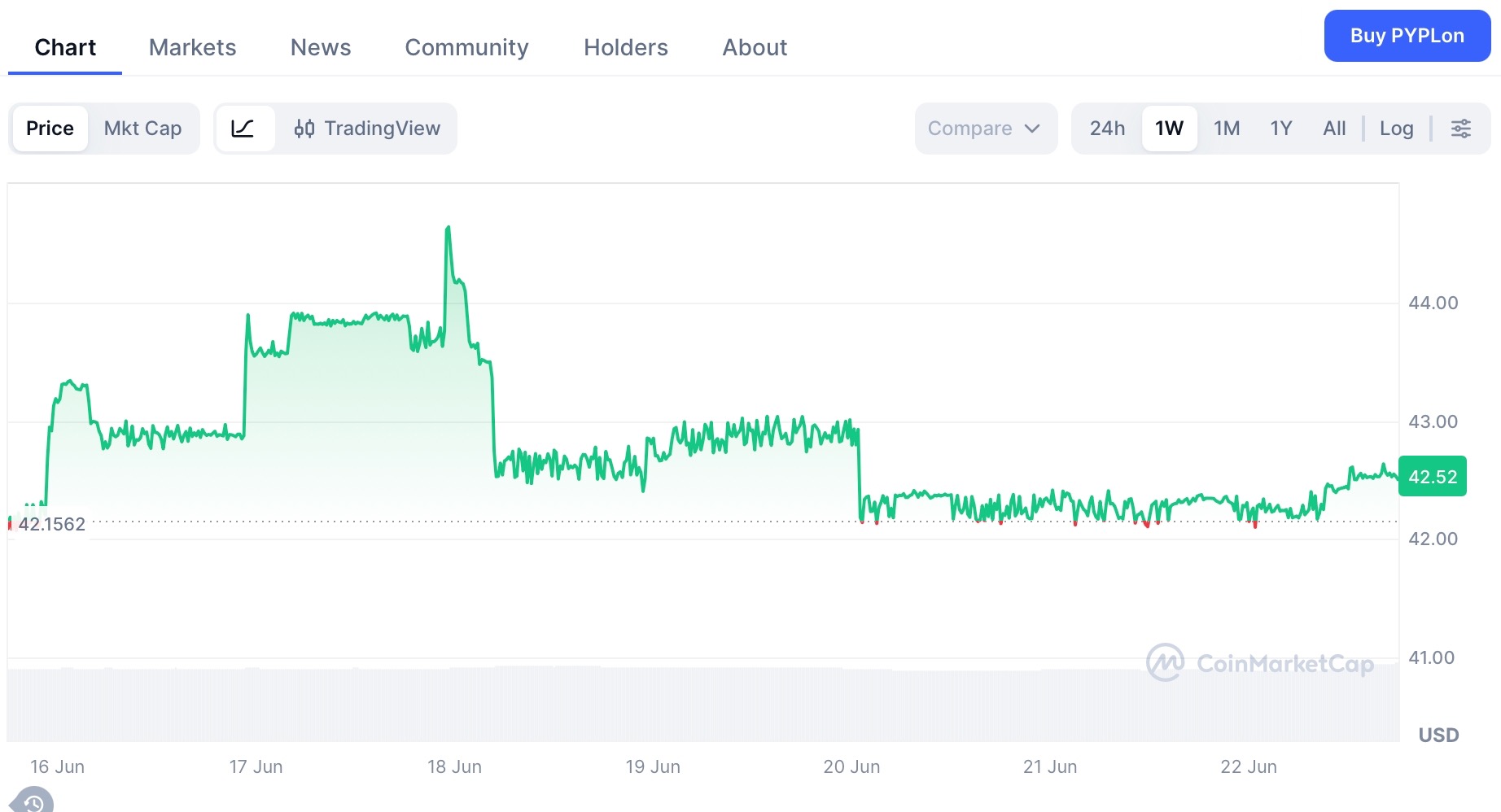
Recent market data shows PYPLON trading around $42.52, with about $767,000 in 24-hour volume. CoinGecko data puts its market capitalization below $1 million, around $973,000, with a circulating supply near 24,000 tokens.
That is small. .For comparison, PayPal stock itself trades around $42.51, with a market capitalization of about $39.1 billion and a price-to-earnings ratio near 7.98.
The close price relationship between PYPLON and PYPL shows the basic tracking design is working at a headline level. But the difference in market depth is huge. PayPal is a large public company with deep stock-market liquidity. PYPLON is a young tokenized product with limited float and thinner trading activity.
That creates a clear lesson for traders: PYPLON may mirror PayPal exposure, but it does not mirror PayPal liquidity.
Why PayPal Matters as the Underlying Stock
PYPLON is only interesting because PayPal itself is still a major fintech name.
PayPal’s Q1 2026 results showed revenue of about $8.35 billion, up 7.2% year over year. Earnings per share came in at $1.34, above consensus expectations of $1.27.
The company’s total payment volume reached roughly $464 billion, up 11% year over year. Venmo volume grew 14%, while branded checkout volume rose only 2%.
That mixed picture explains why PYPL is not trading like a high-growth fintech darling anymore.
PayPal is still profitable. It still processes enormous payment volume. Venmo continues to grow. But branded checkout growth remains modest, competition is intense, and investors are questioning how much growth PayPal can deliver from here.
That is why PYPL trades at a relatively low valuation compared with many technology names.
For PYPLON traders, this matters because the token’s long-term direction should still depend heavily on PayPal’s fundamentals: revenue growth, margins, checkout performance, Venmo monetization, buybacks, guidance, and competition from Apple Pay, Stripe, Block, and other payment platforms.
PYPLON may live on crypto rails. But its story begins with PayPal’s stock.
PYPLON Is Not the Same as PYPL
This is the most important part of the whole trade. If a user buys PayPal stock through a traditional brokerage account, they are buying equity. They own shares under the rules of that brokerage, exchange, custodian, and securities market. If a user buys PYPLON, they are buying a tokenized product designed to track PayPal stock exposure.
That introduces several extra layers of risk.
-
There is issuer risk. Users depend on Ondo and its product structure.
-
There is custody risk. The underlying exposure relies on off-chain brokers, custodians, or related service providers.
-
There is tracking risk. PYPLON may trade above or below the value of PYPL, especially when liquidity is thin or markets are moving quickly.
-
There is redemption risk. Minting and redeeming may only be available to eligible participants under specific conditions.
-
There is regulatory risk. Tokenized stocks may be restricted in certain countries or limited to qualified or professional investors in some regions.
-
There is liquidity risk. PYPLON’s sub-$1 million market cap and roughly $767,000 daily volume show that this is not yet a deep market.
That does not make PYPLON useless. It means traders need to understand what they are trading.
Why Liquidity Matters More Than the Headline Price
A tokenized stock can show a price close to the underlying share and still be risky to trade.
The reason is liquidity. PayPal stock is a large listed equity. It has deep institutional participation, market makers, analysts, options markets, and broad investor coverage. PYPLON is much smaller. With a circulating supply near 24,000 tokens and a market cap under $1 million, order book depth can matter more than the headline price.
During U.S. equity market hours, pricing may be tighter because the underlying PYPL market is open. Outside those windows, spreads can widen and tracking may become less reliable.
That is why limit orders matter. For tokenized stocks, the question is not only “What is the price?” It is also “Can I enter and exit near that price?”
Bottom Line
PYPLON is not PayPal’s coin. It is Ondo’s tokenized PayPal stock product, designed to track PYPL exposure for eligible users through crypto infrastructure.
That makes it interesting, especially for traders who want stablecoin-settled access to U.S. equity themes. But the current data also shows why caution is necessary. PYPLON trades around $42.52, close to PYPL’s roughly $42.51 stock price, but its market cap is still below $1 million and its circulating supply is only about 24,000 tokens.
PayPal itself is a real business with $8.35 billion in quarterly revenue, $464 billion in quarterly payment volume, and a valuation that looks low compared with many tech stocks. But PYPLON adds another layer: issuer structure, custody, liquidity, tracking, redemption, and regulatory risk.
The tokenized stock trend is real. PYPLON is part of it. But traders should not confuse access with ownership.
Explore the latest markets on Tapbit, log in to trade, or create an account to get started.
Frequently Asked Questions (FAQ)
Is PYPLON an official PayPal coin?
No. PYPLON is not issued by PayPal and should not be treated as PayPal’s official cryptocurrency. It is a tokenized stock product issued by Ondo that is designed to track economic exposure to PayPal Holdings stock, PYPL.
What is PYPLON?
PYPLON is a tokenized version of PayPal stock. It gives eligible users crypto-native exposure to PYPL price movements through a blockchain-based token, but it is not the same as directly owning PayPal shares.
Does PYPLON track PayPal stock?
PYPLON is designed to track the price of PYPL stock. However, tracking may not always be perfect. Liquidity, market hours, issuer structure, order book depth, and redemption conditions can all create differences between PYPLON and PYPL.


