What Does NVDA Stock Mean?
NVDA stock prediction is popular because Nvidia sits at the center of the AI infrastructure boom. But before reading any forecast, beginners need to know what NVDA actually means.
NVDA is the ticker symbol for Nvidia Corporation on Nasdaq. It refers to shares of Nvidia, the company known for GPUs, AI chips, data center platforms, and developer software.
NVDA is not a cryptocurrency. It is not a token. It is a stock. On Tapbit, however, users may also see NVDA-USDT perpetual futures, which are trading products based on NVDA price exposure. That is different from owning Nvidia shares directly.
Crypto traders follow Nvidia because its chips powered earlier crypto mining cycles and now power many AI systems. When AI sentiment is strong, NVDA often becomes a signal for AI-related crypto themes.
NVDA Forecast: What the Market Is Watching
An NVDA stock prediction is usually built around revenue, earnings, data center demand, margins, valuation, and Nasdaq momentum.
Recent analyst data has remained broadly bullish, but targets vary widely. StockAnalysis and MarketBeat both showed positive Wall Street consensus views in late May 2026. These numbers can be useful, but they are not guarantees.
The key lesson is simple: a forecast is a scenario, not a promise. NVDA can beat expectations and still fall if investors wanted stronger guidance.
Before using any forecast, check the latest price, earnings date, analyst revisions, and guidance. Old targets can become outdated quickly after earnings.
| Signal to Watch | Why It Matters |
|---|---|
| Earnings and revenue | Shows whether Nvidia is still growing fast. |
| Data center demand | Reflects AI infrastructure spending. |
| Gross margin | Helps show pricing power and cost pressure. |
| Analyst revisions | Shows whether Wall Street expectations are rising or falling. |
| Nasdaq sentiment | Affects high-growth tech stocks like NVDA. |
Why AI Demand Drives the NVDA Forecast
The biggest driver behind the forecast is AI demand. Nvidia designs chips and systems used for training and running AI models. Cloud providers, AI labs, enterprises, and governments need huge computing power, and Nvidia remains one of the most watched suppliers in that market.
Nvidia reported record revenue of $81.6 billion for the first quarter of fiscal 2027, up 85% year over year, according to its May 20, 2026 financial release. That is why investors care so much about AI infrastructure spending.
For beginners, think of Nvidia as a toll road for AI computing. If more companies build AI models and data centers, demand may stay strong. If demand slows, the bullish case weakens.
Crypto traders watch this because AI enthusiasm can affect AI tokens and risk appetite. Still, NVDA is not a direct crypto proxy. A strong Nvidia quarter does not automatically mean every AI token will rise.
Key Risks Behind Any NVDA Forecast
Every NVDA stock prediction needs a risk section. Nvidia is a strong company, but strong companies can still have volatile stocks.
▲ Risk note: A bullish story does not remove downside risk.
The first risk is valuation. When investors expect fast growth, the stock can become sensitive to small disappointments. If revenue slows or guidance misses expectations, the market may reprice NVDA quickly.
The second risk is AI spending. If cloud companies, AI labs, or enterprises reduce budgets, future growth could slow.
The third risk is policy. Export controls, trade rules, and regional restrictions can affect advanced chip sales. Nvidia has discussed these risks in public filings.
Competition also matters. Large technology companies may build custom chips, and other firms may compete in AI accelerators or networking.
How Crypto Investors Can Read NVDA Forecast Signals
Crypto investors can read an NVDA stock prediction as a signal, not just a stock call. A better question is: what does NVDA tell us about AI demand and risk appetite?
Start with earnings. Watch revenue growth, data center revenue, gross margin, and guidance.
Then watch management commentary. Strong demand for new AI platforms may support the AI narrative. Warnings about supply, policy, or slower customer spending may weaken sentiment.
Finally, compare NVDA with Nasdaq, Bitcoin, AI tokens, semiconductor stocks, and liquidity.
Tapbit readers can also check crypto prices to compare broader market movement before making any trading decision.
Bull, Base, and Bear Scenarios for NVDA
A practical forecast should use scenarios.
| Scenario | What It Means | Market Signal |
|---|---|---|
| Bull case | AI demand remains strong, margins stay healthy, and analysts raise targets. | NVDA may keep attracting AI infrastructure buyers. |
| Base case | Nvidia keeps growing, but much of the good news is already priced in. | Price action may become slower and more selective. |
| Bear case | AI spending slows, policy risk rises, competition increases, or the market sells off. | NVDA may fall even if Nvidia remains important. |
Scenario thinking is safer than relying on one target price.
How to Trade NVDA-USDT on Tapbit in 4 Steps
Before trading, remember this: NVDA-USDT on Tapbit is a TradFi perpetual contract. It is not spot Nvidia stock or a crypto token. Futures trading can involve leverage, margin, liquidation, and liquidity risk.
Step 1: Prepare Your Tapbit Account
✓ First, create or access your Tapbit account. New users can create an account. Existing users can access your account.
Before trading, understand the basics: leverage can increase both gains and losses, margin is required, and liquidation can happen if the market moves against you.
Step 2: Open the NVDA-USDT Futures Market
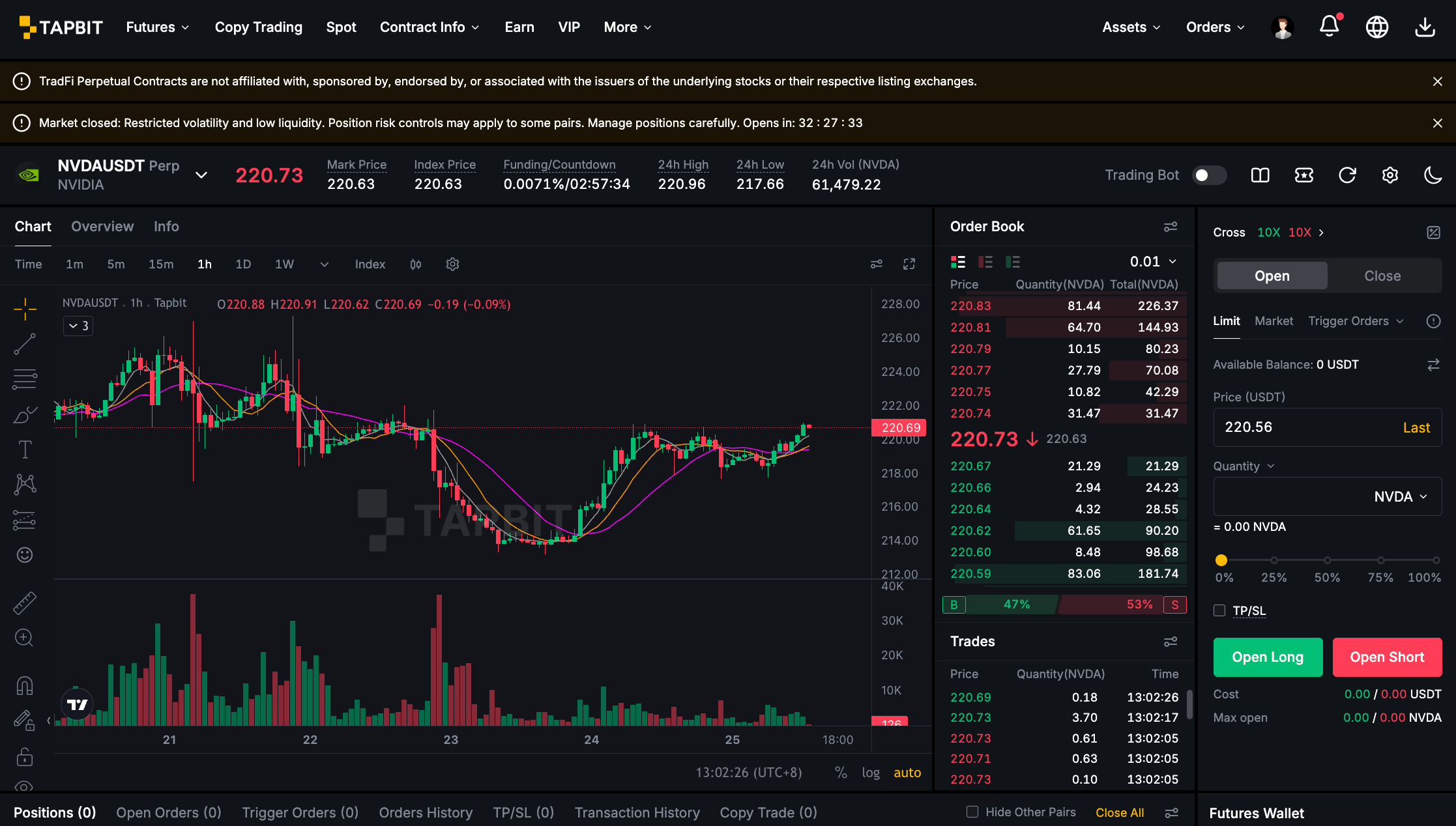
✓ Go to Tapbit's NVDA-USDT perpetual futures page and confirm the pair name shows NVDAUSDT Perp / NVIDIA. You can directly trade NVDA futures on the Tapbit futures interface.
Suggested screenshot: Tapbit NVDA-USDT page with chart, prices, order book, and Open Long / Open Short panel.
Step 3: Read the Chart and Order Book
✓ Before entering an order, review Mark Price, Index Price, 24h High, 24h Low, 24h Volume, chart trend, and order book. If the market shows a closure, restricted volatility, or low-liquidity warning, slow down.
Step 4: Set Order Type, Quantity, and TP/SL
✓ Choose Limit or Market. Enter price and quantity. Consider TP/SL before opening a position. Open Long is for an upside view. Open Short is for a downside view.
Beginners should start small and avoid high leverage. You can review Tapbit's trading fees and contact customer support if needed.
The final point is simple: use an NVDA stock prediction as research input, not as a command. A good NVDA stock prediction helps you form a plan, but risk management decides whether the trade is responsible.
FAQ
Is NVDA a cryptocurrency or a stock?
NVDA is a stock ticker for Nvidia Corporation on Nasdaq. It is not a cryptocurrency. Tapbit's NVDA-USDT market is a perpetual futures product based on NVDA price exposure.
What does NVDA-USDT mean on Tapbit?
NVDA-USDT refers to a Tapbit perpetual futures market where NVDA price exposure is quoted against USDT. It is not the same as buying Nvidia shares.
Why does Nvidia matter to AI and crypto investors?
Nvidia supplies chips and computing platforms used in AI infrastructure. Because AI is also a major crypto market narrative, many crypto traders watch NVDA as a signal for AI sentiment.
What can make an NVDA stock prediction wrong?
Earnings misses, weaker guidance, valuation pressure, export controls, slower AI spending, competition, or broad market selloffs can all make a forecast wrong.
Is trading NVDA-USDT the same as buying Nvidia shares?
No. Buying Nvidia shares means owning stock through an equity broker. Trading NVDA-USDT on Tapbit means trading a perpetual futures product with different mechanics and risks.
What should beginners check before trading NVDA-USDT?
Beginners should check the latest price, Mark Price, Index Price, order book, liquidity warnings, order type, leverage, margin, TP/SL settings, and whether the market is open or restricted.


