

Every seasoned cryptocurrency trader has experienced it: that sudden, visceral spike in your heart rate when a token surges 40% in a single hour, your feed is flooded with profit screenshots, and your portfolio is completely unexposed.
That psychological pressure is called FOMO (Fear Of Missing Out).
In the 24/7, high-volatility environment of the digital asset market, FOMO is more than just a buzzword; it is a powerful behavioral bias. If left unchecked, it will systematically drain your capital. At the Tapbit, we frequently observe retail traders abandoning perfectly sound strategies just to chase a green candle—usually right at the local top.
Here is a professional breakdown of what FOMO actually is, how market makers exploit it, and the exact frameworks you need to stop trading on emotion.
The Anatomy of FOMO
The term FOMO was first coined by marketing strategist Dr. Dan Herman in 2000, long before Bitcoin even existed. He defined it as an exhausting anxiety that an exciting or profitable event is happening elsewhere, and you are being left behind.
In crypto trading, FOMO manifests as the total collapse of critical thinking. It is the moment a trader looks at a vertical price chart and thinks, "If I don't buy right now, I will miss the trade of the year." The reality? By the time an asset has gone parabolic and retail traders are panic-buying just to feel included, the foundational move is already over. The latecomers are not catching the trend; they are buying the top.
How Smart Money Weaponizes Your Emotions
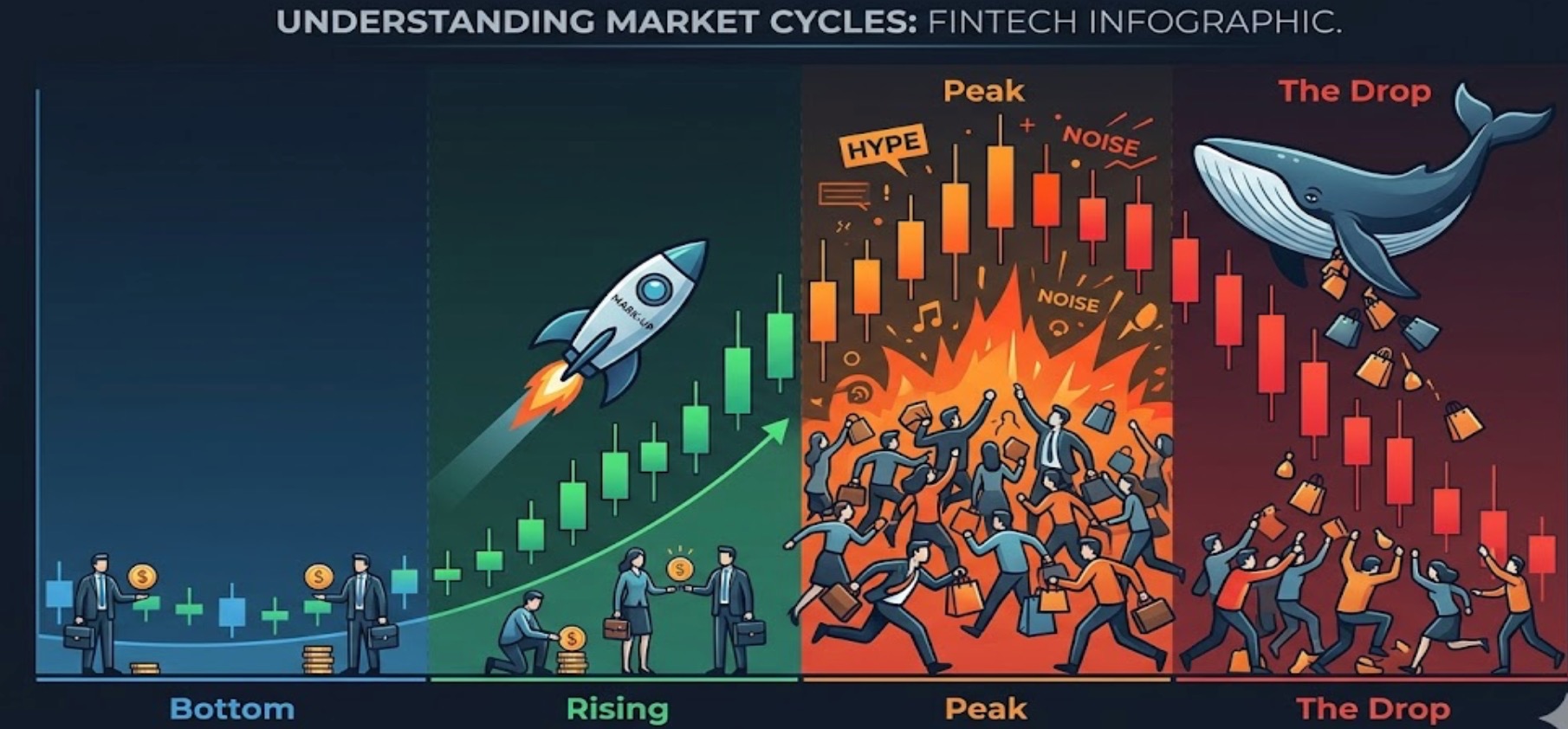
FOMO does not just affect individual traders; it is a core driver of broader market mechanics.
When a token experiences a sudden, FOMO-driven bull run, the buying pressure spikes artificially. However, this is rarely organic. Market manipulators and institutional "whales" actively hunt for retail FOMO.
Here is how the trap works:
-
Accumulation: Smart money accumulates an asset quietly during periods of low volatility and boredom.
-
The Mark-Up: A catalyst triggers a price increase. Algorithms and whales push the price through key resistance levels.
-
The FOMO Phase: Social media algorithms catch the trend. Retail traders experience FOMO and flood the market with market-buy orders.
-
Distribution (The Dump): Whales need massive liquidity to cash out their massive positions without crashing the price. The retail traders buying out of FOMO provide that exact "exit liquidity." Once the whales finish unloading, the bubble bursts, leaving emotionally driven traders holding heavy losses.
The Paradigm Shift: Embracing JOMO
Professional traders counter this anxiety by embracing JOMO—the Joy Of Missing Out.
JOMO is the psychological realization that no single trade will define your career. The crypto market presents lucrative setups every single week. A disciplined trader finds joy in watching a token pump 100% and walking away because the setup didn't meet their strict risk parameters.
Missing out on a chaotic, unpredictable pump is not a failure; it is the successful preservation of capital for a higher-probability setup.
The Tapbit Framework for Managing FOMO
You cannot completely turn off human emotion, but you can build mechanical systems to override it. Here are the core rules our top traders use to neutralize FOMO:
1. Trade the Chart, Not the Feed
Mute the noise. Social media is designed to trigger your emotions. Make it a strict habit to conduct your own technical and fundamental analysis (DYOR). Before entering a trade, look at the order book depth and volume profiles on Tapbit, not the hype on Twitter. You can refer to our article ‘The Tapbit Guide to Crypto Charting: Mastering Technical Analysis and TradingView’ for more details.
2. Define Invalidations Before You Buy
Never enter a trade because it is "going up." Enter because you have a thesis. Before you click buy, you must know exactly where you will take profit, and exactly where your stop-loss will be triggered if you are wrong. If a token has already pumped so high that you cannot find a logical place to put a stop-loss, the trade is dead. Walk away.
3. Deploy Limit Orders
Market buying a surging asset is the definition of FOMO. Instead, use Limit Orders. Identify a historical support level, set your limit bid there, and let the market come to you. If it never retraces to your level, you simply missed a trade—but you kept your money.
4. Pivot to Long-Term Value
The ultimate cure for short-term anxiety is a long-term time horizon. Instead of trying to scalp 15-minute price fluctuations, focus on accumulating fundamentally strong assets with proven utility during market corrections.
The Bottom Line
Trading is ultimately a battle against your own psychology. The market is designed to transfer wealth from the impatient and emotional to the patient and disciplined. Recognize the physiological signs of FOMO, step away from the screen, and force yourself to stick to your original strategy.
Ready to trade with precision? Remove the emotion and execute your systematic strategies using our professional-grade matching engine. Explore the advanced charting tools on the Tapbit Homepage, register your account today to access deep liquidity, or log in to set your limit orders and secure your portfolio.
Frequently Asked Questions (FAQ)
Is FOMO ever a good thing in crypto?
For the market makers who are taking profits, yes. For the individual trader making the purchase, almost never. Buying out of FOMO means you are buying late, which fundamentally skews your risk-to-reward ratio into negative territory.
What is the difference between FUD and FOMO?
They are opposite sides of the emotional spectrum. FOMO (Fear Of Missing Out) makes you buy irrationally because you are greedy. FUD (Fear, Uncertainty, and Doubt) makes you sell irrationally at the bottom because you are panicked by negative news or rumors. Both destroy capital.
How do I stop FOMO trading?
The most effective method is using strict risk management tools. Automate your strategy by using Take-Profit and Stop-Loss orders the moment you enter a position. If your trades are automated based on mathematical levels, your emotional anxiety cannot hijack your execution.


