
For much of the AI boom, investors focused on Nvidia, AMD, Micron and semiconductor equipment companies. But in 2026, the market has increasingly looked overseas for the next layer of AI infrastructure exposure.
South Korea has become one of the most important examples.
The KOSPI, South Korea’s benchmark stock index, has been heavily influenced by the country’s memory chip leaders, especially Samsung Electronics and SK Hynix. As AI data centers require more high-bandwidth memory, DRAM and advanced storage, Korean semiconductor companies have moved closer to the center of the global AI supply chain.
That has helped turn the KOSPI into a major AI memory trade.
But traders should be careful. A strong index rally does not always mean the entire market is healthy. In Korea’s case, much of the move has been tied to a concentrated group of semiconductor names. That creates opportunity, but also volatility.
What Is the KOSPI?
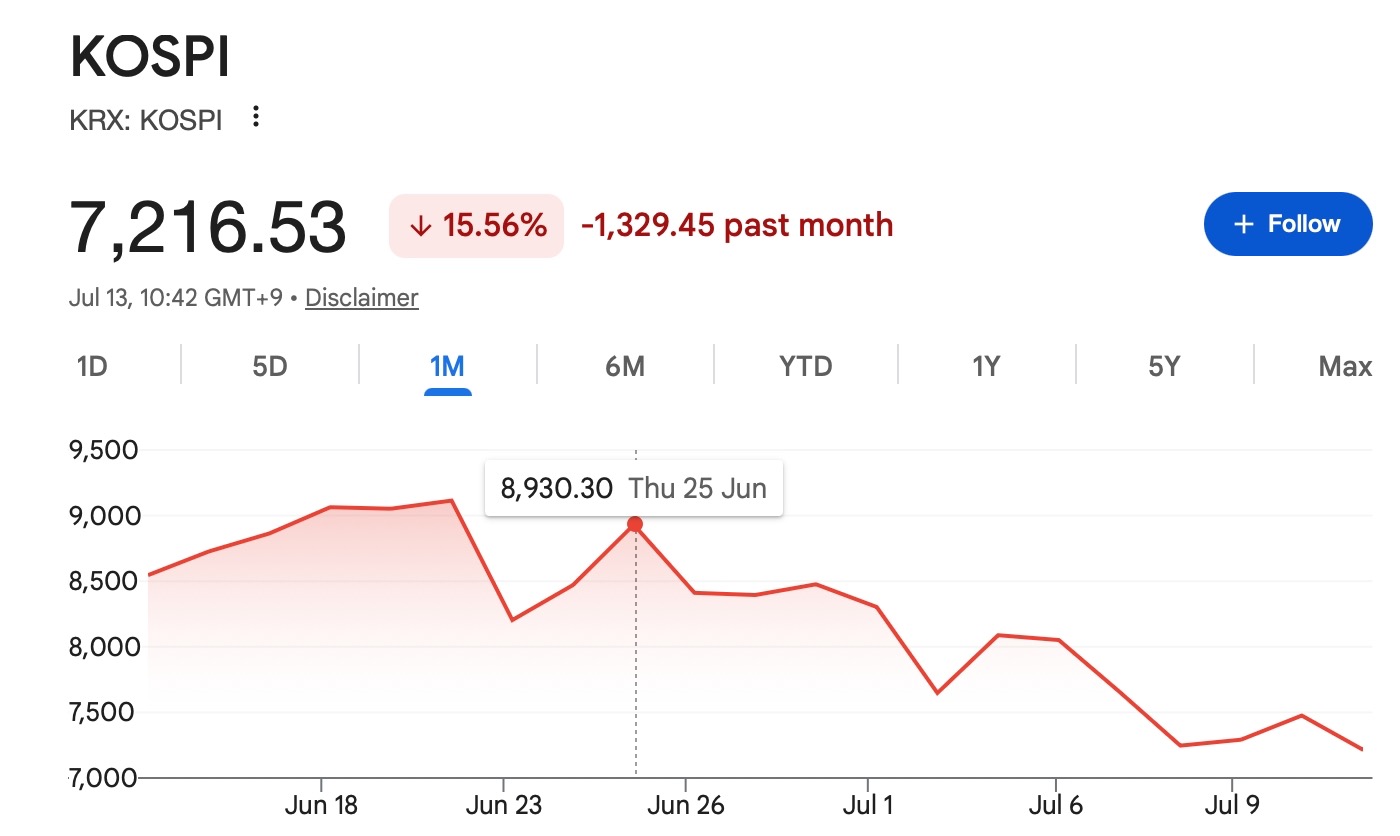
KOSPI stands for Korea Composite Stock Price Index. It is South Korea’s main stock market benchmark and tracks common stocks listed on the Korea Exchange’s main market.
Like many major equity benchmarks, the KOSPI is influenced by market capitalization. This means larger companies can have a much bigger impact on index performance than smaller companies. In practice, Samsung Electronics and SK Hynix can heavily influence the direction of the broader market because of their size and importance to Korea’s economy.
This structure matters for traders.
When the KOSPI rises, it may not mean every Korean sector is performing equally well. It may mean that a few large exporters, technology companies or semiconductor leaders are driving most of the move.
That is exactly what has happened during the AI memory rally.
Why AI Memory Is Driving Korea’s Market
AI infrastructure requires more than GPUs.
Large AI models need massive memory bandwidth. High-bandwidth memory, or HBM, has become especially important because it helps AI accelerators process large amounts of data more efficiently. As AI workloads grow, memory suppliers become more important to the entire hardware stack.
South Korea is central to that market because of Samsung Electronics and SK Hynix.
SK Hynix has become one of the most closely watched companies in HBM. AP reported that SK Hynix’s American depositary receipts rose 12.8% on their Wall Street debut after pricing at $149, opening at $170 and closing at $168.01. The listing raised $26.5 billion, making it the largest-ever U.S. IPO by a foreign company. AP also noted that SK Hynix holds a key position in HBM and has partnered with Nvidia, while AI demand has pushed memory chip prices and profits higher.
This shows why KOSPI has become more than a domestic equity index. It has become a global AI memory exposure.
Samsung’s Results Show the Strength — and the Risk
Samsung’s recent numbers show how powerful the AI memory cycle has become.
Business Insider reported that Samsung Electronics estimated Q2 2026 operating profit at 89.4 trillion won, nearly 19 times higher than the same period last year, while revenue was projected to more than double to 171 trillion won. The same report said the results were driven mainly by booming demand for AI-related memory chips.
But the market reaction was not purely positive.
Business Insider also reported that Samsung shares fell as much as 10% and closed 7% lower after the strong profit forecast, pulling the KOSPI down nearly 5%. Investors were not questioning whether AI memory demand was strong. They were asking whether the momentum could continue and whether future oversupply could pressure profits.
This is an important lesson.
When expectations are already high, strong earnings may not be enough. Markets often demand stronger forward guidance, more pricing power and evidence that the current cycle can last. That is why the KOSPI rally should not be viewed only as a growth story. It is also an expectations story.
KOSPI Is a Global AI Equity Trade
The Korean market shows how AI themes can move across borders.
At first, investors focused on U.S. AI leaders. Then the trade expanded to memory, semiconductor equipment, data center power, cooling and infrastructure. Korea became important because it sits directly inside the AI memory supply chain.
SK Hynix’s U.S. listing highlights this shift. AP reported that the company raised $26.5 billion through its Wall Street debut, while noting that its U.S. market generated 68.8% of its 2025 revenue. The report also said SK Hynix, Samsung and the South Korean government plan a $518 billion investment in a new chipmaking hub.
This shows that Korean semiconductor companies are no longer only local market stories. They are global AI infrastructure companies.
For traders, this means KOSPI can serve as a way to observe global risk appetite for AI hardware. When investors are optimistic about AI memory, Korean chip stocks can benefit. When concerns rise about overcapacity, pricing or valuation, the KOSPI can react sharply.
The Concentration Problem
The biggest risk in the KOSPI rally is concentration.
WSJ reported that the KOSPI had entered bear-market territory after falling more than 20% from a recent high, even though it remained up more than 70% for the year. The same report noted that Samsung and SK Hynix together made up about half of the index’s market capitalization, showing how heavily the index depends on AI chipmakers.
This is the central risk.
If Samsung and SK Hynix continue to beat expectations, KOSPI can remain supported. But if memory prices weaken, HBM supply increases too quickly, or investors begin to worry about an AI capex slowdown, the same concentration can amplify downside.
A concentrated index can rise faster than a diversified market. It can also fall faster.
Volatility Has Already Increased
The KOSPI rally has also become more volatile.
WSJ reported that South Korea’s stock market briefly entered bear territory as the chip-driven AI rally paused, with Samsung Electronics and SK Hynix falling 6.9% and 6.1%, respectively, while the KOSPI dropped as much as 8.2%.
MarketWatch also reported that the Kospi Volatility Index recently surged to 98, compared with the U.S. VIX at 18, highlighting extreme turbulence driven by chip stocks that heavily influence the Korean benchmark.
This does not mean the AI memory story is over.
It means traders should expect sharper swings when the market is crowded, expectations are high and index performance is concentrated in a few large names.
Foreign Flows and Currency Risk
KOSPI also carries foreign flow and currency risk.
The Financial Times reported that traders were preparing for won volatility after SK Hynix’s blockbuster U.S. listing. The same report said South Korea had seen more than $100 billion of foreign equity selling this year, while the won remained one of Asia’s weakest currencies despite a record current account surplus of $141.3 billion.
This matters for international investors.
Even if Korean stocks rise in local currency terms, foreign investors also need to consider exchange-rate movements. If the won weakens, foreign returns may be reduced. If foreign outflows accelerate, they can pressure both equities and the currency.
For KOSPI, the AI memory story is powerful, but it does not remove macro risk.
Tapbit View
KOSPI shows how the AI trade is moving into global equity markets. The Korean market is important because it connects directly to the AI memory supply chain. Samsung and SK Hynix are not just local champions. They are core suppliers for the global AI hardware cycle.
But the same strength creates risk. KOSPI’s rally has been powerful because investors are pricing Korea as an AI memory winner. Yet the index is highly exposed to a small number of semiconductor leaders. When those stocks correct, the broader benchmark can move sharply.
For Tapbit users, the broader lesson is clear: global themes often spread from the obvious leaders to the infrastructure layer. In AI, that means the trade can move from GPUs to HBM, from HBM to memory suppliers, and from memory suppliers to entire country indices.
But traders still need to separate narrative from confirmation.
KOSPI may remain an important AI equity market to watch, but future performance depends on earnings guidance, memory pricing, foreign flows and whether expectations have already moved too far ahead of fundamentals.
Users can visit Tapbit to explore supported crypto services. Existing users can access their accounts through Tapbit Login, while new users can start through Tapbit Register.
Frequently Asked Questions (FAQ)
What is KOSPI?
KOSPI is South Korea’s main stock market benchmark. It tracks common stocks listed on the Korea Exchange’s main market and is heavily influenced by large-cap companies.
Why is KOSPI linked to AI?
KOSPI is linked to AI because major Korean companies such as Samsung Electronics and SK Hynix are key suppliers of memory chips, including HBM, which are important for AI data centers.
Why are Samsung and SK Hynix important?
Samsung and SK Hynix are two of the world’s most important memory chip companies. Their performance can heavily influence KOSPI because of their large market value and role in Korea’s economy.


