
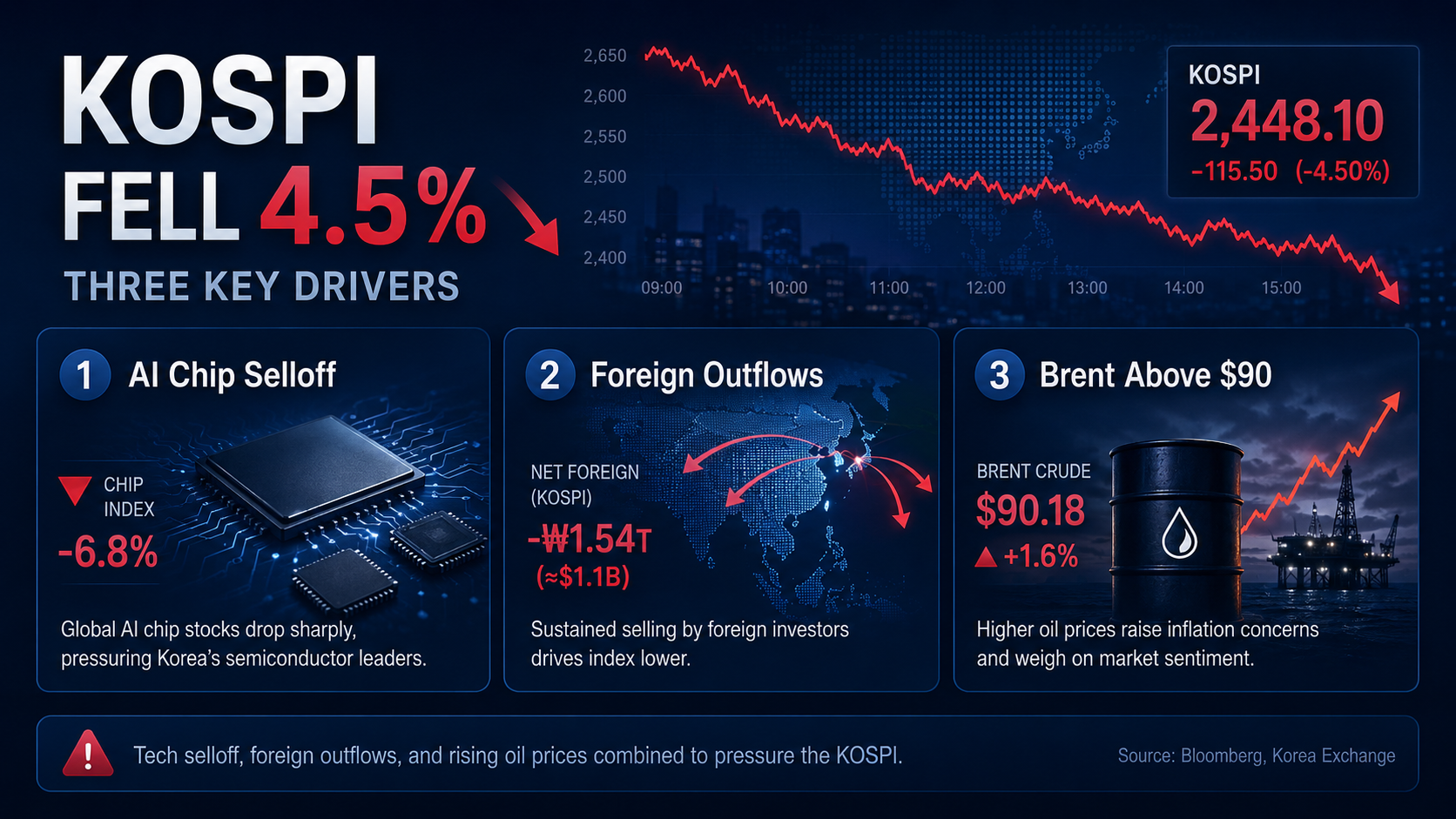
The KOSPI index today fell 4.5% as investors reduced exposure to South Korea's AI and semiconductor leaders. The decline was not a broad rejection of the Korean economy. It was a concentrated correction in a market where Samsung Electronics and SK Hynix have become powerful drivers of the headline index.
AP reported that profit-taking in AI-linked shares, concern about stretched valuations and the debut of a competitive Chinese AI model all contributed to the selloff. At the same time, Brent crude rose to about $90.95 per barrel, creating another problem for a country that imports much of its energy.
KOSPI Index Today: What Changed?
The latest decline follows an unusually volatile period for Korean stocks. Reuters has reported that the KOSPI had already entered a bear-market correction from its June record even while remaining sharply higher for the year. That combination—large year-to-date gains and a deep correction—shows how concentrated the rally had become.
Foreign flows also matter. In an earlier nearly 5% selloff, overseas investors sold roughly 2.9 trillion won of Korean shares while retail investors bought about 3.2 trillion won. When foreign investors reduce semiconductor exposure, the impact on the index can be immediate because the largest chip companies dominate both market capitalization and trading activity.
Why the KOSPI Fell 4.5%
Samsung and SK Hynix Lead the AI Selloff
Samsung Electronics and SK Hynix have been among the strongest beneficiaries of the AI-memory trade. Reuters reported that, before the latest correction cycle, Samsung had risen more than 130% for the year and SK Hynix more than 220%. Those gains created a large pool of profits that investors could lock in when AI sentiment weakened.
The index effect is amplified by concentration. A decline in two major chipmakers can outweigh gains in many smaller companies. That is why KOSPI analysis must look beyond the number of advancing and declining stocks and examine the weighted contribution of the semiconductor leaders.
AI Bubble Concerns Trigger Profit-Taking
The selloff also reflects a change in the AI debate. Investors are no longer asking only whether demand is strong. They are asking whether current valuations already assume several years of perfect execution. New competition, rising infrastructure costs and uncertainty over hyperscaler returns can trigger a reassessment even when chip earnings remain strong.
This does not necessarily mean the AI cycle has ended. It means the market now requires stronger evidence from HBM pricing, customer orders, capacity expansion and margins.
Brent Above $90 Raises Korea's Import Risk
Brent crude's rise to approximately $90.95 adds a macroeconomic layer to the equity selloff. Higher oil prices can widen Korea's import bill, pressure the won and raise inflation expectations. If inflation stays elevated, the Bank of Korea has less room to support growth with easier policy.
For exporters, a weaker won can help overseas revenue, but higher energy and financing costs can offset that benefit. The net effect depends on each company's cost structure and currency exposure.
KOSPI Recovery Conditions
A durable recovery needs more than a one-day bounce. First, Samsung and SK Hynix need to stabilize because they are the main transmission channel between the AI trade and the index. Second, foreign selling needs to slow. Third, oil and rates should stop adding new pressure.
Traders should refresh the exact KOSPI level and chart before publication. A recovery above the first post-selloff resistance area, supported by better breadth and foreign inflows, would be more meaningful than an index rebound driven only by short covering.
Is the KOSPI Selloff a Buying Opportunity?
The buy case depends on earnings estimates remaining intact. If HBM demand, memory pricing and semiconductor guidance stay strong while the index holds support, the decline may represent a valuation reset rather than a fundamental breakdown.
The wait case is stronger when the index rebounds but SK Hynix and Samsung fail to confirm. Investors can require evidence that foreign flows are improving and that oil-price pressure is stabilizing.
The avoid case becomes more persuasive if chip earnings expectations fall, Brent continues rising or the won weakens sharply. In that environment, lower prices may reflect a deteriorating macro and earnings outlook rather than a temporary correction.
How to Trade SKHYNIX-USDT on Tapbit
Tapbit lists SKHYNIX-USDT stock-linked futures. This contract provides derivative price exposure to SK Hynix, not the KOSPI index. It is not direct share ownership and does not grant voting rights or dividends.
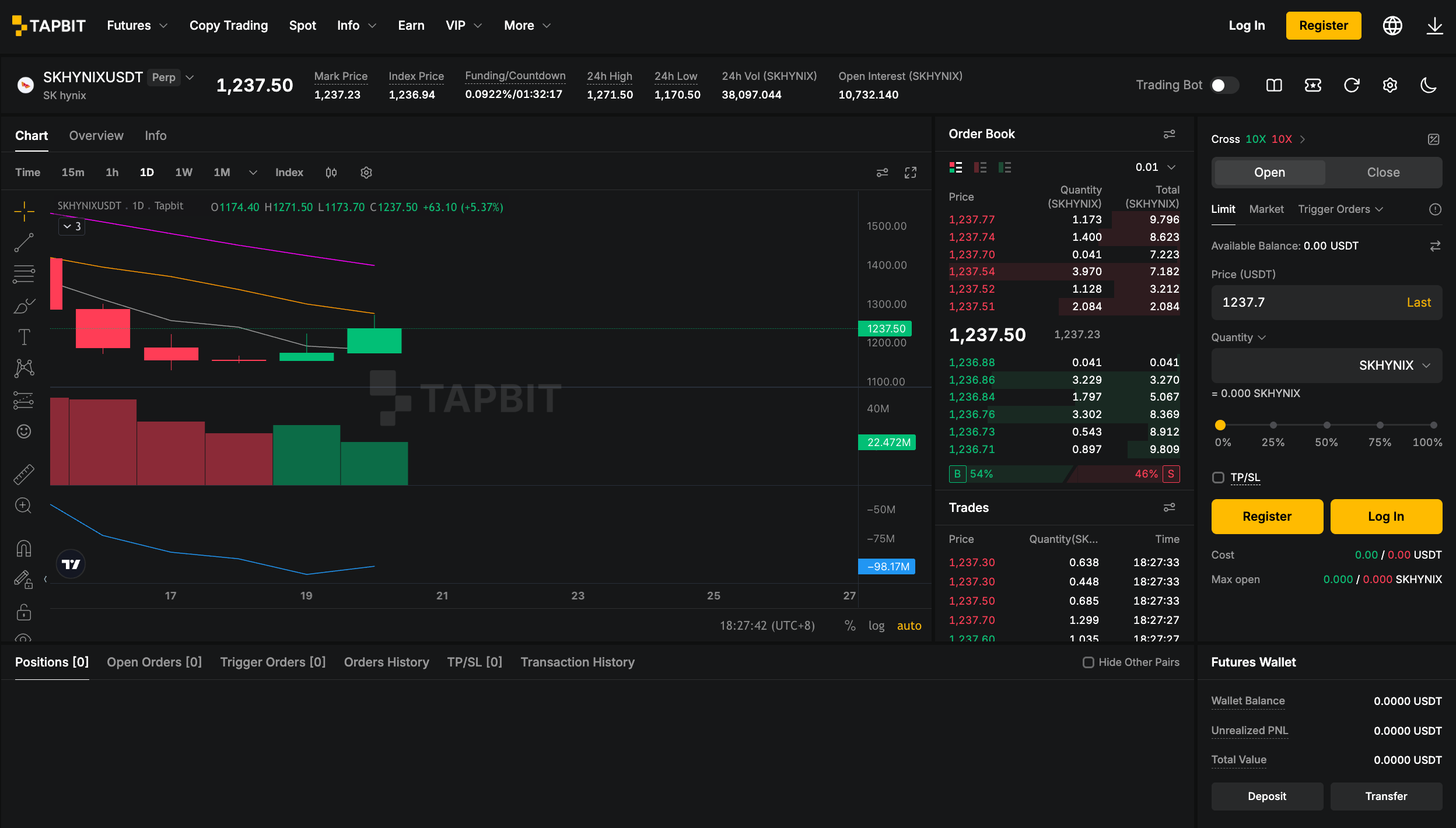
- Create an account and open the SKHYNIX-USDT futures market.
- Review the index price, liquidity, funding rate, leverage and contract details.
- Choose an order type and size the position around a defined support and invalidation level.
- Confirm the order and manage the position with a stop-loss and planned exit.
Why Index Concentration Makes the KOSPI More Volatile
The KOSPI's recent behavior cannot be understood through market breadth alone. Samsung Electronics and SK Hynix carry enough weight to dominate the index when both move in the same direction. This creates a concentration effect: hundreds of smaller stocks can trade relatively calmly while the headline index still posts a dramatic decline.
That concentration also increases sensitivity to a narrow set of global variables. HBM pricing, Nvidia demand, U.S. export rules, memory inventory and hyperscaler capex can influence Korean index performance even when domestic consumption data is stable.
- Positive concentration: strong semiconductor earnings can lift the entire index quickly.
- Negative concentration: valuation compression in two large chipmakers can overwhelm gains elsewhere.
- Portfolio implication: investors using the KOSPI as broad Korea exposure may be taking more AI-memory risk than they realize.
This is why a recovery should be evaluated through both the index and its leaders. If the KOSPI rises while Samsung and SK Hynix remain weak, the rebound may lack durability. A healthier recovery would include improving breadth, foreign buying and stabilization in the semiconductor complex.
Final Assessment
The KOSPI's 4.5% decline reflects concentration, valuation and macro pressure. A recovery requires chip stabilization, better foreign flows and relief from oil and rate risks. Until those conditions improve, a lower index level is not sufficient evidence that the correction is complete.
Frequently Asked Questions
Why did the KOSPI fall today?
The index fell as investors sold AI-linked semiconductor shares, took profits after a strong rally and reacted to higher oil prices and valuation concerns.
How do Samsung and SK Hynix affect the KOSPI?
Their large index weights mean their price moves can dominate the headline index even when other Korean stocks are more stable.
Is the KOSPI in a bear market?
Reuters reported that the index had fallen more than 20% from its June record, meeting a common technical definition of a bear market.
Can users trade the KOSPI on Tapbit?
KOSPI index support is not confirmed. Tapbit does support SKHYNIX-USDT, which is single-stock derivative exposure rather than index exposure.


