
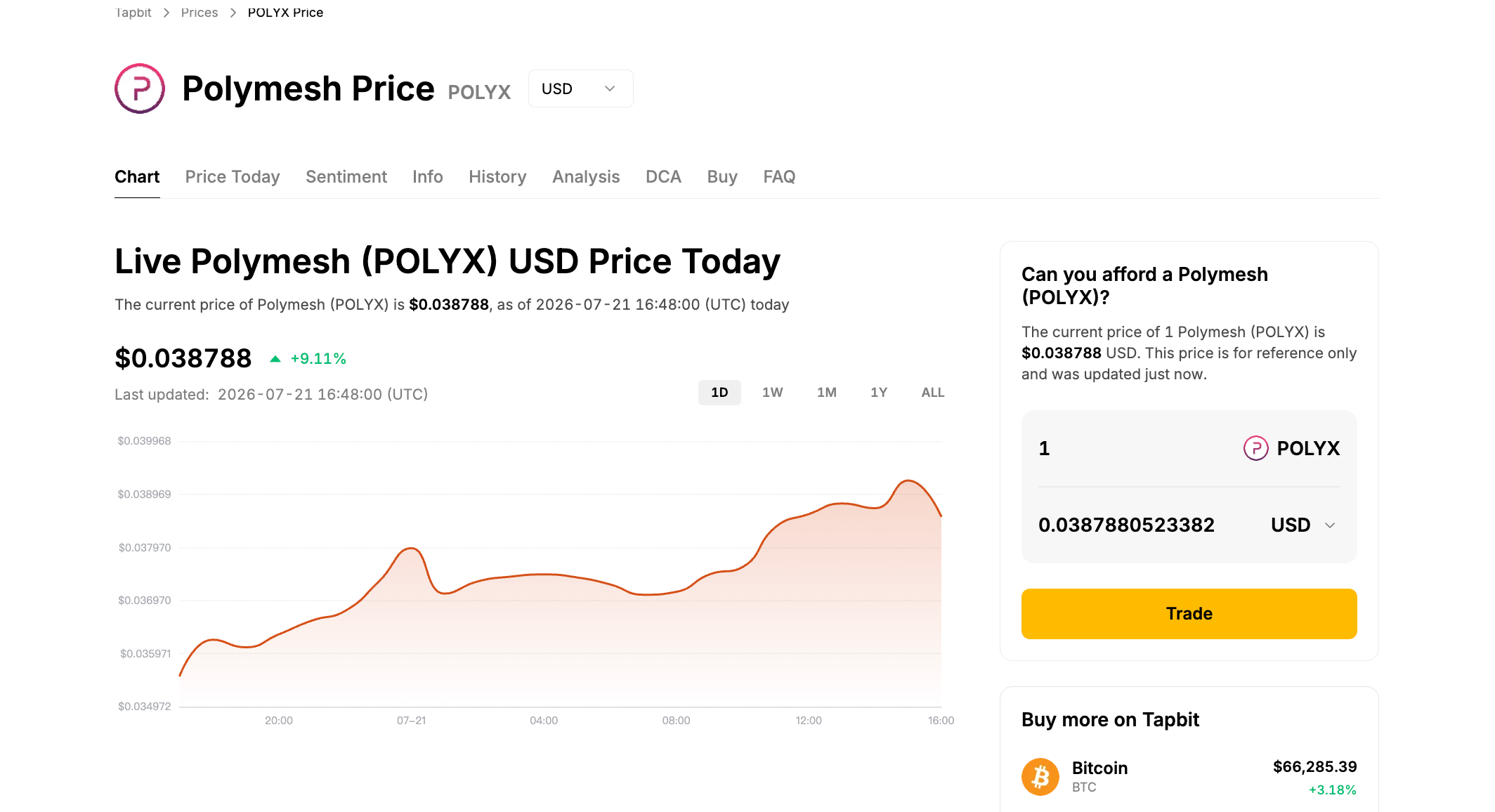
POLYX price is trading near $0.036 as traders position for the Polymesh v8 upgrade. The token has also appeared in rising Korean Google Trends queries, giving the event additional short-term attention. A low nominal price, an approaching network catalyst and renewed interest in real-world asset tokenization can produce sharp moves, but they do not automatically establish a durable uptrend.
POLYX Price Today: Current Setup
Recent snapshots placed POLYX around $0.0357–$0.0362. The exact price, 24-hour change, range, volume and market cap must be refreshed immediately before publication because upgrade-driven moves can reverse quickly.
The token remains far below earlier cycle highs, so a short-term bounce should not be confused with a full trend change. A healthier setup would show rising spot volume, higher lows and a successful hold above the first resistance zone after the upgrade.
Why POLYX Is Moving Before Polymesh v8
Lower-Friction Identity and Onboarding
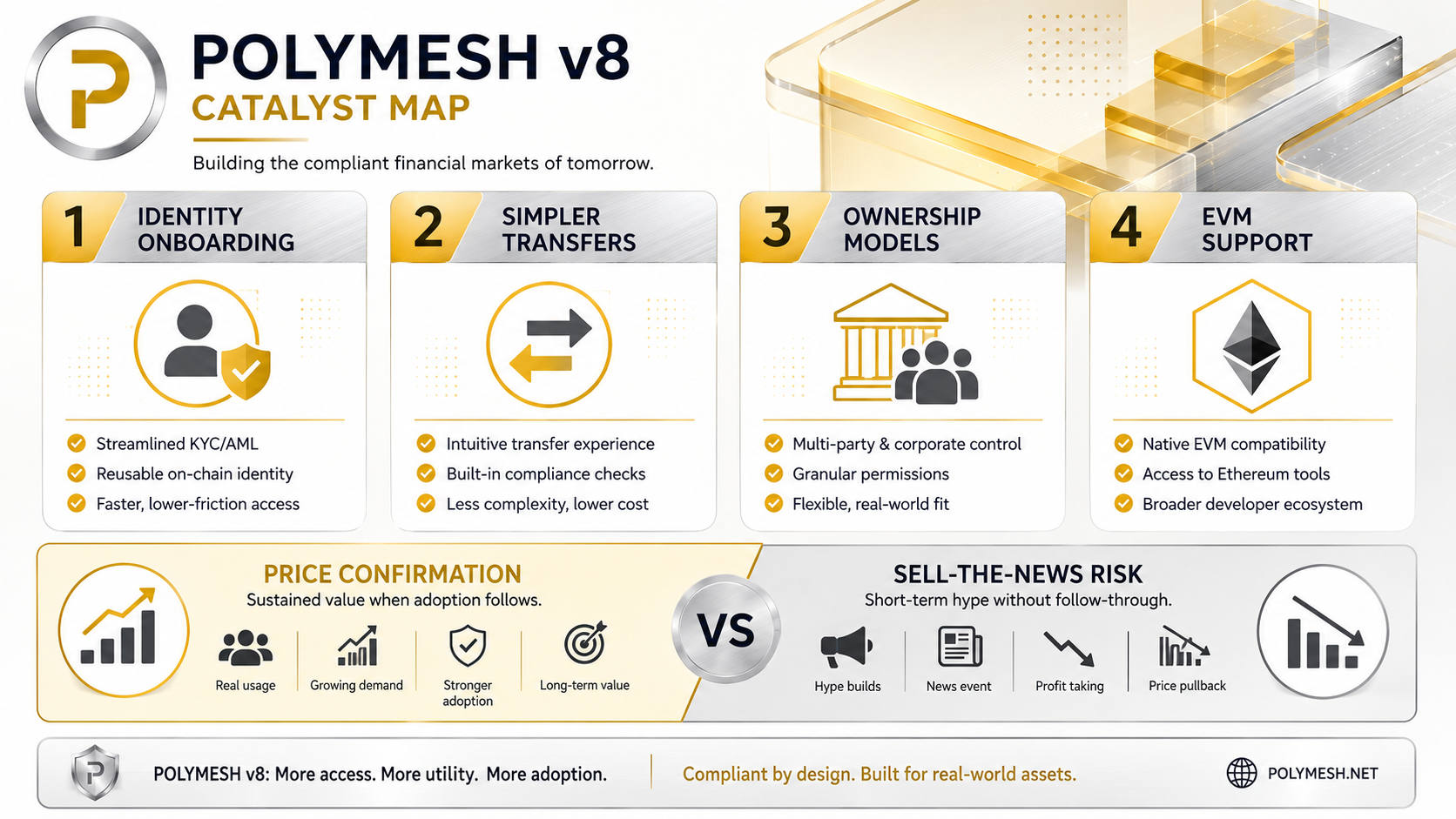
Polymesh is built for regulated assets, so identity and compliance are core network features. The v8 release is expected to simplify parts of onboarding, including self-registration and account-based ownership. Lower friction can make it easier for issuers and developers to work with the network.
Simpler Transfers and Expanded Ownership
Regulated assets require transfer restrictions and ownership records. If v8 makes those operations easier without weakening compliance, the upgrade could improve the practical experience for tokenized funds and securities.
EVM Support
Improved EVM compatibility can expand the developer pool, but compatibility is not adoption. The market will ultimately need evidence of deployed applications, issued assets, active users and transaction growth.
Readers who need the project background can review Tapbit Learn’s guide to what POLYX and Polymesh are.
What the Rally Confirms—and What It Does Not
The rally confirms that traders are paying attention to the upgrade. It does not prove that the market has repriced POLYX for sustained network growth. Event-driven rallies can reverse when the announcement is fully priced in, especially in lower-liquidity markets.
- Price should hold above the immediate breakout area after deployment.
- Spot volume should remain elevated rather than collapse after the event.
- The network should publish evidence of successful deployment and usage.
- The RWA sector should remain supportive.
Support, Resistance and Invalidation
The latest local low should serve as the first support reference, while the recent range high is the first resistance. The final version should use a refreshed chart rather than stale numbers.
The bullish setup weakens if POLYX loses the pre-upgrade base on rising sell volume. It strengthens if price closes above resistance, retests the area and holds it as support.
POLYX Price Outlook
| Scenario | Confirmation | Main Driver | Invalidation |
|---|---|---|---|
| Bull | Successful v8 launch and volume-backed breakout | RWA adoption and developer access | Failed retest |
| Base | Price stays near the recent range | Upgrade delivered, adoption takes time | Range breakdown |
| Bear | Price loses pre-event support | Sell-the-news pressure | Rapid recovery above resistance |
How to Follow POLYX on Tapbit
POLYX does not have a confirmed Tapbit futures contract. Users should not be directed to a fabricated trading page. They can review the live Polymesh price page.
Users who want a confirmed, deeper-liquidity crypto market can create an account and review BTC spot or futures. BTC is a different asset and must not be presented as a substitute for POLYX.
What Would Confirm Real Adoption After the Upgrade?
The strongest post-upgrade signal would not be price alone. A network upgrade can attract speculative buying before deployment, but long-term value depends on whether developers and issuers actually use the new functionality. Traders should therefore watch for evidence that the technical improvements translate into measurable activity.
- New asset issuance: more regulated assets launched on Polymesh would support the RWA thesis.
- Developer activity: increased use of EVM-compatible tooling would show that the upgrade is expanding access.
- Identity registrations: growth in verified participants would indicate lower onboarding friction.
- Transaction activity: sustained growth after the launch would be stronger than a one-day spike.
- Institutional announcements: new issuers, custodians or infrastructure partners would provide external validation.
If those indicators remain flat, the market may eventually treat v8 as a technical improvement without an immediate economic payoff. That does not make the upgrade unimportant, but it would weaken the case for a sustained repricing of POLYX.
How Liquidity Changes the POLYX Price Setup
POLYX is less liquid than major assets such as Bitcoin or Ethereum. Lower liquidity can amplify both upside and downside because a relatively small amount of buying or selling may move the market. It also means that apparent breakouts can be less reliable when they occur on thin volume.
Traders should therefore avoid relying only on percentage gains. A 10% move in a lower-liquidity token may be less meaningful than a smaller move supported by broad spot demand. Slippage, wider spreads and abrupt reversals can also make risk management more difficult around the upgrade.
A stronger setup would combine higher volume with a stable order book and repeated closes above resistance. A weaker setup would show a fast price spike, low follow-through and a rapid return to the previous range.
What Traders Should Watch After the Event
The first 24 to 72 hours after the upgrade will be more informative than the announcement itself. Traders should watch whether volume remains elevated after the initial reaction, whether the network reports a clean deployment, and whether price can hold above the pre-event range. A strong launch followed by fading volume would suggest that the catalyst was mostly speculative. A stable post-launch market with growing activity would provide a better foundation for a sustained move.
Final Assessment
Polymesh v8 gives POLYX a credible catalyst, but the market still needs proof. A successful upgrade, stronger activity and a volume-backed hold above resistance would improve the outlook. A failed breakout would suggest the event was already priced in.
Frequently Asked Questions
What is the POLYX price today?
Recent snapshots placed POLYX near $0.036, but the live price should be refreshed.
Is POLYX available as a Tapbit contract?
No confirmed Tapbit POLYX contract is available. Users can review the Polymesh price page instead.
Can v8 guarantee a higher price?
No. A technical upgrade can improve the network without guaranteeing adoption or price appreciation.


