
USWR Coin, often referred to as United States Water Reserve, has attracted attention because of its official-sounding name and asset-themed narrative. For beginners, the first question is simple: is USWR Coin real?
The careful answer is that USWR may be real in the narrow on-chain sense if it has a contract address, liquidity pool, holders, and transaction history. But that is not the same as being an official U.S. reserve asset, a regulated investment product, or a token backed by actual water resources.
What Is USWR Coin?
USWR Coin appears to use the name United States Water Reserve, a phrase that sounds connected to public infrastructure, natural resources, and national reserves. This type of branding can attract investors who are interested in real-world asset narratives, commodity-linked tokens, or public-resource themes.
However, a name alone does not establish legal status. In crypto, almost anyone can create a token with institutional-sounding language. Investors should focus on verifiable evidence rather than the impression created by the name.
| Project Element | What Investors Should Understand |
|---|---|
| Token name | United States Water Reserve |
| Symbol | USWR |
| Market type | Speculative crypto token unless proven otherwise |
| Main narrative | Water reserve, public asset, or resource-backed branding |
| Key question | Whether claims are supported by verifiable documentation |
Is USWR Coin Real?
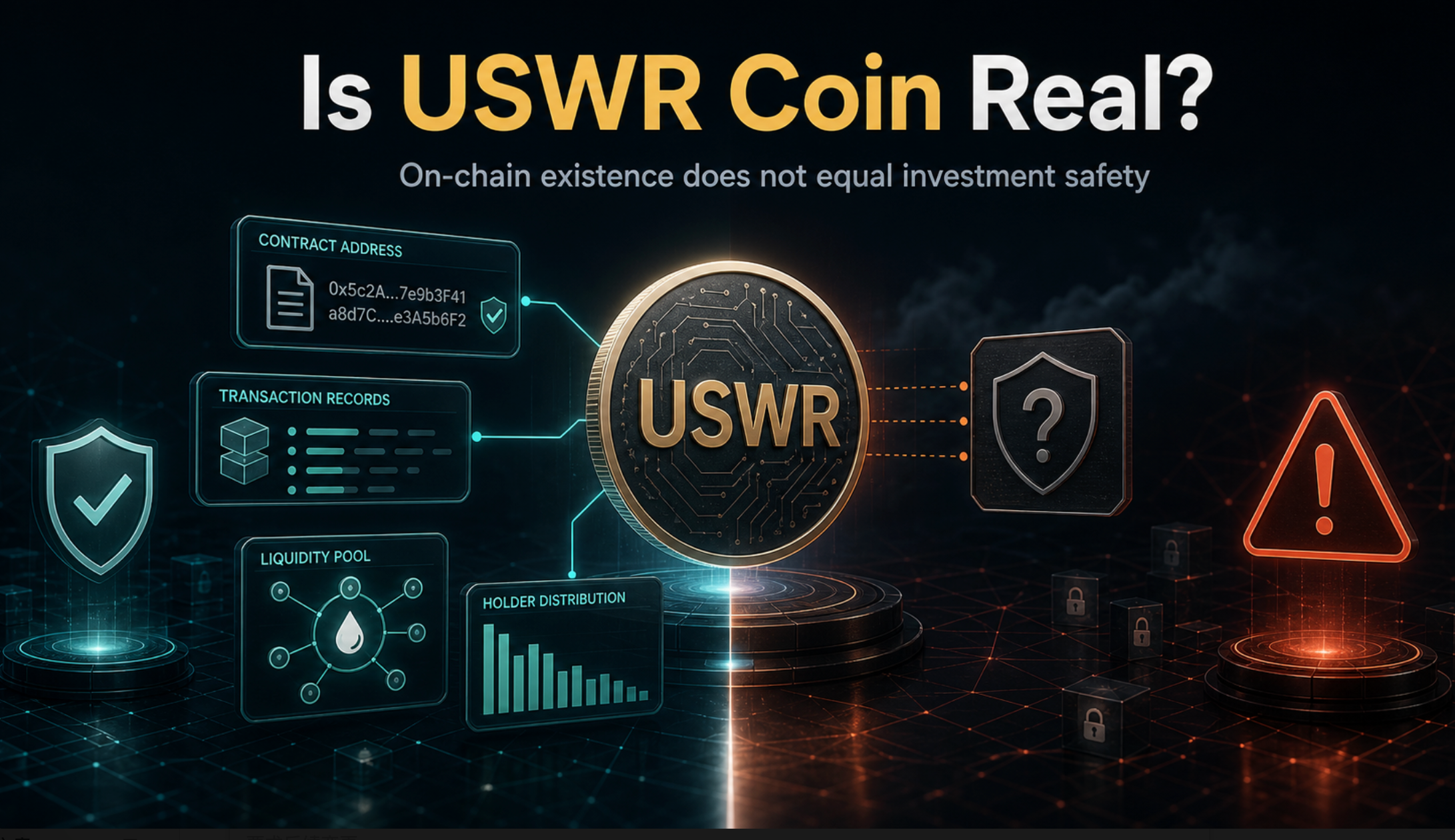
USWR can be considered real only if users can verify that the token exists on-chain. That means checking the correct contract address, transaction history, liquidity pool, and holder records on a blockchain explorer.
But investors should separate token existence from project legitimacy. A token can exist on-chain and still have weak transparency, low liquidity, unclear ownership, or misleading claims.
In other words, “real token” does not automatically mean “safe investment.” It only means the token exists as a digital asset.
Is USWR an Official U.S. Government Coin?
Investors should not assume USWR is an official U.S. government coin. The phrase United States Water Reserve may sound official, but official status requires direct confirmation from government sources, legal documents, or recognized regulatory filings.
Without verified evidence, USWR should not be described as a government-backed reserve token, public water asset, or official United States investment product.
| Claim | What Evidence Is Needed |
|---|---|
| Official U.S. connection | Government announcement or legal filing |
| Water reserve backing | Asset custody, ownership documents, audits, and valuation reports |
| Investor rights | Clear terms explaining what token holders legally own |
| Regulated product | Registration, exemptions, or legal disclosures |
| Project legitimacy | Transparent team, documentation, liquidity, and normal contract behavior |
Why Water Reserve Branding Can Be Risky
Natural resources are powerful investment narratives. Water is essential, scarce in some regions, and often discussed in infrastructure and sustainability conversations. That makes water-related branding attractive in crypto.
The risk is that investors may confuse a story with proof. A token using the words “water reserve” is not automatically backed by water rights, infrastructure, utilities, or government-controlled resources.
Any claim of real-world asset backing should come with legal documents, custodian information, audit reports, and a clear explanation of how token holders benefit.
How to Verify USWR Before Buying
Before buying USWR, investors should begin with the contract address. Similar names and copycat tokens can appear quickly, especially when a token starts trending on social media or decentralized exchanges.
After confirming the contract, review liquidity, holder distribution, trading volume, and whether the token can actually be sold. If a token has little liquidity or a few wallets control most of the supply, price moves can become extreme.
| Area to Check | Why It Matters |
|---|---|
| Contract address | Confirms users are viewing the correct asset |
| Liquidity | Shows whether buyers can exit positions |
| Holder distribution | Reveals concentration risk |
| Trading volume | Indicates real market participation |
| Contract permissions | May reveal tax controls, minting, blacklists, or transfer limits |
| Project documentation | Shows whether claims are explained and verifiable |
Common Red Flags
USWR-style tokens should be researched carefully because official-sounding branding can be used to build trust quickly. That does not mean every such token is fraudulent, but it does mean investors need a higher standard of evidence.
- No verified official website or contract source.
- Claims of government backing without direct evidence.
- No clear explanation of how water reserves are owned or audited.
- Anonymous team and limited project documentation.
- Low liquidity or large holder concentration.
- Unusual contract controls that restrict selling.
- Social media promotion focused only on quick price gains.
Where Tapbit Fits In
USWR may not be available on every major trading platform, and investors should avoid random links or unverified markets. Users who want a broader entry point for exploring digital asset markets can create a Tapbit account or check Tapbit’s crypto rewards hub while researching opportunities.
This does not mean Tapbit lists USWR. Investors should always verify the exact asset, trading pair, market availability, and risk profile before taking any action.
Is USWR Coin a Scam?
It is not responsible to label USWR a scam without clear evidence. A better approach is to ask whether the project’s claims are verifiable.
If USWR claims official status, water reserve backing, or investor rights but does not provide documents to support those claims, investors should treat the token with caution. Limited transparency, low liquidity, and aggressive promotional language are all warning signs.
Final Verdict
USWR Coin may be real as an on-chain token, but investors should not treat it as an official United States reserve asset or water-backed investment without verified documentation.
The key distinction is simple: token existence is not the same as legitimacy. Before considering USWR, investors should verify the contract, liquidity, holder distribution, project documents, official claims, and whether the token can be sold normally.
FAQ
Is USWR Coin real?
USWR may be real if it has a verifiable on-chain contract, trading pool, holders, and transaction history. That does not prove official backing or investment quality.
What does USWR stand for?
USWR is commonly associated with the phrase United States Water Reserve, but investors should verify the project’s own official naming and contract details.
Is USWR backed by water reserves?
Investors should not assume water reserve backing unless legal documents, custody details, audits, and asset disclosures are publicly verified.
Is USWR an official U.S. government token?
There is no reason to assume official U.S. government status unless direct government confirmation or legal documentation is available.
What should investors check before buying USWR?
Investors should verify the contract address, liquidity, sellability, holder concentration, project documentation, contract permissions, and any official claims.


