

United Oil Trust Fund (UOTF) should currently be treated as a high-risk, oil-themed Solana token rather than a verified investment backed by petroleum reserves. The token exists on-chain, and available Solana data indicates that its mint and freeze authorities have been revoked. However, those technical features do not prove that UOTF owns oil, tracks crude prices, generates energy revenue, or gives holders legal rights to physical assets.
For investors, the central question is not whether UOTF is a real token. It is whether the economic claims behind the token can be independently verified. Until clear custody records, audits, legal agreements and redemption terms are available, UOTF remains primarily a speculative crypto asset.
UOTF is not confirmed as available on Tapbit. Users can instead create a Tapbit account to explore supported crypto markets and risk-management tools.
What Is United Oil Trust Fund?
United Oil Trust Fund is a Solana SPL token using the ticker UOTF. Its name connects the asset to oil, trusts and commodity investing—terms normally associated with regulated financial products or legally documented ownership structures.
A token name does not establish those rights. Creating an SPL token does not require the issuer to deposit oil, purchase futures contracts or form a regulated trust. Unless supporting documentation proves otherwise, UOTF should not be confused with an oil ETF, commodity pool, energy company share or tokenized barrel of crude.
The Solana contract associated with UOTF is listed by some trackers as UoTfXNNGNjv9zuS6GqYNfoiS1Lb7Z1SVocwcrPY3cjV. Users should independently confirm this address through the project’s official channels before making any transaction.
Is UOTF Really Backed by Oil?
There is no sufficient independent evidence to conclude that UOTF is backed by physical oil or legally enforceable petroleum assets.
A credible oil-backed token would normally need to disclose the legal issuer, location and owner of the oil, independent reserve reports, a regulated custodian, barrels supporting each token, insurance arrangements, redemption terms and procedures for insolvency.
Without these elements, “oil-backed” may be a branding claim rather than an enforceable financial structure. Even photographs, partnership announcements or references to petroleum reserves do not establish a link between those assets and the token contract.
What Can Be Verified On-Chain?
Third-party Solana data indicates that UOTF has a fixed supply and that its mint, freeze and metadata-mutability controls were revoked after launch. Revoking these authorities can reduce certain smart-contract risks.
| On-Chain Feature | What It May Indicate | What It Does Not Prove |
|---|---|---|
| Mint authority revoked | New tokens may no longer be created | Oil reserves exist |
| Freeze authority revoked | Issuer may not be able to freeze wallets | Holders have legal protection |
| Metadata locked | Token name and image may not be editable | Project claims are accurate |
| Fixed supply | Supply cannot expand through normal minting | Price will increase |
| Solana contract exists | The token can be transferred on-chain | The issuer is regulated |
These controls cover only the token contract. They do not audit off-chain assets, confirm project revenue or protect users from illiquid markets.
UOTF vs a Real Oil Investment
A traditional oil investment usually has a defined mechanism connecting its value to energy markets. An oil ETF may hold futures contracts, while an energy company generates revenue by producing, refining or transporting petroleum.
UOTF does not automatically provide any of those forms of exposure.
| Product | Source of Exposure | Typical Holder Rights |
|---|---|---|
| Oil futures ETF | Regulated crude-oil futures | Fund shares and published disclosures |
| Energy company stock | Company earnings and assets | Shareholder rights |
| Verified commodity token | Audited commodities or contracts | Rights defined by legal documents |
| UOTF token | Crypto-market supply and demand | On-chain token ownership |
Unless UOTF has a documented price-tracking or redemption mechanism, its price may move independently of WTI or Brent crude. Oil prices could rise while UOTF falls because of selling pressure, declining attention or disappearing liquidity.
The Bull Case for UOTF
A bullish view depends largely on narrative and community growth. Oil-market volatility, geopolitical tensions or inflation concerns may increase interest in energy-themed crypto assets. Solana’s low transaction costs can also make small-cap tokens accessible to speculative traders.
The revoked mint and freeze authorities may appeal to users concerned about unlimited token creation or wallet restrictions. If the project later provides verifiable asset backing, transparent leadership, real utility and deeper liquidity, market confidence could improve.
However, these are conditional possibilities. They do not demonstrate that UOTF is currently backed by oil or suitable as a long-term commodity investment.
Why UOTF Is a High-Risk Token
Unverified oil-backing claims
The largest risk is the gap between the token’s oil-related branding and independently verifiable assets. Without audits and enforceable agreements, holders may own only a speculative SPL token.
Thin liquidity
Small liquidity pools can make the displayed price misleading. A modest purchase may push the token higher, while a large sale can cause severe slippage or become impossible near the quoted price.
Holder concentration
If a few wallets control most of the circulating supply or liquidity, their decisions can dominate the market. Investors should exclude known pool or burn addresses before assessing concentration.
Unclear project control
When the operating company, founders and jurisdiction cannot be verified, it becomes harder to evaluate accountability, legal recourse and conflicts of interest.
Narrative-driven volatility
UOTF may react more strongly to social-media attention than to actual oil prices. Energy headlines can attract buyers, but the same demand may disappear when attention moves elsewhere.
What to Check Before Buying UOTF
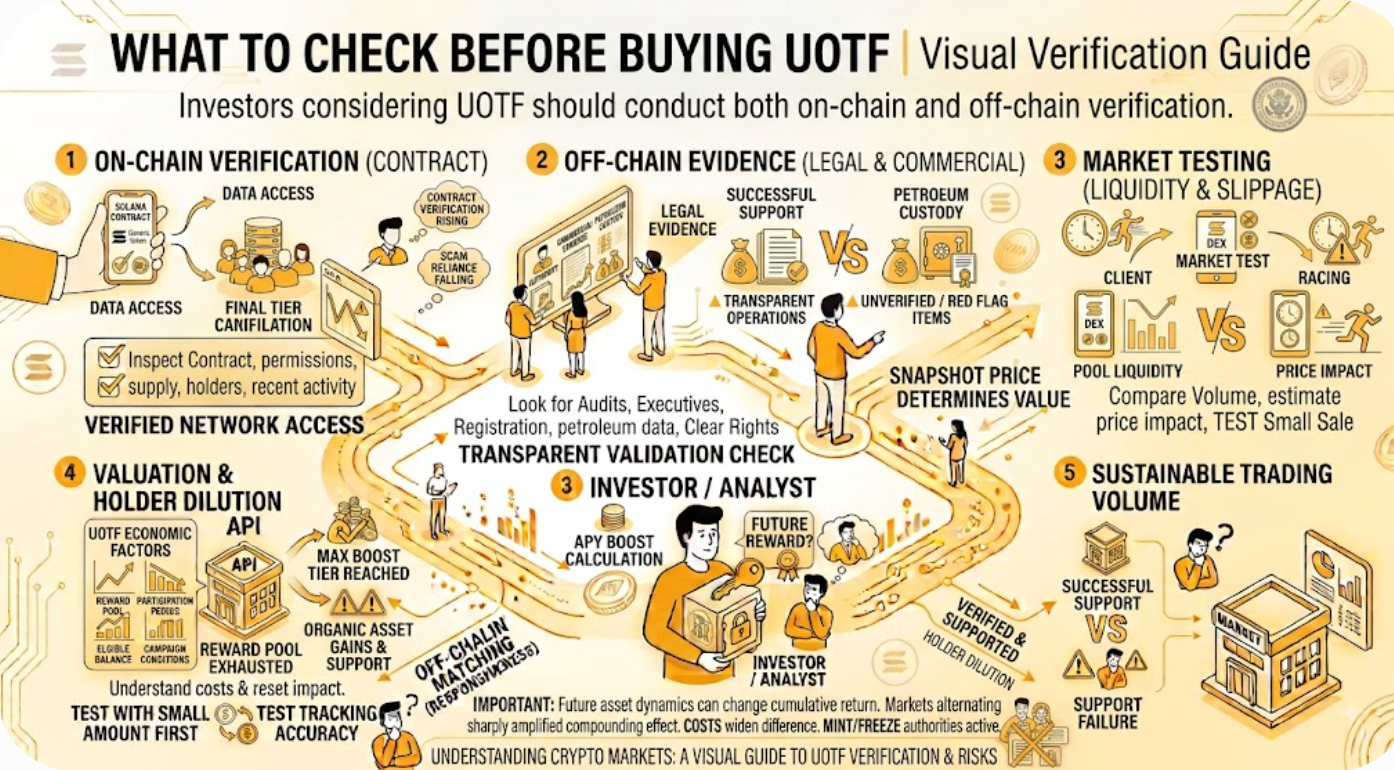
First, confirm the exact Solana contract through multiple official sources. Inspect mint permissions, token supply, top holders, liquidity-pool ownership and recent transaction activity.
Next, review the project’s legal and commercial evidence. Look for identifiable executives, company registration, audited financial statements, petroleum custody records and clear token-holder rights.
Finally, test the market rather than relying on the chart alone. Compare reported volume with actual pool liquidity, estimate price impact and determine whether a small test sale can be completed.
Red flags include guaranteed returns, claims of government approval without official documentation, unverifiable reserve certificates and pressure to buy before an alleged announcement.
What Could Make UOTF More Credible?
UOTF would become easier to evaluate if its issuer published independently audited oil-reserve reports, named the custodian and explained how each token relates to the underlying commodity.
A credible structure would also provide legal opinions, redemption rules, regular attestations and transparent financial disclosures. If UOTF is not intended to be physically backed, the project should clearly describe it as an oil-themed community token rather than implying commodity ownership.
Deeper, distributed liquidity and less concentrated holdings would improve market quality, although neither would prove that the token represents real oil.
Conclusion
United Oil Trust Fund is a real Solana token in the technical sense, but that does not make it a verified oil investment. The available on-chain controls may reduce minting and freezing risks, yet they cannot confirm reserves, legal ownership, redemption rights or a reliable connection to crude-oil prices.
For now, UOTF fits the profile of a high-risk, oil-themed microcap token. Its investment case depends on future transparency, measurable utility and independently verified backing—not its name alone.
FAQ
Is UOTF backed by physical oil?
No sufficient independent evidence currently confirms that every UOTF token is backed by physical oil or enforceable petroleum assets.
Does UOTF track the price of crude oil?
Not necessarily. Without a documented tracking, collateral or redemption mechanism, UOTF can move independently of WTI and Brent prices.
Is United Oil Trust Fund a real token?
UOTF exists as a Solana SPL token. On-chain existence does not verify its off-chain business claims or make it a regulated investment fund.
Is UOTF available on Tapbit?
UOTF is not confirmed as available on Tapbit. Users should check Tapbit’s current market list rather than assuming support.
What is the biggest UOTF risk?
The main risk is the lack of independently verified evidence connecting the token to real oil assets. Liquidity, holder concentration and project transparency are also important concerns.
How can investors verify UOTF?
Confirm the contract address, inspect on-chain authorities and liquidity, research the operating entity, and request independent audits, custody records and legal documentation.


