
AMD and NVIDIA are two of the most important semiconductor stocks in the AI market, but they are not the same type of investment. NVIDIA is the clear leader in AI accelerators, data center GPUs, networking, and the software ecosystem that supports large-scale AI infrastructure. AMD, meanwhile, is the challenger. It has strong CPU products, improving AI GPUs, and a credible opportunity to benefit if cloud customers want alternatives to NVIDIA.
So the better buy depends on what an investor wants. If the goal is to own the strongest AI chip company with the clearest competitive advantage, NVIDIA still looks better. If the goal is to find a stock with more catch-up potential and possibly more room for valuation recovery, AMD may be more attractive.
AMD vs NVDA: Quick Comparison
| Factor | AMD | NVIDIA |
|---|---|---|
| AI chip leadership | Improving, but still behind | Market leader |
| Data center strength | Growing | Dominant |
| Software ecosystem | Weaker than NVIDIA | Major advantage |
| Valuation risk | Tied to future AI share gains | Tied to high expectations |
| Upside case | Gains AI market share | Sustains AI dominance |
| Main risk | Execution and slower adoption | AI growth expectations cool |
NVIDIA has the stronger business today. AMD has the more interesting question: what happens if it catches up faster than expected?
Why NVIDIA Still Has the Stronger AI Position
NVIDIA's advantage is not just about chips. It has built a full AI infrastructure ecosystem around GPUs, networking, software, libraries, and developer tools. That ecosystem makes it difficult for customers to switch quickly, especially when they are building large-scale AI clusters.
This matters because AI infrastructure is not only a hardware purchase. Cloud providers and enterprises care about performance, reliability, software support, supply availability, and total cost of ownership.
NVIDIA's strengths include:
- Leading AI GPUs
- Strong CUDA software ecosystem
- High data center demand
- Deep customer relationships
- Advanced networking and full-stack AI systems
- Strong margins and pricing power
For investors who want the most direct exposure to AI infrastructure growth, NVDA remains the cleaner choice.
Why AMD Still Deserves Attention
AMD's opportunity is different. It does not need to beat NVIDIA outright to create value for shareholders. It only needs to win enough AI accelerator share to prove that it can become a serious second supplier.
Large cloud companies do not want to rely on one vendor forever. If AMD can offer competitive performance, better pricing, and enough supply, customers may increase adoption over time.
AMD also has a strong position in server CPUs, where its EPYC processors remain important for data centers. That gives AMD a broader data center story beyond GPUs.
AMD's bull case includes:
- AI GPU share gains
- Strong server CPU demand
- Better enterprise adoption
- Custom chip partnerships
- Improved margins as AI revenue scales
AMD is not the leader, but it may have more room to surprise if expectations are reasonable.
Valuation: Which Stock Has More Upside?
NVIDIA often looks expensive because it is the market leader. But leadership can justify a premium when growth is strong, margins are high, and customers continue spending heavily. AMD may look cheaper relative to its long-term AI opportunity, but that discount exists for a reason. Investors still need proof that AMD can scale AI GPU revenue and compete effectively against NVIDIA's ecosystem.
| Valuation Question | Better Answer |
|---|---|
| Which company has stronger current earnings power? | NVIDIA |
| Which company has more catch-up potential? | AMD |
| Which company has more proven AI demand? | NVIDIA |
| Which company may benefit more from market-share gains? | AMD |
| Which stock carries more expectation risk? | NVIDIA |
The simple version: NVIDIA is priced for leadership, while AMD is priced more like a challenger that still has to prove itself.
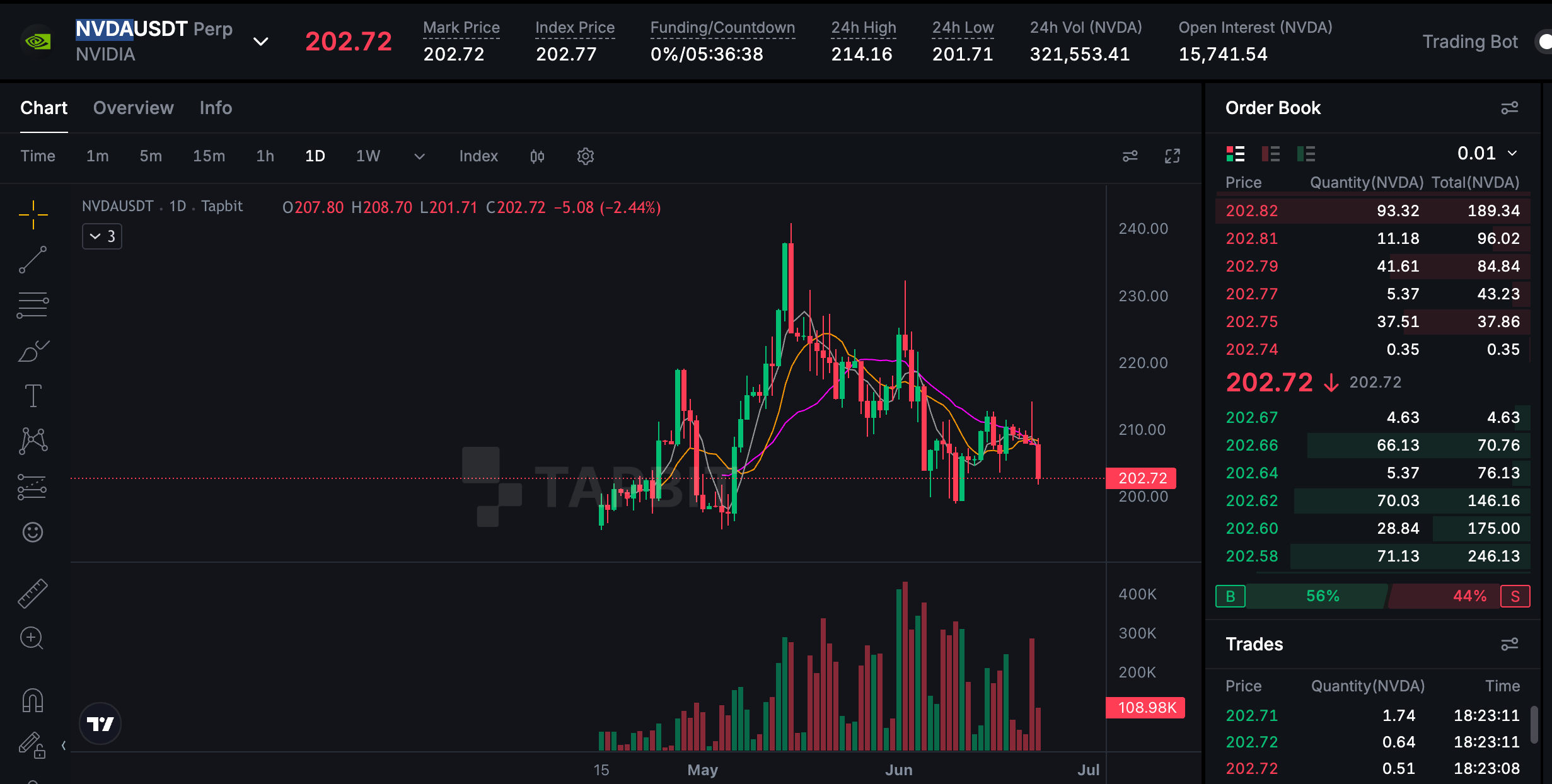
For users who actively follow NVIDIA-related market moves, earnings volatility, and AI chip sentiment, Tapbit also provides an NVDA USDT futures market for tracking NVDA-linked trading activity.
Key Risks for NVIDIA
NVIDIA's biggest risk is not that the company is weak. It is that expectations are extremely high. If AI infrastructure spending slows, margins compress, or major customers shift more spending toward custom chips, NVDA could face pressure. Even great companies can underperform if investors expect too much.
NVIDIA risks include:
- AI capex growth slowing
- Hyperscalers building more custom chips
- Regulatory limits in key markets
- Margin pressure from competition
- Valuation sensitivity after strong gains
NVDA remains a high-quality company, but the stock can still be volatile.
Key Risks for AMD
AMD's main risk is execution. Investors are betting that AMD can take a bigger role in AI accelerators, but that requires more than good products. It needs supply, software support, customer adoption, and consistent performance at scale.
AMD risks include:
- Slower AI GPU adoption
- Weak software ecosystem versus NVIDIA
- Competitive pricing pressure
- Data center demand volatility
- Disappointment if AI revenue ramps too slowly
AMD may have upside, but it also has more to prove.
Which Stock Fits Different Investors?
For conservative growth investors, NVIDIA is usually the better fit. It has the stronger competitive position, deeper AI ecosystem, and clearer demand story.
For investors seeking higher-risk upside, AMD may be more appealing. The stock could benefit if the market starts believing AMD can become a more meaningful AI chip supplier.
| Investor Type | Better Fit |
|---|---|
| Wants AI market leader | NVIDIA |
| Wants catch-up upside | AMD |
| Prefers stronger margins | NVIDIA |
| Accepts higher execution risk | AMD |
| Wants proven demand | NVIDIA |
| Wants valuation recovery potential | AMD |
Final Verdict: AMD or NVDA?
NVIDIA is the better buy for investors who want the strongest AI chip leader with the most proven business model. AMD is the better speculative buy for investors who believe the AI market will become more competitive and that AMD can win a larger share.
The best answer is not one-size-fits-all. For quality and leadership, NVDA looks better. For risk-adjusted catch-up potential, AMD is worth watching. Investors who want exposure to both themes may consider comparing position size rather than treating it as an all-or-nothing decision.
Investment disclaimer: This article is for informational and educational purposes only. It does not constitute financial, investment, trading, or tax advice. Stock and futures markets involve risk, and readers should conduct independent research before making decisions.
FAQ
Is AMD or NVIDIA better for AI exposure?
NVIDIA is the stronger AI exposure today because it leads in GPUs, networking, and AI software infrastructure.
Is AMD undervalued compared with NVIDIA?
AMD may look cheaper in some periods, but the discount reflects higher execution risk and weaker AI market share.
Can AMD catch up to NVIDIA?
AMD can gain share, but fully catching NVIDIA is difficult because NVIDIA has a major software and ecosystem advantage.
Is NVIDIA too expensive?
NVIDIA can look expensive, but its valuation depends on whether AI infrastructure demand continues growing at a strong pace.
Which stock is safer, AMD or NVDA?
NVDA is generally the higher-quality business, while AMD carries more catch-up potential and more execution risk.


