
SpaceX stock did not collapse because the company suddenly stopped being important. It fell because the market finally started asking harder questions.
After one of the most aggressive IPO rallies in history, SPCX is now facing its first real test as a public stock. The shares have pulled back from their post-listing high, dropped below the IPO-day closing price, and forced traders to look beyond the excitement around Starlink, rockets, AI infrastructure, and Elon Musk’s long-term space ambitions.
That does not mean the SpaceX story is broken. It does mean the easy hype trade is over.
For Tapbit users watching the crossover between public equities, tokenized stock products, and crypto-native trading, SpaceX remains one of the most important market stories of 2026. It brings together everything traders care about: scarcity, valuation, retail demand, debt, liquidity, lockups, and product-structure risk.
SPCX Is Down From the High, but Still Above the IPO Price
SpaceX went public at $135 per share. The IPO raised about $75 billion, and the total proceeds later rose to roughly $85.7 billion after the greenshoe option. That made it the largest IPO on record and valued SpaceX at about $1.77 trillion at the offering price.
The first few trading sessions were explosive. SPCX closed its first day around $160.95, then kept climbing as investors chased one of the rarest equity stories in the market.
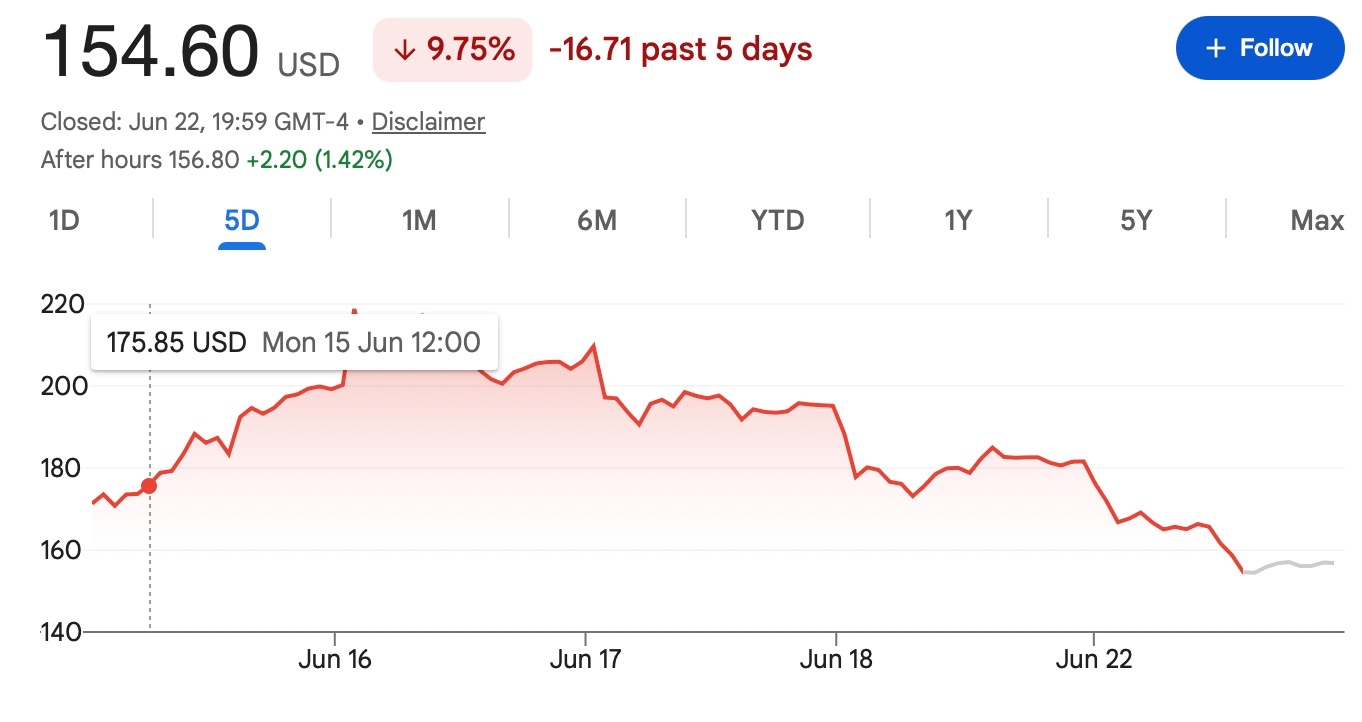
That rally has now cooled sharply. Recent market data shows SPCX trading around $154.60, with an intraday low near $152.62 and volume above 169 million shares. The stock has fallen roughly 27% from its recent high near $211.39.
That sounds ugly, and in the short term it is. But context matters.
At $154.60, SPCX is still about 14.5% above the $135 IPO price. The stock is below its first-day close, but not below the original offering price. So the right description is not “SpaceX crashed to failure.”
The better description is this: The IPO trade is being repriced.
Why SPCX Sold Off
The first reason is obvious.
The stock ran too far, too fast. When a company lists at $135 and quickly trades above $200, the first wave of buyers is sitting on huge short-term gains. Once momentum weakens, profit-taking can become self-reinforcing. Traders who bought the IPO want to protect gains. Late buyers start to panic. Short-term funds move on.
That is normal after a hot IPO.
The second reason is valuation.
SpaceX is not being valued like a traditional aerospace or defense company. It is being priced as a future infrastructure giant across launch services, Starlink, satellite internet, government contracts, AI, and possibly space-based data centers.
That is a powerful story. It is also a very expensive one.
At its peak, SpaceX briefly traded at a valuation that put it among the most valuable companies in the world. That kind of valuation does not leave much room for disappointment. If investors start worrying about losses, capital spending, debt, or execution risk, the stock can move quickly.
The third reason is debt.
The latest selloff accelerated after reports that SpaceX may issue more than $20 billion in bonds to repay a bridge loan and fund future projects. That came shortly after the company raised more than $85 billion from its IPO.
That timing made investors uncomfortable.
SpaceX reportedly had about $100.8 billion in cash and equivalents after the IPO, but the company is still preparing to tap the bond market. For a company that also reported a $4.9 billion loss in 2025 on $18.7 billion of revenue, the market is now asking a fair question:
How much capital will SpaceX need to fund the dream?
The Debt Question Changes the Conversation
Before the latest pullback, the main SpaceX trade was simple: rare company, massive demand, limited float, huge retail excitement.
Now the discussion has shifted. Investors are looking more closely at SpaceX’s funding needs. The company is ambitious by design. Rockets are expensive. Starlink is capital-intensive. AI infrastructure is expensive. Space-based data centers, if they become part of the roadmap, would require enormous upfront spending.
That does not make the strategy wrong. But it does make the stock harder to value.
A company can have huge long-term potential and still be risky at the wrong price. That is especially true when the market is being asked to value projects that may take years to scale.
The bond-market debut is important because it shows SpaceX is not done raising capital. The IPO was not the end of the funding story. It may have been the beginning of a much larger capital cycle.
For traders, that means SPCX is no longer trading only on excitement. It is trading on the cost of ambition.
The Float Is Still a Key Part of the Trade

SPCX’s early rally was helped by scarcity. Only a small portion of SpaceX shares are publicly tradable. That limited float helped push the stock higher when demand was intense. When many buyers chase a small number of available shares, price can move much faster than fundamentals.
But low float works both ways. It can push a stock up quickly. It can also make the decline sharper when momentum turns.
This is why traders should keep watching the lockup schedule. SpaceX insiders, employees, and early investors are not all free to sell immediately. But more shares are expected to become eligible for trading in stages after the IPO.
That matters because the current market is still supply-sensitive.
If more shares become tradable and demand weakens, SPCX could face more pressure. If demand remains strong and institutions want deeper liquidity, a larger float could eventually help the stock mature.
The lockup schedule will show whether investors want SpaceX because the supply is scarce, or because they are comfortable owning the company at this valuation. That is a very different test.
Tokenized SpaceX Products Are Also Being Tested
The SpaceX IPO did not only affect the stock market. It also exposed the strengths and weaknesses of tokenized equity products.
Crypto-native traders wanted access to SpaceX exposure immediately. Tokenized stock products, xStocks, mirror instruments, pre-IPO tokens, and perpetual contracts all became part of the conversation.
But the demand created a real-world bottleneck. Some tokenized SpaceX offerings reportedly struggled because platforms could not source enough underlying shares to support subscriptions. In some cases, campaigns were canceled and users were refunded.
That is a major lesson for crypto traders. Tokenized stock exposure is only as strong as the structure behind it. A token may look like it tracks SPCX. It may trade against USDT. It may be easier to access than a brokerage account. But that does not make it the same as owning SpaceX shares.
What Tapbit Users Should Watch Now
For Tapbit users, the SpaceX story is useful even if they are not buying traditional SPCX shares. It shows how fast a major equity event can become a crypto trading narrative.
A record IPO becomes a tokenized stock story. A low-float equity becomes a liquidity trade. A famous public company becomes a volatility event for crypto users watching synthetic exposure, USDT-based products, and tokenized stock markets.
The key is to focus on data, not headlines. Traders should watch the $135 IPO price, because that remains the original reference point. They should watch whether SPCX can stabilize around the $150–$160 area, now that it has fallen below its IPO-day close. They should watch daily volume, because heavy trading shows active liquidity but also short-term speculation.
Users can visit Tapbit to follow supported markets, monitor volatility, and review available trading products. Existing users can log in, while new users can register here.
Before trading any SpaceX-linked product, users should confirm whether they are trading actual shares, tokenized exposure, a derivative, or a perpetual contract. The risk profile changes depending on the product.
Frequently Asked Questions (FAQ)
Did SpaceX stock crash after its IPO?
Not exactly. SPCX has fallen sharply from its post-IPO high, but it is still trading above its $135 IPO price. The better way to describe the move is a repricing after an overheated IPO rally, not a full collapse.
What was the SpaceX IPO price?
SpaceX priced its IPO at $135 per share. The stock closed its first trading day around $160.95, which means early IPO buyers were still up strongly by the end of the first session.
Why did SPCX fall after such a strong IPO?
The stock rose very quickly after listing, so profit-taking was almost inevitable. The pullback also reflects concerns about valuation, debt financing, limited float, future lockup expirations, and whether SpaceX can justify its multi-trillion-dollar market expectations.


