

BitClassic (B2C) is an older cryptocurrency that appears to be inactive or abandoned in 2026. It was originally presented as a Bitcoin-style digital currency, but current public signals point to weak development activity, missing liquidity, inactive infrastructure, and unclear market support.
For users searching whether BitClassic is a scam, the more careful answer is that B2C looks less like a proven modern scam and more like an abandoned coin with serious risk. That distinction matters, but it does not make the asset safe.
For users who are researching older cryptocurrencies like BitClassic, the safer first step is usually to compare active, liquid crypto markets on a trusted exchange rather than chasing abandoned coins with unclear trading support. Tapbit's crypto market tools can help users follow mainstream digital assets, review market trends, and access structured trading features before making any decision.
What Is BitClassic (B2C)?
BitClassic, also known by the ticker B2C, was a cryptocurrency project launched around 2018. It was described as a PoW/PoS cryptocurrency using the Scrypt algorithm, with branding that positioned it as a Bitcoin-inspired digital currency.
Like many older Bitcoin-style forks and altcoins, BitClassic aimed to present itself as a decentralized payment coin. Its original messaging focused on peer-to-peer transfers, low fees, mining access, and community ownership.
However, the important question in 2026 is no longer what BitClassic originally claimed to be. The real question is whether B2C still has active development, liquidity, infrastructure, and user demand. On those points, the available signals are weak.
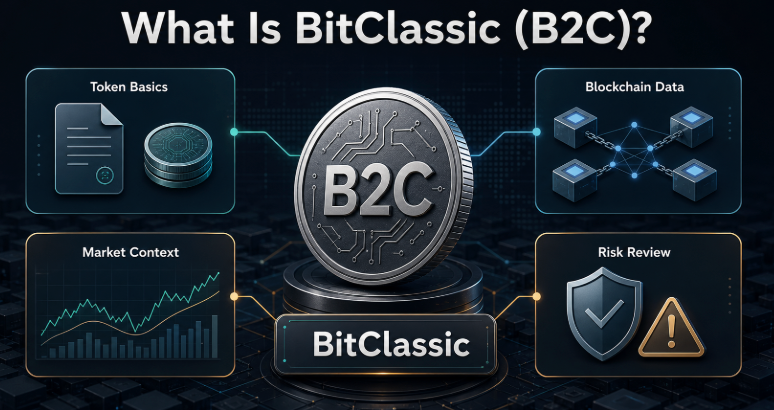
Is BitClassic a Scam or an Abandoned Coin?
BitClassic is better described as an abandoned coin rather than a clearly proven scam. A scam usually implies intentional deception, fake promises, or a coordinated effort to extract funds from users. An abandoned coin may have started as a real project but later lost developers, users, miners, exchanges, and infrastructure.
For BitClassic, the available public indicators suggest abandonment. Development activity appears to have stopped years ago, community channels are inactive, exchange coverage is weak or missing, and current market data is unreliable.
That does not make B2C safe. In practical terms, an abandoned coin can be just as dangerous for investors as a scam because holders may be left with an asset that has no liquidity, no support, and no realistic market exit.
Why BitClassic Looks Abandoned in 2026
The strongest warning sign is inactivity. Crypto projects need ongoing maintenance, especially older chains that depend on nodes, explorers, wallets, miners, validators, or staking infrastructure.
When a project stops updating code, stops communicating, and loses market access, the risk rises sharply. Users may no longer know whether the chain is secure, whether wallets are functional, or whether any exchange still supports real trading.
Several tracking sites still preserve BitClassic as a historical listing, but this does not prove that the project is active. Historical listing pages often remain online long after a coin becomes untradeable or irrelevant.
BitClassic B2C Market Data Problems
Market data for B2C should be treated carefully. Some websites still show old BitClassic information, while others have incomplete price, supply, volume, or exchange data. This is common with abandoned altcoins and delisted assets.
A coin can appear on a price page while having no meaningful market. If there is no reliable order book, no active deposits or withdrawals, and no real trading depth, the displayed price may not be useful for investors.
| Market Signal | What It Suggests |
|---|---|
| Missing live price data | Weak or inactive markets |
| No reliable exchange pairs | Difficult or impossible exits |
| Inactive explorer links | Broken network visibility |
| Old GitHub activity | No recent technical maintenance |
| Repurposed domain risk | Current website may not represent the original project |
| Low or unclear volume | High slippage and liquidity traps |
Is the BitClassic Website Still Official?
This is one of the most important concerns. Older crypto projects often lose control of their original domains after development stops. A domain can later be purchased by unrelated owners and used for blogs, ads, casino content, fake token pages, or SEO traffic.
That means a website using the BitClassic name today should not automatically be trusted as the official source. Users should compare domain history, archived pages, GitHub links, social accounts, and community records before believing any current claims.
If a site claims BitClassic is being revived, relaunched, or newly available to buy, users should be extremely cautious unless there is clear verification from credible historical project channels.
Can You Still Buy BitClassic B2C?
Even if some obscure marketplace claims to support B2C, buyers should be very careful. A coin with no active liquidity can become a liquidity trap: easy to buy in theory, but nearly impossible to sell later.
Before buying any old or abandoned coin, users should verify whether the trading pair is real, whether deposits and withdrawals are open, whether the explorer works, whether the wallet is maintained, and whether the asset is being confused with another token using a similar name.
If those checks cannot be completed, the safer assumption is that the asset is not suitable for ordinary users.
BitClassic Red Flags Investors Should Know
BitClassic shows several red flags common among dead or abandoned cryptocurrencies. The first is inactivity. A project without active development becomes harder to trust over time because blockchain software needs security maintenance, wallet updates, and ecosystem support.
The second is liquidity risk. Without reliable trading venues, holders may not be able to sell. Even if a price appears on a website, that price may not reflect a market where real users can exit.
The third is identity risk. If the original website or social accounts are inactive or repurposed, scammers may use the old name to promote fake revivals, fake exchanges, or fake wallet downloads.
Is BitClassic a Good Investment?
Based on the available public signals, BitClassic does not look like a strong investment candidate in 2026.
The project appears inactive, market data is unreliable, and there is little evidence of meaningful ongoing development or adoption. Investors should not treat old branding, historical listings, or low prices as proof of opportunity.
A low-priced abandoned coin can look tempting because it seems cheap. But cheap does not mean undervalued. If there is no liquidity, no active team, and no functioning ecosystem, the asset may have little practical value.
How to Research B2C Before Taking Any Risk
Anyone researching BitClassic should approach it as an archival crypto asset rather than a normal tradable coin. Start by checking whether the blockchain is still producing blocks, whether explorers work, whether wallets are maintained, and whether exchange deposits and withdrawals are active.
Next, check whether there is any current developer communication. A project with no recent code updates, no roadmap, and no credible team statements should not be treated like an active network.
Finally, compare B2C with active crypto markets. If the goal is to learn about digital assets, using liquid and widely tracked markets is usually more practical than chasing a coin that may no longer have a functioning ecosystem.
Conclusion
BitClassic (B2C) appears to be an abandoned cryptocurrency rather than an active crypto project. While that does not prove it was originally a scam, the current risk profile is severe.
The main concerns are inactive development, weak market data, broken or outdated infrastructure, uncertain website ownership, and likely lack of meaningful liquidity. For most users, B2C should be treated as a historical coin with high risk rather than a serious investment opportunity.
FAQ
What is BitClassic?
BitClassic, or B2C, is an older cryptocurrency project launched around 2018 and described as a Bitcoin-style PoW/PoS coin.
Is BitClassic a scam?
There is no clear proof that BitClassic began as a scam, but it appears abandoned and carries many risks similar to dead crypto projects.
Is B2C still active?
Public signals suggest B2C is not meaningfully active. Development, community activity, and market support appear weak or inactive.
Can I buy BitClassic?
Users should be extremely cautious. B2C appears to have limited or unreliable liquidity, and any platform claiming to support it should be carefully verified.
Why is BitClassic risky?
The main risks are abandonment, missing liquidity, inactive infrastructure, unclear market data, and possible confusion with unrelated websites using the same name.
Is BitClassic a good investment?
BitClassic does not appear to be a strong investment candidate in 2026 due to inactivity, weak liquidity, and lack of clear ongoing development.


