

GPT-5.6 has quickly become a high-interest search term among AI users, developers, and investors watching the next stage of large language model competition. The main question is simple: is GPT-5.6 real, or is it another rumor spreading through social media?
Based on OpenAI's official model documentation, GPT-5.6 is real as a model family. But that does not mean every website, browser extension, bot, or paid tool claiming to offer GPT-5.6 access is legitimate. Users should verify model access through official OpenAI channels and avoid services that promise unlimited, unlocked, or suspiciously cheap access.
For readers tracking how AI narratives influence digital asset markets, infrastructure tokens, and trading sentiment, Tapbit offers broader crypto market access and reward campaigns. These links are general market resources, not a claim that GPT-5.6 itself is a tradable crypto asset.
Is GPT-5.6 Real?
Yes. GPT-5.6 appears in OpenAI's official model documentation as part of a frontier model lineup. That is important because AI model names often circulate online before users know whether they are official, experimental, leaked, or simply invented for traffic.
The safer way to think about GPT-5.6 is this: the model family is real in official documentation, but access details may vary by product, plan, region, API account, and rollout stage. Users should not assume that a third-party site using the name GPT-5.6 is connected to OpenAI.
What Is GPT-5.6?
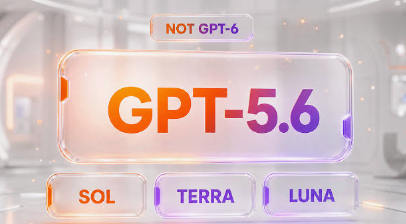
GPT-5.6 is an OpenAI frontier model family designed for advanced reasoning, coding, multilingual work, vision input, and tool-based AI workflows. Instead of appearing as only one model, GPT-5.6 is structured as a lineup with different trade-offs.
| Model | Main Positioning |
|---|---|
| GPT-5.6 Sol | Flagship model for complex reasoning and professional coding |
| GPT-5.6 Terra | Balanced option for intelligence and cost |
| GPT-5.6 Luna | Cost-sensitive model for high-volume workloads |
This kind of model lineup matters because AI use cases are becoming more specialized. A research agent, coding assistant, customer support bot, content workflow, and trading-data summarizer do not always need the same model or the same cost profile.
GPT-5.6 Sol Explained
GPT-5.6 Sol is positioned as the flagship version of the family. It is the model users would expect to consider first for complex reasoning, advanced coding, long-context work, tool use, and professional tasks where accuracy and depth matter more than cost.
For developers, this makes Sol especially relevant for agents, software engineering workflows, analysis tools, and multi-step automation. For everyday users, it may translate into stronger answers when a task requires planning, reasoning, and careful comparison rather than a quick short response.
GPT-5.6 Terra Explained
GPT-5.6 Terra appears to sit in the middle of the lineup. Its role is likely to balance intelligence and cost, which is often what production teams need most. Many real products do not require the highest-end model for every message, but they still need reliable reasoning and strong language quality.
Terra could be useful for businesses building chat interfaces, research assistants, internal productivity tools, or AI features that require consistent performance without using the flagship model for every interaction.
GPT-5.6 Luna Explained
GPT-5.6 Luna is positioned for cost-sensitive and high-volume workloads. That makes it relevant for applications where scale matters: customer support triage, content classification, summaries, lightweight assistants, and other use cases where thousands or millions of requests may be processed.
The existence of a lower-cost model in the same family also gives developers more room to route tasks intelligently. Simple requests can use Luna, more complex tasks can move to Terra, and the hardest tasks can escalate to Sol.
What Could GPT-5.6 Mean for AI Users?
For users, GPT-5.6 could mean better reasoning, more useful coding support, stronger multilingual performance, improved visual understanding, and more reliable help with longer or more complex tasks. The biggest improvements may be felt less in casual chat and more in workflows that require accuracy across several steps.
For the broader technology market, GPT-5.6 also keeps the AI infrastructure narrative active. New model families increase attention on cloud computing, chips, data centers, AI agents, developer tools, and AI-linked crypto narratives. That is why AI model news often spills into financial markets and digital asset discussions even when the model itself is not a token.
What Should Users Watch Before Trusting GPT-5.6 Claims?
The biggest risk is not the model name itself. It is the wave of unofficial products that may use the GPT-5.6 label to attract sign-ups, wallet connections, subscriptions, or data access.
Users should be careful with websites that claim unlimited GPT-5.6 access, ask for unnecessary wallet permissions, promise private jailbreak versions, or advertise a GPT-5.6 crypto token. A real AI model can still become the center of fake apps, phishing links, and misleading promotions.
Is GPT-5.6 a Crypto Token?
No. GPT-5.6 is an AI model family, not a cryptocurrency. If users see a token claiming to be an official GPT-5.6 coin, they should treat it with extreme caution unless there is clear confirmation from official OpenAI channels.
AI-themed tokens can move quickly during model-release cycles, but most are speculative and may have no connection to the companies or technologies they reference. Users should verify contract addresses, liquidity, holder concentration, and official disclosures before engaging with any AI-themed token.
GPT-5.6 vs Earlier AI Models
The practical difference between GPT-5.6 and earlier model generations will depend on the task. Users should watch for improvements in reasoning depth, coding reliability, long-context handling, tool usage, response consistency, and cost efficiency.
For developers, the more useful question is not simply whether GPT-5.6 is better. It is which GPT-5.6 variant fits a specific workload. A high-end model may be best for hard reasoning, while a balanced or lightweight model may be better for production systems that need speed and cost control.
Final Verdict: What Should Users Do Next?
GPT-5.6 is real in official OpenAI model documentation, but users should still approach GPT-5.6 claims with care. The model family may bring meaningful improvements in reasoning, coding, and AI workflows, yet unofficial platforms can easily misuse the name.
The safest approach is to verify model access through official channels, understand which GPT-5.6 variant is being used, and avoid any service that turns GPT-5.6 into an unrealistic trading, investment, or access promise.
FAQ
Is GPT-5.6 real?
Yes. GPT-5.6 is listed in OpenAI's official model documentation as part of a frontier model family.
What is GPT-5.6 Sol?
GPT-5.6 Sol is the flagship model in the GPT-5.6 family, aimed at complex reasoning, coding, and professional work.
What is GPT-5.6 Terra?
GPT-5.6 Terra is positioned as a balanced model for users who want strong performance while managing cost.
What is GPT-5.6 Luna?
GPT-5.6 Luna is designed for cost-sensitive and high-volume workloads.
Is GPT-5.6 a crypto coin?
No. GPT-5.6 is an AI model family, not a cryptocurrency. Any token using the GPT-5.6 name should be treated carefully unless officially verified.
How can users avoid fake GPT-5.6 apps?
Users should rely on official OpenAI channels, avoid suspicious login pages, and be cautious of platforms promising unlimited or unofficial GPT-5.6 access.


