
Google stock today is trading from a position of strength and pressure at the same time. Alphabet closed near $346.77 after moving between $341.39 and $350.43 in the latest session, with the stock falling about 2.2%. The decline came as investors reduced exposure to expensive technology names ahead of a major earnings week and questioned whether the industry's AI spending boom is producing enough incremental profit.
The central debate is no longer whether Alphabet has access to leading AI technology. It does. The harder question is whether Gemini, Google Cloud, AI Overviews and new data-center capacity can generate returns fast enough to justify a 2026 capital-spending plan of $175 billion-$185 billion. Reuters has identified Alphabet's earnings as one of the most important near-term tests for the broader AI trade.
Google Stock Today: Price, Range and Earnings Setup
GOOGL's latest $341.39-$350.43 trading range gives investors a practical map for the earnings setup. The lower end is the first short-term support reference, while the $350 area is the initial recovery barrier. A move above $350 without earnings support could still fail; a post-earnings breakout accompanied by stronger estimates would be more meaningful.
The stock's valuation also matters. Alphabet's forward earnings expectations have risen alongside enthusiasm for AI and Cloud. That means a revenue beat alone may not be enough. Investors will compare revenue growth with operating margin, free cash flow and the pace of capital spending.
What Alphabet Must Prove in Earnings
The report needs to show that AI demand is moving from product adoption into measurable economics. Three areas will determine whether the market raises or cuts its expectations.

Google Cloud Growth and Backlog Conversion
Alphabet's previous quarter showed Google Cloud revenue rising 63% to about $20 billion, while backlog more than doubled quarter over quarter to more than $460 billion. Those figures confirm strong enterprise demand, but backlog is not the same as recognized revenue. Investors need to see how quickly contracts convert into sales and whether capacity constraints or higher infrastructure costs reduce Cloud margins.
Cloud growth above expectations would support the idea that Alphabet can monetize AI infrastructure across enterprise workloads. Slower growth or weaker margins would suggest that spending is arriving faster than revenue.
Gemini and Search Monetization
Gemini adoption is important, but usage metrics must be connected to revenue. Alphabet needs to show whether AI Overviews, AI Mode and Gemini integrations are protecting search engagement and creating new advertising or subscription opportunities. The key risk is that AI answers reduce traditional search clicks without replacing the lost economics.
Investors should separate product headlines from monetization evidence. A larger user base is encouraging, but the stock is more likely to respond to advertising trends, paid Gemini usage, enterprise contracts and management's margin commentary.
Can $175 Billion-$185 Billion of CapEx Earn an Adequate Return?
Alphabet's planned 2026 capital spending is extraordinary even for a mega-cap technology company. The money is funding data centers, networking, chips and power infrastructure. The bullish interpretation is that management sees demand far beyond current capacity. The bearish interpretation is that AI infrastructure costs are inflating faster than the revenue opportunity.
The most useful earnings signals will be depreciation growth, free-cash-flow conversion and management's explanation of when new capacity becomes productive. A higher capex number without stronger Cloud or Gemini economics would pressure the stock.
Why Google Stock Could Rise or Fall After Earnings
The bullish case requires more than a headline beat. Alphabet would need strong Cloud growth, resilient Search advertising, improving AI monetization and no major upward surprise in capital spending. A convincing report could push GOOGL through the $350 area and toward a retest of recent highs.
The base case is a mixed report: revenue remains strong, but spending and margin concerns prevent a decisive breakout. In that scenario, the stock may continue trading between the low-$340s and the mid-$350s while analysts adjust estimates.
The bearish case would involve weaker Cloud growth, cautious advertising guidance, higher capex or evidence that AI products are diluting Search economics. A break below $341.39 after such a report would indicate that the market is reducing the valuation multiple rather than simply reacting to one weak session.
Buy Before Earnings, Wait or Avoid?
A pre-earnings position is appropriate only for traders who can tolerate a gap in either direction. The stock's intraday range already shows elevated uncertainty. Investors seeking better confirmation can wait for the report and require either a sustained move above $350 or a successful defense of the low-$340s.
Avoiding the stock may be reasonable when the investment thesis depends only on AI enthusiasm rather than measurable returns. Alphabet remains a high-quality business, but a strong business can still underperform when expectations rise faster than earnings.
How to Trade GOOGL-USDT on Tapbit
Tapbit lists GOOGL-USDT stock-linked futures. The contract provides derivative exposure to Alphabet's price performance. It is not direct ownership of Alphabet shares and does not provide voting rights or shareholder dividends.
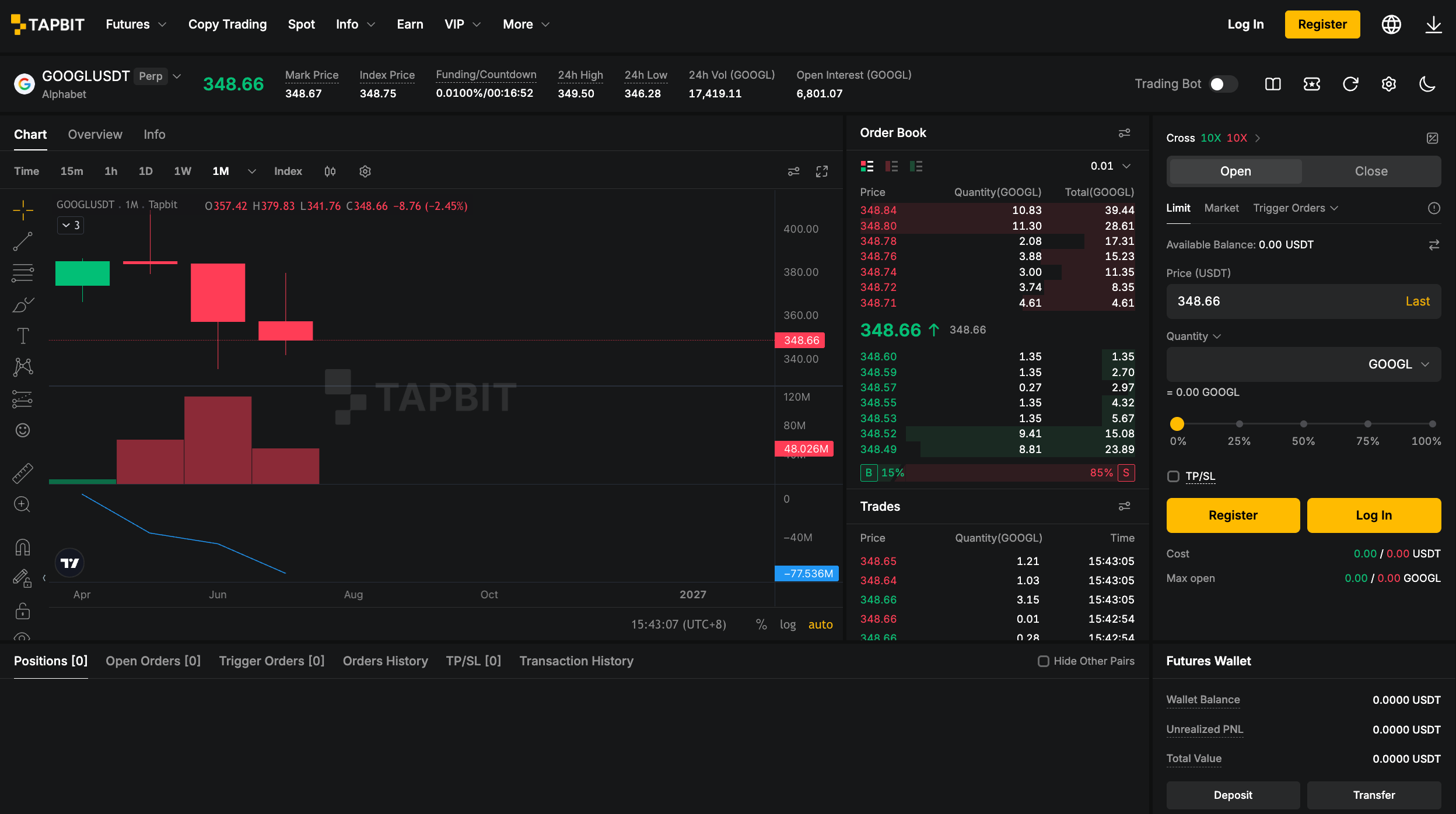
- Create an account and open the GOOGL-USDT market.
- Review the index price, contract specification, liquidity, funding and leverage.
- Choose an order type and size the position around a defined support and invalidation level.
- Confirm the order and manage the trade with a stop-loss and planned exit.
What the Market Is Already Pricing In
Alphabet is not entering earnings as an overlooked value stock. The market already expects strong AI demand, continued Cloud growth and resilience in Search. That means the threshold for a positive reaction is higher than simply beating consensus by a small amount. Investors are likely to focus on whether management raises full-year expectations, whether Cloud margins continue to improve and whether capital spending remains within the previously announced range.
- Already priced in: strong AI demand, data-center expansion and continued Gemini adoption.
- Still unproven: the speed of monetization, return on incremental capex and the durability of Search economics.
- Most sensitive variable: whether management signals another increase in infrastructure spending.
This distinction matters because the same earnings result can produce different stock reactions depending on expectations. A 25% Cloud growth rate may look strong in isolation, but disappointing if the market expected 30%. Conversely, slightly slower revenue growth could still support the stock if margins and free cash flow are better than feared.
Final Assessment
Alphabet's next earnings report is a test of AI economics, not AI relevance. The company has already demonstrated strong demand. The next step is proving that Cloud, Gemini and Search can generate returns that justify the scale of capital spending. Price confirmation above $350 or a resilient defense of the low-$340s would provide a stronger signal than the headline numbers alone.
Frequently Asked Questions
Why is Google stock moving today?
GOOGL is reacting to broader technology-sector pressure, earnings positioning and concern over the return on rapidly rising AI capital spending.
What price levels matter for Google stock?
The recent low near $341.39 is an initial support reference, while the $350 area is the first recovery barrier. Both levels should be refreshed before trading.
How does Gemini affect Alphabet stock?
Gemini can support Cloud, subscriptions and Search engagement, but investors need evidence that usage converts into revenue and does not weaken advertising economics.
Does GOOGL-USDT provide Alphabet shares?
No. It is a derivative contract and does not provide direct stock ownership, voting rights or dividends.


