
Let’s be real: most traders spend their day staring at 1-minute charts, getting chopped up by noise that doesn't mean anything. If you want to actually survive this market, you need to look at the "dinosaur" of technical analysis: Dow Theory.
Created over 100 years ago by Charles Dow and refined by followers like William Hamilton, this theory remains the bedrock of how we understand market cycles today. Whether you were trading industrial stocks in the early 1900s or Ethereum derivatives in 2026, the psychology of the "crowd" remains exactly the same.
At the Tapbit desk, we don't just follow price; we follow the structure of the move. Here is the unfiltered breakdown of how to use this century-old playbook to stop being liquidity for the whales.
The Market is Smarter Than Your News Feed

Dow Theory is built on the idea that asset prices reflect every piece of information available to the public. This is essentially the "efficient markets hypothesis".
-
Everything is Priced In: The current price of a coin will reflect the sentiment from the most recent news updates.
-
The "ETH Merge" Example: When developers propose a major update, the price often skyrockets instantly as the market absorbs that news.
-
Price is the Final Word: Even if you don't do deep research, the price action is already reacting to the most recent information.
Identifying the Three Market Phases
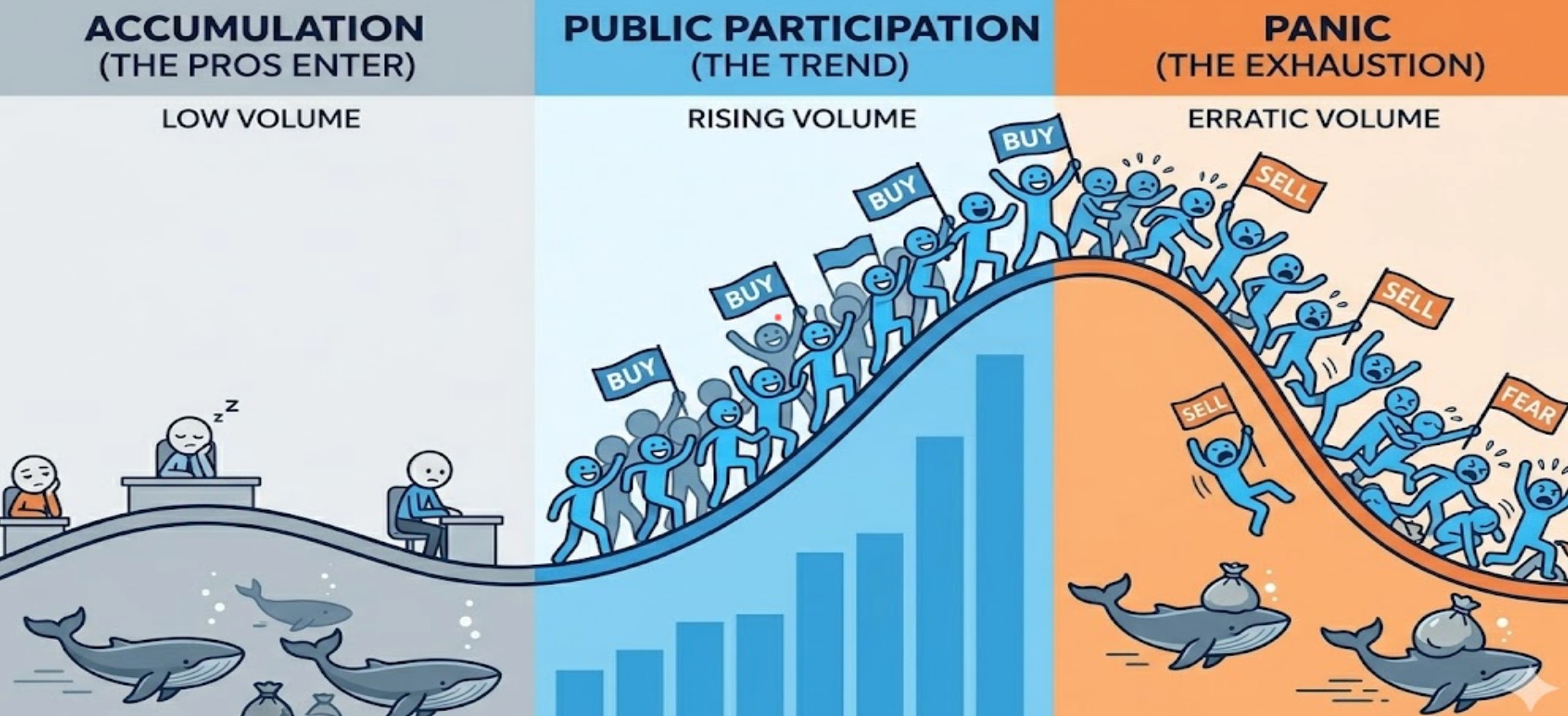
This is where traders get in trouble: they confuse a temporary panic for a total trend reversal. Dow broke the market into three distinct phases of a primary trend:
-
The Accumulation Phase: This is where the pros enter the market to buy or sell assets against the general sentiment.
-
Public Participation: The trend goes "mainstream". As the positive mood grows, more investors jump in, causing prices to increase or decrease rapidly.
-
The Panic Phase: Speculation hits a fever pitch. While many traders try to increase profits through speculation, early adopters notice the trend is fading and start to exit.
Stop Trading the "Noise" (Trend Hierarchy)
Dow categorized trends by their duration to help traders ignore the daily chaos:
-
Primary Trends: These demonstrate the market's long-term direction and can last for years.
-
Secondary Trends: These are reversals of the primary trend, resembling a move that opposes the dominant direction (usually lasting three weeks to three months).
-
Minor Trends: These are the day-to-day zig-zags that last less than three weeks. Dow Theory often views these as market speculation or "noise".
Volume Must Confirm the Move
One of the biggest red flags on a chart is a price rally with no one behind it.
-
Verification: If the market is moving in the direction of the primary trend, volume should rise.
-
The Warning Sign: If the market moves against the primary trend (a pullback), volume should fall.
-
Weakness: Low volume during a price move indicates a weakening trend that may soon reverse.
The Tapbit Takeaway: Trends Persist Until They Don't
The golden rule of Dow Theory is patience: a primary trend is assumed to continue until a "prominent reversal" is clearly established. Don't jump the gun on a 30% sell-off if the higher-low structure is still intact.
-
Peak-and-Trough Analysis: Look for "higher highs" and "higher lows" to confirm an uptrend.
-
Closing Prices Matter: The theory focuses only on closing prices and largely ignores intraday volatility.
-
The Index Check: Dow believed a trend in one market (like crypto) is more reliable if it is supported by trends in other markets like the S&P 500 or NASDAQ.
Ready to trade with the Primary Trend?
-
New Users: Register on Tapbit and claim up to 11,000 USDT in rewards to start your accumulation phase.
-
Pro Traders: Log in to Tapbit to access deep order books that help you verify volume and trend confirmation.
-
Live Analysis: Watch the primary trends unfold in real-time on the Tapbit Homepage.
Frequently Asked Questions (FAQ)
Is Dow Theory too slow for crypto?
It can lag because it doesn't recognize a turn until the reversal has already occurred and been confirmed. However, it prevents you from "catching a falling knife" by forcing you to wait for clear signals.
Why does the theory ignore price spikes during the day?
Dow Theory focuses specifically on closing prices, as they represent the final consensus for the day, rather than the "noise" of active market hours.
What is a "Narrow Range"?
This occurs when price moves sideways in a horizontal frame. Deciding on a trend here is dangerous; it is better to wait for a clear breakout to establish the market's direction.


